
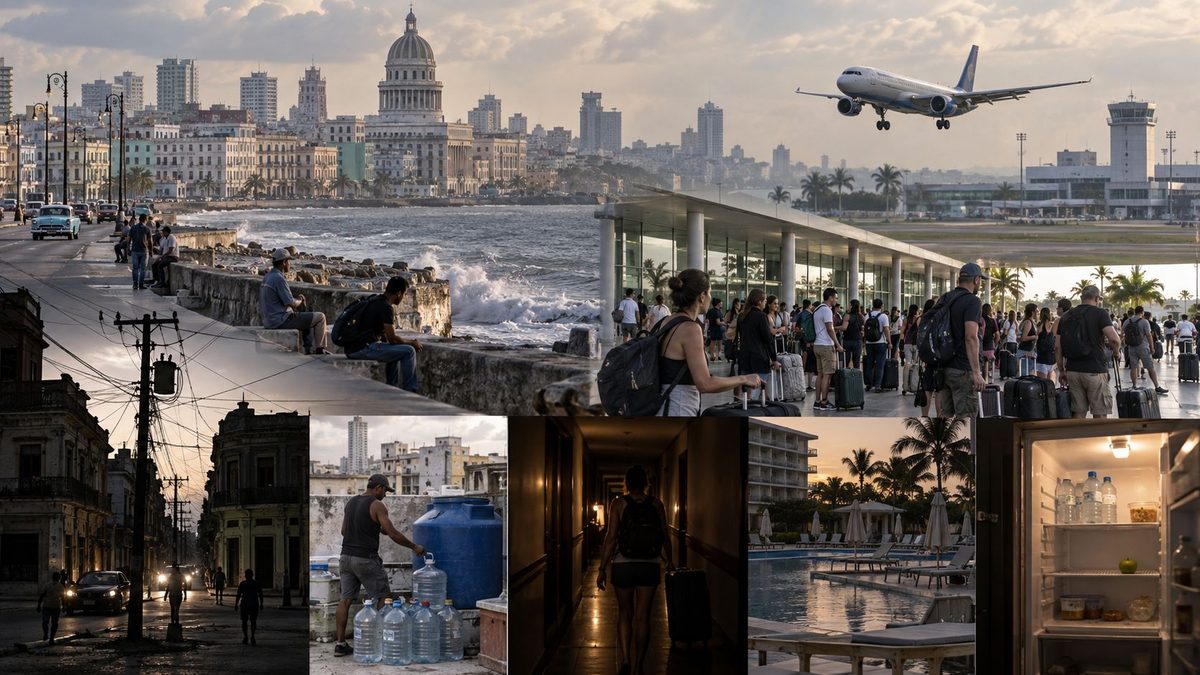
Image generated with Ai
The Cuba health alert issued by the US Embassy in Havana has added a new layer of concern for travellers visiting the Caribbean island. The warning cites a significant rise in diarrhoea illness linked to worsening water and energy infrastructure. Fuel shortages have disrupted electricity generation, refrigeration, sanitation and water distribution. The crisis also comes as Cuba’s tourism industry faces severe operational pressure. International visitor numbers have fallen sharply, while airlines and hotel operators have reduced services. For travellers, the risks now extend beyond conventional food poisoning. Unreliable water, prolonged blackouts and strained medical services can complicate even routine holidays. The UK currently advises against all but essential travel to Cuba.
The latest warning is significant because it connects public health risks directly with infrastructure failure. The US Embassy said the increase in diarrhoea illness is associated with deteriorating water and energy systems.
Those failures create several overlapping problems for visitors. Water treatment and distribution can become unreliable when pumping systems lose power. Food can also spoil faster when refrigerators and commercial cold-storage systems stop operating.
The US Embassy specifically cautioned travellers about perishable food that may have been stored inadequately. It also advised against eating food that has remained at room temperature for extended periods.
Advertisement
Advertisement
For tourism businesses, this is a particularly difficult combination. Hotels must maintain water, kitchens, refrigeration, air conditioning and sanitation simultaneously.
A prolonged electricity interruption can affect all those services at once. Consequently, a destination that remains open operationally may still offer a very different visitor experience.
The warning does not mean every visitor will become ill. However, it indicates a materially more challenging operating environment for international tourism.
The latest US Embassy message should also be viewed alongside wider government travel guidance. The UK’s Foreign, Commonwealth & Development Office currently advises against all but essential travel to Cuba.
Cuba’s energy crisis has moved well beyond inconvenience. It is increasingly affecting systems that travellers normally take for granted.
The UN reported in July that hospitals in Havana had limited services. It also said water-pumping systems had stopped in Havana and Santiago de Cuba.
The resulting water disruptions were raising concerns about disease outbreaks. At that stage, the UN said its emergency plan sought $94 million to support two million people. The plan was only 40% funded at the time.
The relationship between energy and public health is straightforward. Water systems require electricity or fuel to pump and distribute supplies.
Hospitals require power for equipment, lighting, refrigeration and basic operations. Hotels require it for kitchens, lifts, air conditioning and water systems.
Food safety also depends heavily on uninterrupted refrigeration. A blackout therefore creates a chain reaction rather than a single isolated problem.Infrastructure pressure Immediate consequence Potential travel impact Fuel shortages Reduced electricity generation Longer and less predictable blackouts Power interruptions Refrigeration failures Greater food-safety concerns Water-pumping disruption Intermittent water supply Hygiene and showering difficulties Weak sanitation systems Greater contamination risk Higher illness exposure Hospital constraints Reduced service capacity More difficult medical treatment Transport disruption Fewer operational vehicles Delays and cancelled excursions Communications outages Limited connectivity Harder emergency coordination
The implications are particularly serious during Cuba’s hot summer months. Travellers can face uncomfortable conditions when air conditioning and fans stop working.
More importantly, heat and dehydration can make gastrointestinal illness harder to manage. The combination therefore deserves greater attention from tour operators and travellers.
The diarrhoea illness warning arrives against an already complicated disease environment. Cuba has experienced significant mosquito-borne disease pressures.
PAHO reported continuing concerns involving dengue, chikungunya and Oropouche. It also highlighted vulnerabilities created by disrupted water supplies, flooding and strained health infrastructure.
The CDC’s current Cuba traveller guidance recommends hepatitis A vaccination for unvaccinated travellers aged one year and older. It also advises precautions against mosquito-borne diseases.
The agency continues to list dengue, Zika and chikungunya among relevant health considerations. It also highlights leptospirosis risks associated with contaminated water and soil.
This matters because the country’s current problems can compound one another. Water shortages can affect hygiene while power failures undermine refrigeration.
Meanwhile, stagnant water can create favourable conditions for mosquitoes. Flooding and damaged infrastructure can further complicate disease prevention.
Travellers therefore need to consider Cuba as a multi-risk destination rather than focusing solely on the latest diarrhoea illness warning.
The health alert arrives at an especially difficult moment for Cuba’s tourism industry. International visitor numbers have already fallen dramatically.
Reuters reported that Cuba received about 328,608 international visitors during the early months of 2026. That represented less than half the island’s pre-pandemic peak.
In 2018, Cuba welcomed approximately 4.75 million international visitors. The gap demonstrates the scale of the industry’s deterioration.
The decline has affected airlines, hotels, restaurants, private accommodation and excursion providers. Fuel shortages have made moving tourists around the island more difficult.
A tourism economy depends on predictable transport and reliable services. Both are increasingly difficult to guarantee.
The following indicators show why the latest health warning carries commercial significance.Tourism indicator Earlier position 2026 situation International arrivals About 4.75 million in 2018 About 328,608 in early 2026 Tourism direction Major foreign-exchange earner Severe contraction Air connectivity Broad international network Multiple suspensions or reductions Hotel operations Large international presence Closures and consolidation Power reliability Already fragile Severe and sustained disruption Payment environment International cards widely expected Visa and Mastercard restrictions reported by UK authorities
The deterioration is therefore not simply a public-health story. It has become a destination-management challenge.
A shortage of aviation fuel has placed further pressure on Cuba’s international connectivity. The UK government says Cuban authorities have reported that international airports lack aviation fuel.
It also says José Martí International Airport’s Terminal 2 has closed. Flights serving the terminal have been moved to Terminal 3.
Several major airlines have suspended flights or reduced services. The UK guidance names Canadian airlines, Air France, Iberia, World2Fly and LATAM among operators affected.
For travellers, this creates an important distinction. A ticket can remain technically confirmed while the broader operating environment remains unstable.
Airlines may change schedules when fuel supplies or airport operations deteriorate. Consequently, travellers should monitor airline communications closely before departure.
Hotel supply has also been affected. Reuters reported that Spanish hotel group Meliá completed its exit from Cuba in July 2026.
The company had operated 34 hotels on the island. Its departure followed mounting operational, legal and financial difficulties.
That withdrawal is significant for corporate travel planners. Large hotel operators traditionally provide predictable standards, payment systems and international support.
A shrinking international hotel presence can reduce those advantages. It can also make contingency accommodation harder to secure during sudden disruptions.
Anyone already in Cuba should treat food, water and electricity as practical travel-management issues.
Drinking water should come from reliable sources. Travellers should also avoid food whose refrigeration history is uncertain.
Hot food should be served properly hot. Perishable products deserve particular caution during extended power interruptions.
Hand hygiene remains important, especially before eating. The CDC recommends frequent handwashing and using sanitiser containing at least 60% alcohol when soap and water are unavailable.
Travellers should also pack a small health kit before departure. Basic medicines and sanitary products can be difficult to replace locally.
The UK’s travel guidance warns of severe shortages of basic medicines. It says medical facilities in Havana are better equipped than those elsewhere in Cuba.
Medical evacuation insurance is therefore more important than usual. A traveller should understand whether the policy covers treatment, evacuation and disruption caused by infrastructure failures.Traveller priority Recommended preparation Drinking water Use reliable bottled or treated water Food Avoid poorly refrigerated perishables Medication Carry sufficient personal supplies Connectivity Keep devices charged and carry backup power Insurance Confirm medical and evacuation coverage Transport Reconfirm flights and transfers Cash Carry sufficient funds for essential expenses Emergency planning Know local medical and emergency contacts Mosquito protection Use repellent and suitable clothing Documents Keep digital and printed copies
These precautions are especially relevant outside Havana. Medical resources and transport options can be more limited elsewhere.
Travel planning has become more complicated because payment options have also changed.
The UK government says Cuba’s Central Bank announced that international cards such as Visa and Mastercard would no longer be accepted from June 6, 2026.
It advises visitors to bring enough cash for their entire stay. US dollars and euros are widely accepted and can be exchanged through authorised Cadeca exchange houses.
This development has a direct operational implication. A traveller dealing with a cancelled flight or medical problem cannot assume an international card will solve the problem.
Hotels and tour providers should therefore be contacted before arrival. Travellers should establish which payment methods they currently accept.
The issue also matters to travel companies selling Cuba packages. Prepaid services and confirmed transfers can reduce exposure to payment disruption.
However, operators should avoid promising services that depend on unstable local infrastructure.
Government advice is becoming increasingly important because conditions can change quickly.
The UK currently advises against all but essential travel. Its warning specifically cites power outages, fuel shortages, transport disruption and medical-service pressures.
The US State Department’s standing Cuba advisory remains Level 2: Exercise Increased Caution. Its guidance warns about unreliable electrical power and says prolonged outages can affect businesses, hospitals and hotels.
The two advisories therefore differ in their overall travel assessment. That distinction is important for international travel managers.
The US advisory also notes that US law restricts tourism travel to Cuba for people subject to US jurisdiction. Travel generally must fit within one of the authorised categories.
The CDC, meanwhile, continues to provide destination-specific health guidance. Its current traveller page was reviewed on September 3, 2026.
Travellers should therefore consult the guidance applicable to their nationality before making final arrangements.
Cuba’s health warning cannot be separated from its broader energy emergency. The UN has repeatedly described fuel shortages as a major constraint on essential services.
In May, the UN said fuel reserves were largely exhausted and warned of additional pressure on electricity generation, transportation and basic services.
It also reported that more than $32 million had been mobilised through the UN response. Food assistance had reached about 900,000 people, while water-treatment support was being expanded.
PAHO has similarly highlighted the vulnerability of water systems under fuel constraints. It noted that some communities already depended heavily on water deliveries.
These conditions make infrastructure resilience central to tourism recovery. Hotels cannot restore visitor confidence simply by reopening rooms.
They need dependable water, energy, transport, food supplies and medical support. Without those foundations, destination marketing can only achieve limited results.
Cuba’s government is simultaneously pursuing economic reforms intended to stimulate investment. Recent measures have sought to make tourism and other sectors more accessible to private and foreign investors.
That creates an unusual contrast. Cuba is trying to make its tourism economy more flexible while its infrastructure remains severely constrained.
The reforms could eventually improve tourism resilience. Private operators may introduce new services, investment and operational models.
However, investment decisions ultimately depend on predictable operating conditions. Electricity, fuel, payments and international connectivity remain fundamental.
The tourism industry’s immediate challenge is therefore not simply attracting visitors. It is ensuring that visitors can receive the services they were promised.
For travel companies, that means greater due diligence before selling Cuba packages. Contracts, cancellation policies and contingency arrangements deserve closer review.
The latest warning does not automatically make every part of Cuba inaccessible. It does, however, change the risk calculation for leisure travellers.
Visitors should expect that normal holiday assumptions may not hold. Reliable electricity, constant water supply and uninterrupted transport cannot be taken for granted.
Travellers should check flights immediately before departure. They should also confirm hotel operations and airport arrangements directly with providers.
Those already on the island should monitor local conditions closely. They should keep essential supplies available and avoid unnecessary journeys during severe disruptions.
Medical planning deserves particular attention. Travellers should carry necessary medicines and maintain adequate insurance.
For families, older travellers and people requiring regular medical care, the current environment may warrant especially careful consideration.
Cuba’s latest health warning arrives at a pivotal moment for its tourism economy. The island needs foreign visitors and investment, yet infrastructure weaknesses are undermining the visitor experience.
The immediate concern is health. The deeper issue is reliability across the entire travel chain.
Water, electricity, refrigeration, healthcare and aviation fuel are interconnected. When one system fails, several tourism services can deteriorate simultaneously.
For travellers, caution is therefore more appropriate than panic. The key is to understand the changing conditions before departure.
The island remains open to many international visitors. However, travel planning now requires greater preparation, flexibility and financial resilience.
For the tourism industry, the message is equally clear. Cuba’s recovery will depend not only on demand, but also on restoring dependable infrastructure.
The current crisis makes that challenge impossible to ignore.
Advertisement
Advertisement
Advertisement












Saturday, September 5, 2026

Saturday, September 5, 2026

Saturday, September 5, 2026

Saturday, September 5, 2026

Saturday, September 5, 2026
Saturday, September 5, 2026

Saturday, September 5, 2026

Saturday, September 5, 2026



