
Busan Goes Hand in Hand With South Korea’s Tourism Growth as Foreign Visitor Surge Fuels Q4 2026 Recovery Despite Labour Shortages

Published
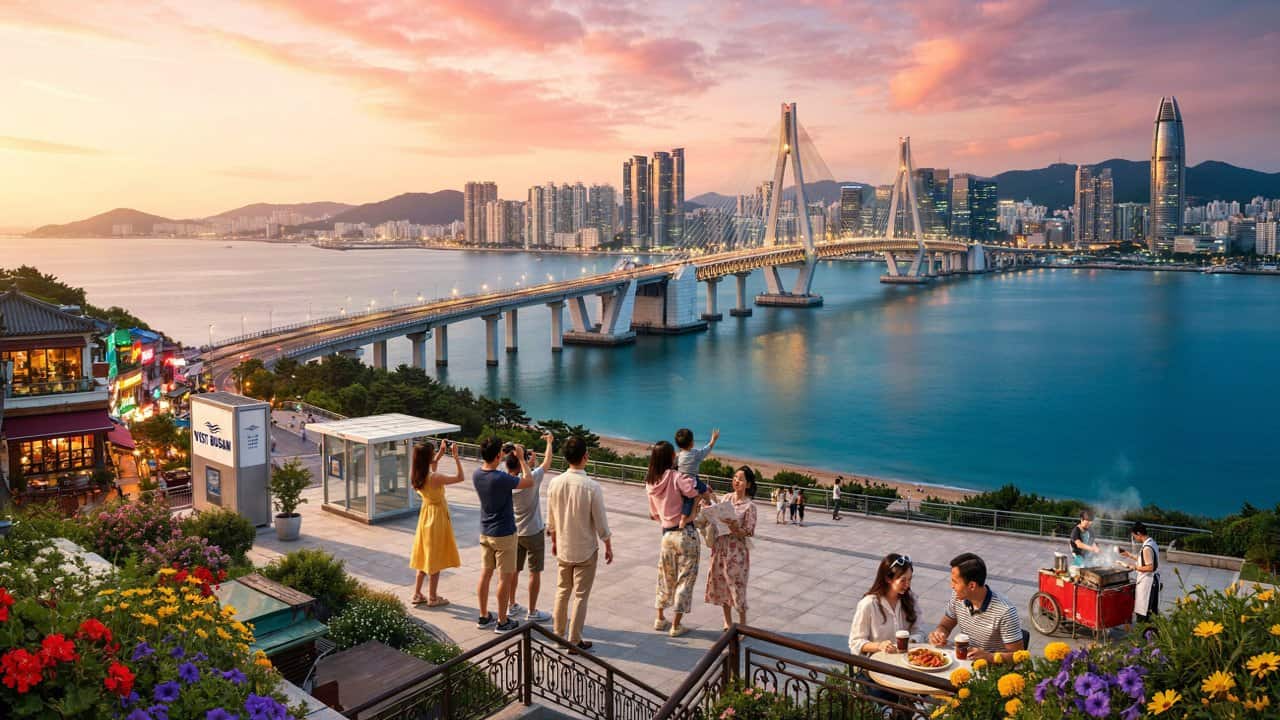
Busan, South Korea’s leading coastal tourism destination, is entering the final quarter of 2026 with renewed industry confidence as local businesses anticipate stronger foreign visitor demand, higher revenue and improving profitability. According to a tourism business survey released by the Busan Tourism Organization on 13 October, international visitor expectations reached 133.0 on the Business Survey Index, outperforming every other major indicator. The survey, covering 455 local tourism companies, points towards an encouraging year-end outlook. However, persistent labour shortages, rising wage costs and the need for more competitive tourism experiences remain serious challenges that could restrict the industry’s ability to benefit from international tourism growth.
Busan Tourism Outlook 2026 Reveals Stronger Business Confidence Across Every Major Indicator
Busan’s tourism sector is showing renewed optimism as businesses prepare for the October–December quarter. The latest survey indicates that confidence has strengthened across revenue, profitability, domestic visitors and international arrivals.
The Business Survey Index, commonly known as BSI, provides a measure of business expectations. A reading of 100 represents the neutral benchmark, while readings above that level indicate positive sentiment.
All four major tourism indicators exceeded 100 in the fourth-quarter outlook, suggesting that businesses anticipate generally favourable operating conditions.
Advertisement
Advertisement
Foreign visitor expectations recorded the strongest reading at 133.0, followed by profitability at 123.1, revenue at 119.3 and domestic visitors at 114.7.
The figures suggest that international tourism remains the principal source of confidence heading into the final months of the year.
Advertisement
Advertisement
However, these readings should not be confused with actual growth percentages. A foreign visitor index of 133.0 does not mean international arrivals have increased by 33%.
Instead, the figure reflects the balance of business expectations within the survey.
Advertisement
Advertisement
The distinction matters because stronger confidence can indicate potential improvement without guaranteeing that projected outcomes will materialise.
For Busan’s accommodation providers, restaurants, attractions and tour operators, the results provide an encouraging indication of the market’s direction.
What Does Busan’s Fourth-Quarter Tourism Business Survey Reveal?
The Busan Tourism Organization collected responses from 455 tourism businesses during its third-quarter industry survey.
The fourth-quarter results show that every major indicator improved compared with the preceding quarterly outlook.
Advertisement
Advertisement
Busan Tourism Business Survey Index for Q4 2026
| Tourism indicator | Q4 2026 index | Previous outlook* | Increase |
|---|---|---|---|
| Foreign visitor expectations | 133.0 | 128.7 | 4.3 points |
| Profitability expectations | 123.1 | 109.4 | 13.7 points |
| Revenue expectations | 119.3 | 111.4 | 7.9 points |
| Domestic visitor expectations | 114.7 | 103.0 | 11.7 points |
Previous outlook readings are calculated from the changes reported in the supplied survey coverage.
Profitability recorded the largest improvement, rising 13.7 points. Domestic visitor expectations followed with an increase of 11.7 points.
Revenue confidence improved by 7.9 points, while foreign visitor sentiment rose by 4.3 points.
Although foreign visitor confidence recorded the smallest quarterly increase, it remained the highest overall index.
This indicates that international demand was already a comparatively strong source of optimism in the preceding outlook.
The simultaneous improvement across all four indicators is important because it suggests that businesses anticipate a wider recovery rather than isolated growth in one tourism category.
Advertisement
Advertisement
Foreign Visitors Become the Main Driver of Busan’s Year-End Tourism Optimism
International visitors are central to the city’s fourth-quarter business expectations.
The foreign visitor index of 133.0 stands 18.3 points above the domestic visitor index, illustrating the difference between confidence in overseas and domestic tourism.
The survey’s underlying responses provide further evidence.
Some 46.4% of participating companies expected international visitor numbers to increase during the fourth quarter.
By comparison, only 31.2% anticipated an increase in domestic visitors.
That represents a difference of 15.2 percentage points.
Advertisement
Advertisement
For local tourism businesses, this suggests that overseas markets are expected to provide stronger growth opportunities as 2026 approaches its conclusion.
International visitors contribute to different parts of the destination economy, including hotels, restaurants, transport, retail, entertainment and organised tourism activities.
Stronger overseas demand could therefore support several business categories simultaneously.
Nevertheless, the survey does not establish which international source markets will grow fastest during the fourth quarter.
Nor does it confirm that actual visitor arrivals will match business expectations.
The findings should be interpreted as a positive industry outlook rather than a final assessment of year-end tourism performance.
Advertisement
Advertisement
Busan’s First-Half International Tourism Growth Provides a Strong Foundation
The fourth-quarter optimism follows an impressive period of international tourism growth during the first half of 2026.
According to figures published by Busan Metropolitan City on 30 July, the destination welcomed 2,420,629 foreign tourists between January and June.
That represented a 43.9% increase from the 1,682,415 visitors recorded during the corresponding period in 2025.
The city therefore attracted 738,214 more foreign visitors than a year earlier.
June was particularly significant, with 484,057 international visitors, the highest monthly total recorded during the first six months.
These historical results help explain why local tourism companies are approaching the final quarter with stronger expectations.
Advertisement
Advertisement
However, the first-half figures should not be presented as evidence of actual fourth-quarter performance.
They establish the scale of the city’s earlier growth, while the October survey measures business expectations for the remaining months of the year.
Busan’s International Tourism Performance in the First Half of 2026
| Tourism measure | Reported figure | Comparison |
|---|---|---|
| Foreign visitors, January–June 2026 | 2,420,629 | +43.9% year on year |
| Foreign visitors, January–June 2025 | 1,682,415 | Historical comparison |
| Additional foreign visitors | 738,214 | Year-on-year increase |
| Foreign visitors in June 2026 | 484,057 | Highest monthly total in H1 |
| Foreign credit-card spending | KRW 591.4 billion | +63.0% year on year |
| Annual foreign visitor target | 4 million | 2026 objective |
| Target achieved by June | 60.5% | First-half progress |
The figures reveal that Busan’s international tourism expansion has been accompanied by a substantial increase in recorded visitor spending.
For tourism businesses, that relationship is particularly important because economic performance depends not only on visitor numbers but also on the expenditure generated during their stays.
Foreign Tourist Spending Surges Faster Than Visitor Arrivals
International tourism spending has become another important indicator of Busan’s growing visitor economy.
According to Busan Metropolitan City’s July announcement, foreign credit-card spending reached KRW 591.4 billion during the first half of 2026.
Advertisement
Advertisement
This represented a 63.0% increase from KRW 362.1 billion in the corresponding period of 2025.
The spending growth rate exceeded the 43.9% increase in visitor arrivals.
It also surpassed the reported national tourism spending growth rate of 55.0% for the same comparison period.
These figures suggest that Busan’s tourism economy has been expanding in financial terms as well as through visitor volumes.
However, the spending data covers expenditure captured through the relevant credit-card analysis. It should not be interpreted as a complete measurement of every form of tourist spending.
Nor does the increase establish that every individual traveller spent more money.
Advertisement
Advertisement
Changes in visitor composition, payment methods and purchasing behaviour can influence aggregate spending figures.
Nevertheless, the stronger growth in recorded expenditure is relevant to the fourth-quarter business outlook.
It demonstrates that international tourism has already contributed to greater commercial activity during 2026, providing a factual foundation for the positive revenue and profitability expectations reported in the latest survey.
Taiwan, China, Japan and the United States Lead Busan’s International Tourism Markets
Busan’s inbound tourism growth is supported by several important international source markets.
Official first-half visitor statistics show that Taiwan remained the largest source of foreign tourists, followed closely by China.
Japan, the United States and the Philippines completed the five leading markets.
Advertisement
Advertisement
Leading International Visitor Markets in Busan, January–June 2026
| Country or region | Foreign visitors | Year-on-year growth |
|---|---|---|
| Taiwan | 477,606 | +54.0% |
| China | 468,876 | +90.7% |
| Japan | 291,141 | Not specified |
| United States | 219,147 | +76.4% |
| Philippines | 93,061 | Not specified |
| United Kingdom | 38,501 | +24.7% |
| Australia | 38,369 | +41.8% |
| France | 26,889 | +112.9% |
Taiwan accounted for approximately 19.7% of international arrivals during the first half of the year.
China recorded particularly strong growth, with arrivals increasing by 90.7% compared with the corresponding period in 2025.
The United States also emerged as a significant source of international visitors, with 219,147 arrivals and growth of 76.4%.
European and Australian markets contributed to the wider expansion.
France recorded a 112.9% increase, while Australia grew by 41.8% and the United Kingdom by 24.7%.
These figures demonstrate that Busan’s international tourism growth has not been restricted to neighbouring Asian markets.
Advertisement
Advertisement
For hotels, restaurants and tourism operators, this geographical diversity creates opportunities to reach travellers with different interests, budgets and travel patterns.
It also increases the importance of multilingual information, accessible booking services and visitor experiences suited to international audiences.
The fourth-quarter survey does not provide country-specific forecasts. Consequently, the first-half market rankings should not be treated as predictions of which nationalities will dominate the final quarter.
Profitability Expectations Rise Sharply as Tourism Businesses Anticipate Better Returns
The profitability index represents one of the most encouraging findings in the latest survey.
It reached 123.1 for the fourth quarter, an increase of 13.7 points from the previous outlook.
That was the largest improvement among the four main indicators.
Advertisement
Advertisement
Furthermore, 38.9% of respondents expected profitability to improve, an increase of 8.1 percentage points from the third-quarter comparison.
The revenue outlook also strengthened.
Its index reached 119.3, rising 7.9 points from the preceding outlook.
Some 38.5% of businesses expected revenue to increase, compared with 19.1% forecasting a decline.
This means the proportion anticipating revenue growth was more than twice the proportion expecting weaker sales.
The improvement in profitability expectations is particularly relevant because higher visitor numbers do not automatically produce stronger business earnings.
Advertisement
Advertisement
Accommodation providers, restaurants and attractions must manage operating costs while maintaining service standards.
A business can attract more customers yet experience limited profit growth if wages, utilities, maintenance or other expenses increase at a similar pace.
The survey indicates that companies are more optimistic about financial performance, but it does not establish whether operating margins have already improved.
Actual fourth-quarter financial results will be necessary to determine whether those expectations translate into measurable gains.
Domestic Tourism Shows Improvement but Remains More Cautious Than International Demand
Although international tourism dominates the positive outlook, domestic visitor expectations have also strengthened.
The domestic tourism index reached 114.7, increasing by 11.7 points from the previous outlook.
Advertisement
Advertisement
This represents a notable improvement in business sentiment.
However, the survey suggests that many operators expect domestic demand to remain relatively stable rather than expand dramatically.
Some 52.3% of respondents anticipated little change in domestic visitor conditions, while 31.2% expected an increase.
The contrast with international tourism is significant.
Foreign visitor expectations are supported by a larger proportion of businesses anticipating growth, whereas domestic tourism is characterised by a stronger wait-and-see attitude.
This does not diminish the importance of South Korean travellers to Busan’s visitor economy.
Advertisement
Advertisement
Domestic tourism can support accommodation providers, restaurants, attractions and transport services throughout the year.
It can also provide a valuable customer base during periods when international travel demand fluctuates.
For businesses, maintaining a balance between domestic and international visitors may help reduce dependence on any single market.
The survey therefore suggests that Busan’s tourism recovery could involve different patterns of growth across its visitor segments.
Labour Shortages and Rising Wage Costs Remain Serious Obstacles
Despite the positive business outlook, workforce difficulties continue to affect Busan’s tourism industry.
Labour shortages and rising wage costs were identified as the most frequently cited business difficulty, accounting for 18.5% of responses.
Advertisement
Advertisement
Meanwhile, 29.7% of participating companies reported insufficient staffing.
This was almost unchanged from the previous quarter’s 29.9%.
The difference of just 0.2 percentage points suggests that workforce constraints have remained persistent despite improving business confidence.
The problem is especially relevant to tourism because many services depend heavily on employees.
Hotels require reception teams, housekeeping personnel and maintenance workers.
Restaurants depend on kitchen staff and customer-service employees.
Advertisement
Advertisement
Tour operators need guides, drivers and booking personnel, while visitor attractions require operational and guest-service teams.
When staffing levels are insufficient, businesses may struggle to serve additional customers effectively.
Workforce shortages can also create pressure on existing employees and increase operating costs.
For businesses already facing higher wages, expanding recruitment may become financially challenging.
The survey does not identify which tourism occupations face the most severe shortages. It therefore does not support conclusions about individual professions or specific staffing categories.
However, the overall findings indicate that workforce availability remains an important condition for sustainable tourism growth.
Advertisement
Advertisement
Why Tourism Businesses Are Calling for More Competitive Visitor Experiences
The survey also reveals strong demand for public-sector support.
Developing competitive tourism content was identified as the leading priority for the Busan Tourism Organization, receiving 29.5% of responses.
Support for tourism businesses followed at 21.5%.
These priorities indicate that operators are concerned not only with attracting additional visitors but also with strengthening the quality and commercial appeal of the destination.
Competitive tourism content can include distinctive cultural experiences, local activities, destination programmes and products that encourage visitors to explore different areas.
Such experiences may help tourism businesses generate revenue beyond accommodation and basic transport services.
Advertisement
Advertisement
For example, travellers interested in Busan’s coastline may also seek food experiences, cultural attractions, shopping districts and organised excursions.
The challenge is developing experiences that meet visitor expectations while providing commercial opportunities for local operators.
Business support is another important priority.
Tourism companies may benefit from measures designed to improve competitiveness, strengthen operational capabilities and develop market-ready services.
However, the survey does not announce specific new funding allocations or confirmed assistance programmes.
The Busan Tourism Organization has indicated that it intends to pursue content development and business competitiveness initiatives informed by industry feedback.
Advertisement
Advertisement
The effectiveness of these efforts will depend on implementation and the extent to which businesses experience practical improvements.
Busan’s Tourism Spending Is Spreading Beyond Traditional Visitor Districts
Another important development is the changing geographical distribution of international tourism spending.
Busan Metropolitan City’s first-half analysis suggests that foreign visitor expenditure has become more widely distributed across the destination.
Haeundae accounted for 32.7% of recorded foreign tourism spending in the previous year’s comparison.
During the first half of 2026, the reported distribution included Busanjin at 26.7%, Haeundae at 25.9% and Gijang at 13.6%.
This suggests that economic activity associated with international tourism is reaching a broader range of districts.
Advertisement
Advertisement
Haeundae remains one of Busan’s most recognisable coastal destinations, but other areas also offer commercial and tourism opportunities.
Busanjin includes important shopping and entertainment areas, while Gijang offers coastal attractions and experiences outside the central tourist districts.
A more geographically distributed tourism economy can potentially benefit additional restaurants, retailers, accommodation providers and local businesses.
However, the figures do not establish that spending has increased in every district.
They also do not confirm that the observed distribution will remain unchanged throughout the year.
The significance lies in the possibility of developing a tourism economy that extends beyond a limited number of established hotspots.
Advertisement
Advertisement
For policymakers, encouraging geographical diversification requires attention to transport, visitor information and the capacity of local businesses.
Major Cultural Events Demonstrate Busan’s Potential to Attract International Travellers
Busan’s experience with major cultural events provides another perspective on the importance of developing competitive tourism content.
The city examined international visitor activity associated with the BTS concert held in June 2026.
According to its official analysis, foreign foot traffic within a three-kilometre radius of Busan Asiad Main Stadium reached approximately 730,000 during the week of 8–14 June.
This represented a 341.9% increase compared with the preceding week.
Foreign credit-card sales in nearby commercial districts also rose sharply.
Advertisement
Advertisement
Spending around the concert venue increased from KRW 255 million in the preceding week to KRW 548 million during the concert week, representing growth of 114.8%.
These findings demonstrate how major entertainment events can influence visitor movements and commercial activity.
However, the foot-traffic figure should not be interpreted as 730,000 unique international tourists or confirmed concert attendees.
It represents measured activity within a defined geographical area and period.
The economic implications extend beyond individual performances.
International visitors attending concerts or festivals may also explore restaurants, shopping areas, coastal attractions and cultural destinations.
Advertisement
Advertisement
This creates opportunities for local businesses to benefit from event-related travel.
Busan’s challenge is to develop experiences that encourage visitors to extend their stays and explore more of the city.
The latest business survey’s emphasis on tourism content development is therefore consistent with the broader economic opportunities associated with cultural tourism.
International Air Connectivity Supports Busan’s Growing Tourism Appeal
Accessibility is another important factor influencing Busan’s position as an international destination.
Gimhae International Airport serves as the city’s principal aviation gateway, connecting Busan with domestic and overseas markets.
International air links are particularly important because several of Busan’s largest visitor source markets are located elsewhere in Asia.
Advertisement
Advertisement
Direct flights can make the city more convenient for travellers who prefer not to enter South Korea through Seoul.
The airport’s international network also supports business travel, leisure tourism and visits involving multiple destinations.
According to Korea Tourism Organization travel information published in 2026, Gimhae International Airport had nonstop international connections to 46 cities across 14 countries and regions.
The organisation also reported approximately 6.07 million international passengers during the first half of 2026.
That figure represents airport passenger traffic, not the number of international tourists visiting Busan.
The distinction is important because passenger statistics may include residents, outbound travellers and other categories of airport users.
Advertisement
Advertisement
Busan also benefits from South Korea’s established railway network.
High-speed rail connections allow travellers to combine the coastal destination with Seoul and other parts of the country.
For international visitors, this provides flexibility when planning city breaks, coastal holidays and longer South Korean itineraries.
However, flight routes and schedules can change. Travellers should verify current services with airlines and transport operators before booking.
Busan’s Long-Term Tourism Strategy Places Greater Emphasis on Visitor Value
The positive fourth-quarter outlook comes as Busan pursues wider ambitions for its tourism economy.
In December 2025, the city announced a longer-term objective of attracting five million foreign visitors annually and generating KRW 1.5 trillion in foreign tourism spending by 2028.
Advertisement
Advertisement
These figures represent strategic targets rather than confirmed future results.
The objectives reflect an ambition to strengthen Busan’s international tourism position while improving the economic contribution of visitors.
The city had already achieved a significant milestone in 2025.
By the end of October that year, Busan recorded 3,019,164 foreign visitors, exceeding three million for the first time since its official statistical series began in 2014.
That represented an increase of approximately 23% from the corresponding period in 2024.
The strong first-half results in 2026 provide further evidence of international visitor growth.
Advertisement
Advertisement
However, achieving long-term targets requires more than attracting additional arrivals.
The destination must also consider accommodation capacity, transport accessibility, visitor services, workforce availability and the commercial sustainability of tourism businesses.
The latest survey demonstrates why these issues are connected.
Strong international demand can create economic opportunities, but insufficient staffing and rising costs may limit the benefits.
Busan’s future tourism performance will therefore depend partly on its ability to align visitor growth with business capacity and destination development.
Why This Matters
Busan’s improving tourism outlook has implications for travellers, local businesses and South Korea’s wider visitor economy.
Advertisement
Advertisement
For travellers, stronger international interest reinforces Busan’s position as a destination attracting attention from multiple overseas markets.
The city offers coastal scenery, cultural attractions, shopping districts, food experiences and transport connections that make it suitable for different types of holidays.
For tourism businesses, the positive survey readings indicate expectations of stronger demand and potentially better financial performance.
However, increased visitor interest does not automatically guarantee higher profits.
Companies must manage staffing, wages, service quality and operating expenses.
For the destination, the survey highlights the importance of distributing tourism’s economic benefits more widely.
Advertisement
Advertisement
Encouraging visitors to explore different districts may create opportunities for businesses beyond the best-known coastal areas.
The findings also demonstrate the importance of tourism product development.
Attracting travellers is only the beginning. Destinations must provide experiences that encourage visitors to stay longer, explore more places and support local commercial activity.
The principal uncertainty is whether fourth-quarter expectations will translate into actual arrivals, spending and profitability.
Those outcomes will become clearer when the relevant statistical and financial data are available.
What Travellers Should Know
Busan’s positive tourism outlook does not itself introduce new entry requirements, discounted travel products or confirmed changes to transport services.
Advertisement
Advertisement
The survey measures business expectations rather than announcing a new tourism policy.
Visitors planning a trip should therefore base their decisions on verified travel arrangements and official destination information.
Before Booking
- Entry requirements: Check South Korea’s current passport, visa and electronic travel authorisation requirements for your nationality.
- International flights: Confirm available routes and schedules through Gimhae International Airport or other South Korean gateways.
- Accommodation: Compare locations, prices, availability and cancellation conditions before making reservations.
- Local transport: Review Busan’s metro, light rail, bus and taxi options when planning journeys.
- Attractions: Check official opening hours, admission arrangements and any advance booking requirements.
- Travel insurance: Consider suitable protection for medical expenses, cancellations and other covered travel disruptions.
- Official information: Consult the Korea Tourism Organization and Visit Busan for updated destination guidance.
Which Areas of Busan May Interest International Visitors?
Busan offers international visitors a combination of coastal scenery, cultural heritage, shopping districts, traditional markets and urban attractions. As the city’s tourism industry anticipates stronger foreign visitor demand in the fourth quarter of 2026, several established destinations may appeal to travellers seeking experiences beyond conventional sightseeing.
Haeundae remains one of Busan’s most recognisable tourism districts. Its famous beach, waterfront hotels, restaurants and nearby attractions make it particularly attractive to visitors interested in coastal holidays and modern city experiences. The district also provides convenient access to popular sightseeing locations, including Dongbaekseom Island and the surrounding waterfront.
Gwangalli Beach offers another distinctive coastal experience. The area is widely associated with views of Gwangan Bridge, particularly after sunset when the illuminated structure creates a striking backdrop. Its beachfront cafés, restaurants and evening atmosphere make it an appealing destination for international travellers exploring Busan’s urban coastline.
Gamcheon Culture Village provides a different perspective on the city. Known for its colourful hillside buildings, narrow streets, art installations and small galleries, the village attracts visitors interested in photography, neighbourhood culture and creative tourism. Its appeal illustrates how local heritage and community-based attractions can contribute to Busan’s wider visitor economy.
Advertisement
Advertisement
Nampo-dong and Jagalchi Market introduce travellers to Busan’s commercial and culinary traditions. Nampo-dong is known for shopping streets, markets and cultural attractions, while Jagalchi Market is closely associated with the city’s seafood industry. Together, they offer opportunities to experience local food culture and traditional urban life.
Seomyeon, located in Busanjin District, is another important commercial centre. Its concentration of shopping facilities, restaurants, entertainment venues and transport connections makes it a practical base for travellers interested in city experiences.
Gijang, on Busan’s eastern coastline, offers coastal scenery and attractions such as Haedong Yonggungsa Temple. The district provides an alternative to the city’s busiest central tourism areas and may interest travellers seeking scenic excursions.
These destinations illustrate the diversity of Busan’s tourism offering. However, the fourth-quarter business survey does not provide forecasts for individual neighbourhoods or attractions. Their inclusion reflects their established tourism appeal rather than confirmed increases in visitor demand.
Frequently Asked Questions About Busan Tourism in Q4 2026
Why is Busan’s tourism industry expecting stronger growth in Q4 2026?
Busan’s tourism industry is anticipating stronger fourth-quarter performance because businesses expect higher international visitor demand, improving revenue and better profitability. The Busan Tourism Organization’s survey of 455 companies recorded a foreign visitor Business Survey Index of 133.0, the highest among the four principal indicators. This reflects positive business expectations rather than confirmed fourth-quarter growth.
How many international tourists have visited Busan in 2026?
According to Busan Metropolitan City’s official figures, 3,434,620 foreign tourists visited Busan between January and August 2026. This represented a 45.9% increase compared with the corresponding period in 2025. The city surpassed three million international visitors in early August, approximately two months earlier than the previous year.
Advertisement
Advertisement
Which countries are the largest sources of foreign tourists visiting Busan?
China, Taiwan, Japan, the United States and the Philippines were Busan’s five largest international visitor markets during January–August 2026. China recorded 719,260 visitors, followed by Taiwan with 718,313, Japan with 407,038, the United States with 289,382 and the Philippines with 124,356.
What are the biggest challenges facing Busan’s tourism businesses?
Labour shortages and rising wage costs remain major challenges. In the latest survey, 18.5% of respondents identified these pressures as their principal business difficulty, while 29.7% reported insufficient staffing. These constraints could limit the ability of tourism companies to accommodate stronger visitor demand and improve profitability.
What is Busan doing to strengthen its international tourism industry?
The Busan Tourism Organization has identified tourism content development, international visitor attraction and business competitiveness as important priorities. Survey respondents particularly emphasised competitive tourism experiences and support for tourism enterprises. These measures are intended to strengthen the destination’s appeal while helping local businesses benefit from international tourism growth.
Closing Update: Busan’s Tourism Recovery Faces a Crucial Test in the Final Quarter of 2026
Busan’s tourism industry is approaching the end of 2026 with stronger business confidence, supported by rising international arrivals, increased visitor spending and improving expectations for revenue and profitability. Official figures showing more than 3.43 million foreign visitors between January and August reinforce the city’s growing international appeal. However, the positive fourth-quarter outlook remains a forecast of business sentiment rather than confirmed financial performance. Persistent labour shortages, higher wage costs and demands for more competitive tourism experiences highlight the challenges ahead. Busan’s ability to translate visitor growth into sustainable economic benefits will depend on stronger business capacity, effective tourism development and continued international demand.
Advertisement
