
Passengers Stranded at Rome Fiumicino Airport as ITA Airways, Ryanair, Wizz Air, British Airways, Lufthansa Flights Disrupted Across London, Paris, Madrid and Other Cities Amid 221 Delays and 2 Cancellations

Published
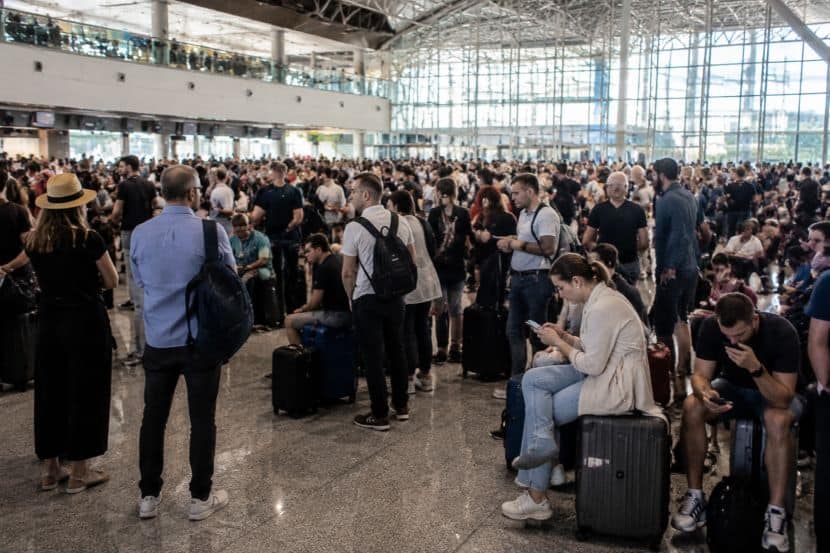
Rome’s principal airport, Leonardo da Vinci International Airport, also called Fiumicino Airport, has suffered major disruption with 221 documented delayed flights and 2 canceled flights. The disruption involved a variety of European and Middle Eastern carriers as well as long-haul flights. Due to this, many global interconnected flight routes were affected.
Disruption on Fiumicino Airport will continue due to delayed flights, congested routines, and a lack of available planes. Some airlines which were affected by the disruption are ITA Airways, Ryanair, Wizz Air, and British Airways. These airlines reported delays on their flights which caused problems in readiness for their following flight.
Widespread Operational Disruption Across Multiple Flight Corridors
The disruption at Fiumicino is not isolated. It has extended across domestic, intra-European, and intercontinental corridors. A total of 221 delayed flights signals high-density traffic stress at one of Southern Europe’s busiest aviation hubs.
Short-haul Schengen routes have been heavily impacted, particularly services linking Rome with major European capitals such as Paris, Madrid, Amsterdam, and Frankfurt. Long-haul sectors connecting North America, the Middle East, and Africa have also experienced schedule shifts due to aircraft rotation delays.
Advertisement
Advertisement
Air traffic flow management adjustments across European airspace, combined with high seasonal passenger loads, have contributed to the cascading impact. Even minor delays in inbound flights have resulted in outbound schedule compression, increasing gate congestion and turnaround pressure throughout the day.
Advertisement
Advertisement
Airlines Most Affected: European Carriers Bear Major Share
The disruption data highlights that several high-frequency carriers have absorbed the majority of delays. ITA Airways recorded the highest operational impact with dozens of delayed flights, reflecting its hub dependency at Fiumicino.
Low-cost operators such as Ryanair and Wizz Air also faced significant disruptions due to their tightly scheduled aircraft utilisation models, where even short delays can cascade into multiple route knock-ons.
Full-service carriers including British Airways, Lufthansa, Air France, KLM, and Turkish Airlines were also impacted, particularly on connecting European feeder routes.
Middle Eastern and long-haul operators such as Emirates, Qatar Airways, and United Airlines experienced moderate delays, largely linked to airport slot availability and extended turnaround times.
Cargo and charter segments also saw minor scheduling disruption, highlighting system-wide pressure rather than isolated operational failure.
Advertisement
Advertisement
Passengers Affected: Missed Connections and Extended Waiting Times
Thousands of passengers have been affected across the airport network, particularly those on connecting itineraries. The most significant impact has been on transit passengers using Rome as a hub for onward travel across Europe and intercontinental destinations.
Common passenger outcomes include missed connections, extended layovers, and rebooking onto alternative flights later in the day or the following morning. Airport terminals have seen increased congestion at airline service desks as re-accommodation processes intensify.
Families, business travellers, and tourism groups have faced varying degrees of disruption, with some passengers reporting delays exceeding several hours. Airlines have activated contingency protocols including standby seat allocation, rerouting via alternate European hubs, and limited hotel accommodation for overnight delays.
Despite the operational strain, airport ground services have maintained standard safety and handling procedures, preventing escalation into broader operational shutdown conditions.
Impact on Tourism and Italy’s Travel Flow
The disruption at Rome’s key international gateway has created measurable short-term pressure on inbound and outbound tourism flows. Rome remains one of Europe’s most visited cities, and any operational slowdown directly affects hotel check-ins, guided tours, cruise transfers, and domestic rail connections.
Advertisement
Advertisement
Tour operators have reported delayed group arrivals, particularly from North America and East Asia, where Rome serves as a primary entry point into Italy’s tourism circuit. This has led to schedule adjustments for cultural itineraries covering Vatican City, Florence, and Venice connections.
Inbound tourism spending may experience minor short-term deferral effects as delayed arrivals compress visitor schedules. However, industry analysts note that such disruptions typically recover quickly once operational normalcy resumes.
Air connectivity remains a critical pillar for Italy’s tourism economy, and sustained delays at Fiumicino can temporarily influence traveller perception of reliability, especially during peak travel windows.
Conclusion: Network Stabilisation Expected but Short-Term Disruption Continues
Although 221 delays and limited cancellations are an operational stress indicator, they still lie within the thresholds for controllable aviation disruptions. There are no reports of a full airport closure, and typical recovery operations will be able to enough stabilize activity within the next operational cycle.
Airlines are adjusting rotations and reassigning aircraft to accommodate changes. Passengers are being rebooked, however, the delays will persist at least until the cumulative effects are worked off during the evening departures.
Advertisement
Advertisement
Fiumicino Airport being the central international hub for Italy, means that even small disruptions will negatively impact the entire European (and beyond) network. How quickly recovery can happen will be reliant on a combination of aircraft availability and air traffic, as well as the efficiency of the operations during the busiest peak times that are most affected.
Authors Observation: All information is manually obtained from FlightAware’s official website, and all operations are subject to change based on real-time updates. In order to maintain safety, airlines actively modify schedules and itineraries. In order to get to their destinations safely, passengers are asked not to panic in such situations and to look for alternate travel choices. Relying on real-time updates, reviewing airline rebooking restrictions, and maintaining flexibility with travel plans are all highly recommended.
Source: Flightaware
Advertisement
