
Dubai Airport Security Upgrades: What You Can Carry In Your Bags To DXB

Published
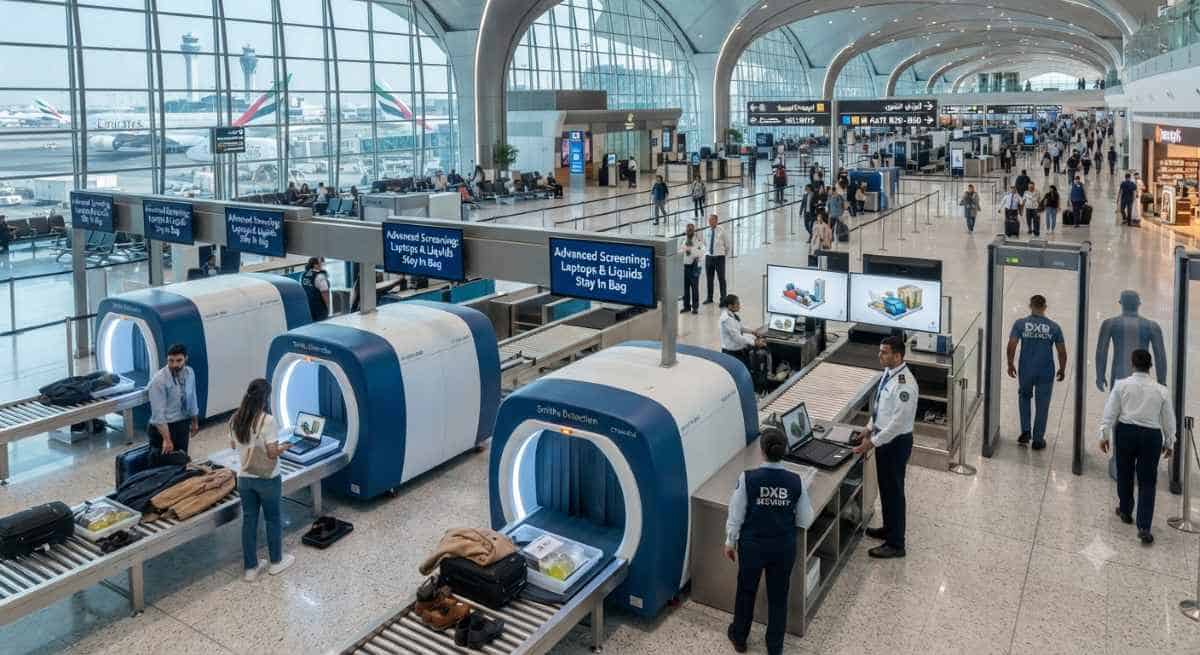
Image generated with Ai
A significant transformation has been initiated in global aviation as Dubai International Airport has started implementing advanced security checks utilizing next-generation scanner technology. This modernization program has been developed to address long-standing traveler grievances regarding the cumbersome preparation required at airport security checkpoints. Historically, passengers navigating through major global hubs have been subjected to rigid protocols, which mandated the tedious separation of electronic items and fluids from hand luggage.
The foundations of this operational shift were laid previously when Dubai Airports CEO Paul Griffiths publicly disclosed that preliminary testing of cutting-edge screening innovations was underway. Following successful trials that demonstrated enhanced reliability and speed, official confirmation was provided regarding the wider rollout. Rather than remaining confined to isolated test zones, the implementation is being integrated across various operational areas within the facility, marking a critical milestone in contemporary airport management and passenger facilitation strategies.
Impact on Travellers
The introduction of these technological advancements is expected to alter the daily experience of millions of passengers traversing the global aviation network. Under the updated protocols, individuals are no longer required to remove laptops, shoes, liquids, and other sensitive personal belongings from their carry-on luggage. The state-of-the-art machinery is engineered to analyze bag contents thoroughly and non-intrusively, minimizing direct manual intervention by security personnel and significantly shrinking the time spent standing in queue lines.
By eliminating traditional procedural bottlenecks, transit times through the departure hall are heavily compressed. Travelers are granted additional breathing room, which can be redirected toward relaxation, dining, or shopping within the terminal premises before boarding announcements are made. The overall psychological friction associated with pre-flight security clearance is substantially mitigated, fostering a far more relaxed atmosphere for families, business commuters, and holidaymakers alike.
Advertisement
Advertisement
Industry Insights
Within the broader aviation sector, the integration of advanced screening infrastructure at a primary global transit hub signals a clear industry trend toward automation and passenger-centric design. Aviation experts note that legacy security methodologies, formulated decades ago, have increasingly struggled to cope with escalating passenger volumes. By adopting multi-dimensional imaging and automated detection systems, facilities can maintain rigorous safety compliance while exponentially increasing throughput capacity.
Advertisement
Advertisement
Furthermore, these structural overhauls are accompanied by concurrent physical refurbishments across terminals. For instance, infrastructural enhancements are actively being executed in specific zones, such as Concourse B and Terminal 1, where upgraded flooring and additional processing lanes are being installed. This holistic approach demonstrates that modern airport operations must align technological innovation with physical spatial redesign to achieve optimum efficiency and maintain global competitiveness.
Practical Information
For passengers planning itineraries through the region, the deployment of these next-generation systems is managed dynamically through a gradual replacement schedule of older equipment across all terminals at Dubai International Airport. While the rollout is progressing steadily, travelers are advised to remain observant of specific lane instructions upon arrival at individual screening checkpoints, as transition phases may involve a mix of legacy and modernized lanes depending on the specific concourse.
Operational updates continue to be implemented hand-in-hand with terminal renovations to ensure minimal disruption to regular flight schedules. Essential updates regarding terminal zoning, such as ongoing refurbishment activities in Terminal 1 and Concourse B, are continuously monitored by airport authorities to guide passengers smoothly through immigration, security, and boarding gates without unexpected procedural surprises.
Advertisement
Advertisement
Comparison with Previous Policies or Developments
When evaluated against historical security protocols, the current upgrades represent a stark paradigm shift in airport security management. Previous frameworks dictated a rigid, manual separation process wherein every electronic device, container of liquid, aerosol, or gel exceeding strict volumetric limits had to be isolated in separate trays for individual inspection. This earlier methodology frequently generated extensive queues, heightened stress levels for travelers, and imposed severe operational constraints on security personnel.
In contrast, the newly deployed inspection infrastructure removes these redundant manual steps entirely. Where previous developments relied heavily on human visual verification and secondary bag searches triggered by overlapping items in luggage, current advanced scanning systems utilize sophisticated software algorithms to peer through dense packing configurations simultaneously. This evolution transitions security operations from a restrictive, friction-heavy bottleneck into an expedited, high-capacity screening mechanism.
Advertisement
