
What Happened to BA295? British Airways Boeing 777 Turns Back After Emergency Over Ireland

Updated
Published
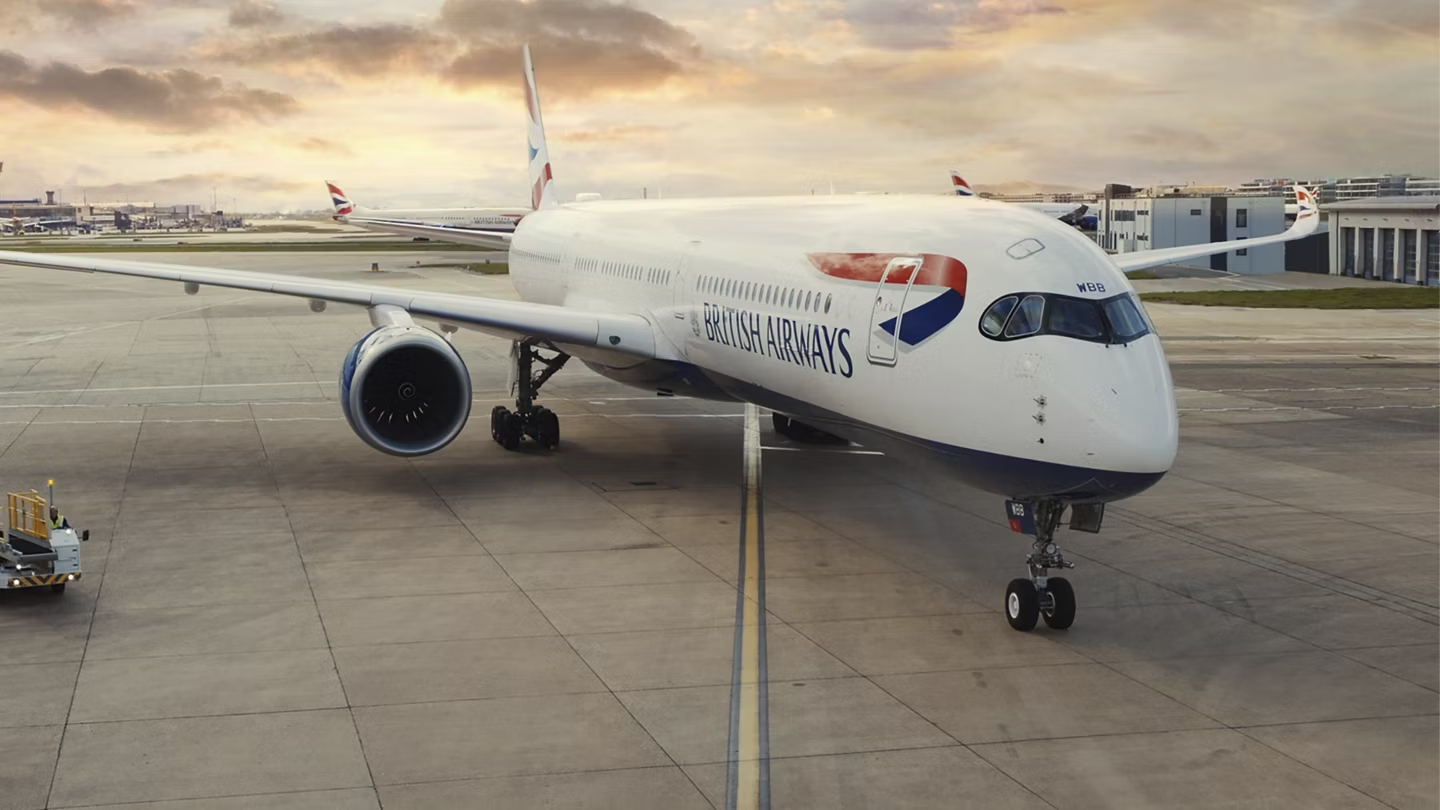
Image generated with Ai
What Happened to BA295? British Airways Boeing 777 Turns Back After Emergency Over Ireland because the Chicago-bound flight encountered an emergency while crossing Irish airspace on 5 October 2026. The British Airways Boeing 777 descended from approximately 37,000 feet to 9,000 feet, transmitting the 7700 emergency code before turning back towards Heathrow. The aircraft landed safely in London, and British Airways described the incident as a technical issue. Passengers disembarked normally. However, the precise technical cause remains unconfirmed. The available information does not establish that the aircraft suffered cabin depressurisation, engine failure or another specific malfunction. The emergency therefore explains why BA295 turned back, while the exact reason behind the technical issue remains under investigation. Pasted markdown
BA295 Emergency Over Ireland Triggered a Major Altitude Reduction
The incident occurred while BA295 was travelling from London Heathrow Airport to Chicago O’Hare International Airport.
Flight-tracking information recorded the aircraft at approximately 37,000 feet before it descended to around 9,000 feet while over Ireland. The aircraft also transmitted the 7700 emergency transponder code. It subsequently turned back towards the United Kingdom instead of continuing across the Atlantic.
The altitude change amounted to approximately 28,000 feet.
Advertisement
Advertisement
| Flight detail | Information |
|---|---|
| Flight | BA295 |
| Airline | British Airways |
| Route | London Heathrow–Chicago O’Hare |
| Aircraft | Boeing 777-200ER |
| Registration | G-VIIA |
| Date | 5 October 2026 |
| Emergency location | Over Ireland |
| Initial altitude | About 37,000ft |
| Lower altitude | About 9,000ft |
| Approximate descent | 28,000ft |
| Emergency code | 7700 |
| Final outcome | Safe return to Heathrow |
The descent was substantial, but its scale alone does not establish what caused the emergency. British Airways subsequently described the event only as a technical issue.
The 7700 Code Confirmed an Aircraft Emergency
The 7700 transponder code is an important part of the incident.
Advertisement
Advertisement
The UK Civil Aviation Authority identifies 7700 as the standard emergency code used when an aircraft is experiencing an emergency. It is distinct from other internationally recognised codes used for communication failure and unlawful interference.
| Code | Meaning |
|---|---|
| 7700 | General aircraft emergency |
| 7600 | Radio communication failure |
| 7500 | Unlawful interference |
| 7000 | Standard conspicuity code in relevant UK operations |
The transmission of 7700 therefore confirms that the flight was dealing with an emergency situation.
Advertisement
Advertisement
However, the code does not identify the cause.
This distinction matters. A 7700 declaration can accompany different types of aviation emergencies. It would therefore be inaccurate to use the code itself as evidence of a particular technical failure.
The aircraft’s subsequent descent and return to Heathrow demonstrate that the crew took operational action after declaring the emergency.
The Boeing 777 Descended From 37,000 Feet to 9,000 Feet
The most striking element of the incident was the aircraft’s rapid reduction in altitude.
Advertisement
Advertisement
The Boeing 777 was reportedly cruising at approximately 37,000 feet before descending to around 9,000 feet over Ireland. The difference was approximately 28,000 feet.
An emergency descent can occur in response to several different circumstances.
The UK Civil Aviation Authority’s guidance refers to emergency descents involving sudden decompression or other malfunctions requiring an emergency descent. The guidance also covers coordination between flight crews and air traffic control during such situations.
That is important because the descent should not automatically be interpreted as proof of a cabin-pressure problem.
The available material does not establish whether BA295 experienced decompression, an engine problem, an electrical malfunction, a hydraulic issue or another technical fault.
The altitude data show what happened to the aircraft’s flight profile, but not why it happened.
Advertisement
Advertisement
British Airways Returned the Aircraft Safely to Heathrow
After the emergency, BA295 did not continue towards Chicago.
The aircraft turned back towards London and ultimately landed safely at Heathrow Airport. British Airways said the aircraft had experienced a technical issue and confirmed that passengers disembarked normally.
Returning to the departure airport was operationally significant.
The aircraft was already over Ireland when the emergency occurred. Instead of continuing on its planned transatlantic route, the crew returned towards the UK.
The available information does not indicate that BA295 attempted to land at an Irish airport.
The successful Heathrow landing also meant that the incident ended without a reported accident involving the aircraft after the emergency declaration.
Advertisement
Advertisement
For passengers, however, the original London–Chicago journey was disrupted and alternative travel arrangements were required.
The Exact Technical Fault Remains Unconfirmed
British Airways has described the incident as a technical issue, but the precise nature of that problem has not been publicly established in the material reviewed.
This leaves several possibilities unconfirmed.
There is currently no verified basis in the source material to state that BA295 suffered:
- cabin depressurisation;
- engine failure;
- electrical failure;
- hydraulic failure;
- navigation failure;
- or another named system malfunction.
Reports may speculate about the aircraft’s predestination system because of the substantial descent. However, the official emergency-descent guidance itself makes clear that emergency descents can occur because of sudden decompression or other malfunctions.
Therefore, the responsible description remains that BA295 experienced an emergency associated with a technical issue, while the exact cause remains unconfirmed.
Advertisement
Advertisement
That distinction should remain central to any further reporting until British Airways or an aviation investigation authority provides additional findings.
Passengers Disembarked Normally After the Emergency
Despite the dramatic flight profile, the available information indicates that the aircraft landed safely and passengers left the aircraft normally.
British Airways said passengers disembarked normally after the aircraft returned to Heathrow. The airline also worked to restore affected customers’ travel arrangements.
No government aviation source reviewed for the incident identifies passenger or crew injuries.
The available information therefore supports a straightforward outcome:
Emergency declared → major descent → return to Heathrow → safe landing → passengers disembark.
Advertisement
Advertisement
That sequence is important because dramatic altitude data can create the impression of a catastrophic incident even when the aircraft ultimately lands safely.
The emergency was serious enough for the crew to declare 7700 and alter the flight plan, but the aircraft reached Heathrow without a reported crash.
The Incident Does Not Currently Indicate a Wider British Airways Safety Problem
There is no evidence in the reviewed material that BA295’s emergency has resulted in a wider suspension of British Airways Boeing 777 operations.
The available information also does not establish that the London–Chicago route has been suspended.
Passengers booked on other British Airways services should therefore check their individual flight status rather than assume that the incident has affected the airline’s wider network.
The aircraft involved was a Boeing 777-200ER, but a single technical incident does not by itself demonstrate a fleet-wide problem.
Advertisement
Advertisement
Any broader safety conclusion would require evidence from the airline or an appropriate aviation-safety investigation.
For travellers, the immediate consequence is more likely to concern passengers directly affected by BA295 and any subsequent schedule involving the aircraft.
The AAIB Investigation Position Remains Important
The UK’s Air Accidents Investigation Branch (AAIB) is responsible for investigating relevant UK aviation accidents and serious incidents.
The AAIB can classify occurrences in different ways, including formal, field, correspondence and record-only investigations, depending on circumstances and the potential for safety lessons.
At the time of the supplied report, no published AAIB investigation specifically naming the BA295 incident of 5 October 2026 had been located.
That does not necessarily mean that authorities have not been notified.
Advertisement
Advertisement
Investigation information can take time to appear publicly, particularly when an incident does not result in a crash or confirmed serious injuries.
Further official information could therefore clarify the technical issue, the aircraft’s flight profile and the operational decisions made during the emergency.
The Descent Does Not Prove Cabin Depressurisation
The distinction between emergency descent and depressurisation deserves particular attention.
BA295 descended to around 9,000 feet. That is consistent with an emergency descent profile, but the altitude alone cannot identify the cause.
The CAA’s guidance explicitly includes both sudden decompression and other malfunctions requiring an emergency descent.
Consequently, any claim that the aircraft definitely suffered cabin depressurisation would go beyond the verified information.
Advertisement
Advertisement
The 7700 code has the same limitation. It confirms an emergency condition, but it does not provide a diagnosis.
The responsible conclusion is therefore that the aircraft experienced a technical emergency requiring a major descent and return to Heathrow, while the exact technical cause remains unknown.
What BA295 Means for Travellers
For travellers, the incident highlights why emergency procedures can dramatically change a long-haul itinerary.
BA295 was scheduled to cross the Atlantic towards Chicago. Instead, the aircraft descended, turned back towards Britain and landed at Heathrow.
Passengers were then required to make alternative travel arrangements. British Airways said its teams were working to restore affected customers’ journeys.
Travellers booked on other British Airways services should not assume that every Boeing 777 flight is affected.
Advertisement
Advertisement
The available evidence supports an isolated flight disruption, not a general network suspension.
Passengers should therefore check official British Airways flight information before travelling and allow for possible changes when aircraft rotations are affected by unexpected technical events.
Conclusion
BA Flight Declares Mid-Air Emergency Over Ireland as It Descends to 9,000ft because British Airways flight BA295 experienced a technical emergency while travelling from London Heathrow to Chicago on 5 October 2026. The Boeing 777-200ER descended from approximately 37,000 feet to 9,000 feet, transmitted the 7700 emergency code and returned safely to Heathrow. British Airways subsequently described the event as a technical issue and confirmed that passengers disembarked normally. However, the precise cause remains unconfirmed. The descent does not prove cabin depressurisation, while 7700 confirms an emergency but does not identify its nature. The available evidence therefore supports a serious in-flight disruption followed by a safe landing, rather than a confirmed aircraft accident.
Comment from Anup Keshan, Founder and Editor-in-Chief of Travel And Tour World
“BA295’s emergency demonstrates why accurate aviation reporting must separate confirmed flight data from speculation about technical causes. The descent from approximately 37,000 feet to 9,000 feet and the 7700 emergency declaration clearly show that the crew faced a serious situation. Yet the safe return to Heathrow and normal passenger disembarkation are equally important facts. Until British Airways or the relevant aviation authorities identify the technical problem, reports should avoid attributing the incident to depressurisation, engine failure or another specific malfunction. For travellers, the key lesson is to rely on official flight information and recognise that an emergency declaration can result in a safe landing without indicating a wider fleet or route safety problem.”
Advertisement
