
China’s Yunnan, Guizhou and Sichuan Emerge as Adventure Tourism Rivals to Nepal and New Zealand

Published
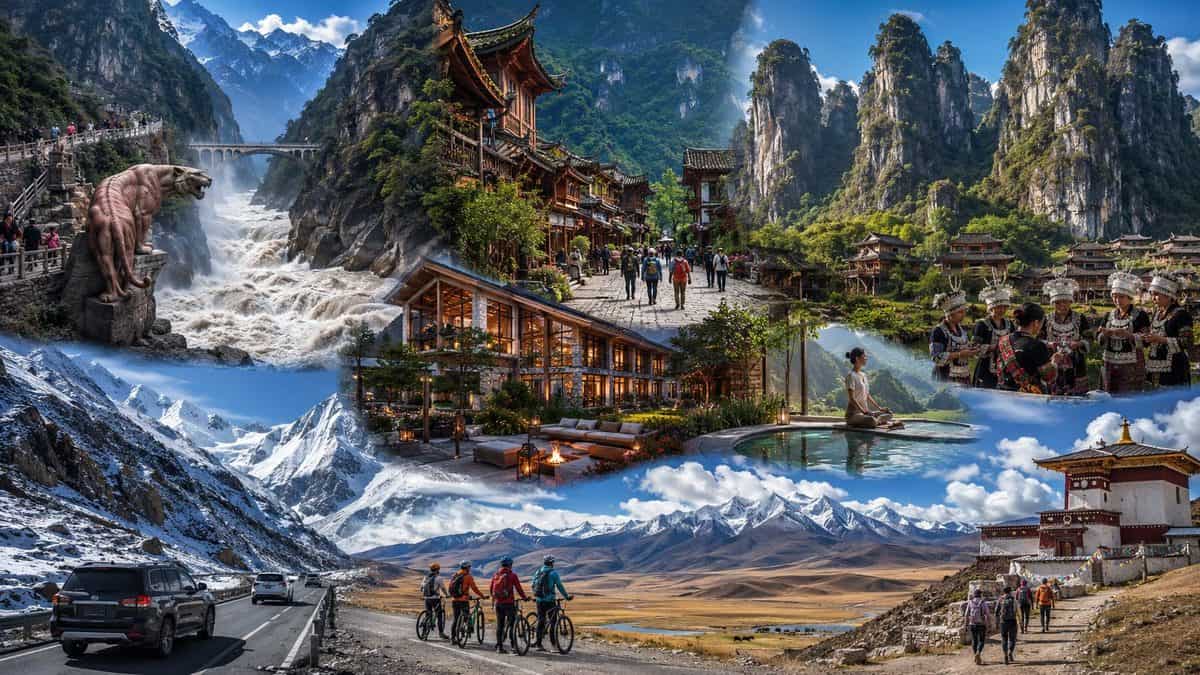
Image generated with Ai
China is quietly building a formidable new proposition for adventure travellers across Yunnan, Guizhou, Sichuan and Tibet. The region combines high mountains, ethnic cultures, scenic highways, wellness retreats, wildlife, heritage villages and increasingly sophisticated accommodation. Its rise comes as China recorded 6.52 billion domestic trips in 2025, with tourism spending reaching 6.30 trillion yuan. Inbound travel also accelerated, with 154.5 million inbound visits and foreign arrivals rising 30.6 percent. For international travellers, the proposition is becoming easier to access too. China has expanded unilateral visa-free entry and 240-hour transit arrangements, while southwest gateways are gaining stronger regional connectivity.
A Four-Region Adventure Corridor Is Taking Shape
The most interesting development is not one new resort or trekking route. Instead, Southwest China is developing a multi-layered travel corridor where different landscapes serve different traveller profiles.
Advertisement
Advertisement
Yunnan offers the gentlest entry point, combining mountain scenery with historic towns, ethnic communities, wellness and boutique hospitality. Guizhou brings karst landscapes, waterfalls, caves and distinctive Miao and Dong cultures. Sichuan moves towards higher mountains, Tibetan communities, giant panda country and serious outdoor pursuits. Tibet then forms the high-altitude frontier, where spirituality, immense plateaux and Himalayan landscapes dominate.
This creates a destination spectrum rather than a single adventure product. Travellers can therefore progress from soft outdoor exploration to high-altitude expedition travel without leaving China’s broader southwest.
Advertisement
Advertisement
| Region | Strongest proposition | Traveller profile | Distinctive advantage |
|---|---|---|---|
| Yunnan | Mountains, culture, wellness | Soft-adventure and luxury travellers | Cultural depth with varied landscapes |
| Guizhou | Karst, waterfalls, villages | Explorers and road-trippers | Less familiar international profile |
| Sichuan | Alpine scenery, wildlife, trekking | Outdoor and nature travellers | Mountains plus panda and Tibetan culture |
| Tibet | High altitude, spirituality, Himalayas | Experienced adventure travellers | Extreme landscape and cultural depth |
The scale of the wider Chinese market also matters. The country’s 2025 domestic tourism volume grew 16.2 percent, while spending increased 9.5 percent. That enormous home market gives destinations an unusually large base for testing accommodation, transport, attractions and new outdoor products.
Advertisement
Advertisement
Yunnan Moves Beyond the Classic Scenic Escape
Yunnan has arguably the broadest product mix in the corridor. Its appeal stretches from Dali and Lijiang towards Tiger Leaping Gorge, Shangri-La, Xishuangbanna and the mountain landscapes bordering Tibet.
The province can combine walking, cycling, cultural immersion, food, wellness and scenic driving within one itinerary. That versatility gives it an advantage over destinations built around one flagship activity.
Shaxi offers a useful example of the emerging model. Once an important Tea Horse Road trading centre, the restored town received more than 3 million tourist visits in 2024, generating reported tourism revenue of 4.298 billion yuan. Restoration has focused on preserving historic buildings while supporting local businesses and visitor infrastructure.
Yunnan is also becoming more connected to Southeast Asia. The China-Laos Railway has strengthened links between Kunming, Pu’er and Xishuangbanna and destinations such as Luang Prabang and Vang Vieng. The 1,035-kilometre railway has enabled cross-border journeys involving travellers from more than 120 countries and regions.
That creates a compelling comparison with northern Thailand. Rather than competing solely with Chiang Mai, Yunnan can potentially participate in a larger China–Laos–Thailand travel circuit.
Advertisement
Advertisement
Guizhou Offers the Emerging-Destination Advantage
Guizhou is perhaps the most intriguing part of the story because international travellers still know it less well than Yunnan or Sichuan.
Its appeal comes from a combination of limestone landscapes, dramatic waterfalls, caves, minority villages and cooler highland conditions. The province has also developed a substantial network of roads and scenic attractions, making it well suited to independent-style touring and organised road journeys.
Zhaoxing Dong Village illustrates the cultural-tourism opportunity. The village received more than 1.51 million visitors in 2025 and generated more than 1.5 billion yuan in comprehensive tourism revenue. Its offer combines Dong Grand Song performances, intangible heritage, homestays, cuisine and village experiences.
Guizhou therefore resembles northern Thailand in one important respect. Culture is not an add-on to the outdoor experience; it becomes part of the journey itself.
For travellers, that can mean a waterfall excursion followed by village dining, craft experiences or a homestay. For tourism businesses, it creates a longer visitor value chain than a conventional sightseeing stop.
Advertisement
Advertisement
Sichuan Builds the High-Altitude Middle Ground
Sichuan occupies the most interesting middle position between accessible adventure and serious Himalayan travel.
Western Sichuan contains high mountain valleys, grasslands, Tibetan cultural landscapes and some of China’s most dramatic road scenery. Meanwhile, the wider province adds wildlife, snow tourism and established attractions around Chengdu and Mount Emei.
The province already has nearly 50 snow and ice tourism areas and 16 key ski resorts, according to provincial tourism authorities. That gives Sichuan a four-season outdoor proposition rather than a purely summer trekking market.
The G318 corridor has also become an important symbol of road-based adventure. In 2025, a mountain tourism festival in Ganzi incorporated motorcycle activities, outdoor experiences, cultural performances and heritage showcases at Tagong Grassland, roughly 3,730 metres above sea level.
This is where the comparison with New Zealand becomes useful. New Zealand has built a powerful international brand around self-drive landscapes and outdoor freedom. Southwest China is developing a different version, where the road connects mountains with Tibetan culture, villages, food and heritage.
Advertisement
Advertisement
Tibet Raises the Adventure Ceiling
Tibet changes the scale of the proposition. It is not simply another mountain destination within the corridor.
In 2025, Xizang recorded more than 70.73 million tourist visits, up 10.71 percent year on year. Tourism revenue reached 81.68 billion yuan, while inbound visitors rose 36.5 percent to 437,400.
The region is also expanding beyond the traditional summer sightseeing season. Nyingchi, for example, recorded 208,600 visitors during its 2025 peach-blossom period, with tourism revenue reaching 150 million yuan.
The more important development is product diversification. Authorities reported that more than 31,000 tourism resources had been newly verified or catalogued since a regional tourism-resource survey began in 2023.
For travellers, however, Tibet demands greater planning. Foreign visitors should check current entry, travel-permit and route requirements before booking. China’s National Immigration Administration also states that travel permits can apply to areas not open to foreigners.
Advertisement
Advertisement
The Luxury Lodge Opportunity Is Growing
The next phase could be less about attracting more visitors and more about increasing the value of each journey.
That is where luxury accommodation, boutique lodges, wellness resorts and premium guided experiences become important. Bhutan offers a useful benchmark because its tourism strategy deliberately combines controlled visitation with higher-value experiences and a Sustainable Development Fee supporting infrastructure, conservation and community programmes.
Southwest China has a different tourism model and vastly greater visitor volumes. Yet the commercial lesson remains relevant: mountains can support premium products when accommodation becomes part of the destination.
The opportunity is especially strong around Yunnan and western Sichuan. Travellers could combine trekking or scenic drives with spa treatments, hot springs, regional cuisine, private guides and design-led mountain stays.
That creates an emerging “adventure-and-recovery” model. The experience no longer ends when the hike finishes; recovery, gastronomy and cultural interpretation become part of the itinerary.
Advertisement
Advertisement
Wellness Could Become the Quiet Differentiator
Wellness is another area where southwest China can escape the conventional adventure-tourism template.
A growing traveller segment wants nature without extreme physical demands. Yunnan is particularly suited to this market because altitude, climate, traditional culture, food and scenic landscapes can be combined into longer restorative stays.
The resulting proposition is simple: walk in the morning, experience local culture during the day and retreat to a wellness property at night.
This places the region closer to Bhutan and northern Thailand than to traditional expedition destinations. It also broadens the potential market to older travellers, couples and affluent travellers who want adventure without sacrificing comfort.
China’s New Access Equation Matters
The international access story has changed significantly. China’s National Immigration Administration listed 50 countries under unilateral visa-free arrangements in 2026, while the 240-hour transit programme had expanded to 65 entry ports.
Advertisement
Advertisement
For New Zealand and Australia, ordinary passport holders can currently enter China visa-free for tourism for up to 30 days under the applicable policy. Travellers must nevertheless verify eligibility and conditions immediately before departure because immigration rules can change.
Southwest China is also gaining relevance through regional mobility. Xishuangbanna has benefited from a visa-free policy allowing eligible ASEAN tour groups to visit for up to six days. In 2024, the destination recorded 319,500 overseas visitors, a 264.67 percent annual increase.
The result is a potentially powerful travel geography: Southeast Asia on one side, the Tibetan plateau on the other, and China’s domestic transport network connecting the two.
Four Established Rivals Show The Opportunity
Southwest China does not need to replace Nepal, Bhutan, northern Thailand or New Zealand. Its more realistic opportunity is to occupy the spaces between them.
Nepal remains stronger for iconic Himalayan trekking. Bhutan retains a distinctive premium, conservation-led model. Northern Thailand remains highly competitive for tropical adventure, food and wellness. New Zealand remains a benchmark for mature self-drive outdoor tourism.
Advertisement
Advertisement
Southwest China instead combines elements of all four.
| Market | Core strength | Southwest China comparison |
| Nepal | Himalayan trekking | Broader mix of adventure levels |
| Bhutan | Luxury, wellness and culture | Larger scale and greater product variety |
| Northern Thailand | Soft adventure and ethnic culture | Similar cultural depth with mountain landscapes |
| New Zealand | Road trips and outdoor infrastructure | Stronger ethnic and high-altitude dimension |
Nepal recorded 1.15 million tourist arrivals in 2024, while New Zealand received 3.38 million international visitors in the year ending June 2025. New Zealand’s international tourism generated NZ$12.1 billion during that period. Bhutan, meanwhile, recorded 209,376 visitors in 2025, up 44.33 percent from 2024, according to its tourism-sector reporting.
These figures are not directly comparable with China’s domestic tourist-visit data. They nevertheless demonstrate the very different scale and positioning of the competing markets.
How China’s Adventure Model Differs Across Asia
China’s southwest is not simply entering a market already defined by Nepal, Bhutan, northern Thailand and New Zealand. Its emerging proposition is distinctive because one broad region can combine Himalayan-scale terrain, ethnic heritage, scenic driving, wellness and premium hospitality, allowing travellers to build very different holidays around the same geographic corridor.
The key difference lies in the breadth of the travel ecosystem. Nepal remains strongly associated with trekking, Bhutan with controlled high-value cultural travel, northern Thailand with tropical soft adventure, and New Zealand with independent outdoor touring. Southwest China can potentially combine elements of all four within a single multi-region journey.
Advertisement
Advertisement
| Travel characteristic | Southwest China | Nepal | Bhutan | Northern Thailand | New Zealand |
|---|---|---|---|---|---|
| Mountain diversity | Very high | Very high | High | Moderate | Very high |
| Ethnic & cultural variety | Very high | High | Very high | High | Moderate |
| Scenic road-trip potential | High | Moderate | Moderate | High | Exceptional |
| Luxury mountain stays | Growing rapidly | Established | Highly developed | Highly developed | Highly developed |
| Wellness potential | High | Growing | Very high | Very high | High |
| High-altitude experiences | Exceptional | Exceptional | High | Low | Moderate |
| Soft-adventure options | Very broad | Moderate | High | Very broad | High |
| Multi-region itineraries | Exceptional | Moderate | Limited | High | High |
| International market maturity | Developing | Established | Established | Established | Highly mature |
The most compelling opportunity is therefore cross-category travel rather than direct destination substitution. A traveller could choose Yunnan for culture and wellness, continue through Sichuan for alpine landscapes, and finish in Tibet for high-altitude experiences. That breadth gives China a different proposition from destinations whose international identities are built around a more concentrated travel experience.
For tourism businesses, this also creates scope for longer itineraries, premium multi-stop journeys and higher-value experiential packages. For travellers, it means Southwest China can be approached not as one destination, but as an expanding adventure geography with markedly different experiences at each stage.
What Travellers Should Know Before Going
The strongest itinerary depends heavily on the traveller’s tolerance for altitude, driving and logistical complexity.
Yunnan is the most accessible starting point for travellers seeking a mixture of culture, scenery and moderate activity. Guizhou suits travellers who prefer less familiar landscapes and village-based experiences. Sichuan is stronger for wildlife, alpine scenery, snow activities and extended road journeys.
Tibet is the most demanding option. Altitude acclimatisation, route restrictions, permits and seasonal conditions require more careful planning. Travellers should also avoid treating high-altitude journeys as ordinary sightseeing holidays.
Advertisement
Advertisement
| Traveller priority | Best regional fit | Why |
| Culture + scenery | Yunnan | Strong combination of towns, communities and mountains |
| Emerging destinations | Guizhou | Less saturated international profile |
| Road adventure | Sichuan | High mountain landscapes and established scenic corridors |
| Luxury + wellness | Yunnan | Strong hospitality and restorative travel potential |
| Wildlife + outdoors | Sichuan | Giant panda country and alpine environments |
| Extreme landscapes | Tibet | High-altitude plateau and Himalayan scenery |
| Southeast Asia crossover | Yunnan | China-Laos connectivity |
| Classic Himalayan trekking | Nepal | More established trekking ecosystem |
Why The Model Could Stay Relevant
The long-term significance of Southwest China adventure tourism lies in its breadth. The region does not depend on one mountain, one trek or one iconic attraction.
China’s tourism authorities are already promoting new tourism formats, including rural tourism, immersive experiences and low-altitude tourism. Nationally, the country had 16,994 A-rated scenic areas at the end of 2025, while those attractions recorded 7.51 billion visits during the year.
That infrastructure creates room for smaller destinations to develop around major gateways. It also allows tourism businesses to build multi-stop journeys rather than isolated excursions.
For travellers, the biggest attraction may therefore be choice. A single southwest journey can move from ancient trading towns to karst valleys, from panda country to Tibetan grasslands, and eventually towards the Himalayan plateau.
The New Adventure Map Is Expanding
Southwest China is not yet a direct replacement for Nepal, Bhutan or New Zealand. However, it is becoming harder to describe the region as an undiscovered side story in Asian tourism.
Advertisement
Advertisement
Yunnan is broadening the entry-level proposition. Guizhou is turning cultural landscapes into commercially viable visitor experiences. Sichuan is connecting road travel with alpine adventure and wildlife. Tibet is expanding a traditionally high-altitude product into a more diversified tourism economy.
The opportunity for international travellers is equally significant. Southwest China now offers an unusually wide adventure spectrum, from gentle cultural journeys to demanding mountain experiences. Its combination of infrastructure, scale, cultural diversity and premium hospitality could make the region one of Asia’s most consequential adventure-tourism developments over the next decade. The real competition may not be about replacing established destinations. It may be about giving travellers a new reason to compare them all.
Advertisement
