
Butler Memorial Airport, Missouri Aviation Tragedy Near Kansas City Region as Skydiving Flight Carrying 12 Crashes Just Moments After Departure, Leaving No Survivors in Devastating Fireball Crash

Published
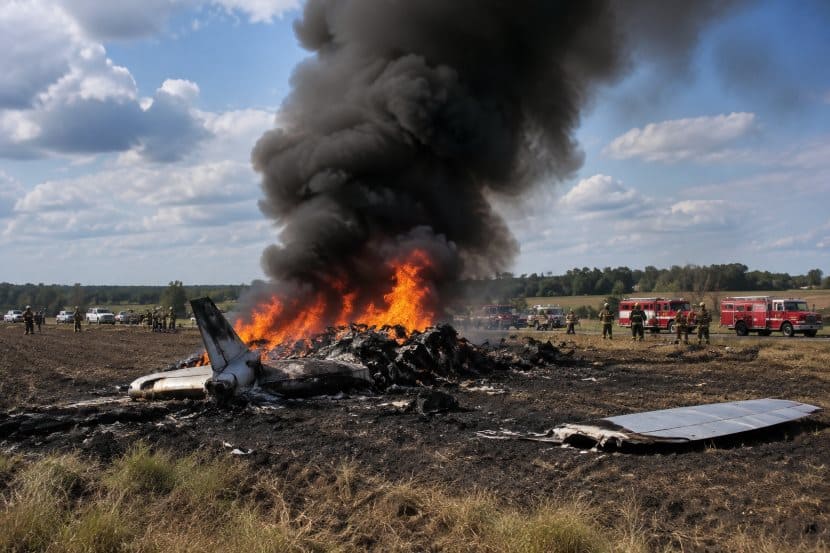
Shortly after departure from Butler Memorial Airport in Butler, Missouri, within the broader Kansas City region, a routine skydiving flight turned into a fatal aviation disaster when a aircraft carrying 12 people crashed just moments after takeoff, leaving no survivors in a devastating fireball crash. The sequence of events began during the initial climb phase, when the aircraft was expected to gain altitude for a recreational jump operation but instead failed to maintain stable ascent. Within seconds of leaving the runway environment, the situation escalated into a loss of control that ended in impact near the airport boundary.
The aircraft involved was operating a standard skydiving flight, a common activity at Butler Memorial Airport, which serves as a regional hub for general aviation and adventure tourism. On board were 12 individuals, including the pilot and skydiving participants, all engaged in a scheduled recreational flight. According to early assessments from aviation authorities in the United States, the aircraft’s performance deteriorated rapidly after takeoff, leading to a crash just moments after departure.
Advertisement
Advertisement
The impact resulted in a high-intensity fireball crash, with emergency response teams later confirming no survivors. The Butler Memorial Airport Missouri aviation tragedy near Kansas City region has since triggered a full investigation by the National Transportation Safety Board and the Federal Aviation Administration, focusing on mechanical performance, operational conditions, and the critical failure during the early climb phase of flight.
Detailed Introduction: A Routine Recreational Flight That Ended in Seconds
The flight had begun as a standard skydiving operation, part of a well-established pattern of recreational aviation activity that regularly operates from Butler Memorial Airport. The airport is known for supporting general aviation services, including adventure tourism flights that carry skydivers to altitude before drop operations over designated rural zones.
Advertisement
Advertisement
On the day of the incident, the aircraft departed under daylight conditions typically considered suitable for visual flight operations. It carried a pilot and a group of skydiving participants preparing for a recreational jump. However, shortly after takeoff, the aircraft failed to maintain expected climb performance and remained dangerously close to the airport environment.
Witness observations and preliminary assessments indicate that the aircraft experienced a sudden deviation in flight path during the initial climb phase. Within moments, it descended rapidly into open terrain near the runway perimeter. The impact triggered a severe post-crash fire that required immediate emergency response intervention.
Advertisement
Advertisement
All 12 individuals onboard were confirmed dead at the scene. Emergency crews quickly secured the area, contained the fire, and restricted access to surrounding roads while recovery operations began. The severity and immediacy of the crash have made it a priority case for federal aviation investigators.
Butler Memorial Airport and Its Role in Skydiving Tourism
Butler Memorial Airport serves as a regional general aviation facility supporting private aircraft operations, agricultural aviation, and skydiving tourism. Positioned within reach of the Kansas City metropolitan travel corridor, the airport is frequently used for recreational aviation experiences, including tandem skydiving and group jumps.
Skydiving operations at the airport typically involve repeated short flights throughout the day, designed to transport jumpers to altitude efficiently before returning for rapid turnaround cycles. This operational structure is common across skydiving hubs in the United States and places significant emphasis on aircraft performance reliability and maintenance discipline.
The surrounding rural landscape functions as a designated drop zone, making the airport an established destination for adventure tourism seekers traveling through Missouri and the wider Kansas City region.
Federal Investigation Led by NTSB and FAA
The National Transportation Safety Board (NTSB), in coordination with the Federal Aviation Administration (FAA), has taken control of the investigation. Standard procedures include detailed examination of wreckage distribution, aircraft maintenance history, pilot qualifications, operational logs, and environmental conditions at the time of departure.
A key focus of the investigation is the aircraft’s inability to achieve or sustain climb after takeoff. The initial climb phase is widely recognized in aviation safety analysis as one of the most critical segments of flight, where aircraft operate at low altitude with minimal margin for error and limited recovery options.
Advertisement
Advertisement
Investigators will also assess whether mechanical malfunction, weight and balance configuration, or engine performance issues contributed to the loss of lift and control. The aircraft’s operational history, including its flight cycles on the same day and preceding days, is expected to be part of the technical review.
Emergency Response and Site Containment
Emergency services responded rapidly after reports of a crash and fire near Butler Memorial Airport. Fire suppression teams were able to bring the blaze under control, preventing further spread into nearby fields and infrastructure. Law enforcement agencies established a secured perimeter and restricted public access to preserve the integrity of the investigation site.
Search operations were conducted along the aircraft’s final trajectory to confirm whether any occupants had exited prior to impact. Officials confirmed that no parachute deployments occurred during the incident.
Regulatory Context of Skydiving Operations
Skydiving flights in the United States operate under general aviation regulations, which differ from commercial airline safety frameworks. While subject to federal oversight, these operations place primary responsibility on operators for aircraft maintenance, inspection schedules, and flight readiness standards.
Aviation safety experts note that the repetitive nature of skydiving flights, often involving multiple cycles per day, can increase operational strain on aircraft systems. This requires strict adherence to maintenance intervals and continuous monitoring of performance conditions.
The investigation will examine whether all required safety protocols were followed in accordance with federal aviation regulations.
Advertisement
Advertisement
Impact on Regional Travel and Tourism Activity
The Kansas City region, including Butler, Missouri, is recognized for its combination of urban tourism and outdoor recreational aviation experiences. Skydiving forms a significant part of the region’s adventure tourism sector, attracting visitors seeking high-altitude recreational activities.
Following the crash, all skydiving operations at Butler Memorial Airport have been suspended pending the outcome of the investigation. This suspension has temporarily affected local tourism operators and reduced recreational aviation activity in the area.
Butler Memorial Airport Missouri aviation tragedy near Kansas City region: skydiving flight with 12 crashed after takeoff due to climb failure, no survivors in fireball crash.
Ongoing Federal Investigation and Expected Timeline
The NTSB investigation is expected to continue over an extended period, potentially lasting several months or more than a year. A final report will determine the probable cause of the crash and identify contributing factors that led to the fatal sequence of events shortly after takeoff.
Until the investigation concludes, Butler Memorial Airport remains under heightened federal scrutiny as authorities work to reconstruct the final moments of the flight and establish a complete technical understanding of the accident.
Advertisement
