
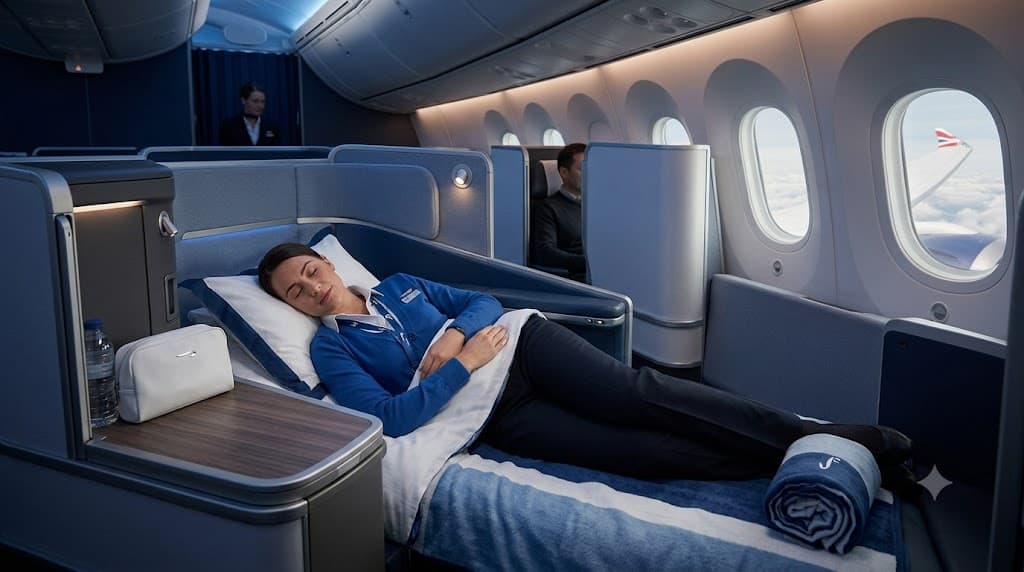
Image generated with Ai
British Airways has officially shattered long-standing aviation norms by rewriting its internal rest policies to permit its massive workforce of nearly 20,000 cabin crew members to sleep in vacant, multi-thousand-pound First and Business Class suites during select long-haul flights. Taking effect across international routes as an immediate operational shift, this unprecedented development is critical for travelers to understand because it fundamentally redefines the relationship between premium ticket exclusivity, airline labor dynamics, and regulatory compliance. The decision directly impacts high-paying premium flyers, corporate travel planners, and an aviation industry grappling with a structural conflict between cabin real estate monetization and modern fatigue risk management rules.
For decades, the standard assumption among commercial airline passengers has been that every widebody aircraft operating overseas possesses a secret, hidden staircase leading to a dedicated crew bunk compartment. In reality, aircraft manufacturers like Boeing and Airbus treat these crew rest modules as optional, high-cost extras.
Advertisement
When configuring its current fleet of Boeing 787-10 Dreamliners and a specific sub-fleet of Boeing 777-200ER aircraft, British Airways management famously elected to forgo these factory-installed crew bunks. The engineering trade-off was simple: by eliminating the dedicated physical crew rest quarters, the carrier successfully squeezed exactly three additional revenue-generating Economy Class (World Traveller) seats onto each Dreamliner.
Until this policy revision, cabin crew on these specific aircraft were required to take their mandatory mid-flight rest periods in “high-comfort attendant seats.” These setups are essentially reinforced, fold-down jumpseats positioned adjacent to the main galley doors. While technically isolated by thin privacy curtains, they offer virtually no recline, zero noise dampening, and minimal comfort for flight attendants working demanding, multi-time-zone overnight schedules.
Advertisement
Advertisement
Following intensive, multi-layered negotiations with the British Airlines Stewards and Stewardesses Association (BASSA), British Airways leadership agreed to a sweeping operational pivot. The newly enacted rules outline a clear hierarchy for how empty premium space will be utilized by working crew members during their scheduled breaks:
To prevent passenger confusion, the airline has instituted strict behavioral guidelines. Off-duty crew members transitioning into premium passenger spaces are required to completely remove or obscure visible uniform items, corporate badges, and branded accessories before settling into a passenger suite.
While public discussion has focused on the visual friction of an off-duty flight attendant sleeping next to a passenger who paid £5,000 for a luxury suite, the real story lies in a massive structural miscalculation. British Airways is essentially paying a massive premium in luxury real estate to offset a short-sighted design choice.
By prioritizing three extra economy seats over permanent crew infrastructure, the airline inadvertently capped the operational flexibility of its Boeing 787-10 fleet. Under UK Civil Aviation Authority (CAA) Flight Time Limitations (FTL), aircraft lacking dedicated, private lie-flat crew quarters are legally barred from operating ultra-long-haul routes where extended duty periods pose critical fatigue risks.
Advertisement
Advertisement
Consequently, these premium aircraft have been structurally bottlenecked, restricted only to shorter long-haul routes out of London Heathrow Airport (LHR). While British Airways is slated to receive brand-new Boeing 787-10 deliveries featuring factory-installed crew bunks, the existing fleet cannot be retrofitted. This leaves the empty-seat policy as the only legally viable mechanism to manage crew fatigue under modern aviation oversight frameworks.
The policy has exposed a stark philosophical divide among the airline’s frequent flyer community, triggering intense debates across luxury travel forums and corporate aviation networks.
“Allowing off-duty crew to rest openly in the premium cabins devalues the entire brand ecosystem,” wrote one prominent FlyerTalk member. “When you pay thousands for an exclusive First Class environment, you are purchasing an atmosphere, not just a physical seat.”
Conversely, aviation safety advocates and a growing segment of the traveling public strongly defend the adjustment. Proponents point out that a well-rested cabin crew is the ultimate line of defense during an in-flight catastrophic emergency. Under modern Safety Management Systems (SMS) audited by regulators, mitigating cognitive decline and physical exhaustion among flight attendants is considered a non-negotiable operational imperative that takes legal precedence over passenger optics.
This policy stands as an industry-wide case study in how corporate cost-cutting measures in aircraft procurement can trigger long-term operational liabilities. As airlines globally look to maximize cabin density, the intersection of labor union leverage and rigid fatigue regulations will continue to force creative, sometimes controversial compromises.
How do you feel about sharing a premium cabin with off-duty crew members knowing it directly supports flight safety? Share this article with your fellow travelers, leave your thoughts in the comments below, and stay tuned for more breaking updates across the global aviation sector.
Advertisement
Tags: aviation safety, Boeing 787-10, british airways, First Class travel, Flight Fatigue Management
Advertisement
Advertisement













Friday, September 4, 2026

Friday, September 4, 2026

Friday, September 4, 2026

Thursday, September 3, 2026

Wednesday, September 2, 2026
Friday, September 4, 2026
Friday, September 4, 2026