
Chile Plans Greener New Tourism Transport Across the Atacama Desert

Updated
Published
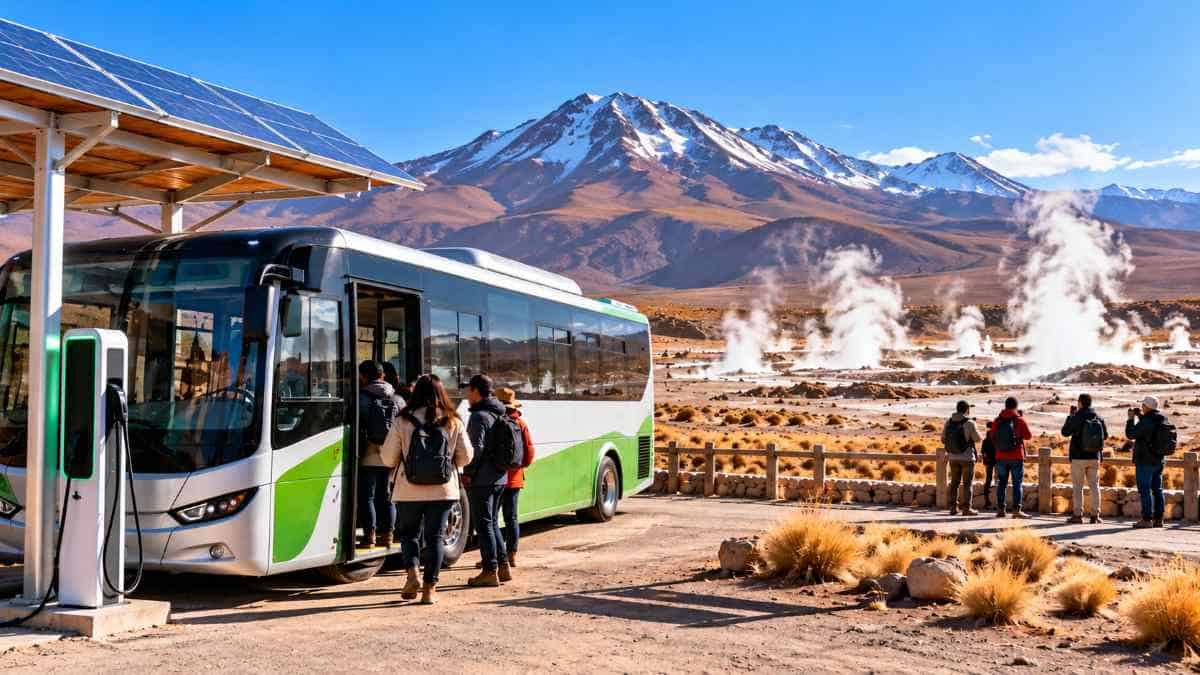
The Atacama Desert in Chile is currently confronted with a critical issue related to the increasing number of international tourists drawn by the country’s high-altitude destinations – how to satisfy the increasing demand without harming the delicate natural ecosystem? An eco-mobility model developed together with Sernatur (National Tourism Service) and the Ministry of Transport of Chile is reported to concentrate on clean transportation and proper visitor management in the area. The new model is designed for San Pedro de Atacama and the adjacent sights in the Antofagasta Region of the country. This solution envisages an eco-friendly fleet of tourist shuttle buses running on electricity, along with solar-powered charging stations and an electronic reservation system for controlling the number of visitors to delicate tourist spots. The model also suggests daily limits of vehicles allowed to visit the El Tatio Geysers and Valle de la Luna. Still, the introduction of the mandatory use of electric vehicles and visitor quotas, along with a centralised access system, needs to be confirmed by Chilean officials.
San Pedro de Atacama at the Centre of Desert Tourism
San Pedro de Atacama is one of Chile’s best-known international tourism destinations. Located in the Antofagasta Region in the country’s north, the town serves as a base for visitors exploring volcanic landscapes, salt flats, high-altitude lagoons and some of the Atacama’s most recognisable natural attractions.
Its appeal extends across several types of travel. International visitors come for landscape photography, astronomy, adventure tourism, cultural experiences and excursions into the surrounding desert.
The El Tatio Geysers are among the region’s most prominent attractions. Situated at high altitude in the Andes, the geothermal field draws visitors to see steam rising from the ground during the cold early-morning hours.
Advertisement
Advertisement
Valle de la Luna, or Moon Valley, offers another distinctive experience, with sculpted rock formations, dunes and mineral-rich landscapes that resemble an extraterrestrial environment.
Both destinations require careful visitor management. Vehicle movements, waste disposal and uncontrolled access can place pressure on sensitive environments, particularly where natural recovery is slow.
Advertisement
Advertisement
Electric Shuttles Could Change How Visitors Explore the Atacama
The proposed framework places electric vehicles at the centre of its transport strategy. Under the reported plan, commercial tour operators would gradually move towards standardised electric shuttle fleets for journeys to fragile high-altitude reserves.
This approach could reduce direct vehicle emissions and noise around popular visitor locations. It could also make it easier for authorities to coordinate transport movements when several tour groups visit the same attraction.
However, introducing electric vehicles in remote desert areas presents practical challenges. Operators need reliable charging facilities, suitable vehicle ranges and maintenance support. High-altitude roads, temperature variations and long distances between attractions can also affect vehicle performance.
A network of solar-powered charging facilities could help address some of these concerns. The Atacama receives exceptionally high levels of solar radiation, giving renewable energy an important role in the region’s wider sustainability potential.
Yet charging infrastructure would need to be supported by battery storage, reliable power management and carefully selected locations. Construction itself would also need environmental assessment to avoid damaging the landscapes the initiative aims to protect.
Visitor Limits Could Help Protect Fragile Natural Sites
Tourism management is not simply a question of reducing vehicle emissions. The number of visitors entering a sensitive destination at a particular time can also affect its environmental condition and the quality of the visitor experience.
Advertisement
Advertisement
The reported framework proposes daily vehicle caps for selected high-altitude attractions. A digital reservation system would allow tour operators and visitors to coordinate access before travelling.
Such a system could help distribute arrivals throughout the day and reduce congestion at popular sites. It could also provide authorities with better information about visitor numbers and demand during peak tourism periods.
For international travellers, advance reservations could make excursion planning more predictable. Tour operators would have a clearer picture of available access periods, while visitors could receive information about entry conditions before leaving San Pedro de Atacama.
However, a reservation platform would need to account for different visitor categories, local communities, independent travellers and changing weather conditions. A rigid quota system could also affect smaller operators if access arrangements are not transparent.
The reported introduction of binding daily limits should therefore be distinguished from the broader principle of managing visitor pressure, which is already an important consideration for protected and environmentally sensitive destinations.
Indigenous Heritage Must Remain Part of Tourism Planning
The Atacama region is also home to indigenous communities whose cultural identity and ancestral relationships with the land are central to its heritage.
Advertisement
Advertisement
Tourism development can create economic opportunities through guiding, accommodation, local food businesses and cultural experiences. However, increased visitor activity must be managed with respect for community priorities, traditional knowledge and access to culturally significant places.
The reported framework includes bilingual guide tracking and coordinated digital systems for tour operators. If implemented with community participation, these measures could improve communication and help ensure visitors receive accurate information about local customs and environmental responsibilities.
Technology alone cannot safeguard indigenous heritage. Meaningful consultation, fair economic participation and respect for community decisions remain essential to responsible tourism development.
Local guides can also provide visitors with a deeper understanding of the desert’s ecology, history and cultural significance, adding value beyond conventional sightseeing excursions.
Tourism and Conservation Across the Antofagasta Region
The Atacama’s international appeal supports a wider tourism economy across northern Chile. San Pedro de Atacama attracts visitors who may also explore Antofagasta, regional coastal destinations and other landscapes in the Andes.
More sustainable transport arrangements could help strengthen the region’s position among travellers seeking nature-based and responsible tourism experiences.
Advertisement
Advertisement
For tour operators, the transition could bring new investment requirements involving electric vehicles, charging access and digital booking systems. Smaller businesses may need financial and technical support to adapt without losing their competitiveness.
For authorities, the challenge will be to balance environmental protection with the economic contribution of tourism. Any new access restrictions must be supported by transparent rules, reliable monitoring and clear communication with businesses and visitors.
What Travellers Should Expect
People who are planning to explore places outside San Pedro de Atacama should make sure to get information on the access conditions, tours, and means of transportation from their guides. High altitude tours require early departures, low temperatures, and harsh environmental conditions. Moreover, tourists need to respect paths and not leave any litter at natural wonders. It would be a great step for Chile to prove its commitment to the reported green mobility model. The future success of the proposed plan will depend on whether the use of electric transportation will not hinder the development of the tourism industry of the region. In the case of Atacama, the protection of natural landscapes is crucial because it attracts people from all over the world.
Advertisement
