
Serengeti Safari Aircraft Makes Emergency Landing in Tanzania After Reported Zebra Strike

Published
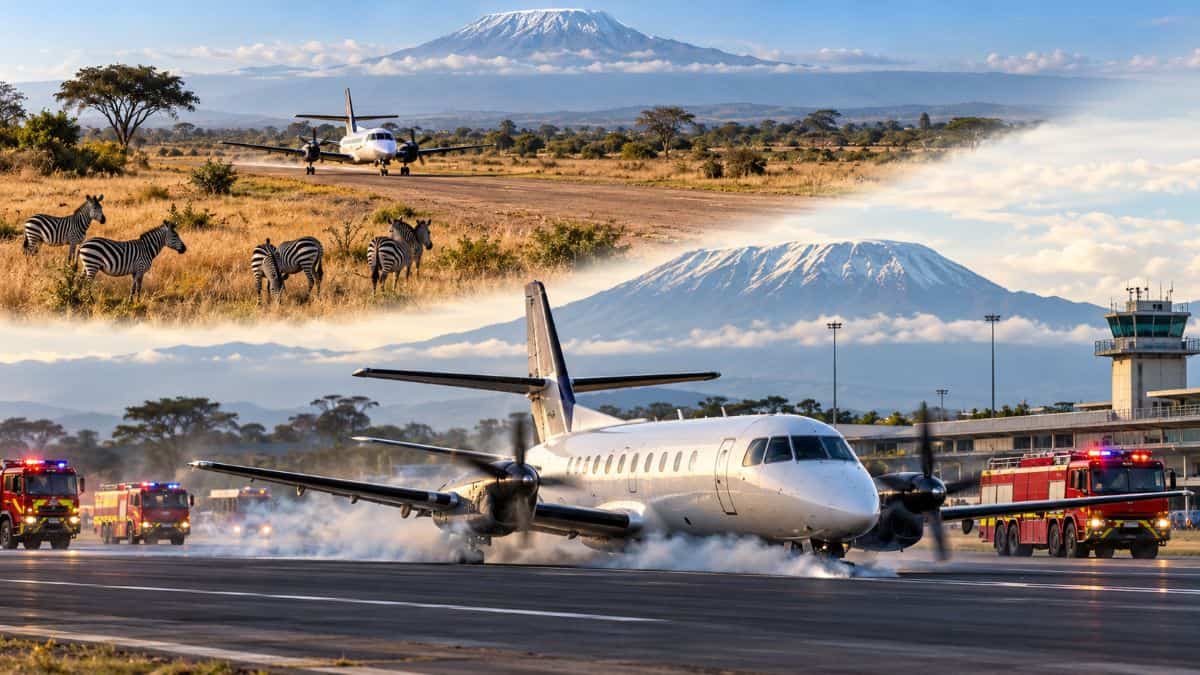
A safari aircraft carrying 30 people made an emergency landing at Kilimanjaro International Airport after a reported wildlife strike in Tanzania’s Serengeti National Park. The incident occurred on 4 October 2026, when an Embraer EMB-120 operating from Seronera Airstrip towards Zanzibar encountered trouble after take-off. Reports said the aircraft had struck a zebra during its departure from the Serengeti. The crew subsequently diverted towards Kilimanjaro after experiencing landing-gear problems. The aircraft landed with its main gear retracted and slid along the runway. All 26 passengers and four crew members escaped safely, according to reports. Kilimanjaro temporarily suspended operations while the aircraft was dealt with.
Wildlife Encounter Triggers Emergency Diversion
The incident took place on Sunday, 4 October, rather than on the day the footage and international reports gained wider attention. Local reporting emerged around the time of the incident, while several international publications subsequently published or updated their accounts between 5 and 7 October.
Advertisement
Advertisement
That distinction matters because the aircraft emergency was not a 7 October occurrence. The latest reports concern an earlier aviation incident, with authorities investigating the circumstances surrounding the aircraft’s damaged landing gear.
The aircraft was flying from Seronera to Zanzibar with 26 passengers and four crew. During departure from the Serengeti, reports said it collided with a zebra before continuing its flight. The Tanzania Airports Authority was reported to have described the animal involved as an ungulate in its account of the incident.
Advertisement
Advertisement
The precise chain of events remains under investigation. Therefore, the wildlife collision should not yet be described as the officially established cause of the landing-gear failure.
Dramatic Landing Followed the Diversion
After leaving Seronera, the crew diverted the aircraft towards Kilimanjaro International Airport. The reported problem involved the aircraft’s main landing gear, which could not be lowered before arrival.
Advertisement
Advertisement
The Embraer EMB-120 eventually approached Kilimanjaro with the main landing gear still retracted. It landed on its underside and travelled along the runway before coming to a stop. Footage from the scene showed smoke and friction beneath the aircraft during the landing.
Despite the dramatic appearance of the landing, the outcome was comparatively reassuring. None of the 30 people aboard were reported injured, and passengers and crew were able to leave the aircraft safely.
Advertisement
Advertisement
Reports said the aircraft sustained substantial damage. The zebra reportedly died following the collision during departure.
Kilimanjaro Operations Were Temporarily Halted
The emergency landing also affected wider aviation activity at Kilimanjaro International Airport. The runway was temporarily closed while authorities responded to the aircraft and worked to restore normal operations.
Local reports said the airport remained closed for several hours before operations resumed at around 16:30 local time. The disruption demonstrated how an incident involving a regional aircraft can affect other flights using an important international gateway.
For travellers, the operational impact is particularly relevant. Kilimanjaro serves visitors heading towards Tanzania’s northern safari circuit, including the Serengeti, Ngorongoro and other major attractions.
Advertisement
Advertisement
A runway closure can therefore affect both incoming international passengers and travellers transferring between safari destinations. However, there is no indication that the airport remains affected by this incident.
Seronera Highlights Safari Aviation Risks
The incident also draws attention to the unusual operating environment surrounding safari airstrips. Seronera sits inside Serengeti National Park, where aircraft operate in close proximity to wildlife.
That environment is fundamentally different from an airport surrounded by urban or industrial development. Wildlife can move through areas near runways, creating hazards that operators must manage alongside conventional aviation risks.
The Serengeti’s air network remains essential to tourism. Smaller aircraft connect safari camps and airstrips with larger airports, reducing lengthy road journeys across the vast national park.
For international visitors, those flights can save many hours of ground travel. They also make remote safari areas accessible to travellers working within relatively short holiday schedules.
The latest incident therefore raises a wider safety question without suggesting that safari aviation is inherently unsafe. Wildlife management remains an important part of operating aircraft in protected areas.
Advertisement
Advertisement
Tanzania Had Recently Reviewed Seronera
The timing of the incident is also noteworthy because Tanzania’s aviation authorities had recently undertaken safety-related work involving Seronera.
On 24 September, the National Civil Aviation Safety Committee visited Seronera, Kogatende and Mikumi airstrips. The Tanzania Civil Aviation Authority said the inspections examined aviation safety, infrastructure and air-navigation services.
TCAA said Seronera had an automated weather station supporting aviation operations. Officials also inspected progress on construction of a control tower intended to strengthen aircraft coordination at the airstrip.
TCAA Director General Dr Jabiri K. Bakari said on 25 September that investment in aviation infrastructure would support safer and more efficient air transport. He also linked improvements at conservation-area airstrips with the growth of Tanzania’s tourism sector.
That development provides important context. The government has been investing in aviation infrastructure serving national parks, while the latest incident demonstrates the distinct operational challenges those facilities face.
Aircraft Registration Needs Careful Attribution
There is also an important discrepancy in publicly available information about the aircraft’s operator.
Advertisement
Advertisement
Several aviation reports identify the aircraft as a Sindbard Air Embraer EMB-120, registration 5H-HLL. Aviation incident databases also identify the flight as operating between Seronera and Zanzibar under that operator.
However, the current Tanzania Civil Aviation Authority aircraft register gives a different regulatory record. It identifies 5H-HLL as an Embraer aircraft and lists Angelic Handlers Company Limited as the operator. The owner is listed as the Ministry of Interior of South Sudan.
That difference should not be ignored in a detailed aviation report. It may reflect operational arrangements that are not fully captured by the public reporting, but the investigation and regulatory records should ultimately establish the aircraft’s operating status.
For publication, it is therefore safer to describe the aircraft as 5H-HLL, while attributing the Sindbard Air identification to aviation reports.
What the Incident Means for Travellers
For safari travellers, the incident is a reminder to allow flexibility around regional air connections. Safari itineraries often combine small-aircraft flights, road transfers and international services within the same journey.
A disruption at a remote airstrip can consequently have a knock-on effect on later travel. Travellers connecting from the Serengeti to Zanzibar or onward international flights should avoid arranging connections with unnecessarily short buffers.
Advertisement
Advertisement
Travel insurance can also provide useful protection when an aviation disruption creates additional accommodation or transport costs. Travellers should check whether their policy covers missed connections involving separately ticketed domestic and international journeys.
At the same time, there is no basis to suggest that travellers should avoid safari flights because of this incident. Safari aviation remains a fundamental part of Tanzania’s tourism infrastructure.
The more practical lesson is to use established operators, retain itinerary flexibility and maintain communication with safari companies when flight conditions change.
Investigation Will Determine What Happened
The central question now concerns the precise relationship between the reported wildlife strike and the subsequent landing-gear problem.
Reports have linked the two events, but that does not establish causation. Investigators will need to determine the extent of the aircraft’s damage during take-off and whether that damage affected the landing-gear system.
They will also examine the aircraft’s technical condition, maintenance history, crew actions and operational circumstances. The investigation should provide the strongest evidence for determining what happened during the flight.
Advertisement
Advertisement
This distinction is especially important because wildlife strikes are recognised aviation hazards. Establishing exactly how this incident unfolded could help inform future safety measures at safari airstrips.
Tanzania’s aviation authorities have already been strengthening infrastructure and air-navigation services at conservation-area airfields. The incident could therefore provide additional evidence for evaluating wildlife-management and operational procedures.
Safari Aviation Remains Vital to Tourism
The 4 October incident was dramatic, but its most significant fact remains the safe outcome for those aboard. All 30 passengers and crew survived without reported injuries, despite the aircraft landing without its main gear.
The event nevertheless illustrates the distinctive challenges facing aviation within Tanzania’s wildlife destinations. Safari tourism depends heavily on small aircraft, while those aircraft operate in landscapes where wildlife is part of the environment.
The incident should therefore be viewed through two lenses. It was an unusual aviation emergency, but it also highlights the importance of continuing investment in remote-airstrip infrastructure and wildlife-risk management.
For travellers, the safest response is not alarm. It is preparation. Flexible itineraries, reputable operators and adequate connection time can reduce the consequences when remote aviation encounters an unexpected disruption.
Advertisement
Advertisement
The investigation should ultimately establish whether the reported zebra strike caused the landing-gear failure. Until then, the wildlife collision remains a reported element of the incident rather than a confirmed technical finding.
Advertisement
