
Italy’s Piobbico Showcases Five Castles Trek With Renaissance Palio Tourism in Pesaro and Urbino Province

Published
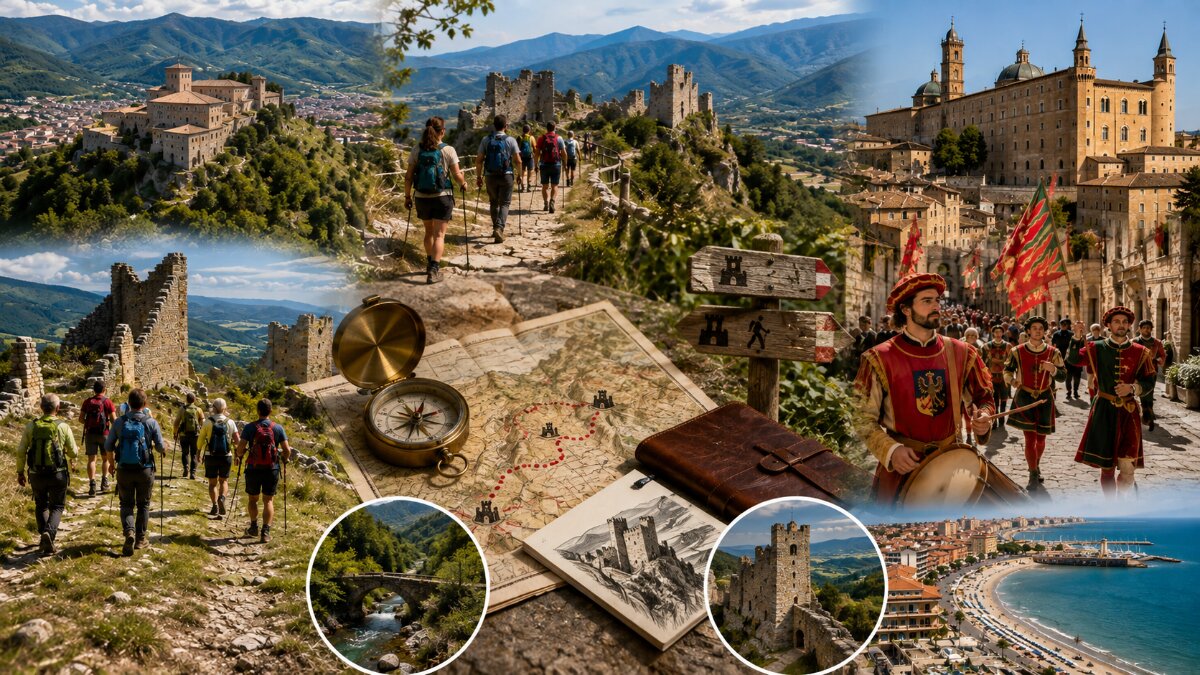 Image generated with Ai
A small Marche town is doing something strategically larger than staging a historical festival. On 23 August, Piobbico is pairing guided hiking through ancient fortification landscapes with the final Renaissance programme of the Palio dei Brancaleoni. The format closely matches Marche’s newly adopted tourism priorities around outdoor experiences, historic villages, slow travel and better territorial organisation. For travel businesses the significance mainly lies in whether heritage-rich inland communities can turn history from something that visitors simply observe into an active experience capable of extending itineraries beyond major anchors such as Urbino and Pesaro.
Piobbico Is Turning One Festival Day Into An Active Heritage Journey
The most significant development in Piobbico on 23 August is not the historical procession alone. It is the sequencing of landscape, interpretation and Renaissance heritage within the same visitor day.
Advertisement
Advertisement
According to the official Palio dei Brancaleoni programme, the Trekking dei 5 Castelli begins at 09:00 with environmental hiking guides and specialists in local history. Participants are offered two different levels: the easier Sentiero dei Folletti and the medium-difficulty Sentiero dei Cinque Castelli. The latter runs through the remains of ancient defensive fortifications that once surrounded and protected Piobbico.
At 16:30, the programme shifts from physical exploration to historical performance with the procession leading towards the Palio arena. Italy’s official tourism portal confirms that the 2026 Palio runs from 20 to 23 August and that the Five Castles Trek forms part of the final day alongside the historical procession and competition.
Advertisement
Advertisement
That structure creates an unusual tourism proposition. Visitors are not merely being shown a reconstructed version of the past. During the morning they move through the physical geography that shaped that history, before experiencing its interpretation through Renaissance re-enactment later in the day.
| 23 August component | Officially confirmed format | Travel-product significance |
|---|---|---|
| 09:00 morning programme | Guided outdoor excursions | Creates an activity-led reason to engage with the surrounding landscape |
| Sentiero dei Folletti | Easier walking option with views towards Castello Brancaleoni | Broadens accessibility across different hiking abilities |
| Sentiero dei Cinque Castelli | Medium-difficulty trek through remains of historic fortifications | Converts defensive archaeology and landscape into an experiential attraction |
| Environmental hiking guides | Included in the organised excursion format | Adds interpretation, visitor management and specialist guidance |
| Local-history specialists | Integrated into the trekking experience | Connects physical movement with historical narrative |
| 16:30 historical procession | Afternoon transition into the Palio programme | Encourages visitors to remain in the destination across different parts of the day |
| Renaissance setting | Castle, historic centre and Brancaleoni narrative | Links landscape exploration directly with the town’s principal cultural asset |
The distinction between a five-castle trek and a tour of five preserved castles is also important. Official programme information describes a route among the remains of ancient fortifications. Travel sellers should therefore market the experience as archaeological landscape and active heritage rather than promising five intact monumental castles.
Advertisement
Advertisement
Why This Matters Now For Marche Tourism In 2026
The timing gives Piobbico greater industry relevance than the scale of the town might initially suggest.
Marche’s Regional Tourism Plan 2026–2028 identifies outdoor and nature tourism and tourism centred on historic villages as priority development areas. The regional policy framework calls for natural parks, protected areas, walking routes, cycleways and hiking networks to be integrated more closely with visitor services. It also identifies villages and historic centres as important mechanisms for regenerating inland areas and strengthening slow-tourism positioning.
Piobbico’s 23 August configuration sits almost exactly where those priorities intersect: a historic village, a Renaissance story, a mountain environment, guide-led walking and a scheduled cultural event.
This does not mean the regional government has designated the Five Castles Trek as an official pilot programme. No primary source reviewed for this report establishes such a designation. Its importance is analytical. The event provides a real-world example of what the policy language around integrated outdoor, experiential and village tourism can look like when translated into an actual visitor itinerary.
That distinction matters for B2B travel companies. Policy documents can remain abstract. Piobbico offers a tangible product model that operators can evaluate in terms of duration, interpretation, visitor movement, packaging and potential expenditure distribution.
Marche Is Also Trying To Solve Tourism Fragmentation
The active-heritage experiment arrives while Marche is restructuring destination governance.
Advertisement
Advertisement
According to Regione Marche, new Destination Management Organisations are being developed in 2026 to connect territories, tourism businesses, municipalities and local communities and reduce fragmentation in the way tourism supply is promoted and managed. The DMO framework forms part of the 2026–2028 tourism plan.
That is directly relevant to small inland destinations.
Piobbico has strong individual assets, but the commercial challenge for a small town is rarely the absence of heritage. It is converting dispersed assets into a coherent reason to visit, stay longer and spend across multiple services.
| Regional tourism priority | Piobbico evidence on 23 August | B2B opportunity |
| Outdoor tourism | Guided walking routes | Add physical activity to conventional cultural itineraries |
| Historic villages | Piobbico historic centre and castle landscape | Package smaller settlements alongside established destinations |
| Experiential travel | Walking through the defensive landscape before the re-enactment | Move visitors from passive sightseeing towards participation |
| Slow tourism | Exploration on foot | Support lower-speed, place-based itineraries |
| Better destination organisation | Guides, local historians and scheduled cultural programming | Coordinate multiple local assets into one visitor journey |
| Visitor dispersal | Inland location within Pesaro e Urbino province | Create reasons to travel beyond coastal and major urban attractions |
| Stronger tourism networks | Regional DMO development | Potentially connect small products with larger destination marketing systems |
Official Tourism Numbers Explain Why The Model Deserves Attention
The wider market is no longer marginal.
According to Regione Marche, the region recorded approximately 2.9 million tourist arrivals and 11.9 million overnight stays during 2025, both record levels. Arrivals increased by 6.9 per cent from 2024 while overnight stays grew by 4.4 per cent. Compared with 2019, arrivals were up 22.5 per cent and overnight stays were 14.7 per cent higher.
International demand also strengthened. The regional government recorded around 577,000 foreign arrivals and 2.3 million international overnight stays in 2025. The foreign component increased by 12.5 per cent against 2024, while the longer-term increase reported against 2019 reached 45.6 per cent.
Advertisement
Advertisement
| Marche tourism indicator | 2025 official figure | Change cited by Regione Marche |
| Total arrivals | About 2.9 million | +6.9% year on year |
| Total overnight stays | About 11.9 million | +4.4% year on year |
| Arrivals versus 2019 | About 2.9 million | +22.5% |
| Overnight stays versus 2019 | About 11.9 million | +14.7% |
| International arrivals | About 577,000 | Foreign component expanding |
| International overnight stays | About 2.3 million | Record level reported |
| Foreign tourism versus 2024 | — | +12.5% |
| Foreign tourism versus 2019 | — | +45.6% |
Those numbers make dispersal increasingly important. Rising demand creates a stronger commercial case for products that move visitors beyond the best-known coastal centres and Renaissance landmarks.
For accuracy, the regional Tourism Observatory currently lists 2026 provisional tourism data only through January to March and warns that provisional figures remain subject to revision before statistical consolidation. Full-year 2025 therefore provides the strongest comparable annual benchmark available from the regional statistical system as of 23 August 2026.
Urbino Provides The Renaissance Gateway For Piobbico
Urbino is more than a convenient city name for positioning the story.
The Historic Centre of Urbino has been a UNESCO World Heritage Site since 1998, with UNESCO describing the city as one of Europe’s major Renaissance cultural centres during its 15th-century flowering.
Piobbico has genuine historical and architectural links with that Renaissance world.
According to the Comune di Piobbico, Castello Brancaleoni evolved from a defensive stronghold into a noble Renaissance residence. Its Cortile d’Onore is associated with Baccio Pontelli, while elements of the complex reflect the Brancaleoni family’s relationship with the Montefeltro court in Urbino. The municipal tourism authority also identifies links between the castle staircase and Urbino’s Palazzo Ducale.
Advertisement
Advertisement
That relationship gives tour operators a stronger narrative than simply combining two nearby stops. Urbino can supply the internationally recognisable Renaissance context; Piobbico can offer a smaller-scale landscape where the political, defensive and territorial dimensions of that era can be explored on foot.
Pesaro Creates A Different Gateway From The Adriatic Coast
Pesaro offers a complementary tourism base.
According to Italia.it, Pesaro combines a significant cultural offer with seven kilometres of sandy coastline. The city has more than 100 tourism accommodation establishments and almost 11,000 bed spaces, while its UNESCO Creative City of Music status strengthens its cultural positioning beyond beach tourism.
For the travel trade, that produces a potentially useful three-layer itinerary structure: coastal stay in Pesaro, high-profile Renaissance culture in Urbino and active inland heritage in Piobbico.
There is no primary evidence showing that substantial numbers of Pesaro or Urbino visitors are currently being diverted specifically to the Five Castles Trek. Such a claim would be premature. The opportunity lies instead in itinerary design: Piobbico offers a different experience category that can complement, rather than replicate, the two better-known destinations.
The Landscape Itself Becomes The Museum
Piobbico’s strongest differentiator may be its ability to use terrain as historical evidence.
Advertisement
Advertisement
The municipal tourism authority describes Castello Brancaleoni as the town’s central historic symbol, while nearby sites such as the Muracci preserve remains of an earlier Brancaleoni stronghold. The Comune also promotes Monte Nerone, Monte Montiego, river valleys, gorges and local hiking routes as integral components of Piobbico’s tourism landscape.
This creates a broader interpretation of heritage.
A conventional re-enactment reconstructs history at a particular venue. Active heritage extends interpretation into the territory where defensive positions, mountains, river corridors and settlements shaped that history.
For adventure-tourism businesses, this is commercially useful because historical content can differentiate a walking itinerary from a generic countryside hike. For cultural-tour specialists, the physical journey can make historical explanation more immersive than an exclusively museum-based programme.
B2B Analysis: Piobbico Could Reveal A Replicable Inland Tourism Formula
The important industry question is whether Piobbico’s approach can become more than an annual programming novelty.
Its 23 August structure contains several characteristics that can increase tourism value without requiring a major new attraction. An existing trail is connected with an existing heritage narrative. Specialist guides provide interpretation. Different difficulty levels broaden participation. A morning activity is followed by an afternoon cultural programme, creating a stronger reason to remain in the town rather than make a brief photographic stop.
Advertisement
Advertisement
For tour operators, that structure is potentially replicable across other Italian inland destinations with fortifications, historical trails or cultural events.
The model could be summarised as heritage asset + navigable landscape + expert interpretation + scheduled event + nearby gateway destination.
What remains unproven is equally important. No official data currently establish trek participation, incremental visitor expenditure, additional overnight stays or conversion from Pesaro and Urbino. Neither has an official year-round Five Castles tourism product been announced in the sources reviewed.
The 23 August programme should therefore be regarded as a market signal rather than evidence of completed tourism transformation.
Its value for the industry is precisely that it reveals what needs to be measured next.
Critical Operational Takeaways For Travel Agents And Tour Operators
- Describe the product accurately. The Five Castles route passes through remains of ancient fortifications; it should not be sold as a visit to five fully preserved castles.
- Match travellers to the correct route. The organiser distinguishes between the easier Sentiero dei Folletti and the medium-difficulty Sentiero dei Cinque Castelli.
- Confirm current operational information before departure. Trail access, meeting points, participation requirements and local conditions should be checked with the official organiser.
- Allow adequate programme buffers. The morning trekking activity and the 16:30 historical procession form separate components of the day.
- Treat hiking preparation seriously. Footwear, physical capability and weather-appropriate equipment should reflect the terrain and route difficulty.
- Use Urbino as a Renaissance context rather than a substitute product. Piobbico offers a landscape-led extension to the better-known UNESCO destination.
- Consider Pesaro for accommodation and coastal itinerary development. Its substantial tourism bed base creates commercial scope for inland day extensions or multi-stop programmes.
- Avoid claiming an official regional pilot. Piobbico’s significance is its alignment with Marche policy, not a formal pilot designation.
- Track measurable outcomes. Operators developing packages should monitor participation, transfer demand, dwell time, accommodation conversion and local expenditure.
- Build repeatability beyond festival dates. The strongest long-term commercial opportunity would come from converting heritage interpretation and hiking into products that can operate outside the annual Palio period.
Piobbico Points Towards A More Participatory Future For Italian Heritage Travel
Piobbico’s 23 August programme is small in scale, but it touches a much larger challenge facing mature European destinations: how to turn extensive cultural assets into experiences that generate additional reasons to travel rather than simply additional places to photograph.
Advertisement
Advertisement
Marche already has growing tourism demand, recognised cultural gateways and a regional policy prioritising villages, outdoor experiences, slow travel and better destination management. Piobbico brings those strands together at ground level.
The Five Castles Trek does not by itself prove that active heritage will materially redistribute visitor flows from Pesaro or Urbino. What it does provide is a practical format through which that objective can be tested.
If the walking component, historical interpretation and nearby city gateways can eventually be connected into repeatable, measurable tourism products, Piobbico could demonstrate how Italy’s smaller inland communities extract greater value from heritage without needing to manufacture entirely new attractions.
On 23 August 2026, that makes the most important story in Piobbico not simply who wins the Palio, but whether the landscape surrounding the Renaissance spectacle can become part of the destination product itself.
Advertisement
