
Legionnaires’ Disease in Los Angeles Raises US Travel Health Questions After Bacteria Found in Cooling System

Published
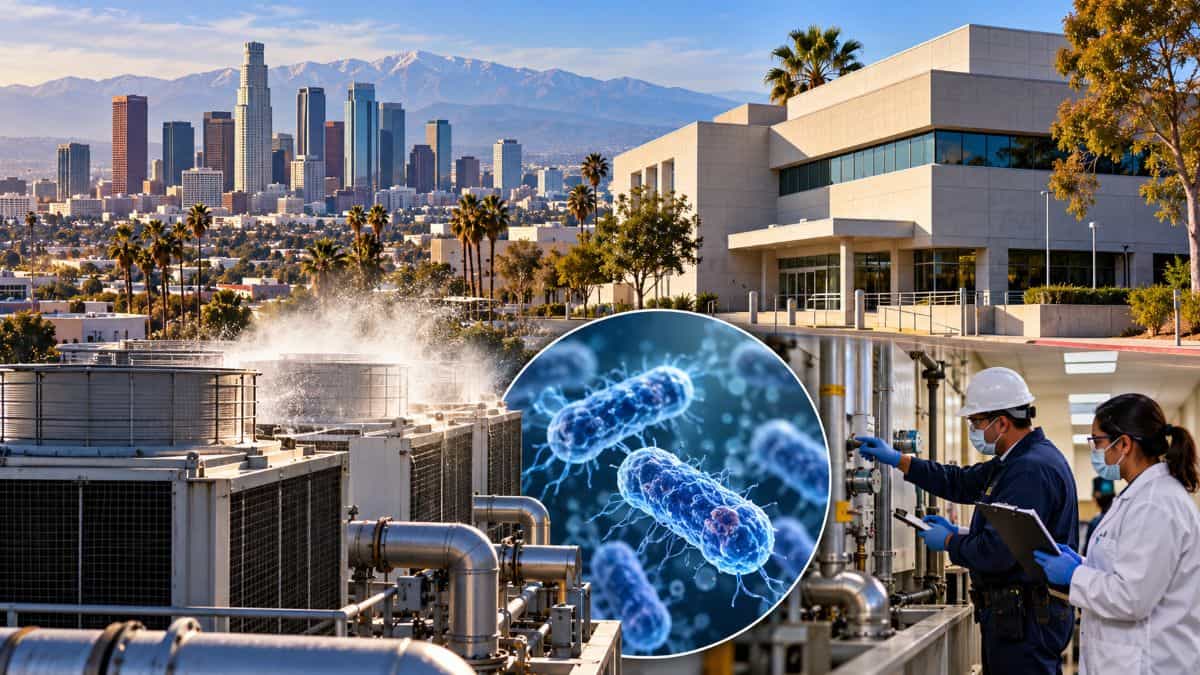
A reported discovery of Legionella bacteria in a cooling system at the Los Angeles County Medical Examiner’s Office has raised fresh questions about building water safety after an employee tested positive for Legionnaires’ disease. According to a report published on 21 October 2026, maintenance work uncovered the bacteria in May, while employees received notification later in the year. Officials have not established whether the employee contracted the infection through the contaminated system. No additional cases linked to a shared exposure had been identified at the time of reporting. For visitors, the incident highlights the importance of water-system maintenance in hotels, public buildings and other facilities, without establishing a wider threat to tourism.
What Happened at the Los Angeles County Office?
The reported incident centres on the Los Angeles County Department of Medical Examiner’s office, located near downtown Los Angeles. According to the supplied news report, maintenance workers discovered Legionella bacteria in a cooling system in May 2026. An employee subsequently tested positive for Legionnaires’ disease, although officials have not confirmed a direct connection.
The employee’s identity and medical condition were not publicly disclosed in the report. County health officials also stated that they had not identified additional cases involving people with a shared exposure. These details matter because detecting bacteria in a building system does not, by itself, prove that the system infected an individual.
The timing raises further questions about the investigation, including the measures taken after the initial discovery and the system’s subsequent condition. The available report does not establish whether remediation has been completed or whether further environmental testing has taken place. Travellers should therefore avoid treating this isolated report as evidence of a citywide outbreak.
Advertisement
Advertisement
Why Building Water Systems Matter
Legionella bacteria occur naturally in freshwater environments. However, they can multiply in human-made water systems when conditions support their growth. Large buildings can provide complex networks of pipes, storage equipment and cooling infrastructure where bacteria may persist.
Cooling towers and certain water-cooling systems can release fine droplets into the surrounding air. If contaminated water produces infectious aerosols, people nearby may inhale them. Building plumbing, showers, hot tubs and decorative water features can also provide potential exposure routes.
Advertisement
Advertisement
The distinction between airborne transmission and ordinary air-conditioning is important for visitors. Legionnaires’ disease does not spread simply because someone enters a building with conventional air conditioning. The concern involves contaminated water and the potential release of bacteria-containing droplets.
A hotel room’s window air conditioner, for example, differs from a large central cooling system that uses water. The presence of cooling equipment alone does not establish a risk. Instead, maintenance, water management and the conditions within the system determine whether Legionella becomes a public health concern.
How the Infection Affects Travellers
The Los Angeles incident highlights an issue that can affect travellers anywhere: the safety of complex building water systems. Hotels, resorts, cruise ships, healthcare facilities and leisure venues all use water infrastructure that requires appropriate maintenance. Public health authorities have documented Legionella exposure in several of these settings.
Nevertheless, the reported incident does not establish a risk to hotel guests, airport passengers or tourists visiting Los Angeles. The reported employee worked at a county medical examiner’s office, and officials had not established the source of the infection. No wider tourism-related exposure was identified in the supplied report.
The broader lesson concerns prevention rather than avoidance. Travellers do not need to reject destinations simply because an isolated Legionella detection occurs. Instead, they should pay attention to credible public health notices, particularly when authorities identify a specific hotel, cruise ship, spa or other facility.
The following table explains the difference between a potential exposure setting and evidence of an actual travel-related incident.
Advertisement
Advertisement
| Travel setting | Potential source of exposure | What travellers should understand |
|---|---|---|
| Hotels and resorts | Complex plumbing, showers and water features | Routine water management helps reduce risk |
| Cruise ships | Large plumbing networks and recreational water systems | Investigators may examine passenger itineraries and exposure histories |
| Spas and leisure centres | Hot tubs, whirlpools and aerosol-producing water features | Water treatment and maintenance are important |
| Hospitals and healthcare facilities | Complex water distribution and specialist equipment | Vulnerable patients may face greater risks |
| Airports and public buildings | Certain water systems and cooling infrastructure | A building’s size or cooling equipment alone does not prove exposure |
These settings represent potential sources, not confirmed hazards at every property. The relevant question is whether a specific water system has been implicated by environmental testing or a public health investigation.
What the Health Data Reveals
California’s public health guidance provides important context for understanding the reported discovery. The California Department of Public Health states that approximately 500 laboratory-confirmed cases of Legionnaires’ disease are reported annually across California. Most reported cases appear sporadic rather than associated with recognised outbreaks.
That figure covers the entire state, not Los Angeles alone. It also represents reported laboratory-confirmed cases rather than every infection that may occur. Readers should not interpret it as a current 2026 case count or as evidence that the medical examiner’s office incident has generated further infections.
The US Centers for Disease Control and Prevention (CDC) explains that Legionnaires’ disease is a serious form of pneumonia. It can require hospital treatment, although antibiotics can treat the infection successfully. The CDC estimates that approximately one in ten people who develop the disease die from complications. Among people who acquire it during a healthcare facility stay, the estimated proportion is around one in four.
These figures describe disease severity, not the probability that a traveller will become infected during a visit. Most healthy people exposed to Legionella do not develop Legionnaires’ disease. Older adults, current or former smokers, and people with certain chronic conditions or weakened immune systems face higher risks.
| Public health indicator | Official information | Relevance for travellers |
|---|---|---|
| California case burden | Approximately 500 confirmed cases reported annually | Provides statewide context, not a local outbreak count |
| Typical incubation period | Usually 2–14 days | Symptoms may appear after a journey ends |
| Main transmission route | Inhaling contaminated water droplets or mist | Certain water systems matter more than ordinary building occupancy |
| Treatment | Antibiotics | Prompt medical assessment is important |
| Higher-risk groups | Older adults, smokers and people with certain health conditions | These travellers should pay particular attention to symptoms |
The figures above come from California and US public health guidance. They should be read alongside location-specific alerts rather than used to estimate an individual’s personal risk.
Advertisement
Advertisement
Recognising Symptoms After a Trip
Legionnaires’ disease can initially resemble other respiratory infections. Symptoms commonly include fever, chills, cough, headache, muscle aches and shortness of breath. Some patients also experience nausea, diarrhoea or confusion. Symptoms usually develop two to 14 days after exposure, although longer intervals have occasionally been reported.
This incubation period matters for people who move between destinations frequently. A traveller may develop symptoms at home after staying at a hotel or visiting a leisure facility elsewhere. Consequently, the place where symptoms begin may not be the place where exposure occurred.
Anyone who develops compatible symptoms after a suspected exposure should seek medical advice promptly. They should mention relevant travel dates, accommodation, healthcare visits and possible contact with affected water systems. This information can help clinicians assess whether Legionella testing is appropriate.
Travellers should not attempt to diagnose the infection from symptoms alone. Other illnesses can produce similar signs, and a clinician may need laboratory testing to identify the cause of pneumonia.
What Authorities Check During Investigations
A positive case does not automatically establish an outbreak. Public health teams typically verify the diagnosis, interview the patient and review potential exposures during the period before symptoms began. They may then decide whether environmental sampling or a broader investigation is necessary.
The CDC defines a Legionnaires’ disease outbreak as two or more cases associated with the same possible source within 12 months. This definition helps investigators identify connections between cases, including those involving travel and building water systems.
Advertisement
Advertisement
For the Los Angeles office, the supplied report does not establish whether the employee’s infection originated there. Nor does it confirm that a travel-associated cluster exists. The reported absence of additional cases with shared exposure is relevant, but it does not independently establish the condition of the cooling system.
An environmental investigation may involve examining water-management records, inspecting equipment, collecting samples and reviewing remediation measures. Investigators must interpret environmental findings alongside clinical and exposure information. A positive water sample alone cannot always identify the precise source of an individual infection.
How California’s Rules Compare
California’s reporting framework requires healthcare providers and laboratories to report Legionella infections to the relevant public health authorities. The state also directs local health departments to investigate potential exposure sources and suspected clusters. Its guidance recommends reporting suspected outbreaks to the state within 24 hours of identification.
At the federal level, the CDC provides investigation protocols and resources for environmental assessment, sampling, remediation and communication. These resources help public health teams determine whether cases share a source and what control measures may be necessary.
California’s approach therefore combines mandatory case reporting with risk-based investigation. It does not mean every positive environmental sample automatically triggers a public warning across an entire city. Authorities assess the circumstances, potential exposures and available evidence before determining the appropriate response.
The following comparison clarifies how the main responsibilities differ.
Advertisement
Advertisement
| Measure | California framework | Federal CDC guidance |
|---|---|---|
| Case reporting | Healthcare providers and laboratories report cases | Supports surveillance and investigation practices |
| Exposure assessment | Local health departments investigate possible sources | Recommends reviewing exposure histories, commonly covering the 14 days before symptoms |
| Environmental investigation | Local authorities assess potential clusters and sources | Provides sampling and investigation resources |
| Outbreak assessment | Suspected outbreaks are escalated under state guidance | Defines an outbreak as two or more cases linked to a possible source within 12 months |
| Prevention | Encourages control of Legionella in building water systems | Recommends water-management programmes and appropriate remediation |
These are complementary responsibilities rather than competing policies. Their purpose is to identify potentially contaminated systems, reduce exposure and prevent further illness.
Why Water Management Matters for Tourism
For the hospitality sector, Legionella prevention is an operational responsibility, not simply a facilities-management concern. Hotels and resorts rely on complex water networks, while cruise ships must manage water systems within confined environments. Spas, swimming facilities and decorative fountains also require suitable maintenance and water treatment.
A reported contamination incident can prompt questions about inspection schedules, building maintenance and communication with occupants. However, the commercial consequences depend on the evidence, the scope of any exposure and the response taken by the operator or authorities.
Preventive water management is more useful than reactive reassurance. Building owners and operators can reduce risks by monitoring water conditions, maintaining equipment, preventing stagnation and following appropriate cleaning and disinfection procedures. The CDC recommends water-management programmes tailored to buildings where Legionella growth and spread could pose a risk.
For travel businesses, transparent communication also matters. If authorities identify a potentially affected property, operators should follow official instructions and communicate verified information to guests. They should avoid unsupported claims that a facility is either completely safe or necessarily dangerous.
The Los Angeles case does not establish that any hotel, airline, cruise operator or tourism attraction has been affected. Its relevance to the travel industry lies in the wider importance of effective building maintenance and credible public health communication.
Advertisement
Advertisement
Practical Guidance Before Your Visit
Travellers planning a visit to Los Angeles do not need to change their itineraries solely because of the reported incident. The available information identifies a county office rather than a hotel or tourist attraction, and it does not establish a connection between the employee’s infection and the building’s cooling system.
Nevertheless, sensible precautions can help travellers respond appropriately to health information. Check official advisories if authorities announce a confirmed exposure location, particularly before visiting a named property or facility. If you belong to a higher-risk group, discuss individual concerns with a healthcare professional before travelling.
When booking accommodation, travellers can also look for operators with established maintenance procedures. No booking platform, hotel category or star rating guarantees that a property is free from Legionella. Equally, an absence of public reports does not prove that every water system has been tested.
The practical priority is to respond to evidence rather than speculation. If public health authorities identify a specific location, follow their instructions and contact the property directly for verified information about any relevant restrictions or remedial work.
What Visitors Should Watch Next
The most important outstanding question concerns the relationship between the contaminated cooling system and the employee’s infection. The supplied report does not establish that connection. It also does not confirm the results of any subsequent environmental testing or the completion of corrective measures.
Further information from the Los Angeles County Department of Public Health could clarify whether investigators identified a plausible exposure source. Details about remediation, follow-up testing and any additional cases would help establish the significance of the incident.
Advertisement
Advertisement
Until such information emerges, travellers should distinguish between a reported environmental detection, a confirmed infection and a confirmed outbreak. These are different findings, and each carries a different public health meaning.
The episode nevertheless highlights an important principle for destinations worldwide. Safe tourism depends partly on the maintenance of buildings and water infrastructure that visitors rarely see. Effective monitoring, timely reporting and proportionate communication help protect both public health and traveller confidence.
Advertisement
