
Italy Opens a New Chapter for Lampedusa Travel With Palermo-Built Costanza I From Porto Empedocle

Published
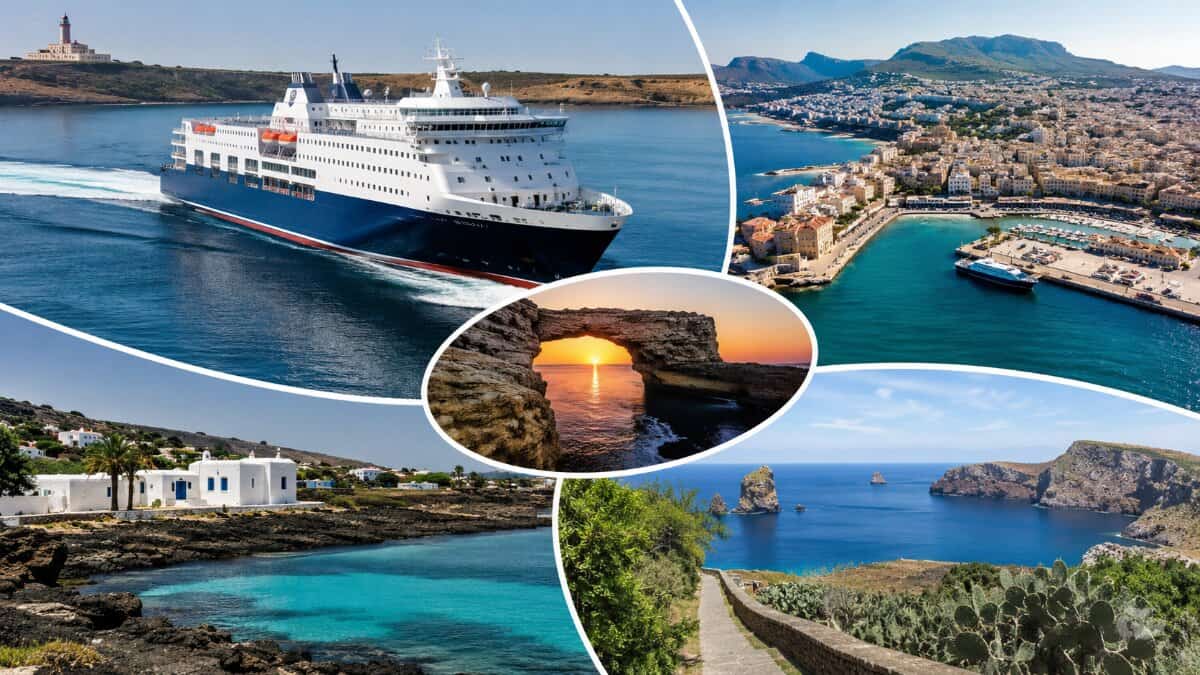
Image generated with Ai
Italy has moved a significant Sicilian island-connectivity project from construction into operation, with the Palermo-built Costanza I di Sicilia declared operational from Porto Empedocle on 6 August for daily links to Linosa and Lampedusa. The deeper tourism story is now whether higher-capacity, technologically advanced and publicly owned maritime infrastructure can support travel beyond the summer peak. Pantelleria represents the next strategic test, with Sicily pursuing a second Ro-PAX concept and stronger port infrastructure rather than placing the island within the new vessel’s confirmed daily Pelagie deployment.
Sicily’s New Ferry Is Really a Test of Year-Round Tourism Resilience
The immediate development is straightforward. According to Regione Siciliana, Costanza I di Sicilia became the first ferry owned by the Sicilian Region to enter operation, with its inaugural departure from Porto Empedocle scheduled after the 6 August ceremony and its deployment structured around daily connections with the Pelagie Islands. The route links mainland Sicily with Linosa and Lampedusa.
The more consequential question for the travel industry is different. Sicily is effectively testing whether better maritime reliability can become part of its tourism de-seasonalisation infrastructure.
That matters because destination marketing alone cannot produce a durable shoulder season on remote islands. Hotels, tour operators, car-hire businesses and experience providers require predictable access. Travellers need confidence that an autumn or spring itinerary will work even when demand is thinner and maritime conditions are more challenging.
Advertisement
Advertisement
Costanza I provides a substantial upgrade, but the project also exposes an important structural issue. A single advanced vessel improves capacity and quality, yet genuine resilience ultimately depends on the entire system: ship availability, replacement capacity, ports, weather tolerance, timetables and onward transport.
Advertisement
Advertisement
That makes Sicily’s ferry programme a considerably more important tourism story than a conventional vessel launch.
Costanza I Brings a New Transport Platform to Lampedusa and Linosa
The vessel was constructed at Fincantieri’s Palermo shipyard and delivered during the first half of 2026 before entering the regional network. Fincantieri had originally secured the contract in 2023 for a base tender amount approaching €120 million, while the contract structure included an option for another vessel.
The final regional launch information shows a Ro-PAX Class A ferry designed for mixed passenger and vehicle movements rather than a purely seasonal tourist shuttle.
Advertisement
Advertisement
| Costanza I di Sicilia operational feature | Latest official position | Tourism relevance |
|---|---|---|
| Vessel type | Ro-PAX Class A | Combines passenger and vehicle mobility |
| Length | About 140 metres | Large-capacity island transport platform |
| Gross tonnage | About 14,500 GT | Significantly larger capability than a fast passenger craft |
| Passenger capacity | Up to 1,000 | Supports high summer demand and group movements |
| Vehicle capacity | Up to 200 cars | Important for fly-drive, self-drive and longer island stays |
| Cabins | 137 | Improves suitability for longer crossings |
| Accessibility | Some cabins adapted for reduced-mobility passengers | Expands accessible tourism possibilities |
| Maximum speed | 19 knots | Supports improved journey performance |
| Propulsion | Dual fuel using diesel and LNG | Adds an environmental component to maritime tourism |
| Additional energy system | Photovoltaics plus battery storage | Reduces dependence on conventional power while berthed |
| Zero-emission port capability | Around four hours under the published design | Reduces local emissions during port stays |
| Current deployment | Porto Empedocle–Linosa–Lampedusa | Directly strengthens the Pelagie tourism corridor |
Source: Regione Siciliana and Fincantieri.
This combination matters commercially because ferry tourism is not simply about carrying more passengers. Vehicle capacity enables visitors to arrive with cars, motorcycles or campers, while cabins improve the experience on a long sea crossing. Those attributes can support longer stays and more dispersed expenditure once travellers reach the islands.
Advertisement
Advertisement
Why Reliability Matters More Than Raw Passenger Capacity
The most important information gain for travel professionals is that the new vessel should not be interpreted as eliminating disruption risk.
Caronte & Tourist, the operator responsible for the connection, currently advises passengers that the Porto Empedocle to Lampedusa crossing generally takes approximately nine to ten hours and that schedules and journey durations can change because of adverse weather or technical requirements.
That distinction is critical.
A technologically superior ship can improve comfort, manoeuvrability and operating performance. It cannot remove the meteorological realities of the Strait of Sicily.
The regional project therefore needs to be judged by reliability over several seasons, not simply by passenger capacity during August 2026.
Advertisement
Advertisement
Official material published during the vessel’s development also identified advanced stabilisation among the features intended to improve operations around the smaller islands. The Region has additionally presented the vessel as capable of improving the Porto Empedocle–Pelagie journey compared with previous arrangements.
For tour operators, the commercially meaningful metric will eventually be the percentage of scheduled services completed, especially from October through spring.
Sicily’s Tourism Data Explain Why the Timing Matters
This maritime investment arrives as Sicily is already pursuing a wider shift away from concentrated summer tourism.
According to Regione Siciliana’s 2026 tourism assessment, tourist arrivals across Sicily increased by 2.8 per cent in 2025 compared with 2024, while overnight stays rose by 0.24 per cent. The regional government identified stronger performance during medium and low-season periods as evidence that de-seasonalisation was progressing.
The longer-term growth is substantial. Sicily recorded approximately 22.421 million tourism nights and more than seven million arrivals in 2024. Overnight stays were 9.7 per cent above 2023, while foreign visitor nights exceeded 12.832 million. The average stay was approximately 3.2 days.
Advertisement
Advertisement
| Sicily tourism indicator | Official result | Strategic implication |
| 2024 overnight stays | 22.421 million | Large destination economy requiring stronger infrastructure |
| 2024 arrivals | More than 7 million | Broad tourism demand base |
| 2024 overnight-stay growth | +9.7% year on year | Strong post-pandemic expansion |
| Foreign overnight stays in 2024 | More than 12.832 million | International demand is increasingly important |
| Average stay in 2024 | About 3.2 days | Longer stays remain a policy opportunity |
| 2025 arrivals growth | +2.8% | Demand continued expanding |
| 2025 overnight-stay growth | +0.24% | Growth became more moderate |
| Lampedusa airport passenger growth in 2025 | +2.5% | Island access demand remains positive |
| Palermo airport growth in 2025 | +3.4% | Strengthens the gateway feeding western Sicily |
| Regional policy priority | More non-summer tourism | Ferry reliability becomes strategically relevant |
Sources: Regione Siciliana Tourism Department and regional tourism programme.
Sicily’s Tourism Development Programme for 2026–2028 explicitly places de-seasonalisation and tourism-product diversification among its main objectives and identifies improved transport infrastructure and accessibility as part of the policy context required to strengthen destination competitiveness.
The ferry programme therefore intersects directly with tourism policy rather than operating as an isolated transport investment.
The Most Important Limitation Is Fleet Redundancy
There is, however, a structural issue the travel industry should watch closely.
Costanza I is currently the first vessel in this region-owned model. The contract contained an option for another ferry, but Sicily’s latest official position on 6 August was that resources were still being sought for a second unit.
Advertisement
Advertisement
That makes redundancy the next crucial test.
A modern ship can materially improve a route. A resilient tourism transport system generally requires enough fleet depth to manage planned maintenance, technical disruption and extreme weather recovery without leaving an island heavily exposed to one principal asset.
This is where Pantelleria becomes strategically significant.
In September 2024, Regione Siciliana authorised a request for €140 million in financing for a second Ro-PAX Class A vessel intended for the Trapani–Pantelleria corridor. The proposal covered passenger transport, cars, heavy vehicles and freight and was linked to the second-vessel option already built into the Fincantieri arrangement.
As of 16 August 2026, however, the current Costanza I daily deployment confirmed by the Region is the Porto Empedocle–Linosa–Lampedusa corridor. Pantelleria should therefore be described as the next-stage fleet strategy, not as part of the vessel’s confirmed present daily operation.
Advertisement
Advertisement
Pantelleria Shows Why Better Ships Must Be Matched by Better Ports
Sicily’s strategy also recognises that modern vessels cannot deliver resilience without suitable berthing infrastructure.
For Pantelleria, Regione Siciliana has advanced planning for strengthening the breakwater head at Scauri port to create an alternative berth for ferries and emergency vessels. The project was also among island-port resilience proposals identified by the Region for seismic-risk prevention and infrastructure consolidation.
Lampedusa was included in the same wider programme through safety interventions affecting Molo Favaloro.
This is an important distinction for tourism investors.
The real infrastructure product is not the ferry alone. It is a network comprising vessels, ports, safe alternative berths, mainland gateways, booking systems and multimodal connections.
Advertisement
Advertisement
A stronger harbour can increase the number of conditions under which maritime operations remain feasible. A second ship could create redundancy. Together, these investments would produce a more credible foundation for packaging island holidays outside July and August.
Palermo and Porto Empedocle Gain New Roles in Sicily’s Island Economy
The programme also creates two different mainland economic effects.
Palermo becomes more than Sicily’s administrative and tourism gateway. Costanza I was built entirely at Fincantieri’s Palermo yard, making the project part of a renewed ferry-construction capability. Fincantieri reports more than 500 direct personnel at the Palermo yard and an associated regional supply chain exceeding 2,500 workers.
Porto Empedocle, meanwhile, gains strategic relevance as the mainland gateway for the Pelagie route. The operator identifies it as the Sicilian ferry departure point for Lampedusa and notes its proximity to Agrigento, creating opportunities to connect island stays with western Sicilian touring itineraries.
For tour operators, that opens a potentially stronger combined product: Agrigento and southern Sicily on land, followed by Lampedusa or Linosa by sea.
Advertisement
Advertisement
Such combinations become more commercially viable when schedules are dependable enough to be incorporated into multi-stop packages.
What Travel Agents and Tour Operators Should Do Now
- Sell Lampedusa and Linosa as the confirmed new-service beneficiaries. Do not describe Pantelleria as part of Costanza I’s current daily Pelagie deployment.
- Retain connection buffers. Maritime timetables remain exposed to weather and technical variation, so same-day tightly timed onward flights or transfers create avoidable risk.
- Use the vehicle capacity commercially. The ability to carry up to 200 cars expands opportunities for self-drive, motorcycle and longer-stay island products.
- Plan accessible travel early. Caronte & Tourist asks passengers requiring reduced-mobility assistance to submit requests at least 48 hours before departure.
- Monitor the second-vessel programme. A funded Trapani–Pantelleria unit would materially broaden the tourism implications of Sicily’s public-ferry strategy.
- Watch port projects as closely as fleet announcements. Alternative berths and stronger maritime infrastructure will determine how much additional operational resilience reaches travellers.
- Avoid promising year-round reliability prematurely. The key evidence will come from completed sailings, disruption levels and passenger demand during the 2026–27 autumn, winter and spring seasons.
Sicily’s Bigger Maritime Tourism Experiment Has Only Just Started
Costanza I marks a genuine change in Italy’s island-transport landscape because Sicily now owns a modern Ro-PAX asset built around passenger capacity, vehicle transport, accessibility and lower-emission technology while contracting its operation into the public-service network.
But the decisive tourism result will not be measured by the number of travellers carried during the August peak.
It will be measured by whether Lampedusa and Linosa become easier to sell in April, May, October and eventually deeper into winter; whether cancellations and operational uncertainty decline; whether travellers stay longer; and whether Sicily follows through with the additional vessel and port investments required to create genuine redundancy.
That is why the Palermo-built ferry leaving Porto Empedocle is more than a new transport service. It is the first live test of whether maritime infrastructure can become a practical tool for de-seasonalising Mediterranean island tourism.
Advertisement
