
China Launches Guangxi’s Massive Pinglu Canal as New River-to-Sea Route Transforms Trade and Maritime Connectivity

Published
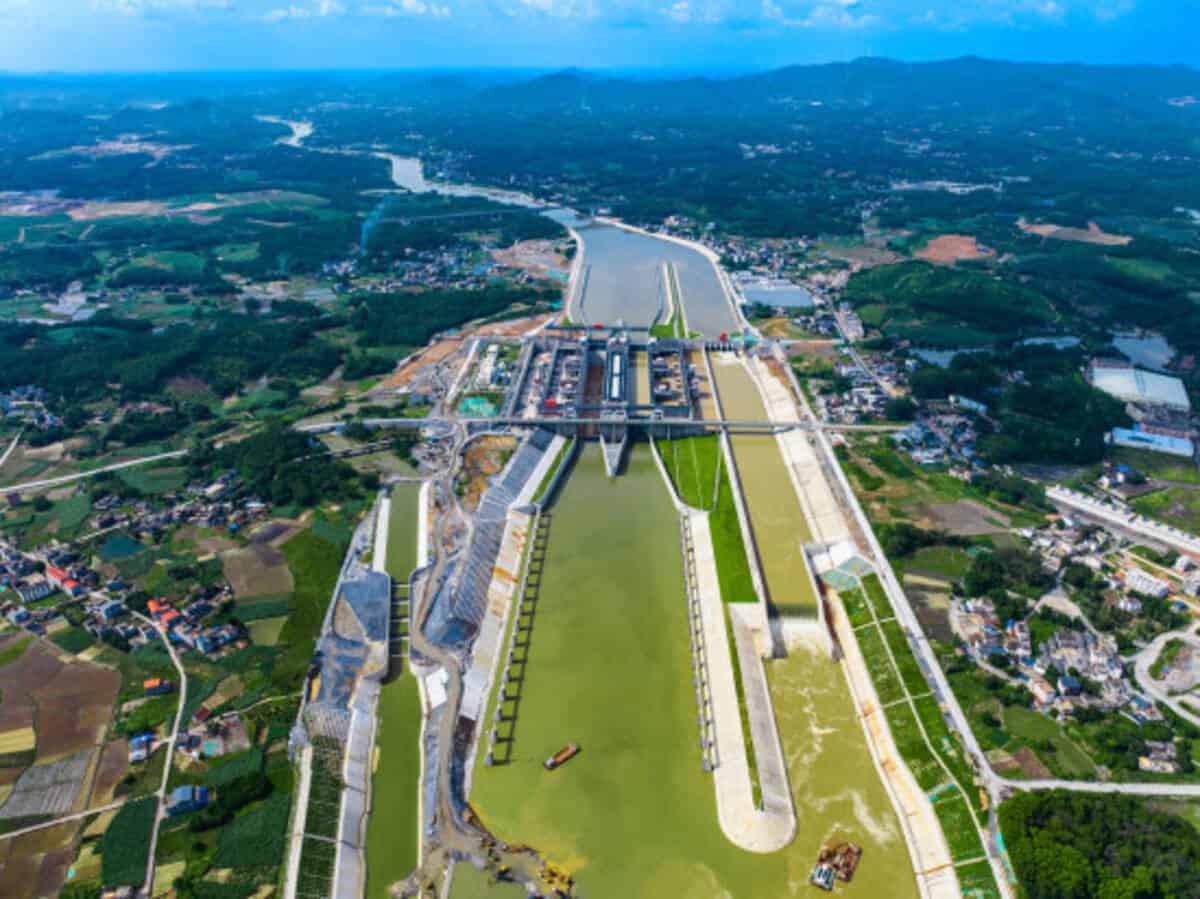
On September 16, the Pinglu Canal officially began operations with a landmark navigation ceremony held in Qinzhou, Guangxi, marking the opening of a major new waterway connecting China’s inland river network with the sea. At 10:25 a.m., the first vessel passed through the Madao Hub as its powerful whistle signalled the start of commercial navigation, while crowds gathered to witness the historic moment.
Located near Qinzhou Port, where the river meets the Beibu Gulf, the Madao Hub represents a major engineering achievement. Its towering 39.08-metre inverted V-shaped lock gates have become a symbol of the canal’s scale and ambition, creating a new gateway for maritime transport, trade expansion and regional economic development.
Advertisement
Advertisement
The Pinglu Canal stretches from the Pingtang River Estuary in Hengzhou, Nanning, through Luwu Town in Lingshan County, Qinzhou, before reaching the Beibu Gulf through the Qinjiang River. Covering 134.2 kilometres, the waterway has been developed according to Grade I inland navigation standards and is capable of handling vessels weighing up to 5,000 tonnes.
Construction of the canal started on August 28, 2022, involving hundreds of organisations and tens of thousands of workers who contributed to the development of the large-scale infrastructure project. Built with a focus on quality, efficiency, environmental considerations and long-term value, the project includes three major cascade hubs — Madao, Qishi and Qingnian — along with navigation channels and supporting facilities.
Advertisement
Advertisement
The Pinglu Canal has achieved four major global engineering milestones. These include the world’s highest navigation capacity among comparable canals, the fastest ship lock operation speed of its type, the highest water head achieved by a water-saving ship lock, and the largest inland river water-saving lock system worldwide.
The opening ceremony also marked the launch of new trade routes. The international “Nanning–Can Tho, Vietnam” route and the domestic “Nanning–Yangpu, Hainan” route officially started two-way operations, creating additional transport connections for regional commerce.
Advertisement
Advertisement
During the first navigation activities, 14 cargo vessels carrying goods including sugar, construction materials, minerals and steel successfully passed through the locks and began their maiden journeys. At the same time, 16 vessels transporting coal, iron ore, bauxite, fertilisers, high-calcium limestone and other commodities entered the Xijiang River Basin through the canal system.
The coordinated operation of the Madao, Qishi and Qingnian hubs ensured smooth vessel movement through the locks. Ship scheduling, safety management and navigation procedures were carried out in an organised manner, demonstrating the canal’s readiness for large-scale commercial transport.
Advertisement
Advertisement
Alongside cargo operations, four passenger water transport routes were also introduced to support tourism and local mobility. The new services include the Xinfu Water Comprehensive Service Area–Madao Hub loop route, Xinfu Water Comprehensive Service Area–Pingtang River Estuary loop route, Qinzhou Water Comprehensive Service Area–Qingnian Hub loop route and Qinzhou Water Comprehensive Service Area–Longmen Bridge loop route.
The Pinglu Canal creates a new north-south maritime connection by linking the Xijiang River system with the Beibu Gulf. It provides southwestern China with a direct route to the sea, complementing existing eastward shipping routes and reducing travel distances to maritime gateways by more than 560 kilometres.
The new waterway is expected to significantly improve logistics efficiency across the surrounding regions. By reducing transport distances and improving access to coastal shipping networks, the canal is projected to help save more than 5 billion yuan annually in freight costs for areas connected to the route.
The opening of the Pinglu Canal also carries historical significance for Guangxi. More than 2,000 years ago, the ancient Lingqu Canal was built in the region to connect the Yangtze River and Pearl River water systems. The completion of the Pinglu Canal represents a modern continuation of Guangxi’s long history of waterway development.
Advertisement
Advertisement
The new canal is expected to transform regional connectivity by strengthening Guangxi’s role as a major transport link between inland China and international maritime routes. It is also positioned to support broader economic growth in southwestern and south-central China by improving logistics networks, expanding trade opportunities and encouraging greater regional cooperation.
Beyond domestic development, the Pinglu Canal is expected to contribute to stronger China–ASEAN transport, logistics and economic connections. By creating a more efficient shipping corridor between inland areas and the Beibu Gulf, the waterway adds new momentum to cross-border trade and regional supply chain development.
The opening of the Pinglu Canal marks a major milestone in China’s modern water transport infrastructure, creating a new channel between rivers and the sea while reshaping the future movement of goods, people and economic activity across southern China.
Advertisement
