
China Builds the World’s Largest Ocean Airport as Dalian Redefines Global Aviation

Published
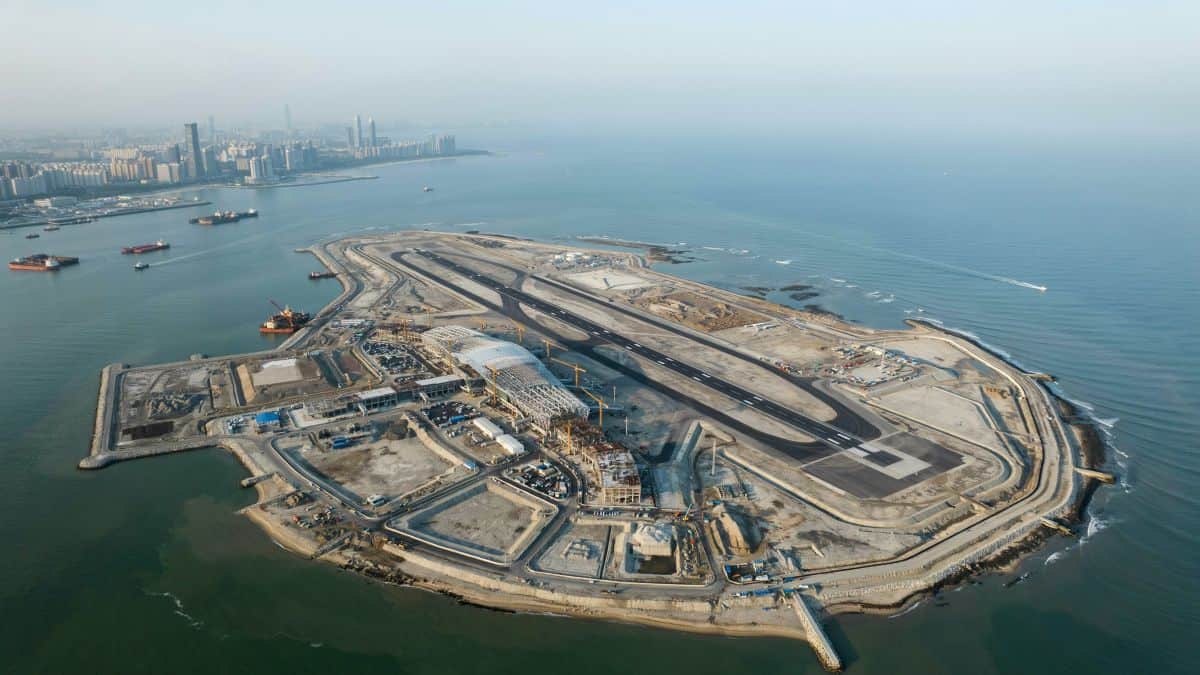
China constructs the world’s largest ocean airport as Dalian sets a new definition for global aviation through an extensive man-made island in Jinzhou Bay. This reflects how China creates new spaces in situations where coastal cities find themselves constrained by their limited geographical extent. In addition, Dalian will be able to enhance tourism connections, cargo connections, and international flights once its first stage is opened. The airport is planned to handle 43 million passengers per year. On the other hand, its ocean-based nature implies that there is a lot of engineering and environmental management that should take place here.
China Leads the World With Dalian Ocean Airport
The biggest project in this global aviation story is Dalian Jinzhouwan International Airport in Liaoning Province, China.
This is the project often called China’s “$4 billion airport in the ocean”. The official project figure is RMB26.3 billion. The US-dollar amount is an approximate currency conversion, not the official budget.
Dalian Jinzhouwan is being built on an offshore artificial island in Jinzhou Bay. Around 20 square kilometres of land have been created from the sea for the airport. This makes it the world’s largest offshore artificial-island airport project.
Advertisement
Advertisement
The principal reclamation work has been completed. Construction of the airport is now being accelerated.
The first phase will include two runways. One will measure 3,600 metres. The other will measure 3,400 metres. A terminal of around 500,000 square metres is also planned.
Advertisement
Advertisement
The airport is designed to handle 43 million passengers a year. It will also have capacity for 550,000 tonnes of cargo and mail annually.
These figures show the size of China’s ambition. Dalian Jinzhouwan is not a small regional airport. It is planned as a major international aviation hub.
The project received central approval in 2022. Official planning indicates commercial operations during China’s 2026 to 2030 development period. However, no exact opening date has been confirmed.
The airport could give Dalian more room for future passenger and cargo growth. It could also improve links between north-east China and international markets. For tourism, it may make travel easier to Liaoning’s coast, cities, business districts and cultural attractions.
The project also shows China’s ability to build infrastructure in difficult marine settings. Yet it also creates a responsibility. A sea-made airport needs strong engineering, long-term monitoring and careful environmental planning.
Xiamen and Macao Strengthen China’s Sea Airport Cluster
China’s ocean-airport story does not begin and end with Dalian.
Advertisement
Advertisement
Xiamen Xiang’an International Airport in Fujian is another major airport project involving land formation from the sea. It is a reclaimed-coastal project rather than a fully offshore artificial island like Dalian. However, official Fujian records identify sea reclamation as part of the airport’s construction work.
Xiamen Xiang’an is expected to open in 2026. Its terminal-area works passed quality completion acceptance in February 2026.
The new airport is planned to handle around 45 million passengers a year. It will also have capacity for 750,000 tonnes of cargo annually.
This will give Xiamen a powerful new aviation gateway. The city is already an important coastal destination, business centre and port. A larger airport can support more domestic and international flights.
More capacity can help business travellers, holidaymakers and cargo operators. It can also help connect visitors with Xiamen’s beaches, islands, heritage areas and wider Fujian travel routes.
Official information reviewed for the project does not provide one clear current total cost or a full funding breakdown. This is important. Figures from unverified sources should not be treated as confirmed facts.
Advertisement
Advertisement
Macao is also building new airport land.
Macau International Airport Expansion and Reclamation Project will reclaim 129.6234 hectares of sea. The new land will sit around the existing airport runway and taxiway structures.
The first expansion phase is expected to finish by 2030.
Physical work is underway. Crews are building embankments, installing deep cement-mixing piles and carrying out hydraulic sand filling. The airport company has reported that the reclaimed land is already taking shape.
The project is being designed for an airport capacity of 13 million passengers a year. It will create more aircraft parking space and improve taxiway movement. It will also support higher runway and terminal capacity.
This matters greatly for Macao’s visitor economy. The destination depends on tourism, meetings, events, leisure travel and strong international links. A larger airport can improve its ability to welcome future visitors.
Advertisement
Advertisement
Macao’s project also stands out because of its environmental controls. The airport company has published measures for water monitoring, noise control, dust reduction and ecological restoration.
The plan includes protection measures for the Chinese white dolphin. It also includes ecological seawalls, fish stocking and special features to support marine life.
The project will reuse inert construction materials as reclamation fill. This can reduce demand for marine sand and lower pressure on landfill areas.
Macao shows what a more detailed environmental approach can look like. Sea reclamation can never be risk-free. However, public monitoring, clear controls and mitigation plans can help reduce harm.
South Korea Takes On a Giant Engineering Challenge
South Korea is pressing ahead with Gadeokdo New Airport near Busan.
This airport requires major coastal and offshore land formation. It is one of Asia’s biggest future aviation projects. It is also one of the most difficult to build.
Advertisement
Advertisement
The planned airport will have one runway measuring 3,500 metres by 45 metres. Official planning documents list a passenger terminal of around 250,000 square metres. A cargo terminal of about 19,000 square metres is also planned.
The full airport site will cover roughly 4 million square metres.
Gadeokdo New Airport is intended to strengthen Busan’s role as an international gateway. It is expected to support trade, logistics, tourism and wider regional growth.
Busan is a major port city. Supporters see the new airport as a way to create a stronger southern aviation hub. Better airport links could help the city attract visitors, global business and cargo activity.
However, the project has faced changes in its schedule. Procurement issues affected earlier plans. A consortium led by Daewoo Engineering & Construction entered the basic-design stage in March 2026.
Priority works are expected to begin in the second half of 2026. The official opening target is now the second half of 2035.
Advertisement
Advertisement
This long timeline shows the real difficulty of building near the sea. Engineers must deal with soft ground, water movement, strong weather, settlement and coastal safety.
Costs can also rise. South Korean officials have recognised that changing construction prices may affect the project.
The airport’s legal framework requires environmental planning. It includes strategic environmental assessment and environmental-impact assessment requirements.
These checks matter because marine airport projects can affect birds, fish, water quality, coastlines and nearby communities. A project of this scale needs careful planning before work becomes more advanced.
Gadeokdo is real and important. Yet its long delivery period shows that sea-linked airports need patience, money and deep technical skill.
The Philippines Restarts the Sangley Point Airport Plan
The Philippines has renewed its push for Sangley Point International Airport in Cavite City, beside Manila Bay.
Advertisement
Advertisement
The project aims to transform the existing Sangley airfield into a much larger international airport. Land reclamation is central to the plan because the site needs more space for airport development.
In August 2026, President Ferdinand Marcos Jr ordered relevant agencies to speed up the project after delays.
A Joint Technical Working Group has been created to guide development. It includes the Department of Transportation, the Philippine Reclamation Authority, the Civil Aviation Authority of the Philippines, environmental agencies and the Cavite provincial government.
This group has an important role. It must coordinate aviation policy, reclamation work, environmental compliance and land matters.
Sangley Point could help ease pressure on the wider Manila airport system. Metro Manila has long needed more aviation capacity. A new major gateway could give passengers more options and improve cargo movement.
The project could also support tourism. Better airport capacity can help bring more international visitors to the Philippines. It can also strengthen access to destinations across the country.
Advertisement
Advertisement
However, several key figures remain unconfirmed in the latest official update. The August 2026 order does not restate a final project cost, passenger capacity, runway layout or opening date.
This means reports should be careful. Older figures should not automatically be described as the official 2026 design.
Environmental protection will remain central to the project. The government has directed agencies to protect marine and coastal ecosystems and meet environmental requirements.
That is especially important for Manila Bay. Reclamation can affect water quality, fishing grounds, coastal habitats and local communities. The project’s future will depend on both delivery speed and strong environmental oversight.
The Maldives Creates New Airport Land Across Its Islands
The Maldives has the broadest group of airport reclamation projects in this review.
China has the largest mega-airport schemes. The Maldives is taking a different path. It is creating airport land across several islands.
Advertisement
Advertisement
This approach reflects the country’s geography. The Maldives has limited natural land and many scattered islands. Airports can improve local access, support tourism and strengthen island economies.
At Kadhdhoo and Fonadhoo in Laamu Atoll, the latest plan includes 114 hectares of airport reclamation. Another 30 hectares is planned for Fonadhoo.
The airport is expected to have a 2,800-metre runway. Full development is planned within 36 months from October 2025.
The project aims to support tourism, education, travel and wider economic activity in the area.
At Vihafaru in Noonu Atoll, reclamation began physically in January 2026. More than 40 hectares will be reclaimed. The new land will be raised around 1.6 metres above sea level.
The airport is planned to support surrounding islands and diversify the local tourism economy.
Advertisement
Advertisement
At Dhidhdhoo in Haa Alifu Atoll, a 112-hectare reclamation project began in January 2026. The new land will support airport development, housing and essential services.
This makes Dhidhdhoo a mixed-use development. It is not only an airport project.
At Vilufushi in Thaa Atoll, the planned airport will have an 1,800-metre runway. The government has given the project a 30-month construction period.
At Mathiveri, the state airport company signed an agreement to reclaim land and develop an airport. A further 26.5 hectares will support community development.
The government expects the airport and reclamation works to become operational within two and a half years from August 2025.
At Bileiyfahi, airport development and operations have been handed to Maldives Airports Company Limited. The project includes reclamation and has a 30-month delivery period.
Advertisement
Advertisement
At Milandhoo, 40 hectares of reclamation were contracted. The wider airport and harbour programme has a 30-month target.
The official reclamation deadline suggested completion around June 2026. However, no later official completion notice was found. It would therefore be wrong to state that the work has definitely finished.
Together, these projects show a national plan to improve island connections. They may help tourists reach more places. They may also make domestic travel easier for residents.
However, public information is uneven. Government announcements often give land area, timelines or runway size. Many do not publish full costs, dredging plans, environmental permits or detailed coral-protection measures.
The absence of public detail does not prove that approvals do not exist. It means the official material reviewed does not provide those details.
Singapore Is a Different Type of Sea Airport Story
Singapore’s Changi Terminal 5 is under construction. It is planned to add around 50 million passengers of annual capacity when it opens in the mid-2030s.
Advertisement
Advertisement
However, it does not belong in the strict list of active sea-reclamation airport projects in 2026.
The land at Changi East was reclaimed mainly between 1992 and 2004. Terminal 5 is being built on land that was made from the sea many years ago.
It still shows how reclaimed land can support future airport expansion. But it is different from Dalian, Macao, Gadeokdo, Sangley Point and the Maldives projects, where current plans directly involve sea reclamation or marine land formation.
Ocean Airports Bring Opportunity and Serious Risk
Sea-made airports can create major opportunities.
They can provide land where cities and islands have little room to grow. They can add flight capacity. They can strengthen tourism. They can also support cargo, jobs and business activity.
For travellers, these projects may eventually mean more routes, better schedules and easier access to destinations.
Advertisement
Advertisement
For tourism destinations, a larger airport can welcome more visitors. It can also spread travel beyond one crowded gateway.
However, the sea is not empty land waiting to be used.
Reclamation can change water flow. It can create sediment plumes. It can affect fish, birds, coral, seabed habitats and fishing areas.
New airport land must also face strong weather, waves, flooding risks and sea-level rise. Reclaimed ground can settle over time. That makes engineering quality essential.
Every project needs deep research before work begins. It needs proper environmental assessment. It needs regular monitoring. It also needs clear action when damage or risk appears.
Macao’s project offers a useful lesson. Its published measures include hydrological monitoring, ecological features, water protection and dolphin conservation. Similar transparency can help travellers, local communities and environmental groups understand how risks are being managed.
Dalian Defines a New Aviation Era
The world’s largest ocean airport is being constructed by China as Dalian rewrites the script of global aviation with an enormous man-made island in Jinzhou Bay. The most significant point is that this ambitious venture demonstrates the potential of coastal cities to generate space for development in case of limited availability of land. The first phase of the project will be able to accommodate up to 43 million passengers annually. In turn, Xiamen and Macao continue their efforts to develop their own airport construction plans.
Advertisement
