
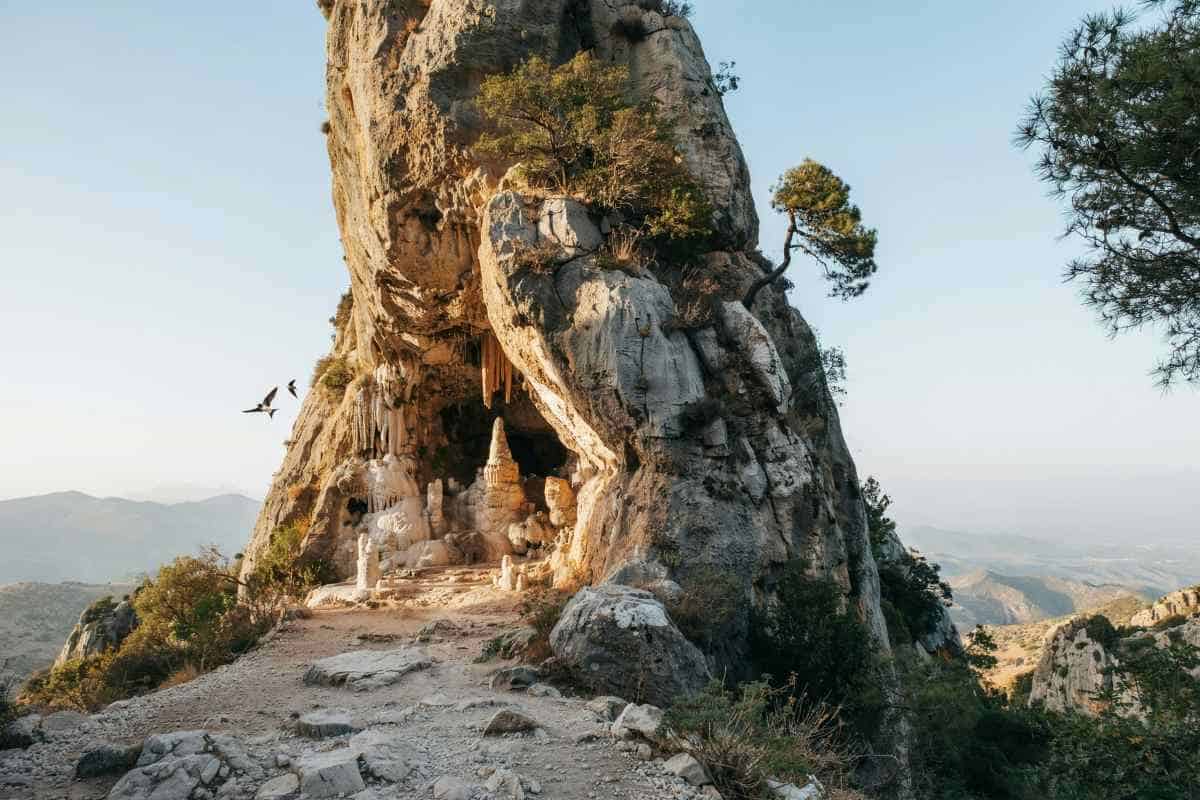
Image generated with Ai
Crete, Mount Ida and the Cave of Zeus continue to attract visitors fascinated by the stories that shaped ancient Greek civilisation. Hidden within the mountains of central Crete, the legendary Cave of Zeus, also known as the Ideon Cave, has long been associated with the birth and childhood of Zeus, the supreme ruler of the Greek gods. Combining dramatic natural beauty with one of mythology’s most enduring legends, the cave has become one of Greece’s most significant cultural and archaeological attractions, drawing travellers eager to explore the birthplace of the king of Olympus.
Few places in Greece are more closely connected with mythology than the Cave of Zeus.
According to ancient Greek tradition, this remote cave beneath Mount Ida served as the secret refuge where Zeus was born and raised.
The legend transformed the cave into one of the most sacred places in the ancient Greek world, attracting worshippers for centuries.
Advertisement
Advertisement
Today, visitors travel from around the globe to experience the remarkable location where one of Western civilisation’s greatest mythological stories begins.
The story begins with Cronus, the powerful leader of the Titans.
Ancient mythology tells that Cronus feared a prophecy predicting that one of his children would eventually overthrow him. Determined to prevent this fate, he swallowed each of his newborn children immediately after birth.
When Zeus was born, however, his mother Rhea devised a daring plan to save him.
Advertisement
Advertisement
Instead of handing over the infant, she secretly hid Zeus inside a cave on Mount Ida and presented Cronus with a stone wrapped in cloth, which he swallowed without realising the deception.
The hidden child would later grow into the ruler of the Olympian gods.
According to the myth, Zeus spent his childhood inside the cave, protected from Cronus’ reach.
Ancient stories describe how the Curetes, mythical warrior guardians, clashed their shields and weapons together to drown out the cries of the infant Zeus, ensuring that Cronus could never discover his hiding place.
The goat Amalthea is also said to have nourished Zeus with her milk, while sacred bees produced honey to sustain him.
These legendary details remain central to the mythology surrounding the cave and continue to fascinate visitors today.
After reaching adulthood, Zeus challenged his father.
Greek mythology recounts how he forced Cronus to release his swallowed siblings—Hestia, Demeter, Hera, Hades and Poseidon.
Together they defeated the Titans in the legendary Titanomachy, establishing the reign of the Olympian gods.
Zeus subsequently became ruler of Mount Olympus and one of the most influential figures in ancient Greek religion.
The Cave of Zeus therefore represents not only the beginning of his life but also the starting point of one of mythology’s greatest triumphs.
Beyond its legendary significance, the Cave of Zeus impresses visitors with its extraordinary natural beauty.
The entrance leads into an extensive underground chamber featuring impressive stalactites, stalagmites and dramatic limestone formations created over thousands of years.
The cool interior contrasts sharply with Crete’s warm Mediterranean climate, while underground pools enhance the cave’s mysterious atmosphere.
Many visitors describe the cave as an ideal setting for one of Greek mythology’s most powerful stories.
The Cave of Zeus is significant not only because of mythology but also because of archaeology.
Excavations have uncovered numerous artefacts, including bronze figurines, pottery, ceremonial objects and ancient offerings left by worshippers.
These discoveries demonstrate that the cave functioned as an important religious sanctuary for centuries during the Minoan and later Greek periods.
Many of the artefacts recovered from the site are now displayed in museums across Crete, providing valuable insight into ancient religious practices.
A visit to the Cave of Zeus also introduces travellers to the spectacular landscapes surrounding Mount Ida, also known as Psiloritis, Crete’s highest mountain.
The region is characterised by rugged peaks, deep valleys, traditional mountain villages and scenic walking trails.
Nature enthusiasts often combine a visit to the cave with hiking or exploring nearby cultural attractions that highlight the island’s rich heritage.
The mountain itself remains one of Crete’s most important natural landmarks.
The Cave of Zeus plays a major role in Greece’s growing cultural tourism sector.
While Crete is internationally renowned for its beaches and seaside resorts, destinations such as the Cave of Zeus encourage visitors to explore the island’s ancient history, mythology and inland landscapes.
This diversification supports local communities, extends visitor stays and promotes year-round tourism beyond the traditional summer season.
For travellers interested in mythology, few destinations offer a stronger connection to ancient Greek legends.
Visitors should wear comfortable walking shoes, as reaching the cave involves a short uphill walk over uneven terrain.
Carrying drinking water and sun protection is recommended during the warmer months.
Guided tours can enhance the experience by explaining both the archaeological discoveries and the mythology associated with the cave.
Combining the visit with nearby villages and scenic mountain routes offers a fuller appreciation of central Crete.
1. Why is the Cave of Zeus famous?
It is traditionally regarded as the birthplace and childhood refuge of Zeus, the king of the Olympian gods.
2. Is the cave an archaeological site?
Yes. Excavations have uncovered numerous ancient offerings that demonstrate its importance as a religious sanctuary.
3. Where is the Cave of Zeus located?
The cave is situated beneath Mount Ida (Psiloritis) in central Crete, Greece.
The Cave of Zeus remains one of Greece’s most extraordinary destinations, where mythology, archaeology and natural beauty converge spectacularly. Hidden beneath Mount Ida, the legendary sanctuary invites travellers to step into the story of Zeus, whose rise from a hidden child to the ruler of Mount Olympus became one of the defining narratives of ancient Greek civilisation. Combined with Crete’s breathtaking landscapes and rich cultural heritage, the Cave of Zeus offers an unforgettable experience that continues to inspire visitors seeking the origins of one of history’s greatest mythological traditions.
Advertisement
Advertisement
Advertisement













Friday, September 4, 2026

Friday, September 4, 2026

Friday, September 4, 2026

Thursday, September 3, 2026

Wednesday, September 2, 2026

Friday, September 4, 2026

Friday, September 4, 2026