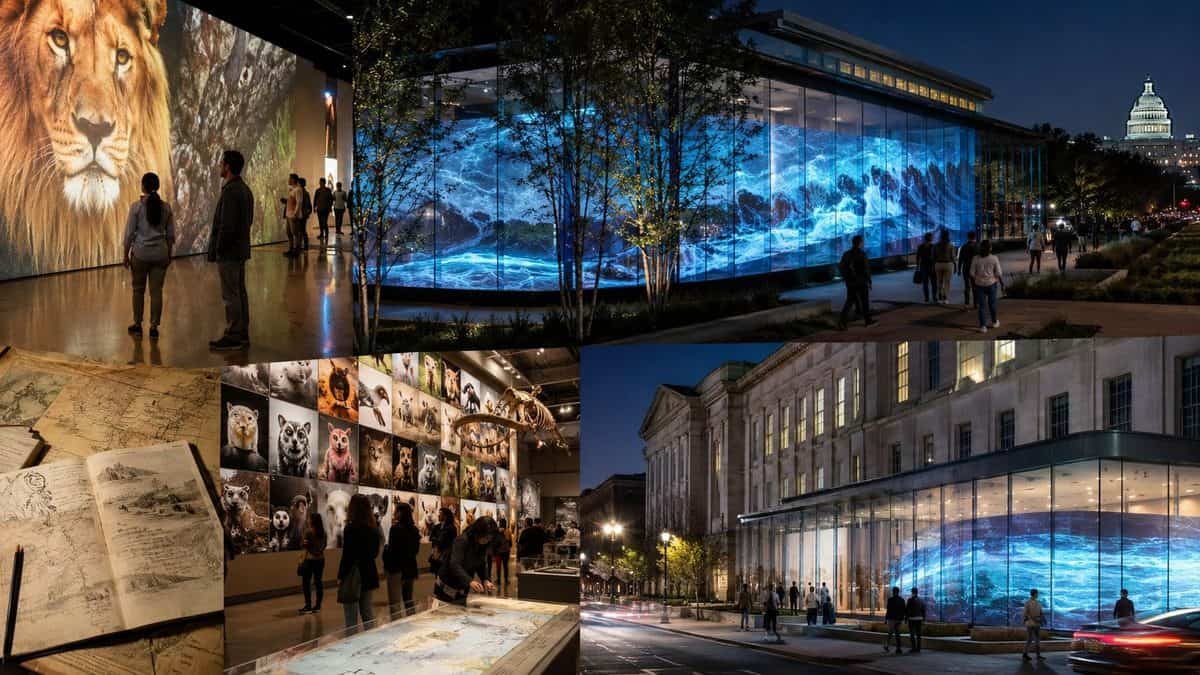
Image generated with Ai
The opening of the National Geographic Museum of Exploration is a major new cultural draw for Washington, D.C. The Museum spans 100,000 square feet and transforms the National Geographic Society headquarters into an interactive space for world travelers.
Museum visitors will be immersed in historical photography, rare artifacts from expeditions, and conservation stories. The Museum also features immersive digital experiences and a 270-degree immersive theater, along with a nightly ocean show featuring augmented reality and other experience-enhancing technology.
Advertisement
With its grand opening, the Museum of Exploration provides a new cultural paid-entry experience to the offerings in D.C.’s already well-known museum landscape. The Museum of Exploration is located at the intersection of Farragut North and Farragut West Metro Stations at 1600 M Street NW. SNAP and WIC visitors are eligible for $3 tickets and general admission for adults starts at $29.99. With a different set of rotating exhibitions and Explorer events, there will always be reasons for consumers to return.
The National Geographic Museum of Exploration marks a notable departure from the conventional museum format. Instead of presenting exploration as a completed chapter, it places visitors closer to the process behind discovery. The experience blends physical collections with technology, photography and live programming to create a more participatory visit.
Advertisement
Advertisement
The museum occupies more than 100,000 square feet of public space within the National Geographic Society’s Washington headquarters. Its galleries combine photographs, artefacts, archival material, interactive installations and immersive environments. Consequently, travellers can experience National Geographic’s work through several different formats during one visit.
That distinction matters in Washington, where visitors can already choose from an enormous range of cultural attractions. Many Smithsonian museums offer free entry, creating strong competition for travellers’ time and spending. The new National Geographic attraction therefore needs to offer something beyond conventional collection displays.
Its answer is immersion and access. Visitors can examine original field material, explore digital collections and experience landscapes through technology. They can also connect historic exploration with contemporary scientific and conservation work.
For National Geographic followers, the concept carries particular weight. The organisation has spent generations documenting remote landscapes, wildlife, archaeological sites and scientific research. The new museum brings many of those themes into a physical experience in the heart of Washington.
The museum’s galleries cover several interconnected subjects, including photography, exploration, archives, conservation and geography. Rather than separating those themes completely, the visitor experience shows how they influence one another. That approach gives travellers a clearer sense of how exploration becomes storytelling.
One of the permanent highlights is In Focus: Photographs of National Geographic. The gallery draws from more than a century of National Geographic photography and demonstrates the influence of visual journalism on public understanding of the world. Its Spotlight Gallery introduces additional temporary presentations that will change during the year.
The current Spotlight exhibition, Red, White, & Blue: Photographs of the United States, brings together images connected by the colours of the American flag. The exhibition is scheduled to remain on display through January 2027. Travellers visiting Washington before then can therefore include it within a broader National Geographic photography itinerary.
The main Exhibition Gallery operates on a different rotation. Its opening presentation is Photo Ark: Animals of Earth, based on photographer Joel Sartore’s long-running effort to document species held in zoos, aquariums, wildlife sanctuaries and rehabilitation centres.
Sartore’s Photo Ark project has photographed more than 18,000 species. At the museum, those portraits appear through large-scale projections and interactive displays that explore biodiversity and conservation. The format should appeal particularly to families, wildlife enthusiasts and travellers interested in environmental issues.
Another significant attraction is The Archives, which offers visitors an unusually direct connection with National Geographic’s past. Field notes, maps, film reels and other materials reveal the work that happened before stories reached readers. The displays help turn exploration from an abstract idea into something tangible.
The archive experience also examines how National Geographic stories are produced. Visitors can follow a story from field assignment through writing, editing and final magazine layout. A digital research table contains more than 300 photographs, film clips, artefacts and sound recordings from the Society’s collection.
Technology forms a substantial part of the museum’s visitor experience, but it is not presented simply as spectacle. The attraction uses digital tools to help visitors understand environments and research that would otherwise remain difficult to experience directly. That distinction gives the technology a clear editorial purpose.
The 270-degree immersive theatre draws on National Geographic’s long history of mapping and geographical storytelling. Its programmes use geographic data, GPS technology and interactive visuals to explore ideas including scale, time, patterns and layers. One experience takes visitors into Australia’s Great Victoria Desert through an interactive exploration of its plants, wildlife and ecology.
The experience continues outside the galleries. During daylight hours, augmented-reality features in the courtyard allow visitors to encounter digital animals alongside installations inspired by different ecosystems. This outdoor component gives families and younger visitors another way to engage with the museum.
After sunset, the courtyard changes character again. Wonders of Our World: Ocean transforms the pavilion into the setting for a 17-minute nighttime presentation. The experience uses high-resolution screens, lighting, spatial sound and smart-glass technology to create an ocean-inspired spectacle.
An interactive floor projection produces the illusion of bioluminescent waves moving beneath visitors’ feet. The result gives travellers a reason to consider visiting after dark rather than treating the museum solely as a daytime attraction. This can also make the experience easier to incorporate into an evening Washington itinerary.
The nighttime ocean experience is separately ticketed. Travellers should therefore check the official booking information before arrival, particularly if they want to combine daytime admission with the evening presentation.
The opening strengthens Washington’s already substantial cultural tourism economy. Destination DC reported that the city welcomed 27.2 million visitors in 2025, including 25.1 million domestic visitors and 2.1 million international travellers. Tourism generated approximately $11.9 billion in visitor spending during the year.
The economic contribution extends well beyond visitor expenditure. Tourism supported approximately 114,013 jobs and generated around $2.4 billion in tax revenue in 2025. Those figures underline the importance of developing attractions that encourage visitors to spend more time and money across the city.
The National Geographic brand gives the museum an additional advantage in international markets. Its global recognition can help the attraction appeal to overseas travellers who may already associate the organisation with wildlife, photography, science and exploration. This is particularly relevant for travellers building a first Washington itinerary.Washington, D.C. Tourism Indicator 2025 Figure Total visitors 27.2 million Domestic visitors 25.1 million International visitors 2.1 million Visitor spending $11.9 billion Tourism-supported jobs 114,013 Tourism-generated tax revenue $2.4 billion
The museum also occupies a useful position away from the National Mall. That encourages visitors to explore downtown Washington and potentially distribute their spending across restaurants, hotels and other attractions. For the wider tourism industry, that geographic spread can be valuable.
The National Geographic Museum enters a market dominated by the Smithsonian Institution. The Smithsonian operates 21 museums and the National Zoo, creating one of the world’s most concentrated cultural tourism environments. Most Smithsonian museums in Washington offer free admission, although some attractions use timed-entry arrangements.
The National Geographic model is different. Travellers pay for admission, but they receive an experience built around immersive technology, rotating exhibitions, National Geographic collections and live Explorer programming. The distinction makes the attraction more comparable with a premium cultural experience than with a conventional free museum.Visitor Consideration National Geographic Museum Smithsonian Museums General admission From $29.99 for adults Generally free Experience style Immersive and interactive Collection-led and varied Rotating exhibitions Yes Varies by museum Evening experience Ocean show available separately Varies Advance planning Recommended Depends on attraction Accessibility Braille, captions, descriptions and ASL Varies Location 1600 M Street NW Multiple D.C. locations
For travellers managing a limited budget, the price difference is significant. However, visitors should assess the National Geographic attraction according to the experience it provides rather than comparing admission prices alone. Its combination of immersive storytelling and archival access creates a distinct proposition.
Perhaps the museum’s most significant tourism feature is its commitment to changing content. The main Exhibition Gallery will change annually, while the Spotlight Gallery will rotate approximately twice each year. Explorer talks and other live events will also introduce new stories and perspectives.
That strategy could influence how repeat visitors perceive the attraction. A traveller visiting Washington once may focus on the permanent galleries and headline experiences, while returning visitors could encounter substantially different exhibitions.
Emily Dunham, chief campus and experiences officer for the National Geographic Society, explained the ambition behind the design on August 31, 2026. “We designed the museum to evolve, with new exhibitions, fresh programming and new Explorer stories, so there’s always something new to discover.”
For Washington’s tourism industry, that approach has broader significance. Attractions that regularly refresh their content can create stronger reasons for repeat visitation and local engagement. The museum therefore has the potential to become part of Washington’s longer-term cultural tourism ecosystem.
The museum is located at 1600 M Street NW, Washington, D.C., in the city’s downtown area. Its location makes it particularly accessible for visitors staying around central Washington. Farragut North and Farragut West Metro stations are both within walking distance.
Current summer visitor information lists museum hours from 9 a.m. to 8 p.m. daily, with last admission at 7 p.m. Travellers should verify the schedule for their specific date because seasonal hours, special programmes or events can affect operating times.
General admission begins at $29.99 for adults. Visitors aged five to 17 receive discounted admission, while children aged four and younger enter free. Qualifying SNAP and WIC participants can purchase $3 tickets through Museums for All.Practical Information Current Visitor Guidance Address 1600 M Street NW, Washington, D.C. Current summer hours 9 a.m.–8 p.m. daily Last admission 7 p.m. Adult admission From $29.99 Children aged four and under Free Ages five–17 Discounted SNAP/WIC visitors $3 through Museums for All Ocean experience Separate $10 nighttime ticket Nearest Metro stations Farragut North and Farragut West Advance booking Recommended
Travellers should consider booking ahead if the museum forms an important part of their itinerary. This becomes especially relevant when visitors want to attend the separate nighttime ocean experience. Checking official ticket availability before travelling can prevent scheduling problems.
Accessibility is incorporated across several aspects of the museum experience. Signage is available in both English and Spanish, while Braille supports key wayfinding points. These provisions can make navigation easier for a wider range of visitors.
The museum also provides captioning, visual descriptions and American Sign Language across selected media experiences. Some photographs within the In Focus gallery incorporate tactile elements, adding another dimension for visitors with different access requirements.
Families planning multigenerational trips should nevertheless check the museum’s latest accessibility guidance before visiting. Individual exhibitions and immersive experiences can have different physical, visual or sensory characteristics. Advance planning can therefore make the visit more comfortable.
The museum works particularly well for travellers staying in downtown Washington. Its central location allows visitors to incorporate it into an itinerary without committing an entire day to travel between neighbourhoods. The nearby Metro stations also make it accessible from other parts of the city.
Travellers with strong interests in photography, wildlife or exploration should allow sufficient time for the galleries. Rushing through the attraction could undermine some of its strongest features, particularly the archival displays and interactive installations.
The nighttime ocean experience creates another scheduling possibility. Visitors can explore the museum during the day and return after sunset for the separate presentation. Alternatively, travellers can structure their afternoon around the museum and finish with the evening show.
That flexibility is useful in a city where museum-heavy itineraries can become demanding. The attraction can also provide a weather-proof cultural option when outdoor sightseeing becomes uncomfortable. Visitors should, however, check the latest programme schedule before fixing their itinerary.
The National Geographic Museum of Exploration does not compete primarily through the size of its collection. Its strongest proposition lies in bringing exploration closer to the visitor. Field notebooks, photographs, maps and scientific stories become components of a more immediate experience.
A field note can reveal the thinking behind an expedition. A photograph can demonstrate the urgency of conservation, while geographic data can become an interactive landscape. These elements create a stronger connection between the visitor and the work of National Geographic Explorers.
That approach also distinguishes the museum from many traditional Washington attractions. Instead of simply looking back at famous expeditions, the museum connects historic material with ongoing scientific and environmental work. The result should feel more contemporary than a conventional retrospective.
For travellers, the experience can connect familiar destinations with places they may never reach. It can also provide context for global environmental and geographical issues through a format that remains accessible to general audiences.
The National Geographic Museum of Exploration offers a reason to wander beyond the National Mall in Washington. At 100,000 square feet, the museum offers an extended area for immersive galleries and changing exhibits in the crowded cultural scene of Washington, DC.
Moreover, as the first museum dedicated to exploration and cultural tourism, the museum offers its visitors a journey from field notes of the past to present day wildlife conservation and immersive geography or a night-time presentation inspired by the ocean.
The range attracts so many visitors. Photographers, wildlife enthusiasts, and families are all drawn to the museum. Imperative repeat clients, international visitors, and cultural exploration enthusiast all find a reason to visit the museum.
Washington is already one of the destination cities in the world, and the museum creates an opportunity to add another reason for Washington visitors to extend their stay. More so, the museum’s changing exhibits will offer an added incentive for repeat visitors.
For visitors booking Washington now, careful planning will help them to experience the museum. The museum is a place for visitors to experience the stories that lie behind National Geographic’s exploration.
Advertisement
Advertisement
Advertisement











Wednesday, September 2, 2026
Tuesday, September 1, 2026

Wednesday, September 2, 2026
Wednesday, September 2, 2026
Tuesday, September 1, 2026
Tuesday, September 1, 2026

Tuesday, September 1, 2026

Tuesday, September 1, 2026



