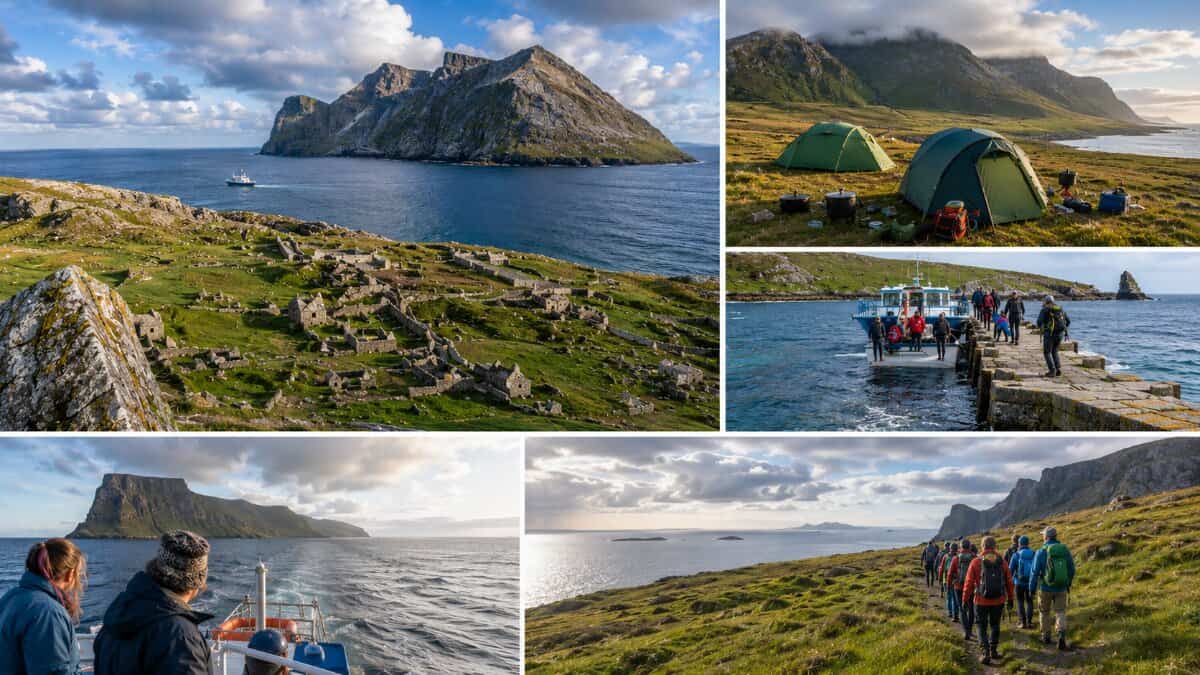
Image generated with Ai
St Kilda has entered the final stage of its 2026 camping season, with its only visitor accommodation scheduled to close on 11 September. The more important development for the travel trade is the combination of that narrow remaining window with substantial weather exposure. National Trust for Scotland reporting from this summer recorded almost as many days without visiting boats as days with arrivals, while official visitor guidance warns that crossings can be abandoned because of bad weather. The result is one of Britain’s most distinctive but operationally fragile heritage products.
St Kilda itself is not closing on 11 September. National Trust for Scotland lists the property as open throughout the year. What ends on 11 September is the second and final 2026 operating period of the small campsite on Hirta, the only accommodation available to ordinary visitors. That distinction matters for both travellers and travel sellers.
According to the National Trust for Scotland, the campsite operated from 20 April to 7 August before reopening from 19 August to 11 September. Stays have to be booked in advance and are restricted to a maximum of five nights. The scheduled closing date is therefore only ten days away as of 1 September.
The visitor proposition is deliberately basic. Campers receive access to drinking water, showers and toilets, but there is no mobile reception, Wi-Fi or other internet service. Visitors must take their own cooking equipment and sufficient food, including additional provisions in case weather delays their departure. The current facilities charge is £25 per person per night.
Advertisement
Advertisement
For a specialist travel business, those conditions transform St Kilda from a conventional destination booking into a contingency-dependent expedition product.2026 St Kilda operating factor Official position Trade significance Final camping period 19 August–11 September 2026 Very limited remaining overnight inventory window Maximum campsite stay 5 nights Prevents open-ended itinerary extensions on Hirta Visitor accommodation Campsite is the only visitor accommodation No hotel fallback if plans change Campsite charge £25 per person per night Low accommodation cost but high logistical dependency Connectivity No mobile reception, Wi-Fi or internet Disruption management cannot depend on normal digital communication Food provision Visitors must bring supplies and extra provisions Operators need stronger pre-departure preparation Access Boat only No independent land or air tourism alternative Western Isles crossing Approximately 3–6 hours Weather and sea-state dependent Mainland crossing Up to 18 hours Significant journey-time exposure Weather disruption Vessels can be forced to turn back Arrival should never be marketed as operationally certain
Source: National Trust for Scotland visitor information current on 1 September 2026
The new travel angle becomes more significant when the campsite calendar is read alongside current-season operational evidence.
In an official update dated 2 July 2026, the National Trust for Scotland’s St Kilda ranger reported that the summer had experienced persistent unsettled conditions and that days without visiting boats had almost matched days when vessels were able to reach the archipelago. Visitor journeys had consequently been cancelled.
That is important because poor-weather disruption is not merely theoretical. Official visitor guidance separately states that journey times depend on weather, tides and vessel type and that boats sometimes have to turn back because conditions deteriorate.
For the travel industry, this produces a different commercial risk from the disruption commonly encountered at airports or railway stations. There is no parallel scheduled transport network to absorb displaced travellers. There is no road connection. There is no alternative accommodation market on Hirta. A missed St Kilda landing can therefore remove the principal purpose of a highly specialised Outer Hebrides itinerary rather than merely shift its timing.
The second important correction concerns the regulatory development behind the campsite.
According to Historic Environment Scotland, the decision made on 16 April 2026 was a renewal of Scheduled Monument Consent for continued seasonal campsite use, not approval for a new campsite development. The application was validated on 3 March and granted without conditions.
That detail fundamentally changes the interpretation of the news.
The decision does not represent accommodation expansion, additional carrying capacity or conventional tourism infrastructure growth. Instead, it allows an established low-impact visitor use to continue within a nationally protected archaeological landscape.
Historic Environment Scotland identifies the village and associated structures as a Scheduled Monument, meaning interventions within the protected area fall under heritage legislation and regulatory oversight.
This is therefore better understood as controlled continuity rather than development.
According to UNESCO, St Kilda covers 25,837 hectares and carries both cultural and natural World Heritage significance. The archipelago contains evidence of thousands of years of human occupation alongside internationally important seabird colonies, dramatic sea cliffs, marine habitats and a largely intact ocean environment.
Its remoteness has historically protected many of those attributes, but tourism creates a complicated management equation.
The current St Kilda World Heritage Site Management Plan identifies concentrated visitor numbers as a potential source of erosion, pressure on limited water resources, invasive-species risk and changes to both the sense of place and visitor experience.
Official management data provide useful scale.St Kilda tourism indicator Official management-plan evidence Why it matters now Average annual visitors since 2015, excluding 2020 5,112 Demonstrates meaningful tourism demand despite remoteness Visitor concentration in May and June 58% on average Demand is compressed into a short operating season Main landing point Small pier at Village Bay, Hirta Physical arrival capacity is concentrated Major access modes Charter boat, private yacht, cruise ship Tourism is almost entirely maritime Day-trip departure areas identified Lewis, Harris and Skye St Kilda supports wider Hebridean tourism activity Weather effect Poor sea conditions cause cancellations Capacity is partly controlled by nature rather than timetable Tourism strategy objective Develop sustainable tourism approach Growth is expected to remain conservation-led Infrastructure objective Improve landing and welcome facilities Visitor experience remains linked to controlled gateway investment
The figures originate from the St Kilda World Heritage Site Management Plan 2022–2032, hosted by UNESCO and developed for the site’s management framework.
The closing date creates what can be described as a compressed fulfilment window.
A traveller attempting St Kilda in early September is no longer simply choosing between available departure dates. The customer is simultaneously exposed to marine weather, boat availability, campsite capacity, the five-night accommodation ceiling and the approaching seasonal cutoff.
That combination has implications for packaging.
A conventional short-break model tends to assume that the core attraction can be delivered on a specified date. St Kilda requires the opposite assumption. The itinerary should be structured around the possibility that the principal landing may not occur when originally planned.
This changes how pre- and post-St Kilda nights should be designed in the Outer Hebrides. It increases the value of flexible accommodation around the embarkation region. It strengthens the case for secondary heritage, nature and cultural experiences that can be activated if sea conditions remove St Kilda from a particular day.
It also makes transparent customer communication central to product quality. Operators selling the destination as a guaranteed island visit risk creating expectations that the geography itself cannot reliably support.
The paradox is commercially important: St Kilda’s scarcity and difficulty of access are part of its attraction, yet those same characteristics reduce the certainty required by conventional tourism distribution.
St Kilda’s access controls extend beyond heritage protection.
National Trust for Scotland requires visitors arriving in their own vessels to come ashore using an open tender during daylight hours, reducing the risk of unwanted animals reaching the island. Boats should have appropriately treated hulls, while anchors and chains should be clean. Dogs and other animals must remain aboard vessels. Drones are not permitted.
Visitors are also asked to clean footwear and equipment because mud, seeds, pathogens and non-native organisms can threaten the island ecosystem. Marine biosecurity extends to anchors, chains, hull fouling and discharge of ballast or bilge water.
UNESCO separately identifies invasive species and unsustainable tourism among the threats requiring active management at St Kilda.
For expedition cruise companies, yacht operators and specialist boat businesses, biosecurity therefore belongs inside operational preparation, not merely visitor interpretation.
The wider tourism context shows why St Kilda remains strategically relevant despite its tiny visitor volume.
According to VisitScotland, scenery and landscape influence 70% of visitors choosing Scotland, while history and culture influence 48%. Among long-haul travellers from markets including the United States, Canada and Australasia, history and culture rises to 70% as a reason for visiting.
The Outer Hebrides also attracts a strongly engaged market. VisitScotland’s regional visitor research found that 34% of overnight visitors surveyed in 2023 were international and 78% were repeat visitors, while 8% described their journey as a trip of a lifetime.
That profile aligns closely with St Kilda’s potential position in premium specialist itineraries: low volume, high emotional value and strong heritage motivation.
The opportunity is therefore not unlimited growth. It is higher-quality, better-prepared and conservation-compatible tourism.
The final days of St Kilda’s 2026 camping calendar illustrate a broader shift that the travel industry will increasingly need to understand.
The most valuable remote destinations may not be those capable of accepting continually rising visitor numbers. Their competitive strength may instead depend on preserving scarcity, environmental integrity and tightly managed access while improving the quality of each successfully delivered journey.
St Kilda already contains the principal elements of that model: internationally recognised heritage with finite infrastructure alongside limited accommodation as well as maritime dependence, conservation obligations, weather-driven capacity and strong emotional appeal.
Its April consent renewal preserves overnight access without converting Hirta into a conventional accommodation destination. Its September deadline reinforces seasonality. The difficult 2026 marine conditions demonstrate that even permitted capacity cannot always become realised tourism capacity.
For agents, cruise planners and specialist operators, the strategic lesson is clear. Remote heritage travel requires resilience to be designed into the product before it is sold.
That may ultimately prove more significant than the campsite closing date itself.
Advertisement
Advertisement
Advertisement











Wednesday, September 2, 2026

Tuesday, September 1, 2026

Wednesday, September 2, 2026

Wednesday, September 2, 2026
Tuesday, September 1, 2026

Tuesday, September 1, 2026

Tuesday, September 1, 2026

Tuesday, September 1, 2026