
Serbia Election Weekend Puts Croatia and Regional Nations in Travel Focus as Border Rules Shape Journeys

Published
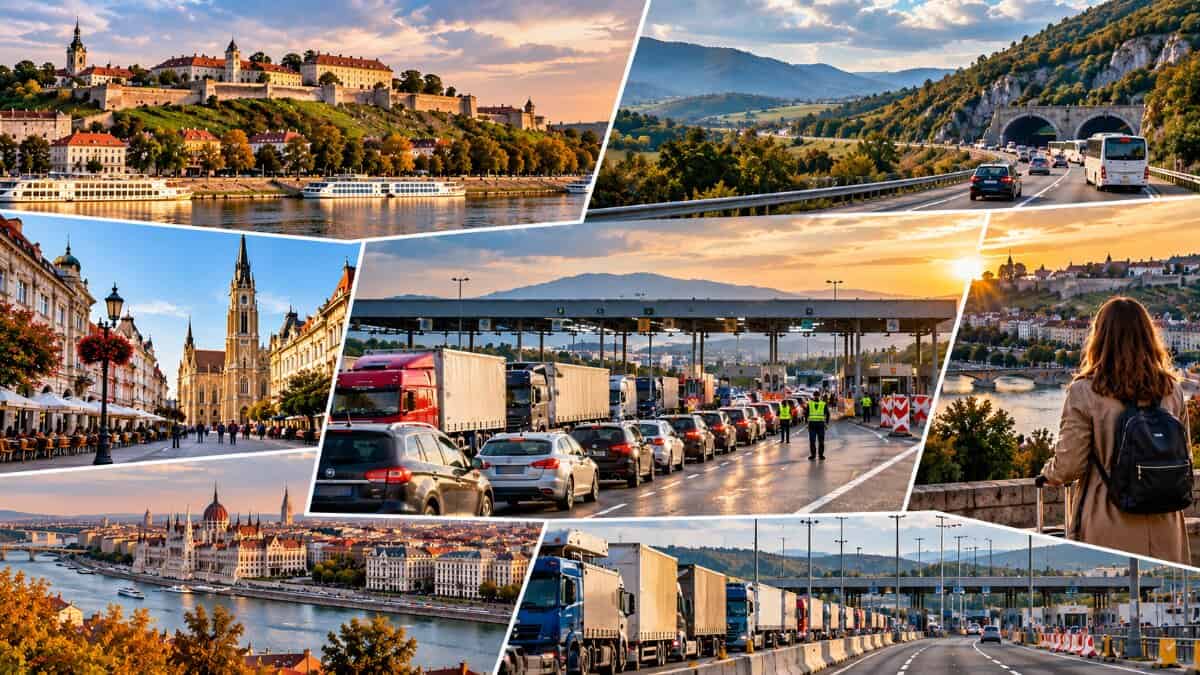
Serbia’s 25 October parliamentary election has prompted official travel precautions for visitors from Croatia, Slovakia and Austria, while Romania has issued a separate, date-specific Belgrade traffic warning. On 24 October, Croatia’s motoring authority reported a three-kilometre freight queue at Bajakovo and a transit-lorry restriction at Tovarnik–Šid. Hungary continues to list operating border routes, and Romania has a limited, temporary crossing opening this weekend. A simultaneous overnight clock change adds another scheduling consideration. Importantly, there is no verified evidence that the election caused the reported freight congestion.
Serbia Election Weekend Creates a Six-Country Road Travel Planning Challenge
The central development is not a regional border shutdown but overlapping warnings, freight restrictions and changing road conditions. The UK Foreign, Commonwealth and Development Office updated its Serbia advice on 22 October, identifying possible disruption to public transport and communications around the 25 October election and the following days.
Advertisement
Advertisement
Croatia, Hungary and Romania border Serbia; Slovakia and Austria rely on connecting routes. Their exposure differs, as the official evidence shows.
| Country | Verified development | Practical consequence |
|---|---|---|
| Serbia | Travel warnings and motorway works | Allow flexibility for transfers |
| Croatia | Postponement advice and freight queues | Check vehicle-specific restrictions |
| Hungary | Published crossing hours and eligibility | Choose an authorised checkpoint |
| Romania | Dated Belgrade alert; temporary Uivar access | Uivar is not a car route |
| Slovakia | Travel and motoring guidance | Check routes and driving rules |
| Austria | Advisory on potential road disruption | Protect connection margins |
Croatia–Serbia Border Alert: Freight Queues and Tovarnik Restrictions Are Already Documented
Croatia provides the clearest measured cross-border concern. On 24 October, the Croatian Automobile Club, HAK, using Croatian Interior Ministry border data, recorded a three-kilometre queue of freight vehicles at Bajakovo heading towards Lipovac at 09:15. The same service stated that transit freight traffic through Tovarnik–Šid was suspended and directed towards Bajakovo.
Advertisement
Advertisement
HAK also lists a ban on freight vehicles above 7.5 tonnes at Erdut–Bogojevo until 31 December. Ilok–Bačka Palanka bridge traffic is restricted to vehicles up to 24 tonnes at 30 km/h. Neither measure prohibits tourists generally.
The Croatian Ministry of Foreign and European Affairs advised on 20 October that Croatian citizens should postpone non-essential visits to Serbia and exercise heightened caution when necessary travel proceeds. The advisory and freight congestion are distinct developments.
Advertisement
Advertisement
What the Border Data Actually Establish
| Crossing or route | Official position available on 24 October | Relevant traveller group |
|---|---|---|
| Bajakovo–Batrovci | Three-kilometre freight queue reported at 09:15 | Hauliers and road operators |
| Tovarnik–Šid | Transit freight suspended; HAK directs lorries to Bajakovo | Transit freight, not a stated blanket car closure |
| Erdut–Bogojevo | Freight above 7.5 tonnes restricted until 31 December | Heavy goods operators |
| Ilok–Bačka Palanka | Maximum vehicle weight 24 tonnes; bridge speed 30 km/h | Vehicles using the alternative bridge |
Serbia’s road operator, Putevi Srbije, reported at 23:51 on 23 October that freight movements on the E70 near Šid towards Batrovci had resumed after a border-related hold. Resumption did not eliminate subsequent queues. Neither authority attributed the delays to the election.
Hungary–Serbia Crossings Remain a Crucial Alternative for International Motorists
Hungary offers direct access to northern Serbia via Röszke–Horgoš. The Hungarian Police border-information service lists that motorway checkpoint for international passengers and freight around the clock. It also lists Tompa–Kelebia for 24-hour international passenger and goods traffic.
The separate Röszke road checkpoint also operates 24 hours but excludes coaches and goods vehicles. Tiszasziget–Đala runs 07:00–19:00 with citizenship and family-member eligibility restrictions. An apparently shorter route may therefore be unsuitable for a coach or particular passport holder.
Hungarian police note that waiting times fluctuate. No election-related Hungary–Serbia border closure is substantiated.
Romania–Serbia Road Advisory Has a Different Date and an Unusual Weekend Opening
The Romanian Ministry of Foreign Affairs issued a notice on 21 October identifying road closures and public transport diversions in Belgrade on 22 October, particularly around Novi Beograd, the Arena, Rajko Mitić Stadium and Slavija Square. That date-specific notice does not establish identical closures on 24 or 25 October.
Romania’s border authorities independently announced a temporary 24–25 October crossing near Uivar, in Timiș County, with hours of 08:00–20:00. According to the Romanian Border Police, the facility uses the cycle route beside the Bega Canal, linking the Timișoara and Zrenjanin areas. It promotes local cross-border mobility and is not a motorway diversion for cars or coaches.
Advertisement
Advertisement
Regular road travellers should instead investigate authorised vehicle crossings, including Moravița–Vatin and Jimbolia–Srpska Crnja, using the Border Police Trafic Online service for direction- and vehicle-specific updates. The Uivar opening is unrelated to the election.
Slovakia and Austria Face Transit Planning Risks Rather Than Direct Border Closures
The Slovak Embassy in Belgrade published guidance on 20 October advising travellers to allow for possible traffic restrictions in Serbia. Its motoring guidance covers motorway tolls and standard speed limits of 50 km/h in towns, 80 km/h outside and 130 km/h on motorways, subject to signs.
Austria’s Federal Ministry for European and International Affairs likewise identifies the prospect of urban traffic disruption around 25 October. Its published country information still describes Serbia under its general security level one framework. That is not equivalent to Croatia’s recommendation to postpone unnecessary journeys.
Neither Slovakia nor Austria borders Serbia, making intermediate Hungarian crossings important. Their advisories do not constitute coordinated road restrictions.
Serbian Motorway Conditions Add an Independent Layer of Travel Risk
The Serbian road operator also lists unrelated infrastructure and driving hazards. On 23 October it identified daytime lane-marking work on the I A-1 between Novi Sad South, Kovilj and Beška towards Belgrade, scheduled through 31 October. This section matters to motorists travelling south after crossing from Hungary.
Its 24 October bulletins also warned of fog, including reduced visibility around the Manajle tunnel and other southern motorway sections. These are not election-related disruptions, but can compound border or urban delays.
Advertisement
Advertisement
The 25 October Clock Change Affects All Six Countries
A further scheduling issue falls on the same Sunday. Serbia’s Directorate of Measures and Precious Metals confirms that at 03:00 on 25 October, Serbian clocks return to 02:00. The European Commission’s official timetable sets the same changeover date for Austria, Croatia, Hungary, Romania and Slovakia.
Serbia and the four Central European Time countries remain aligned after the change; Romania continues to run one hour ahead. Operators should verify local check-in times, scheduled driver changes and overnight transfers, particularly where a repeated clock hour appears in booking records. The clock change is not a border restriction.
EU Entry–Exit Checks and Serbian Travel Documents Still Apply
At the EU’s external border with Serbia, travellers also face routine entry formalities. The European Commission confirms that the Entry/Exit System became fully operational on 10 April 2026. It records travel-document and biometric information for eligible non-EU short-stay travellers entering or leaving participating European countries. EU citizens are not subject to that registration requirement.
This is not an election measure; occupants of one vehicle may nonetheless face different document checks. The Serbian Foreign Ministry confirms that EU citizens can generally enter Serbia with a valid national identity card. Third-country nationals must check their own Serbian visa rules and the requirements for returning to the EU.
Serbia Tourism Figures Show Why Reliable Land Access Matters
The latest published monthly figures from the Statistical Office of Serbia, released on 30 September, underline the significance of dependable visitor mobility. August 2026 recorded approximately 537,000 tourist arrivals, 7.9 per cent above August 2025. Foreign guests accounted for approximately 731,000 overnight stays, a year-on-year increase of 10.1 per cent.
| Serbia tourism indicator, August 2026 | Approximate count | Annual change |
|---|---|---|
| All tourist arrivals | 537,000 | +7.9% |
| Total overnight stays | 1,582,000 | +7.3% |
| Domestic overnight stays | 851,000 | +5.0% |
| Foreign overnight stays | 731,000 | +10.1% |
These figures measure accommodation stays, not border traffic or financial losses from the alert.
Advertisement
Advertisement
Independent Analysis: The Bigger Exposure Is a Poorly Designed Cross-Border Itinerary
The practical industry lesson is that destination warnings and transport-network constraints belong in different operational systems. A travel advisory informs the decision to depart; a border-status bulletin identifies which vehicle can cross, where and under what conditions. Combining them without distinction risks turning a genuine freight bottleneck into an inaccurate warning that all tourists are stranded.
A second weakness is the common assumption that nearby crossings are interchangeable. Hungary’s limited-hours checkpoints impose nationality and vehicle restrictions. Croatia’s Tovarnik diversion concerns transit freight. Romania’s Uivar opening serves a cycle corridor. Alternative routing therefore requires an eligibility check before distance or travel-time optimisation.
For tour operators, a more resilient model separates gateway selection, border formalities, motorway conditions and final-city access into independently monitored stages. Each itinerary should have a second legal crossing option, a supplier contact for delayed arrival and a stated decision point for replanning. That approach protects customers without inventing closures or predicting how the election will unfold.
Operational Takeaways for Travel Agents and Tour Operators
- Check vehicle class: cars, coaches and freight can face different rules.
- Use official live feeds: recheck HAK, Hungarian Police, Romanian Border Police and Putevi Srbije.
- Apply country-specific advice: Croatia’s postponement recommendation differs from the cautionary guidance published by Austria and Slovakia.
- Protect buffers: separate border, motorway and city-transfer contingencies.
- Reconfirm Sunday timings: check every 25 October departure and arrival against the overnight clock change.
- Audit travel files: check identification, visas, vehicle permissions and booking terms.
Long-Term Outlook: More Precise Border Intelligence Will Matter to Regional Tourism
This weekend illustrates a wider operational challenge for European overland tourism: travellers increasingly cross borders governed by different document systems, checkpoint hours and road-traffic controls. Digital information is available, but agencies must interpret it by direction, vehicle type and publication time rather than relying on a single regional alert.
Dependable access supports Serbia’s city breaks, coach touring and business travel. From 24 October onwards, any new restriction requires fresh official confirmation.
FAQs
Is Serbia closing its international road borders for the 25 October election?
No election-related nationwide border closure was established by the official sources reviewed on 24 October. Particular freight restrictions and checkpoint rules do apply. Travellers should review the exact crossing before departure.
Advertisement
Advertisement
Can tourists still travel between Hungary and Serbia by road?
Hungarian Police lists 24-hour international crossings at Röszke–Horgoš motorway and Tompa–Kelebia. The separate Röszke road crossing excludes coaches and goods vehicles. Waiting times and permissions can change.
What is happening at the Croatia–Serbia crossings?
HAK reported a three-kilometre freight queue at Bajakovo on 24 October and suspended transit freight movements through Tovarnik–Šid. This does not establish a blanket suspension of private-car travel or election causation.
Does the temporary Romanian Uivar crossing provide another driving route?
No. The special 24–25 October opening concerns a Bega Canal cycle route and has advertised hours of 08:00–20:00. Drivers should use authorised road checkpoints and verify their operating conditions.
What extra precaution matters on Sunday, 25 October?
Clocks move back one hour overnight in Serbia, Hungary, Croatia, Romania, Slovakia and Austria. Confirm local departure times, especially for overnight itineraries, and keep checking official road and border updates.
Advertisement
