

The ePlane Company and Noida International Airport Agree to Develop Advanced Air Mobility Infrastructure

Published
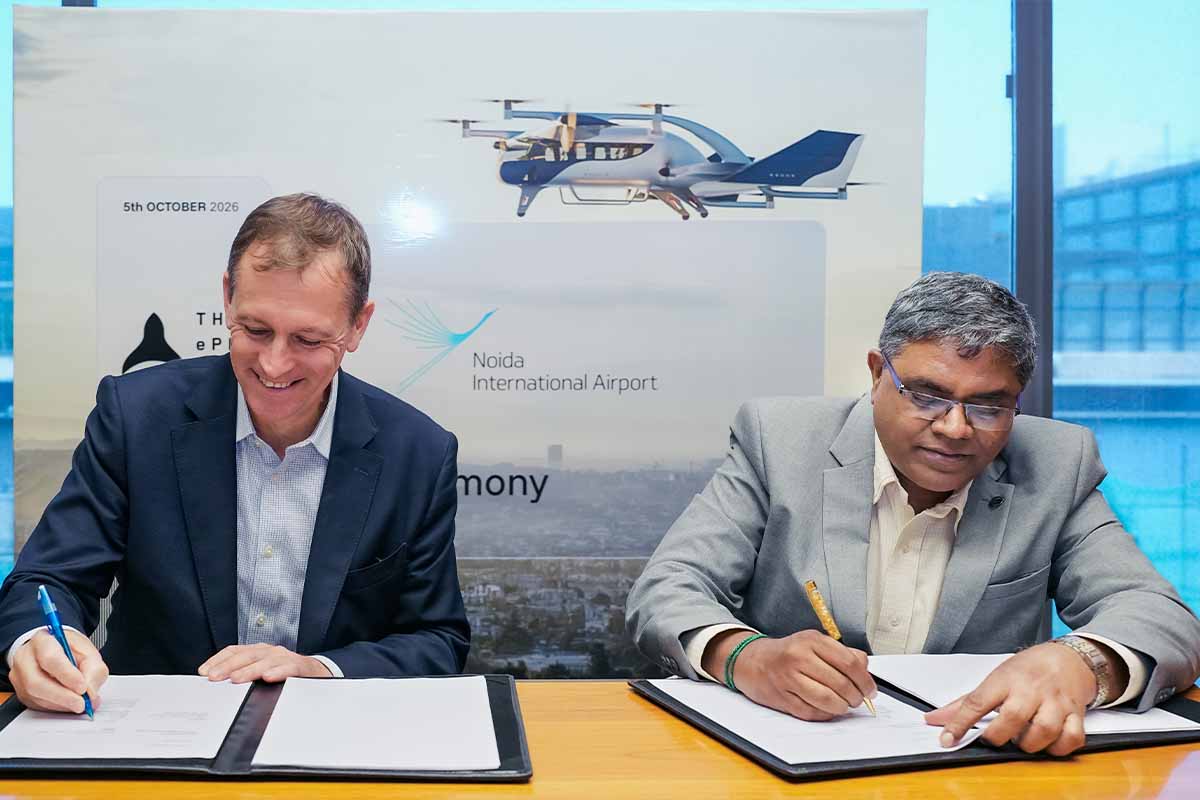
The ePlane Company and Noida International Airport have signed an MoU to develop infrastructure and operating systems for advanced air mobility. The partnership will support eVTOL trials, vertiports, charging facilities and regulatory procedures, creating a framework for future airport-to-airport travel, urban commuting and emergency air ambulance services across Delhi-NCR.
What does the agreement between ePlane and Noida International Airport cover?
The agreement establishes a framework for developing the infrastructure and operational ecosystem needed to support electric vertical take-off and landing aircraft at Noida International Airport.
Rather than focusing only on physical infrastructure, the partnership will address the wider requirements of advanced air mobility, including Standard Operating Procedures, Vertiport Management Systems, charging infrastructure, regulatory coordination and integration with existing airport operations.
Yamuna International Airport Private Limited, the company responsible for developing and operating Noida International Airport, will allocate space within the airport premises for proof-of-concept trials, future vertiport facilities and charging stations. The airport will also work towards adapting its operational procedures to accommodate eVTOL activity.
Advertisement
Advertisement
For The ePlane Company, the agreement creates an opportunity to develop and validate the operational environment around its flagship e200X aircraft alongside its continuing aircraft engineering and testing programme.
Why is infrastructure important for India’s electric air taxi ambitions?
The development of an eVTOL aircraft is only one component of creating a viable advanced air mobility network. Aircraft certification, passenger handling, charging, airspace management, ground operations and safety procedures must also develop in parallel.
Advertisement
Advertisement
The ePlane Company says the new partnership is designed to address precisely this requirement. By working with an airport operator before commercial aircraft deployment, the companies can develop procedures and infrastructure that can eventually support regular eVTOL operations.
The approach is particularly relevant for urban aviation because electric air taxis will need to operate within existing transport and aviation systems rather than functioning as an entirely separate network.
For passengers, the potential benefit is shorter journey times between important urban locations. For airports, advanced air mobility could provide an additional transport layer connecting terminals and cities without relying entirely on congested road networks.
How will Noida International Airport support eVTOL trials?
Noida International Airport is expected to provide space for proof-of-concept activities, vertiports and charging infrastructure as the partnership develops.
These facilities will form part of the ground ecosystem required to operate electric aircraft safely. The airport will also work on Standard Operating Procedures covering the integration of eVTOL services into its broader aviation environment.
The companies intend to work with regulators, Air Traffic Control authorities and state governments to establish appropriate safety and operational frameworks.
Advertisement
Advertisement
This cooperation is significant because advanced air mobility involves multiple stakeholders. An aircraft must satisfy aviation certification requirements, while airport infrastructure, airspace procedures, security arrangements and ground operations must be aligned before passenger services can scale.
The partnership therefore represents an attempt to develop the aircraft and its supporting ecosystem simultaneously rather than sequentially.
What role will the e200X aircraft play?
The e200X is The ePlane Company’s flagship electric vertical take-off and landing aircraft and is central to the partnership’s long-term objectives.
The company recently unveiled its full-scale e200X PT-01 prototype, with ground testing now underway. According to the company, the new airport agreement will allow progress on the aircraft to be matched by development of the operational environment in which it is intended to fly.
The company plans to pursue the necessary clearances from India’s Directorate General of Civil Aviation and the Bureau of Civil Aviation Security while continuing prototyping and flight testing.
The partnership also envisages drone trials as an intermediate stage before piloted e200X operations. This staged approach could allow operational procedures and infrastructure to be assessed progressively before the introduction of certified passenger aircraft.
Advertisement
Advertisement
Could the partnership support airport-to-airport and urban travel?
The proposed ecosystem is intended to support several forms of advanced air mobility, including airport-to-airport connections and intra-city travel.
The companies also identify emergency air ambulance operations as a potential application. Such services could provide rapid aerial connectivity for critical medical transport where road congestion can create significant delays.
The broader proposition is based on using electric aircraft to connect locations that may be difficult or time-consuming to link by road. If the required aircraft certification, infrastructure and operating systems are established successfully, eVTOL services could become another component of urban and regional mobility.
However, commercial deployment will depend on regulatory approvals, aircraft certification, operational validation and the development of appropriate safety standards.
How will regulation and airspace integration be addressed?
Regulation will be a central part of the partnership. The ePlane Company will work towards securing the required DGCA and BCAS clearances, while both organisations will engage with regulators, ATC authorities and state governments.
The companies also plan to develop Vertiport Management Systems and AI-assisted fleet scheduling that can potentially connect with smart city systems.
Advertisement
Advertisement
This highlights an important distinction between conventional airport infrastructure and advanced air mobility networks. A high-frequency electric aircraft operation could require sophisticated coordination between aircraft, charging infrastructure, passenger facilities, airspace and ground movements.
Developing these systems early could help establish operational standards before larger-scale services are introduced.
What does the partnership mean for Noida International Airport?
For Noida International Airport, the agreement supports its stated ambition to develop future-ready and multi-modal connectivity.
The airport’s masterplan provides for long-term expansion and is designed to serve more than 70 million passengers annually over the concession period. Integrating advanced air mobility into that broader development strategy could provide another potential means of connecting the airport with the surrounding region.
Daniel Bircher, Chairman of Noida International Airport, said the airport’s long-term vision is closely linked with innovative infrastructure and seamless multi-modal connectivity. He described the collaboration with The ePlane Company as an important step towards developing the ground infrastructure and operating procedures required for safe, zero-emission air transport and emergency services in Delhi-NCR.
What is the significance for The ePlane Company?
For The ePlane Company, the agreement extends its work beyond aircraft development into airport operations and mobility infrastructure.
Advertisement
Advertisement
Founded in 2019 and incubated at the IIT Madras Incubation Cell, the company describes itself as an Indian deep-tech aerospace manufacturer focused on advanced air mobility.
It operates an integrated eVTOL prototyping, manufacturing and testing facility at the IIT Madras Discovery Campus in Thaiyur, Chennai. The company also says it has accumulated more than 10,000 kilometres of physical flight testing through its ATVA and e50 technology demonstrators.
Its e200X has been accepted into the DGCA’s Type Certification pipeline, according to the company. It also says it has received Design Organisation Approval from DGCA for electric aircraft.
The company’s approach centres on its patented Synergistic Lift technology and an aircraft footprint of approximately 8 by 11 metres. It says this compact configuration is intended to support rooftop operations using existing municipal helipads rather than requiring entirely new specialised vertiport sites in every location.
What could happen next?
The immediate focus will be on proof-of-concept trials, infrastructure planning, regulatory coordination and continued e200X testing.
The companies will need to demonstrate that aircraft operations, charging, airport procedures, airspace coordination and safety systems can function together. Drone trials are expected to provide an early opportunity to validate operational models before piloted e200X flights are introduced.
Advertisement
Advertisement
The longer-term objective is to create an ecosystem capable of supporting passenger air taxis, emergency air ambulances and potentially other urban air mobility services.
The partnership therefore marks an infrastructure and operational step towards India’s emerging advanced air mobility sector, while commercial deployment remains dependent on certification, regulatory approvals and successful testing.
Conclusion
The ePlane Company and Noida International Airport are building more than a future vertiport network; they are developing the operational framework needed for electric aviation. By combining aircraft testing, infrastructure, regulation and airport integration, the partnership could provide a foundation for safer, cleaner and faster urban connectivity across Delhi-NCR.
Advertisement
