
Albania Advances With Serbia and Others as EU Roaming Negotiations Open Path to Easier Balkan Travel

Updated
Published
Travellers should not treat the Western Balkans as part of the EU domestic-rate roaming zone yet. Albania, Bosnia and Herzegovina, Kosovo, Montenegro, North Macedonia and Serbia are all negotiating towards inclusion but no implementation deadline has been fixed. The crucial travel-industry detail is that each partner must pass a separate legal and regulatory process before reciprocal surcharge-free roaming can begin. Meanwhile, a voluntary EU–Western Balkans arrangement is reducing selected data prices, including a 2026 benchmark below €14 per GB for qualifying products from participating operators, but this is not a universal tariff applying automatically to every traveller.
Albania and the Western Balkans Enter a New Travel Connectivity Transition
The latest official position creates a far more complicated travel picture than the shorthand description of free roaming coming to the Western Balkans may suggest.
Advertisement
Advertisement
According to the Council of the European Union, negotiations were authorised on 4 June 2026 with Albania, Bosnia and Herzegovina, Kosovo, Montenegro, North Macedonia and Serbia. The objective is to extend the EU Roam Like at Home framework to all six Western Balkan partners.
However, authorisation to negotiate is not the same as activation.
Advertisement
Advertisement
According to the European Commission‘s current roaming guidance, there is no set deadline for completing the Western Balkans process. EU travellers visiting any of the six markets should therefore continue checking their mobile operator’s tariff before departure rather than assuming their normal domestic allowance will work without additional roaming charges.
This distinction matters particularly for travel companies packaging regional touring holidays, escorted coach programmes, fly-drive itineraries and independent multi-country journeys. Connectivity is now integral to navigation, boarding documentation, accommodation management, messaging, payments and disruption handling. Treating an anticipated regulatory benefit as an existing entitlement could create both traveller confusion and avoidable cost.
Advertisement
Advertisement
Tirana and Brussels Explain Why Albania Is Central to the Story
The inclusion of Tirana and Brussels in this story is not decorative geography.
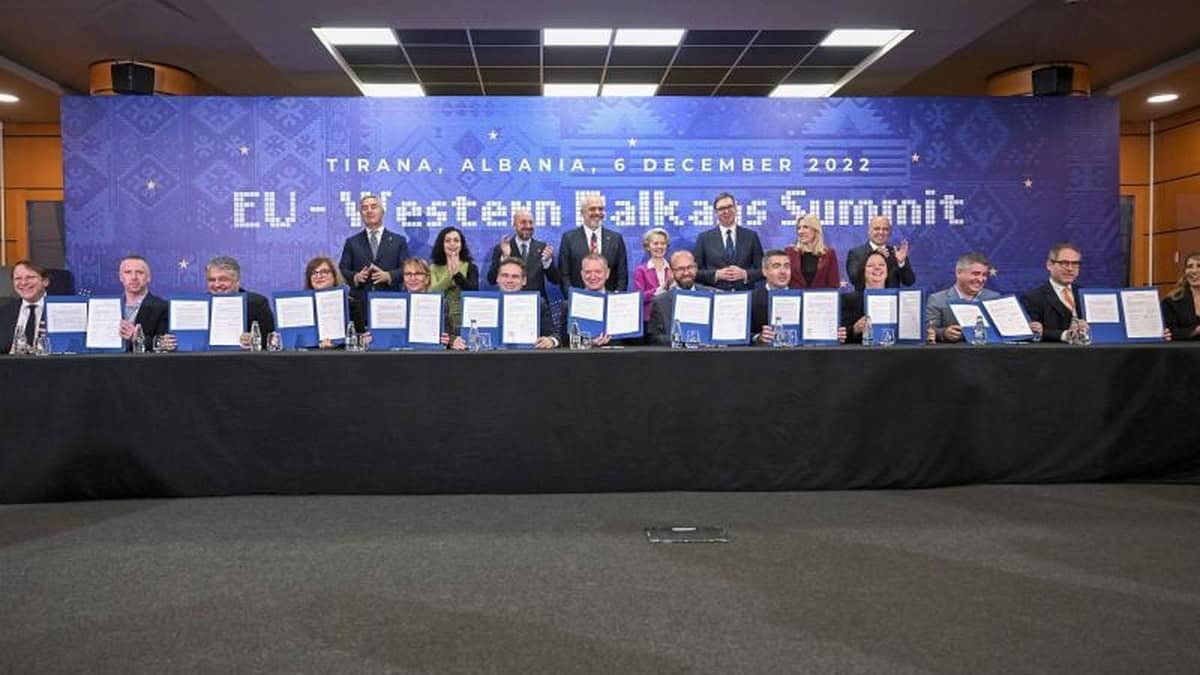
Tirana became a direct milestone in the roaming process on 6 December 2022, when the EU-Western Balkans Summit was held in the Albanian capital. Telecommunications operators from the European Union and Western Balkans signed the declaration that established the pathway towards reduced roaming charges from October 2023.
That voluntary commercial framework later expanded. The European Commission recorded that 38 telecommunications operators from the EU and Western Balkans had agreed in 2023 to reduce the gap between domestic and roaming data charges.
Brussels represents the institutional end of that journey. The Council’s June 2026 approval allowed negotiations on formal sectoral agreements to proceed, shifting the project from voluntary price reductions towards possible integration into the EU roaming regulatory area.
The result is an unusually relevant policy bridge between Tirana and Brussels for the travel sector: one city marks the voluntary pricing stage, while the EU institutions in Brussels now lead the regulatory stage required for domestic-rate roaming.
The Critical New Travel Angle: Six Countries Mean Six Approval Tracks
For travel planners, the most important structural detail is that Western Balkan inclusion is not being handled through a single blanket regional switch.
Advertisement
Advertisement
The Council states that the European Commission will negotiate sectoral agreements with each of the six partners. Every partner must fully align with and implement the relevant EU roaming acquis. The Commission must then assess whether that partner has met the required conditions. After a positive assessment, the relevant joint institutional body can approve reciprocal opening of roaming markets.
That architecture produces four distinct regulatory gates.
| Implementation stage | Official requirement | Why it matters to travel |
|---|---|---|
| Negotiation | Separate sectoral agreement with each Western Balkan partner | One regional announcement does not constitute activation |
| Regulatory alignment | Partner must implement EU roaming rules | Legal readiness is country-specific |
| Compliance assessment | European Commission verifies conditions | Political agreement alone is insufficient |
| Market opening | Relevant joint body approves reciprocal access | Domestic-rate roaming begins only after final institutional approval |
There is currently no official guarantee that all six partners will enter on the same date. That does not mean a staggered rollout has been announced. It means travel companies should avoid building future itineraries or connectivity promises around an assumed single regional activation date unless EU institutions later confirm one.
That is especially relevant to multi-border itineraries containing two, three or more Western Balkan destinations.
What Applies Today in Albania, Bosnia and Herzegovina, Kosovo, Montenegro, North Macedonia and Serbia
All six partners have the same broad status under the June mandate, although each must complete its own implementation process.
| Western Balkan partner | EU RLAH active on 13 Sept 2026? | Negotiations authorised? | Separate agreement required? | No official completion deadline? |
|---|---|---|---|---|
| Albania | No | Yes | Yes | Yes |
| Bosnia and Herzegovina | No | Yes | Yes | Yes |
| Kosovo | No | Yes | Yes | Yes |
| Montenegro | No | Yes | Yes | Yes |
| North Macedonia | No | Yes | Yes | Yes |
| Serbia | No | Yes | Yes | Yes |
The Council identifies these six collectively as the WB6.
Advertisement
Advertisement
For Albania, the Commission’s current consumer guidance specifically confirms that Council authorisation has been granted and that further work on extending RLAH remains necessary.
Bosnia and Herzegovina, Kosovo, Montenegro, North Macedonia and Serbia are covered by the same Council mandate and must similarly satisfy the regulatory and institutional requirements before their markets can be opened reciprocally with the EU.
The €14 Per GB Figure Needs Careful Travel Journalism
The most important pricing qualification for 2026 is easy to miss.
The Regional Cooperation Council states that under the voluntary EU–Western Balkans Roaming Declaration, one gigabyte of data in at least one product offered to the widest number of consumers by each participating signatory should cost below €14 from 2026. The corresponding benchmarks were below €18 from October 2023 and are scheduled to fall below €9 in 2028.
This does not mean every EU traveller entering Albania, Serbia or another WB6 market has a legally guaranteed maximum price of €14 per GB.
The arrangement is voluntary. It relates to participating signatories. It concerns at least one qualifying product. Operators may implement their reductions through roaming packages or other pricing structures.
Advertisement
Advertisement
The RCC itself directs consumers to contact their mobile operator for details.
For travel agents, therefore, marketing copy stating that Western Balkans data costs no more than €14 per GB would be too broad.
The accurate message is that participating operators have a 2026 reduced-data pricing benchmark under the voluntary declaration, while actual traveller charges remain dependent on the operator and product.
Western Balkans Roaming Is Already Free Regionally but That Does Not Automatically Cover EU SIM Cards
Another distinction can create confusion.
The six Western Balkan partners already operate their own regional Roam Like at Home system. The Regional Cooperation Council confirms that the arrangement became fully roaming-free across the Western Balkans from 1 July 2021, following the Regional Roaming Agreement signed in Belgrade in April 2019.
That arrangement applies within the Western Balkan regional roaming framework. It should not be interpreted as meaning an EU mobile subscription automatically becomes surcharge-free merely because its owner moves between Albania, Montenegro and Serbia.
Advertisement
Advertisement
For EU visitors, the relevant issue remains the tariff provided by their own operator until formal EU–WB6 market opening takes place.
This creates a distinctive regulatory geography for tourism: the Western Balkans have already eliminated regional roaming surcharges for eligible regional subscribers, while the EU and WB6 remain connected through an interim voluntary price-reduction framework.
Twenty-Seven EU Markets Sit on the Other Side of the Negotiations
The eventual effect would extend across the entire European Union, not simply neighbouring Balkan markets.
The EU currently has 27 Member States. They are:
| EU countries covered by the existing EU roaming framework |
|---|
| Austria, Belgium, Bulgaria, Croatia, Cyprus, Czechia, Denmark |
| Estonia, Finland, France, Germany, Greece, Hungary, Ireland |
| Italy, Latvia, Lithuania, Luxembourg, Malta, Netherlands, Poland |
| Portugal, Romania, Slovakia, Slovenia, Spain, Sweden |
The official European Union country register confirms the current 27-member composition.
The existing RLAH area also extends beyond those 27 countries. The Council confirms coverage of the European Economic Area countries Iceland, Liechtenstein and Norway, while Moldova and Ukraine joined the EU roaming area from 1 January 2026.
Advertisement
Advertisement
That makes the Western Balkans negotiations strategically significant for European tourism. If completed, they would remove another major mobile-connectivity boundary around a region heavily integrated into European cross-border movement.
Why This Matters More for Tour Operators Than a Normal Telecom Update
The information-gain issue for the travel trade lies in itinerary design.
A booking may include an EU arrival gateway and multiple Western Balkan stops. The traveller may use a single device for airport transfers, digital vouchers, maps, supplier communication, translation, banking authentication and emergency assistance.
Today, the mobile tariff cannot safely be inferred merely from geography.
A traveller accustomed to EU domestic-rate roaming can cross into one of the WB6 markets and enter a different charging environment. Likewise, an agency cannot assume that the June Council decision itself changed customer tariffs.
That creates a distribution responsibility.
Advertisement
Advertisement
Travel documentation increasingly needs the same precision for connectivity that agencies already apply to passports, insurance, baggage and border procedures.
A simple pre-departure note telling customers to verify mobile roaming conditions may prevent a considerable service problem during complex Balkan itineraries.
EU Roaming Expansion Is Part of a Wider Integration Strategy
The policy also sits within the EU’s broader gradual integration of the Western Balkans.
The December 2025 EU-Western Balkans Brussels Declaration recorded the reduction of roaming costs since October 2023 and reaffirmed the objective of extending the EU Roam Like at Home area to the region. It also placed digital integration alongside wider economic measures under the Western Balkans Growth Plan.
The Council subsequently converted that political direction into authority for negotiations in June 2026.
For tourism, the progression is important:
Advertisement
Advertisement
| Stage | Date | Travel-connectivity significance |
|---|---|---|
| Western Balkans Regional Roaming Agreement signed | April 2019 | Established regional pathway to surcharge removal |
| Regional roaming-free regime fully active | July 2021 | WB6 subscribers gained regional domestic-like roaming |
| EU-WB operator declaration signed in Tirana | December 2022 | Created voluntary reduction pathway |
| First EU-WB reductions | October 2023 | Lower selected data charges began |
| 2026 voluntary benchmark | 2026 | Qualifying products from signatories target below €14 per GB |
| Council authorises formal negotiations | June 2026 | Regulatory integration process formally advances |
| Full EU-WB6 RLAH | Date not set | Requires individual completion of all legal gates |
Operational Takeaways for Travel Agents and Tour Operators
- Do not advertise EU roaming as already active in Albania, Bosnia and Herzegovina, Kosovo, Montenegro, North Macedonia or Serbia.
- Tell clients to check their specific mobile operator and tariff before travelling because the current reduced-price mechanism is not universal.
- Do not describe €14 per GB as a statutory region-wide maximum. The 2026 figure applies to at least one qualifying product from participating declaration signatories.
- Treat each WB6 partner separately in future updates. Six individual sectoral agreements and country-level compliance processes mean agents should verify each destination before changing customer guidance.
- Update multi-country Balkan itinerary notes whenever the European Commission confirms a partner has completed the regulatory process.
- Avoid promising one common launch date. None has been officially announced as of 13 September 2026.
- Keep mobile-connectivity advice alongside other pre-departure operational information, particularly for self-drive, touring, adventure and digitally dependent itineraries.
Outlook: A Future European Travel Zone With Fewer Digital Borders
The strategic significance extends well beyond cheaper phone bills.
The Western Balkans already work as an area where eligible phone users don’t pay extra for using their devices. The European Union has offered phone rates since 2017 and added Moldova and Ukraine to the area in January 2026. Talks with Albania, Bosnia and Herzegovina, Kosovo, Montenegro, North Macedonia and Serbia are steps to make this connected travel space bigger.
The main message for travel companies in September 2026 is to be careful rather than excited.
The plan is clear. The exact time is not.
Until all the needed deals, adjustments, evaluations by the Commission and decisions to open the market are done tour companies and travelers must keep thinking of EU to Western Balkans phone use as a cost.
If all six countries join together the benefits for tourism could be big in ways not just in marketing. Travelers would not have to make many decisions about phone service when crossing borders. Using phones would be easier during trips across the region. There would also be consistency between actual travel, in Europe and the digital services that modern travelers rely on more and more.
Advertisement
Advertisement
Frequently Asked Questions
Is EU roaming free in Albania in September 2026?
No. Albania is included in the EU negotiating process, but EU Roam Like at Home has not yet been activated there. The European Commission says there is currently no fixed deadline for completion.
Are Bosnia and Herzegovina, Kosovo, Montenegro, North Macedonia and Serbia joining too?
All five, together with Albania, are covered by the Council’s June 2026 authorisation. Each requires a separate sectoral agreement and completion of the EU regulatory process.
Does the €14 per GB benchmark mean tourists cannot be charged more?
No. The RCC framework concerns at least one broadly offered qualifying product from each participating declaration signatory. Travellers must check their own operator and plan.
Is roaming already free between the six Western Balkan partners?
A regional Roam Like at Home regime has operated across the Western Balkans since July 2021 for subscribers covered by that regional framework. That does not automatically make an EU SIM surcharge-free in those destinations.
When will EU–Western Balkans roaming become fully surcharge-free?
No official completion date has been announced as of 13 September 2026. Each partner must complete its agreement, regulatory alignment, Commission assessment and final reciprocal market-opening process before full RLAH treatment can begin.
Advertisement
