
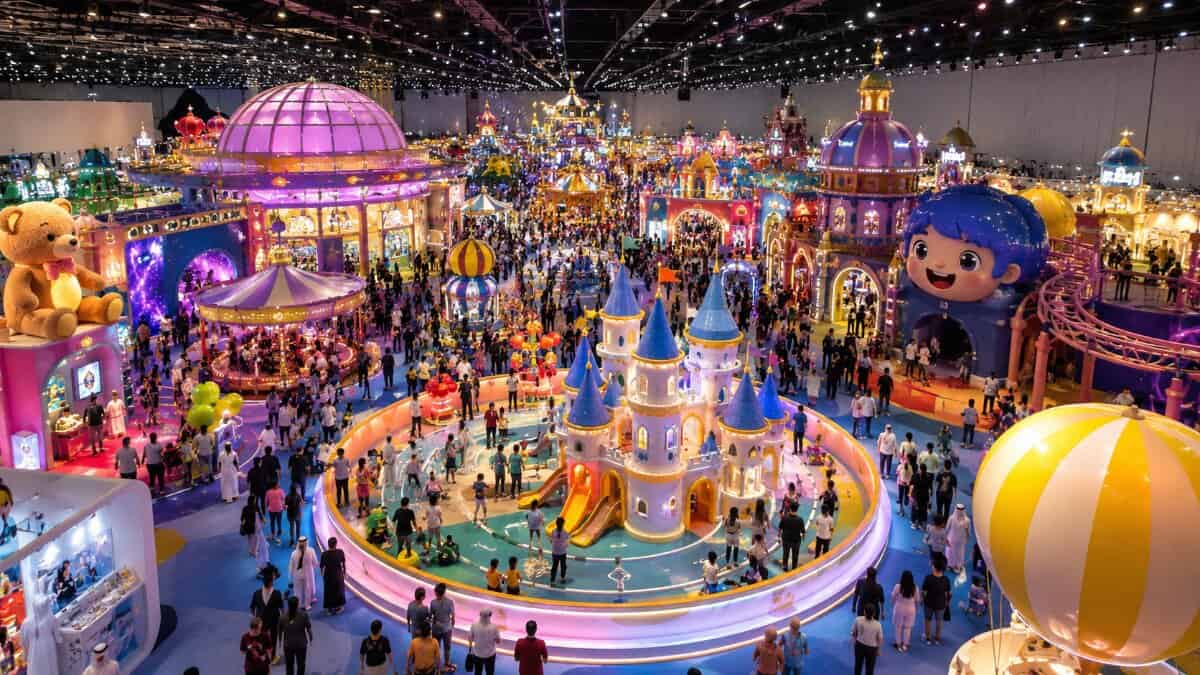
Image generated with Ai
Qatar is strengthening its peak-summer family tourism proposition through the fourth Qatar Toy Festival, running at the Doha Exhibition and Convention Centre until 31 July 2026. The indoor event occupies more than 22,000 square metres across four halls. It combines five themed islands, seven broader entertainment zones, 33 activity corners, ten retail stores, more than 66 entertainment brands and 14 live shows each day. A children’s summer camp and Back-to-School exhibition extend its educational value, while children with special needs receive free festival admission.
The Qatar Toy Festival opened on 1 July and will continue until 31 July at the Doha Exhibition and Convention Centre in West Bay. General festival hours run from 2pm to 10pm on weekdays and from 2pm to 11pm between Thursday and Saturday. These afternoon and evening operating times reduce the need for families to travel during the most intense part of the day.
Advertisement
This timing carries particular importance in July. Official destination guidance places Qatar’s average July temperature at about 36°C, with summer highs sometimes exceeding 40°C. Qatar Civil Aviation Authority climate information also identifies July as the second month of summer, with a higher mean air temperature than June. Visit Qatar advises travellers to use air-conditioned attractions during late mornings and afternoons.
The festival therefore operates as more than a children’s entertainment event. It gives Qatar a controlled, climate-resilient visitor attraction during a month when outdoor activity requires careful planning.
Advertisement
Advertisement
| Festival operating detail | Verified 2026 information | Traveller relevance |
|---|---|---|
| Festival dates | 1–31 July | Supports weekend breaks and longer family stays |
| Main operating hours | 2pm–10pm on weekdays | Keeps the experience inside during peak afternoon heat |
| Extended hours | 2pm–11pm from Thursday to Saturday | Creates additional evening capacity |
| Event footprint | More than 22,000 square metres | Enables multiple experiences within one indoor venue |
| Venue allocation | Four exhibition halls | Helps distribute crowds and activities |
| Entertainment structure | Seven themed zones | Provides age-specific activity choices |
| Activity corners | 33 | Allows families to build personalised itineraries |
| Entertainment brands | More than 66 | Expands international character and product appeal |
| Live programme | 14 shows daily | Gives repeat visitors changing reasons to attend |
| Retail component | Ten stores | Adds toy shopping and merchandise spending |
| Accessibility benefit | Free entry for children with special needs | Improves inclusion and family affordability |
Official opening information confirms the 22,000-square-metre footprint, four halls, seven zones, 33 activity corners, more than 66 brands and 14 daily shows. The Visit Qatar event listing separately identifies five islands and ten retail stores. The five islands are internal themed festival sections and should not be described as geographical islands.
The festival uses several overlapping formats to avoid functioning as a single-stage attraction. Interactive games, live entertainment, workshops, character encounters, science demonstrations, music, dancing and merchandise retail are distributed across its halls.
Official promotional information highlights dedicated experiences linked to well-known family entertainment properties, an escape-room concept and physical gaming activities for teenagers. The programme also includes character encounters and stage-based learning. This gives the festival a wider age range than a conventional toy fair.
The opening-day operational inventory records 33 activity corners rather than the almost 30 entertainment corners promoted before the event opened. For publication accuracy, 33 is the strongest current figure because it reflects the post-opening festival configuration.
Advertisement
Advertisement
This mixed structure matters commercially. A family with children of different ages can spend several hours at the venue without relying on one performance or attraction. Longer dwell time can also increase food, beverage and retail spending inside the event and across the surrounding West Bay district.
The Qatar Toy Festival Summer Camp returned for its second edition on 5 July and is scheduled to continue until 30 July. It operates from 8am to 1pm and covers children aged four to 12 through three age bands.
Activities include hands-on science, sport, art, games and creative learning. Children also receive prizes and personalised participation certificates. The camp creates a daytime product that is separate from the main afternoon and evening festival schedule.Summer camp component Programme detail Operating period 5–30 July 2026 Daily hours 8am–1pm Eligible ages Four to 12 Age groupings Four to six, six to nine and nine to 12 Learning areas Science, sport, art, games and creative activities Visitor benefit Structured indoor activity during school holidays Tourism value Supports longer stays and repeat venue visits
For travel planners, the camp opens a different packaging opportunity. Parents can combine a structured morning programme with hotel leisure facilities, shopping, museums or the main festival later in the day. However, agents must distinguish camp access from general festival admission and confirm availability before building it into a package.
A new Back-to-School exhibition is planned for the final week of the festival. It will combine educational stage presentations, promotions, competitions and school-related personalisation activities.
Children will be able to customise items such as backpacks, pencil cases and water bottles. This positions the festival’s closing phase close to the school preparation cycle and gives families an additional practical reason to attend.
The extension also reduces the risk of demand becoming concentrated around the opening period. A changing programme can encourage repeat visits from Qatar residents while giving late-July international arrivals a distinct experience.
The Doha Exhibition and Convention Centre is normally associated with conferences, exhibitions and corporate events. The Qatar Toy Festival shows how Qatar can repurpose major MICE infrastructure for seasonal leisure demand.
DECC has a total site footprint of 47,700 square metres and 29,035 square metres of pillar-free exhibition space. Its five main exhibition halls range from 5,368 to 7,160 square metres. The centre also has a 9,000-square-metre foyer with food, beverage and visitor services.
The festival’s footprint of more than 22,000 square metres represents roughly three-quarters of DECC’s published pillar-free exhibition capacity. That scale gives organisers space for parallel shows, retail, physical play, workshops and crowd circulation without exposing families to outdoor temperatures.
DECC is served by the Red Line through DECC Metro Station. Bus route 777, taxis, private cars and hotel transfers also provide access. The venue is approximately a 20-minute drive from Hamad International Airport under normal conditions.DECC infrastructure Published capacity or facility Tourism implication Total site footprint 47,700 square metres Supports large-scale events in central Doha Pillar-free exhibition space 29,035 square metres Allows flexible themed layouts Exhibition halls Five Enables simultaneous attractions Foyer and concourse 9,000 square metres Supports circulation and visitor services Airport access About 20 minutes by road Suitable for short breaks and stopovers Public transport DECC Metro Station on the Red Line Reduces dependence on private vehicles Nearby accommodation More than 20 hotels and over 6,000 rooms Enables walkable or short-transfer packages Accessibility Wheelchair-accessible public areas and reserved parking Supports inclusive family travel
The centre’s public areas are wheelchair accessible. Reserved parking is available, and wheelchairs can be provided subject to availability. These venue provisions complement the festival’s free-entry policy for children with special needs.
The festival sits within Visit Qatar’s Hala Summer programme, which runs from 1 May to 30 September 2026. The campaign combines events with hotel and attraction benefits rather than promoting entertainment as an isolated product.
Approximately 100 participating hotels are included. The programme provides family benefits such as selected free stays, meals and activities for children, flexible booking conditions, free cancellation options, early check-in and late check-out, subject to each provider’s terms.
Children under 12 can receive selected Kids Go Free benefits. One child may benefit for each paying adult. Participating guests can also unlock attraction benefits through the Visit Qatar digital wallet.
This integration is important for conversion. A festival alone may generate local attendance. A festival linked to hotel inventory, transport, attractions and flexible booking terms becomes a tourism product that agents can sell to GCC families and international stopover passengers.
Qatar received 5.1 million international visitors in 2025, an increase of 3.7 per cent. GCC markets generated 35 per cent of arrivals, while Europe contributed 25 per cent. Air travel accounted for 61 per cent of entries, compared with 32 per cent by land and seven per cent by sea.
Accommodation supply reached 42,469 room keys by the end of 2025. Full-market occupancy averaged 71.3 per cent, while room nights sold increased by 8.6 per cent to 10.84 million.Qatar tourism indicator 2025 result Strategic relevance International visitors 5.1 million Establishes a substantial inbound market Annual visitor growth 3.7 per cent Shows continued post-event expansion GCC visitor share 35 per cent Identifies a core short-haul family market European visitor share 25 per cent Supports long-haul and stopover potential Air arrivals 61 per cent Highlights the role of aviation connectivity Land arrivals 32 per cent Supports regional drive tourism Accommodation supply 42,469 keys Provides capacity for event-led packages Full-market occupancy 71.3 per cent Shows solid annual hotel utilisation Room nights sold 10.84 million Demonstrates accommodation demand July hotel occupancy 60 per cent Confirms a measurable summer demand gap
July 2025 hotel occupancy stood at 60 per cent, below the 71.3 per cent annual average. It was also one of the softer months in the official accommodation cycle.
That gap explains the commercial value of a month-long indoor anchor. Even a modest increase in family arrivals, stay duration or local hotel use can help improve summer room consumption across a large accommodation base.
The festival reflects a practical form of climate adaptation in destination management. Qatar is not attempting to market July as an outdoor sightseeing month. It is organising the visitor day around indoor entertainment, morning camps, afternoon festival access, evening dining, malls, museums and hotel facilities.
Three components make the model commercially stronger.
First, the attraction operates for an entire month. This gives airlines, hotels and tour operators enough inventory to build repeatable packages rather than one-weekend promotions.
Second, DECC sits inside a mature visitor district. Metro access, thousands of nearby hotel rooms, shopping and dining reduce transfer friction and allow families to remain within a compact, air-conditioned tourism ecosystem.
Third, the festival connects entertainment with education, retail and inclusion. The summer camp can lengthen stays. The Back-to-School exhibition can stimulate late-month demand. Free entry for children with special needs broadens access and strengthens the destination’s family positioning.
The economic impact cannot be measured from event scale alone. Verified attendance, hotel conversion, average spend and visitor-origin data will be required after July. Nevertheless, the operating design directly addresses Qatar’s documented summer occupancy gap.
The 2026 Qatar Toy Festival gives Doha a large, accessible and bookable family attraction during the most climate-sensitive part of the year. Its value lies in the combination of scale, duration, education, retail, hotel benefits and transport-connected indoor infrastructure.
The model could influence wider Gulf destination planning. Exhibition venues that traditionally depend on business calendars can support leisure tourism during seasonal gaps. Hotels can attach family benefits to event admission. Airlines and agents can build short-break products around predictable indoor programming.
For Qatar, the long-term test will be whether such events improve July hotel occupancy, increase average stay and convert regional families into repeat summer visitors. The festival provides the infrastructure and programme needed to pursue those outcomes. Verified post-event attendance and accommodation data will determine how strongly it changes Qatar’s summer tourism performance.
Advertisement
Tags: Doha Exhibition and Convention Centre, Doha Family Tourism, Hala Summer Qatar, Qatar summer events, Qatar Toy Festival 2026
Advertisement
Advertisement













Friday, September 4, 2026

Friday, September 4, 2026

Friday, September 4, 2026

Thursday, September 3, 2026

Wednesday, September 2, 2026
Friday, September 4, 2026

Friday, September 4, 2026