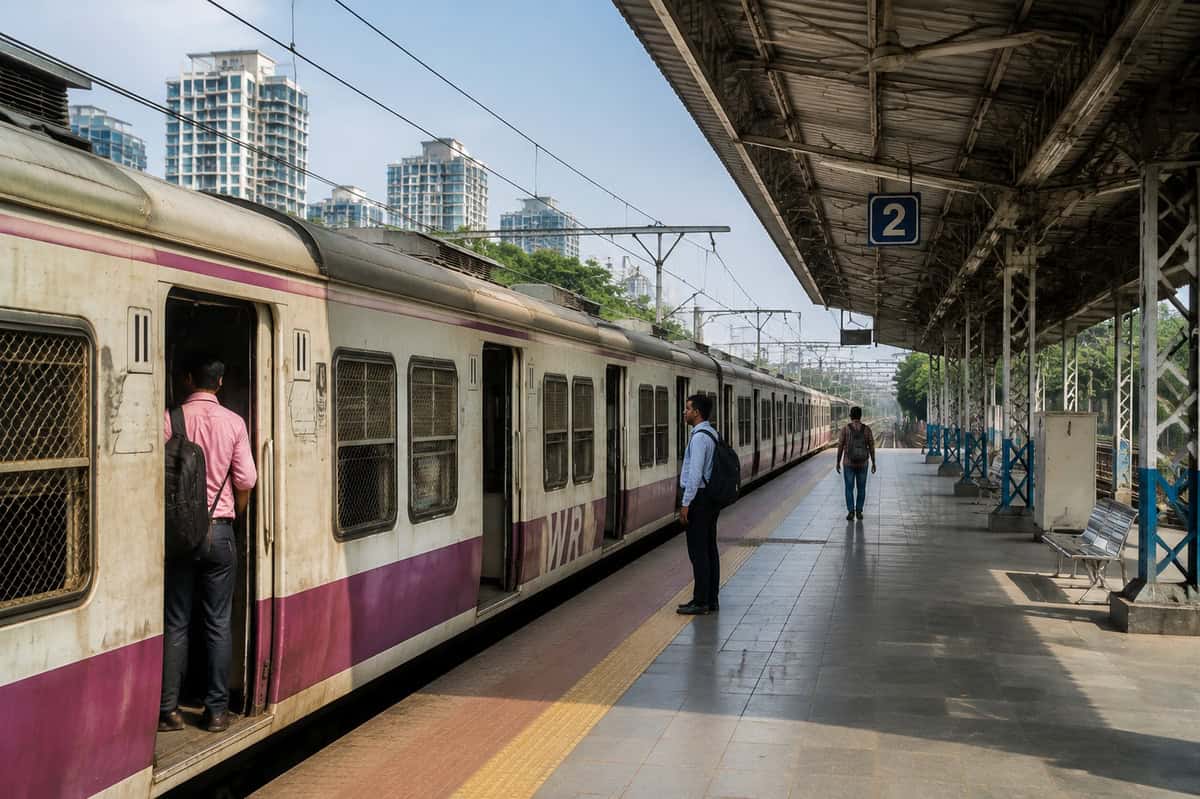
Image generated with Ai
Mumbai Metro expansion is changing how people travel each day across the city because local train ridership fell by 44.65 lakh passengers from April to June 2026. This drop is connected to Metro links on key suburban corridors, such as Borivali‑Dahisar and Andheri, where commuters now have more transport options. The data does not show how many commuters moved from trains to Metro services but the new ridership patterns show a big change in Mumbai’s urban mobility system. Meanwhile the growing demand, for AC trains shows commuters are looking more for comfort, convenience and better travel experiences.
Mumbai’s suburban railway system, long considered the backbone of the city’s daily commute, recorded a decline of nearly 44.65 lakh passengers during the April-June 2026 quarter compared with the previous year. The reduction comes amid the rapid expansion of Metro connectivity across several parts of the city, offering commuters additional travel options beyond traditional local trains.
Advertisement
Passenger data from Western Railway’s Mumbai Central Division shows that suburban railway traffic decreased by 1.71%, falling from 26.04 crore passengers in the April-June period of 2025 to 25.60 crore during the same quarter in 2026.
The decline has been observed mainly along corridors where Metro services now provide alternative connections, including areas around Borivali-Dahisar and Andheri. However, the available figures do not establish the exact number of passengers who moved from suburban trains to Metro services, as changes in ridership can be influenced by multiple transport and lifestyle factors.
Advertisement
Advertisement
The reduction in suburban railway usage was most visible among regular non-AC passenger categories.
Second Class services, which account for the largest portion of Mumbai’s railway commuters, witnessed a decline of about 3%. Passenger numbers dropped from 21.94 crore during April-June 2025 to 21.28 crore in the same period of 2026.
First Class travel experienced a larger decrease, with ridership falling by 7.23%. Passenger numbers reduced from 2.74 crore to 2.54 crore during the quarter.
The decline reflects a changing urban mobility environment where commuters are increasingly evaluating different transport options based on speed, convenience, reliability and comfort.
Meanwhile, AC suburban services moved in the opposite direction. Passenger numbers using AC journey and season tickets increased from around 1.37 crore to 1.78 crore, representing growth of nearly 30%.
The rise in AC local travel highlights stronger demand for premium commuting experiences. However, the increase may partly be linked to existing First Class and Second Class passengers upgrading their travel category rather than only attracting new users.
The growth of Mumbai’s Metro network has introduced fresh competition for suburban railway services, particularly along routes where both systems provide connectivity.
Metro corridors covering sections of the Borivali-Dahisar route recorded significant passenger movement during the quarter. The Yellow and Red Metro lines reportedly handled around 2.26 crore passenger rides between April and June 2026, averaging nearly 2.48 lakh journeys each day.
The Aqua Line, which provides another option for commuters travelling through parts of the Andheri and south Mumbai corridor, recorded around 1.65 crore passenger rides during the same period, with average daily usage of approximately 1.82 lakh journeys.
Together, these Metro routes accounted for nearly 3.91 crore passenger movements during the quarter.
Although Metro ridership growth indicates increasing acceptance of alternative transport options, the available data does not directly measure how many local train passengers have shifted to Metro services. Commuter behaviour is influenced by several factors, including route convenience, travel duration and service availability.
Andheri has emerged as one of the major railway stations showing a noticeable change in passenger trends.
First Class journey ticket sales at Andheri declined by 15.02%, while Second Class journey ticket sales reduced by 6.51%. The station’s position on important east-west and north-south travel routes has made it a key point where new Metro connectivity is influencing commuter choices.
Several other stations also reported significant reductions in ticket sales. Mahalaxmi recorded a 19.18% decline in First Class journey tickets, followed by Marine Lines with a 15.66% drop, Andheri with 15.02%, Mira Road with 13.32% and Prabhadevi with 12.26%.
Season ticket usage also declined sharply at some locations. Mahalaxmi and Prabhadevi recorded substantial reductions in both First Class and Second Class season ticket categories.
Despite the overall fall in suburban railway passenger numbers, AC local trains continued to attract increasing demand across Mumbai.
Lower Parel recorded a major rise of 175% in AC journey ticket sales. Ram Mandir followed with a 156% increase, while Goregaon and Khar Road recorded growth of 127% and 115%, respectively.
Goregaon also reported a strong increase in AC season ticket sales, rising by 164.50%.
The growing popularity of AC trains reflects a broader shift in commuter expectations. Passengers are increasingly looking beyond affordability and prioritising a more comfortable and convenient daily travel experience.
The latest ridership trends indicate that Mumbai’s public transport system is undergoing a significant transformation. The suburban railway network continues to carry millions of passengers every day, but Metro expansion is creating a more diverse mobility environment.
The decline in conventional local train categories, combined with the rapid growth of AC suburban services, suggests that commuter preferences are evolving. Comfort, reliability and travel efficiency are becoming increasingly important factors in daily transport decisions.
Mumbai is growing fast. Mumbais future urban mobility will rely on better coordination between suburban rail, Metro networks and other transport systems. A integrated approach is essential to keep Mumbais rising population, with efficient and accessible travel options.
Advertisement
Tags: India, mumbai metro, Railway News, Travel News
Advertisement
Advertisement












Wednesday, September 2, 2026

Tuesday, September 1, 2026

Wednesday, September 2, 2026

Wednesday, September 2, 2026
Tuesday, September 1, 2026
Tuesday, September 1, 2026

Tuesday, September 1, 2026

Tuesday, September 1, 2026



