
Budapest Joins Katowice and Five Other Routes as Wizz Air Abu Dhabi Services Face January Delays

Published
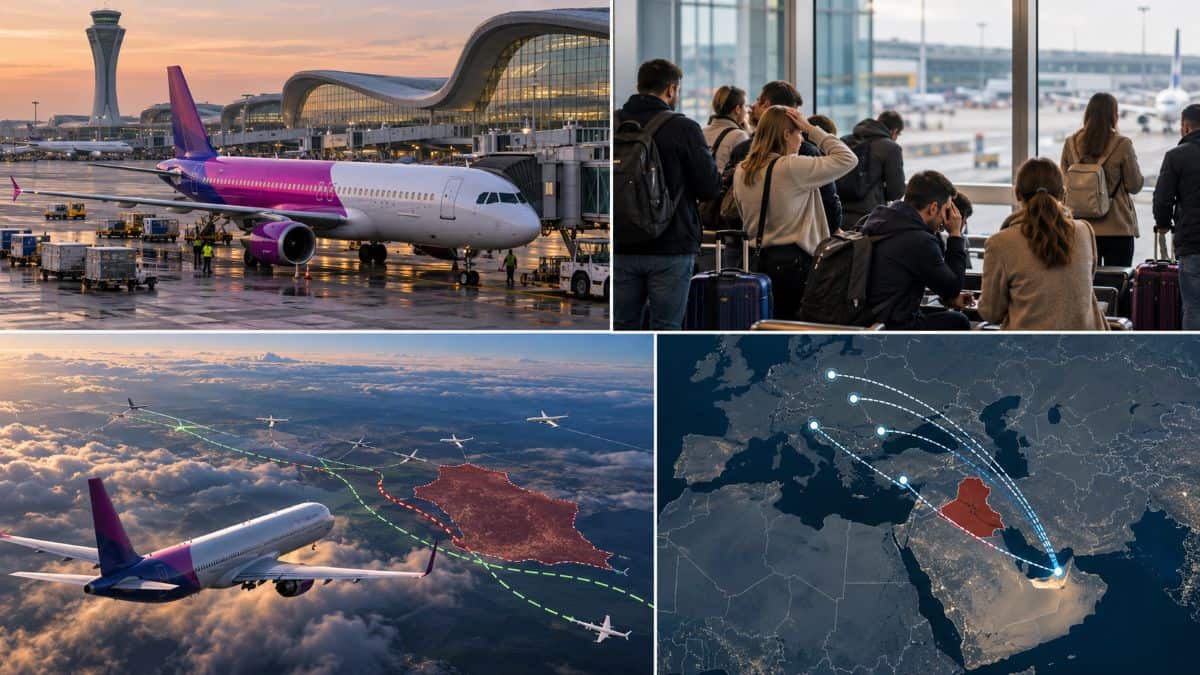
Wizz Air has postponed the return of six Abu Dhabi routes from late October to January 10, 2027, after continued Iraqi airspace restrictions complicated flight operations. The decision affects services connecting Zayed International Airport with Budapest, Katowice, Kraków, Sofia, Cluj-Napoca and Larnaca. Together, the six routes represented 20 planned weekly flights.
The Hungarian low-cost carrier had announced the services as part of a wider Middle East winter expansion. However, Wizz Air now says the latest European Union Aviation Safety Agency (EASA) security assessment and restrictions affecting Iraqi airspace require longer routings. Those changes can also force Airbus A321neo aircraft to make technical refuelling stops, pushing fuel and operating costs higher.
Six Routes Face a Winter Delay
The postponed services were originally scheduled to return in two stages. Budapest and Katowice were due to restart on October 25, while Kraków, Sofia, Cluj-Napoca and Larnaca were scheduled for October 27.
All six services will now share the revised January 10, 2027 launch date. The change removes 20 planned weekly flights from the original late-October schedule until the new start date.
Advertisement
Advertisement
| Route | Original Restart | Planned Weekly Flights | Revised Start |
|---|---|---|---|
| Abu Dhabi–Budapest | October 25, 2026 | 4 | January 10, 2027 |
| Abu Dhabi–Katowice | October 25, 2026 | 5 | January 10, 2027 |
| Abu Dhabi–Kraków | October 27, 2026 | 3 | January 10, 2027 |
| Abu Dhabi–Sofia | October 27, 2026 | 3 | January 10, 2027 |
| Abu Dhabi–Cluj-Napoca | October 27, 2026 | 2 | January 10, 2027 |
| Abu Dhabi–Larnaca | October 27, 2026 | 3 | January 10, 2027 |
| Total | — | 20 | January 10, 2027 |
The revised timetable matters particularly for travellers who booked autumn or early-winter journeys around the original launch dates. Wizz Air has said affected customers will be contacted about their available options.
For passengers, however, the issue extends beyond a simple schedule adjustment. The delay demonstrates how geopolitical risk can quickly reshape commercial aviation plans, even after tickets have gone on sale.
Advertisement
Advertisement
Iraqi Airspace Remains a Key Constraint
The operational pressure centres on Iraqi airspace. EASA currently lists a Conflict Zone Information Bulletin covering Iraq, with operators advised not to fly through Baghdad FIR at any altitude or flight level. The current advisory identifies continuing risks linked to military activity, air-defence systems, missile and drone threats, and violent non-state actors.
EASA’s conflict-zone framework requires airlines to consider security risks when planning routes. The agency says operators should monitor developments and follow applicable airspace restrictions and aviation authority guidance.
Advertisement
Advertisement
The wider Middle East framework has also evolved during 2026. EASA withdrew its earlier broad regional bulletin in July and replaced it with more targeted advisories covering specific higher-risk areas. Separate active advisories now cover Iraq, Iran, Lebanon, Jordan and parts of the Persian Gulf region.
That distinction is important for travellers. An airline can continue serving a destination while avoiding specific airspace corridors. However, avoiding restricted areas can substantially alter the economics of individual routes.
Longer Flights Change the Economics
Aircraft do not simply draw a straight line between two airports. Airlines build routes around airspace restrictions, weather, traffic-management constraints, aircraft performance and fuel planning.
When a restricted corridor forces an aircraft to take a longer path, the airline may burn more fuel and require additional contingency planning. Wizz Air says the affected A321neo services could also require technical refuelling stops under the current routing conditions.
Advertisement
Advertisement
The commercial effect becomes sharper for an ultra-low-cost carrier. A longer flight can increase fuel consumption, crew utilisation, aircraft hours and airport-related costs. A technical stop can also consume valuable aircraft time that could otherwise support another scheduled service.
| Operational Factor | Potential Effect on Airline | Passenger Relevance |
|---|---|---|
| Iraqi airspace restrictions | Longer routing | Longer journey times |
| Increased flight distance | Higher fuel consumption | Potentially higher operating costs |
| Technical refuelling | Additional operational stop | Longer overall journey |
| Higher fuel prices | Greater cost per sector | Pressure on route profitability |
| Aircraft utilisation | More time per rotation | Fewer opportunities for additional flights |
| Security assessments | Schedule flexibility required | Launch dates can change |
Wizz Air has therefore characterised the affected services as commercially unviable under present conditions. The airline’s decision reflects the combined impact of security restrictions and operating economics, rather than a simple change in passenger demand.
Abu Dhabi Remains a Major Gateway
The postponement comes against a backdrop of rapid growth at Zayed International Airport. Abu Dhabi Airports reported 32.5 million passengers at AUH in 2025, a 12.6% increase from the previous year. The airport crossed the 30-million-passenger threshold for the first time.
The airport’s Terminal A has an annual capacity of 45 million passengers. Abu Dhabi Airports says the terminal can process up to 11,000 passengers per hour and connects the UAE capital with more than 100 international destinations.
That growth gives the postponed Wizz Air services a broader strategic context. The six routes would strengthen Abu Dhabi’s links with Central and Eastern Europe, particularly Poland, Hungary, Bulgaria and Romania.
The delay does not therefore signal weakening demand for Abu Dhabi. Instead, it highlights the operational difficulties facing airlines attempting to restore capacity while regional airspace remains subject to evolving security assessments.
Advertisement
Advertisement
Wizz Air Had Planned a Bigger Return
The delayed services formed part of Wizz Air’s broader Middle East comeback announced on September 10. The airline planned 12 routes and 49 weekly flights connecting European cities with Abu Dhabi, Dubai, Jeddah and Amman during the winter season.
Wizz Air projected around 470,000 seats across those returning services. The original announcement also included fares starting from €24.99, although individual routes carried different advertised starting fares.
The September schedule showed how significant Abu Dhabi was within the programme. Budapest–Abu Dhabi was planned at four weekly flights, Katowice–Abu Dhabi at five, Kraków–Abu Dhabi at three, Sofia–Abu Dhabi at three, Cluj–Abu Dhabi at two and Larnaca–Abu Dhabi at three.
That combination produced the 20 weekly flights now postponed.
| Wizz Air Middle East Winter Plan | Original Programme |
|---|---|
| Destinations | 4 |
| Total routes | 12 |
| Weekly flights | 49 |
| Planned winter seats | About 470,000 |
| Abu Dhabi routes affected | 6 |
| Abu Dhabi weekly flights affected | 20 |
Wizz Air said the wider restoration followed EASA’s regional review alongside the airline’s own operational and security assessments. The carrier also stressed that services remained subject to continuing assessments.
What Travellers Should Do Now
Travellers holding tickets for the six postponed services should not assume that the original October itinerary remains valid. They should check their booking directly with Wizz Air and monitor email, SMS and app notifications for schedule changes.
Advertisement
Advertisement
The airline’s redesigned digital journey system also provides flight-status information and notifications for changed, delayed and cancelled flights. Wizz Air introduced these features as part of its broader Customer First Compass programme.
Passengers should also review connecting arrangements. A changed flight can affect separate hotel bookings, rail tickets, airport transfers and onward flights, especially when travellers booked different providers independently.
| Traveller Situation | Sensible Action |
|---|---|
| October or November booking | Check the booking immediately |
| Trip depends on the original launch date | Reassess the entire itinerary |
| Separate connecting flight | Check connection validity before accepting changes |
| Hotel booked separately | Review cancellation and amendment conditions |
| Airport transfer booked | Confirm whether the revised date changes the booking |
| Flexible travel plans | Compare alternative dates around January 10 |
Travellers should also avoid relying solely on third-party flight-status websites. Airline notifications and airport information should take priority when a schedule has changed because of security-related operational decisions.
Central Europe Loses a Direct Link
For Central and Eastern European travellers, the postponement removes several direct links to Abu Dhabi during part of the winter season. Katowice and Kraków are particularly important because Poland accounts for two of the six affected origins.
Budapest also represents a significant regional market, while Sofia and Cluj-Napoca extend Abu Dhabi’s reach into Southeast Europe. Larnaca provides a direct connection from Cyprus into the UAE capital.
The temporary absence of these flights could influence travel choices during the autumn and early-winter period. Some passengers may switch to alternative carriers, use connecting itineraries or defer travel until Wizz Air’s revised January launch.
Advertisement
Advertisement
For Abu Dhabi, the effect is more limited within the context of the airport’s much larger international network. AUH serves more than 30 airlines and over 100 destinations, meaning the postponed Wizz Air capacity represents only one component of the gateway’s connectivity.
A Wider Test for Middle East Aviation
The episode offers a useful indicator of how modern airline planning responds to geopolitical instability. Route announcements can remain commercially attractive on paper but become difficult to operate when airspace restrictions change the underlying cost structure.
This is particularly relevant for low-cost carriers. Their business models depend heavily on aircraft utilisation, predictable rotations and disciplined cost control. A technically possible route may therefore remain commercially unattractive if it requires significant additional fuel or refuelling arrangements.
Wizz Air’s wider network illustrates the scale at which such decisions matter. The carrier said in June that it had reached 1,200 flights in a single day, carrying more than 200,000 passengers and connecting 45 countries with 185 airports.
At that scale, aircraft scheduling becomes a tightly interconnected system. A longer regional rotation can affect aircraft availability, crew planning and subsequent sectors.
January Becomes the New Target
For now, January 10, 2027 represents the new target date for all six postponed Abu Dhabi services. Whether that date holds will depend on the security environment, applicable aviation guidance, route economics and Wizz Air’s own operational assessment.
Advertisement
Advertisement
The airline has already shown that it is willing to alter its winter programme when conditions change. That approach prioritises operational viability rather than preserving a previously announced launch date at any cost.
For travellers, the immediate lesson is straightforward. A booked route can remain vulnerable to airspace developments long after an airline announces its schedule. The Abu Dhabi postponements show why travellers should monitor official airline updates closely when flying through regions affected by changing security conditions.
Abu Dhabi itself remains a rapidly expanding international aviation gateway. Yet the Wizz Air decision underlines an important reality for the winter season: regional connectivity depends not only on passenger demand, but also on safe airspace, viable routings and sustainable operating economics.
FAQs
Why has Wizz Air delayed its Abu Dhabi routes?
Wizz Air delayed six Abu Dhabi routes because Iraqi airspace restrictions are forcing longer routings and increasing operating costs.
When will the six Wizz Air Abu Dhabi routes resume?
The revised start date for all six routes is January 10, 2027.
Which Abu Dhabi routes have been postponed?
The affected routes connect Abu Dhabi with Budapest, Katowice, Kraków, Sofia, Cluj-Napoca and Larnaca.
Advertisement
Advertisement
How many weekly flights are affected?
The postponement affects 20 planned weekly flights across the six routes.
How are Iraqi airspace restrictions affecting Wizz Air?
Restrictions are forcing affected aircraft to use longer routes, with some Airbus A321neo flights potentially requiring technical refuelling stops.
Will passengers with affected bookings be contacted?
Yes. Wizz Air has said it will contact affected customers regarding their available options following the schedule change.
Advertisement
