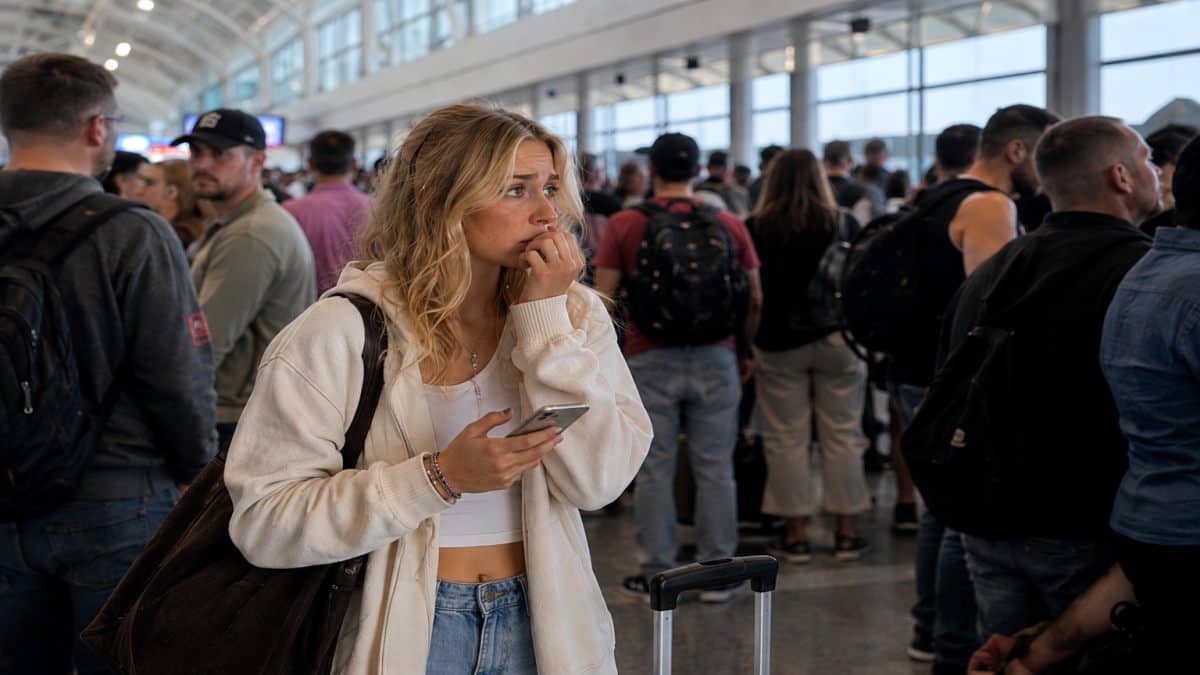
Image generated with Ai
Travelers across Asia are facing a busy day on the flight boards, with 4,224 delays and 152 cancellations recorded across major airports in China, Japan, South Korea, Indonesia, and Singapore.
The biggest numbers are concentrated in China, where one airport alone comes close to 800 delays. Yet the most interesting part is the contrast between airports: some recorded hundreds of delayed flights with only a handful of cancellations, while others saw cancellations rise despite much smaller delay totals.
Guangzhou Baiyun International Airport stands at the top of the delay count with 782 delays.
That is 304 more delays than Shanghai Pudong International Airport, which recorded 478. Hangzhou Xiaoshan International Airport followed with 305.
The busiest airports by delays were:
Advertisement
Advertisement
At Guangzhou Baiyun International Airport, the delay count was particularly notable among individual airlines. China Southern Airlines alone accounted for 341 delayed flights there.
The figures from Japan show another busy group of airports.
Tokyo International Airport (Haneda) recorded 157 delays and one cancellation, while Fukuoka Airport recorded 110 delays and four cancellations.
New Chitose Airport added 80 delays and three cancellations. Narita International Airport recorded 70 delays and six cancellations, while Osaka International Airport (Itami) had 31 delays and three cancellations.
Advertisement
Advertisement
At Narita, Jetstar Japan accounted for five of the six cancellations.
At Fukuoka, Jetstar Japan recorded two cancellations, while Japan Airlines and Fuji Dream each recorded one.
The numbers from South Korea are led by Incheon International Airport, which recorded 298 delays and four cancellations.
Jeju International Airport followed with 206 delays and two cancellations. Gimpo International Airport recorded 138 delays and two cancellations.
At Incheon, Korean Air recorded 79 delays.
That figure alone was enough to place Korean Air among the airlines with the most delays across all of the airports.
Across the airports in Asia, two airlines separated themselves from the rest.
China Southern Airlines recorded 551 delays. China Eastern was close behind with 517.
Together, the two airlines accounted for 1,068 delays.
That puts them comfortably ahead of the next airline in the ranking, Air China, which recorded 228 delays.
The top airlines by delays were:
The numbers also show how much individual airports can shape an airline’s overall total.
For China Southern Airlines, the 341 delays at Guangzhou Baiyun International Airport make up a large share of its 551-airline total. China Eastern, meanwhile, recorded 137 delays at Shanghai Pudong International Airport and another 98 at Shanghai Hongqiao International Airport.
Beijing Capital International Airport recorded 159 delays and 18 cancellations.
That makes it one of the most notable airports for cancellations, even though its delay figure is nowhere near the top of the regional ranking.
Air China accounted for 14 of the 18 cancellations at the airport.
Meanwhile, Beijing Daxing International Airport recorded 128 delays and four cancellations.
The contrast between the two Beijing airports is striking: Capital recorded 31 more delays and 14 more cancellations than Daxing.
Jakarta-Soekarno-Hatta International Airport recorded 207 delays and 22 cancellations.
That 22-cancellation figure was the highest at any airport across Asia.
Batik Air accounted for 16 of those cancellations, giving the airline the third-highest cancellation total across all airlines.
Juanda International Airport recorded another six cancellations, all attributed to Citilink.
Singapore Changi Airport recorded 182 delays but only one cancellation.
The lone cancellation came from Singapore Airlines.
The airport’s figures also included 51 delays for Singapore Airlines and 38 for Scoot.
That makes Changi one of the clearest examples of a high-delay airport where cancellations remained relatively low.
Across Asia, the day’s figures show that delay totals and cancellation totals can move in very different directions.
Guangzhou Baiyun International Airport recorded the highest delay count at 782, but only six cancellations.
By comparison, Chengdu Tianfu International Airport had just 108 delays but 20 cancellations.
Jakarta-Soekarno-Hatta International Airport recorded 207 delays and 22 cancellations, the highest cancellation count among the 22 airports.
Then there is Singapore Changi Airport, with 182 delays and just one cancellation.
For travelers across Asia checking an airport board today, those differences matter. A large delay figure does not automatically mean a large number of cancellations, and the airport with the most cancellations may look very different from the airport with the most delays.
The data has been extensively curated by our editorial team using real-time aviation figures recorded on 31 August 2026 at 2:03 pm ET USA (11:33 pm IST)
Primary Source: FlightAware.
Verification Protocol: All statistics have been independently reviewed and cross-checked by our human editorial desk. Timestamped records, data logs and feed snapshots are securely archived internally to support historical accuracy and editorial transparency.
Note: Real-time flight-tracking figures reflect active airspace and operational data. Minor variations may occur when compared with information displayed at individual airport terminals or airline departure gates.
Travellers are advised to check directly with their respective airlines and airports for the latest flight status, schedule changes and operational updates.
Advertisement
Tags: Asia flight cancellations today, Asia flight delays today, China Flights Cancelled Today, Japan cancelled flights today, Tokyo International Airport Cancellations Today
Advertisement
Advertisement












Wednesday, September 2, 2026

Tuesday, September 1, 2026

Wednesday, September 2, 2026

Wednesday, September 2, 2026
Tuesday, September 1, 2026

Tuesday, September 1, 2026

Tuesday, September 1, 2026

Tuesday, September 1, 2026