
South Asia Shockwave as Noida International Airport Targets 225 Million Passengers in 12-Million Phase One Launch and What Others Are Missing in the Aviation Power Shift

Published
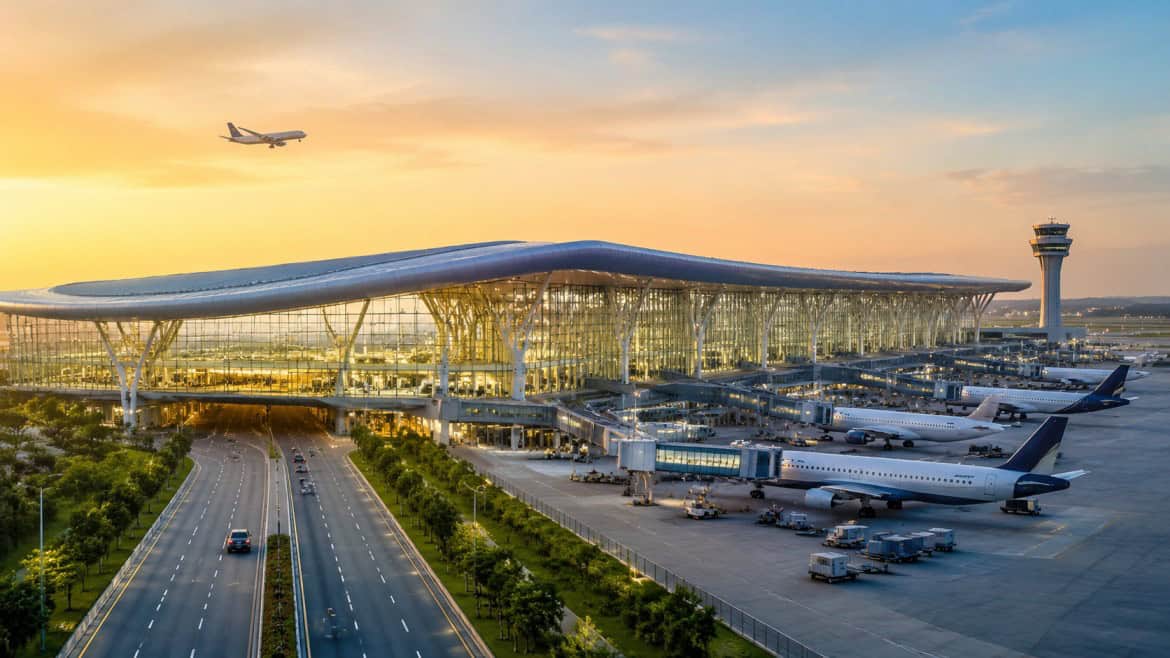
A major aviation shift is underway in North India as Noida International Airport (DXN) begins commercial operations on 15 June 2026. The development is already altering travel flows across the Delhi National Capital Region.
This matters now because congestion at Delhi’s main hub is forcing airlines and passengers to seek alternatives immediately. The new airport is positioned as a pressure-release valve for the overburdened Indira Gandhi International Airport (DEL) network.
Advertisement
Advertisement
The impact is direct. Airlines, daily commuters, students, tourists, and corporate travellers are already shifting patterns. With early operations live and rapid expansion scheduled, North India’s aviation map is being redrawn in real time.
A Strategic Opening That Reshapes Delhi NCR Aviation
The launch of Noida International Airport marks one of India’s most significant aviation infrastructure additions in recent years. Located in Jewar, Uttar Pradesh, the airport is designed to serve Noida, Greater Noida, and western Uttar Pradesh.
Advertisement
Advertisement
Unlike incremental upgrades at existing airports, this is a greenfield transformation. It introduces a parallel aviation ecosystem that reduces dependency on Delhi’s saturated air traffic system.
Authorities expect the airport to ease operational pressure while improving regional connectivity across one of India’s fastest-growing economic corridors.
Advertisement
Advertisement
Key early goals include:
- Reducing congestion at Delhi IGI Airport
- Expanding aviation access for western Uttar Pradesh
- Supporting industrial and tourism growth in the NCR belt
Why Delhi Congestion Is Forcing a Structural Aviation Shift
Delhi’s aviation demand has outgrown single-airport capacity. The region now requires distributed infrastructure rather than centralised flow management.
Advertisement
Advertisement
This is where Noida becomes critical. It is not simply a secondary airport. It is a parallel aviation spine.
The shift is driven by:
- Rising passenger volumes across North India
- Increasing corporate travel demand in NCR
- Tourism growth linked to Agra and heritage circuits
- Airline network optimisation strategies
Instead of expanding vertically at a single airport, India is now expanding horizontally across multiple aviation nodes.
This structural change is what many analysts are overlooking.
Advertisement
Advertisement
Route Expansion: Early Airline Network Already Scaling
Initial operations are led by IndiGo (6E) and Akasa Air (QP), both aggressively expanding domestic connectivity.
Current operational routes include:
- Bengaluru
- Hyderabad
- Jammu
- Amritsar
- Navi Mumbai
Akasa Air is already running daily Bengaluru and Navi Mumbai services, while IndiGo operates multiple daily links to key northern and southern cities.
From July 2026, expansion accelerates sharply. New IndiGo routes include:
- Chandigarh
- Jaipur
- Jodhpur
- Bareilly
- Bhopal
- Dehradun
- Dharamshala
- Kishangarh
This rapid scaling signals that DXN is being positioned as a domestic distribution hub rather than a limited feeder airport.
Connectivity Advantage: The Agra–Taj Mahal Travel Game Changer
One of the most powerful strategic advantages of DXN is its proximity to Agra.
Advertisement
Advertisement
The airport is located approximately 139 km from the Taj Mahal, making it a faster gateway compared to Delhi for many travellers.
The Yamuna Expressway enables travel times of around two hours to Agra, significantly improving tourism efficiency.
This unlocks:
- Faster access to the Taj Mahal circuit
- Reduced congestion-driven delays from Delhi routes
- Stronger weekend tourism flows
- Improved domestic travel packaging for tour operators
This is where tourism economics begin to shift, not just aviation logistics.
Infrastructure Blueprint: Built as a Multi-Phase Megaproject
The airport spans nearly 1,334 hectares, making it one of India’s largest planned aviation sites.
The development is structured across four major phases:
Advertisement
Advertisement
Phase One
- Operational runway
- Integrated passenger terminal
- Air traffic control tower
- Capacity: up to 12 million passengers annually
Long-Term Expansion
- Five runways planned
- Massive terminal scaling
- Cargo and logistics integration
- Multimodal transport connectivity
This design is aligned with long-term national aviation strategy and regional economic planning frameworks supported by Indian aviation authorities and infrastructure planners.
Future Vision: A 225 Million Passenger Global Hub
When fully developed, Noida International Airport is expected to handle up to 225 million passengers annually.
This positions it among the largest airport ecosystems globally.
The vision is not limited to air travel. It includes:
- Retail expansion zones
- Global dining and hospitality clusters
- Integrated transport corridors
- Smart mobility and road-air connectivity systems
Retail brands already planned include major food and beverage chains and travel retail outlets, signalling a shift toward an airport-city model.
What Travellers Gain Immediately
Even in its early phase, the airport delivers immediate user benefits:
Advertisement
Advertisement
- Reduced congestion compared to Delhi IGI
- Faster boarding and terminal processing
- Improved access for NCR residents outside central Delhi
- Shorter road travel to airport for western UP passengers
- Increasing flight frequency and choice
For passengers, this is not a future promise. It is an active alternative already in motion.
The Overlooked Economic Angle: Beyond Aviation Infrastructure
What many analyses miss is the broader economic redistribution underway.
DXN is not only an airport project. It is a regional economic catalyst.
It is expected to:
- Shift tourism revenue toward western Uttar Pradesh
- Strengthen industrial logistics corridors
- Reduce dependency on Delhi-centric aviation flows
- Create aviation-linked employment clusters
- Encourage hotel and hospitality expansion near Jewar and Agra corridor
This is the real story: decentralisation of economic gravity from Delhi to emerging satellite nodes.
Final Outlook: A New Aviation Geography Emerges
The launch of Noida International Airport (DXN) is not just an infrastructure milestone. It is the beginning of a redesigned aviation geography for North India.
Advertisement
Advertisement
With a 225 million passenger long-term vision and rapid route expansion already underway, the airport is set to become a defining pillar of India’s aviation future.
Travellers, airlines, and investors are now watching the same signal: the Delhi NCR aviation monopoly is ending, and a multi-airport system is beginning.
Call to Action:
As connectivity expands month by month, travellers should actively reassess flight options from DXN for faster access, better routing, and reduced congestion. The next phase of Indian aviation has already begun.
Advertisement
