
Singapore Leads Asia’s New Travel Shift as Airlines Upgrade Connectivity and Destinations Rethink Tourism

Published
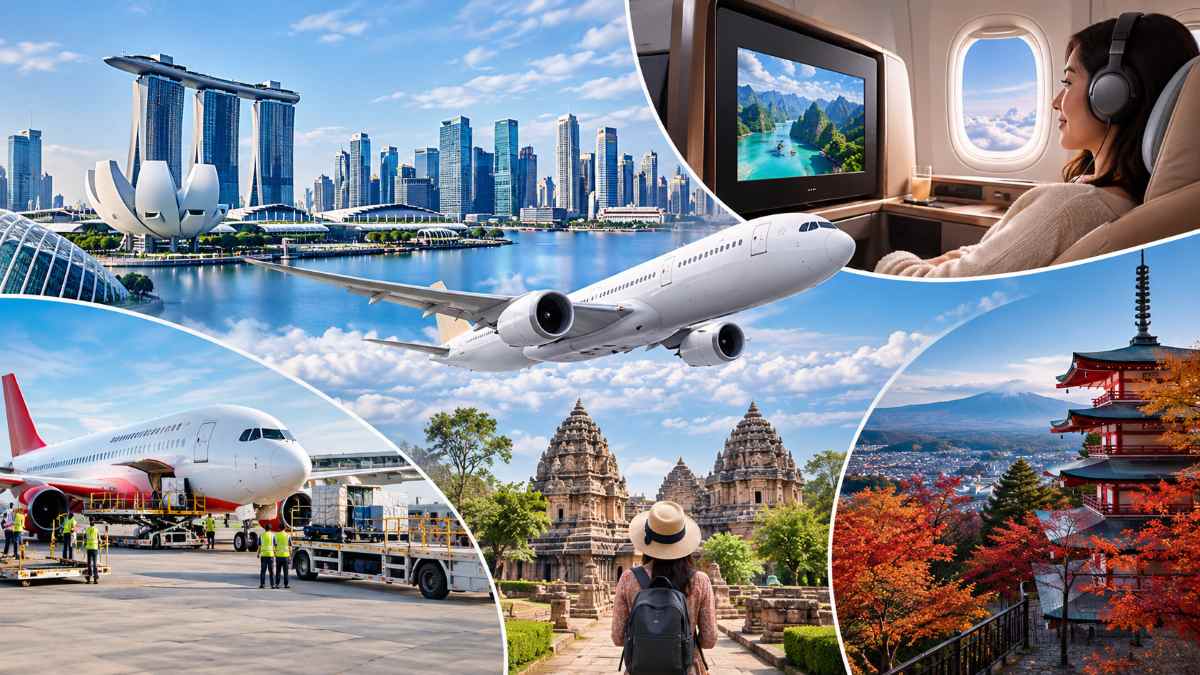
The travel industry in Asia is now in the midst of a transitional phase, with airlines focused on improving their passengers’ experience and building a robust system. There are many examples from Singapore and Vietnam that highlight the response of the aviation sector to the emerging trends in passenger expectations and the business environment. In addition, there are initiatives in India to develop heritage tourism and initiatives in Japan to solve the problems of tourism congestion. It can be observed that the various initiatives are taking various forms but have a common goal in mind.
Singapore Airlines Raises the Standard for Long-Haul In-Flight Entertainment
Singapore Airlines has announced a major upgrade to its KrisWorld in-flight entertainment platform, introducing 4K high-resolution touchscreen displays, spatial audio, Bluetooth headphone connectivity and a redesigned digital interface. The announcement, made on 22 October 2026, forms part of a wider effort to improve the long-haul passenger experience.
The new system will offer more than 2,500 entertainment options, including films, television programmes, music and podcasts. A redesigned interface will make it easier for passengers to search for content, browse categories and continue watching programmes while checking other flight information. A wellness planner will also provide sleep and meditation content, breathing exercises and in-seat stretches.
The upgrade is planned for 41 retrofitted Airbus A350-900 long-haul and ultra-long-range aircraft, with the aircraft expected to enter service progressively from 2027. The system will also feature on the airline’s upcoming Boeing 777-9 aircraft. Screen sizes and specifications will vary by aircraft and cabin class, with First Class displays reaching 32 inches.
Advertisement
Advertisement
Connectivity is another part of the plan. Singapore Airlines intends to introduce Starlink high-speed connectivity progressively from early 2027 on selected A380 and A350 aircraft. This is expected to allow passengers to stream content, use social media, play games and work on their personal devices during flights.
The announcement reflects a wider shift in long-haul competition. Airlines are increasingly competing through the overall journey, including digital entertainment, connectivity, cabin comfort and personalised services, rather than relying only on routes and seating capacity.
Advertisement
Advertisement
Vietnam Strengthens Aviation Supply Chains Through Vietjet and Satair Partnership
Vietnam’s aviation sector is also focusing on the infrastructure behind international expansion. Vietjet and Satair, an Airbus Services company, exchanged a strategic Memorandum of Understanding during the Vietnam-Denmark Business Forum in Copenhagen on 22 October 2026.
The agreement builds on an existing Integrated Material Services programme supporting Vietjet’s Airbus fleet. The two companies intend to explore expanded material management, digital systems and aircraft lifecycle services to improve maintenance planning and operational efficiency.
Their proposed cooperation covers six areas. These include optimising procurement and inventory positioning, exploring aviation logistics support at Long Thanh International Airport, and examining the use of serviceable aircraft components, repair services and surplus inventory management.
The partners also plan to assess data integration and predictive demand planning, alongside improved responses to aircraft-on-ground situations. Emergency logistics and technical training are additional areas under consideration.
The distinction between an agreement and an operational change is important. The MoU establishes a framework for further work, with a joint working group expected to assess potential measures. It does not mean that every proposed service has already been introduced.
For Vietjet, stronger access to aircraft materials and maintenance support could help manage the demands of fleet growth. For Vietnam, the partnership also offers an opportunity to build local technical expertise as the country develops its aviation infrastructure and international network.
Advertisement
Advertisement
India Builds on Public-Private Partnerships to Improve Heritage Tourism
India’s heritage tourism strategy is increasingly bringing private organisations into the development of visitor facilities. One established initiative is the Ministry of Culture’s Adopt a Heritage 2.0 programme, which provides a framework for companies, public sector organisations and other partners to support amenities at protected monuments.
The programme focuses on facilities such as toilets, drinking water, pathways, signage, lighting, accessibility features and visitor information. These improvements are intended to make heritage sites more accessible and comfortable while keeping archaeological conservation under the supervision of the Archaeological Survey of India.
The government reported that 30 memorandums of understanding had been signed under the programme by March 2026. The initiative does not amount to a blanket transfer of monument management to private operators, nor does it establish the luxury hotel concessions and VIP transit corridors described in some accounts of the policy.
India’s wider tourism planning also includes destination development, rural tourism and improvements to visitor infrastructure. These measures could support higher-value experiences around cultural and natural attractions, provided that development protects local communities and the heritage assets themselves.
Destinations such as Hampi, Khajuraho, Jaipur, Varanasi and the wider Buddhist circuit illustrate the range of opportunities. Better interpretation, transport links, accommodation and local services can encourage visitors to spend more time in individual regions rather than concentrating their journeys around a small number of famous monuments.
Japan Seeks to Spread Visitor Demand Beyond Crowded Destinations
The tourism authorities of Japan continue to work to tackle the problem of congestion created by the concentration of tourist visits at destinations. While both Kyoto and Tokyo continue to attract tourists from all around the world, season-specific tourist destinations like fall foliage can create congestion at specific streets, temples, transportation nodes, and scenic spots. Japan Tourism Agency has encouraged the use of regional measures to utilise ICT technologies to develop visitor services and address the congestion problem. In its strategy, it involves collaboration among regional authorities, tourism businesses, and technology firms, along with improving regional infrastructure for tourism. However, a country-wide implementation of AI-based autumn tourism bookings and timed access to direct visitors from Kyoto and Tokyo to provincial destinations is not considered a nationwide strategy. It is important for rural tourism destinations as well. Rural regions that have spas, mountainous regions, historic cities, and changing seasons can make use of the fact that tourists visit areas of Japan other than the most popular urban centres. Train connections may help link such places, even though transportation facilities vary throughout the country. It is up to the communities within the region to attract tourists in a way that does not bring any further congestion.
Advertisement
