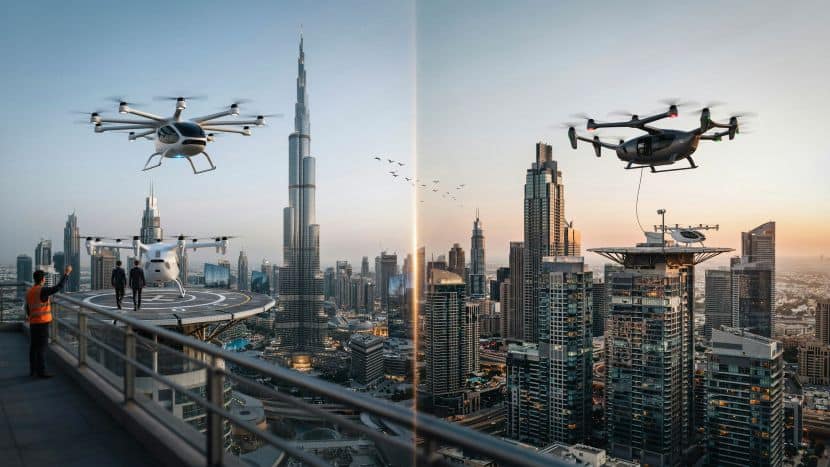
Image generated with Ai
US and UAE are racing against time for the first electric air taxi launch, with Dubai and America eyeing a 2026 breakthrough as both aviation markets compete to lead the future of urban mobility. The reason behind this historic race is the rapid development of electric vertical take-off and landing (eVTOL) technology, supported by major investments, regulatory progress and growing demand for faster city transport. The UAE, particularly Dubai, has gained an advantage through advanced vertiport infrastructure and government support, while America remains a powerful contender because leading companies such as Joby Aviation are progressing towards certification. However, the first commercial launch remains uncertain as safety approvals and operational readiness will decide whether Dubai or a US city achieves the milestone.
Electric air taxis are finally approaching commercial reality after nearly a decade of research, investment and technological development. However, the location of the world’s first passenger service remains uncertain, with Dubai in the United Arab Emirates and several US cities competing for the historic milestone.
The UAE has moved rapidly through infrastructure planning and government support, while the United States remains a major contender because leading manufacturers such as Joby Aviation are based there. The final launch will depend on certification progress, operational readiness and regulatory approvals.
The first services will not create futuristic flying cities overnight. Instead, passengers can expect limited routes, small fleets and premium urban connections before the technology expands globally.
Advertisement
Advertisement
The biggest question facing the emerging electric air taxi industry is whether Dubai or the United States will achieve the first commercial passenger launch. Both locations have strong advantages, but their approaches differ significantly.
Dubai has positioned itself as a global leader in advanced air mobility through government support, aviation innovation and early infrastructure investment. The city has prepared vertiport facilities and created a regulatory environment designed to accelerate eVTOL operations.
The United States, meanwhile, has the advantage of being home to several leading aircraft developers, including Joby Aviation and Archer Aviation. However, companies must complete strict Federal Aviation Administration (FAA) certification processes before large-scale commercial operations can begin.
Joby Aviation is expected to play a major role in both markets. The company has been developing partnerships and testing aircraft capabilities while preparing for commercial deployment.
At present, Dubai appears to have an early advantage because of faster infrastructure preparation. However, the United States remains a serious competitor because regulatory approval and aircraft certification could determine the final outcome.
The electric air taxi concept gained worldwide attention in 2016 when Uber introduced its Uber Elevate vision for urban air mobility. The idea was based on zero-emission electric vertical take-off and landing aircraft that could transport passengers above crowded roads.
The announcement triggered a wave of investment, with more than 1,200 eVTOL proposals emerging from companies around the world. Many projects promised passenger flights by the middle of the 2020s, but most failed to move beyond early concepts, prototypes or funding stages.
Today, the industry has become more realistic and focused. Companies are prioritising safety certification, aircraft reliability and practical operations rather than promising immediate transformation of city transport.
Leading developers now include Joby Aviation, Archer Aviation, Wisk Aero, Eve Air Mobility, Beta Technologies and Vertical Aerospace. These companies are working towards commercial services while navigating complex aviation regulations.
The industry’s progress shows that electric air taxis are no longer only a futuristic idea. However, the transition from successful test flights to regular passenger operations remains a major challenge.
Dubai has become one of the strongest candidates for the first commercial electric air taxi launch because of its advanced urban mobility strategy. The city has combined tourism ambitions, aviation expertise and smart transport planning to support next-generation travel.
The UAE has invested in vertiport infrastructure designed specifically for eVTOL aircraft. These facilities are essential because electric air taxis require dedicated landing areas, charging systems and passenger facilities.
Dubai’s planned network aims to connect important locations, including airports, business districts and tourism areas. The goal is to provide faster urban travel options while reducing road congestion.
Joby Aviation is expected to operate services in Dubai, with passenger flights targeted for 2026. If successful, the launch could make Dubai the first city to introduce a commercial air taxi network.
However, the UAE’s position is not guaranteed. Delays in aircraft certification, operational testing or safety approvals could allow US cities to move ahead.
The United States remains one of the most important markets in the global air taxi race because many leading companies are developing aircraft there. Cities including New York, Los Angeles and Miami are considered potential locations for early operations.
The country’s biggest advantage is technological development. Companies such as Joby Aviation and Archer Aviation have invested heavily in aircraft testing and commercial preparation.
However, the US aviation system operates under strict regulatory standards. The Federal Aviation Administration must approve aircraft designs, operational procedures and safety requirements before passenger services can begin.
The eVTOL Integration Pilot Program (eIPP) has helped accelerate progress by allowing companies to demonstrate aircraft operations while working towards full certification.
The first American services are expected to focus on short urban routes, such as airport transfers and premium city connections. Possible examples include links between airports and city centres or transportation for major events.
Although the US may not be the first launch location, it is expected to become one of the largest electric air taxi markets in the world.
The first electric air taxi flights will be very different from the futuristic visions shown in films. Initial operations will involve small fleets, limited routes and carefully controlled passenger services.
The main purpose will be solving short-distance transport problems. Electric air taxis are expected to connect airports with city centres, business districts and popular destinations.
Potential routes could include airport-to-city transfers such as JFK Airport to Manhattan, Miami International Airport to downtown Miami and Los Angeles International Airport to nearby coastal areas.
Major events could also become early markets, with air taxis providing faster access for travellers attending international sporting and entertainment events.
However, early passengers are likely to pay premium prices because aircraft production remains limited. Similar to other emerging technologies, costs are expected to decrease as manufacturing improves and competition increases.
The long-term goal is to make electric air taxis a practical transport option for millions of passengers worldwide.
Although commercial launches may begin in 2026, widespread adoption will take much longer. Industry experts believe the 2030s will be the key decade for expansion as production increases and infrastructure improves.
The advanced air mobility market could become a major global industry. Some forecasts suggest the sector may eventually reach around $1 trillion by 2050.
However, several challenges remain, including aircraft certification, public acceptance, operating costs, charging infrastructure and safety standards.
The first launches in Dubai or the United States will only represent the beginning of a much larger transformation.
Electric air taxis are expected to complement existing transport systems rather than replace airlines or ground transportation completely.
The success of the industry will depend on whether manufacturers can deliver safe, affordable and reliable services at scale.
The UAE, particularly Dubai, is currently considered the strongest candidate, but the United States remains a major competitor because of its advanced aircraft developers and certification progress.
Limited commercial services are expected from 2026, although wider availability will likely take several years.
Joby Aviation is considered one of the leading companies because of its progress in aircraft development, testing and certification preparation.
No. Early electric air taxis will focus on short urban journeys, airport transfers and premium travel connections rather than replacing traditional aviation.
Dubai sees advanced air mobility as part of its future transport strategy to reduce congestion and create faster urban connections.
Initially, services are expected to be expensive and mainly used by higher-income travellers, but prices could decrease as technology develops.
The electric air taxi race is entering a historic phase as Dubai and the United States compete for the first commercial eVTOL launch. The cause behind this competition is rapid aviation innovation, growing urban congestion and demand for faster transport solutions. The answer remains uncertain because Dubai leads in infrastructure while the US leads in aircraft development and certification progress. The reason this milestone matters is that the first successful service could shape the future of urban mobility worldwide. Electric air taxis will not transform travel overnight, but they could begin a new chapter in aviation.
Advertisement
Tags: america, Chicago, Dubai, Los Angeles, Miami
Advertisement
Advertisement













Monday, September 7, 2026

Monday, September 7, 2026

Monday, September 7, 2026

Monday, September 7, 2026

Monday, September 7, 2026

Monday, September 7, 2026

Monday, September 7, 2026