
South Korea Cherry Blossom Travel Boom, How An Early Spring Season Broke All Inbound Tourism Records

Published
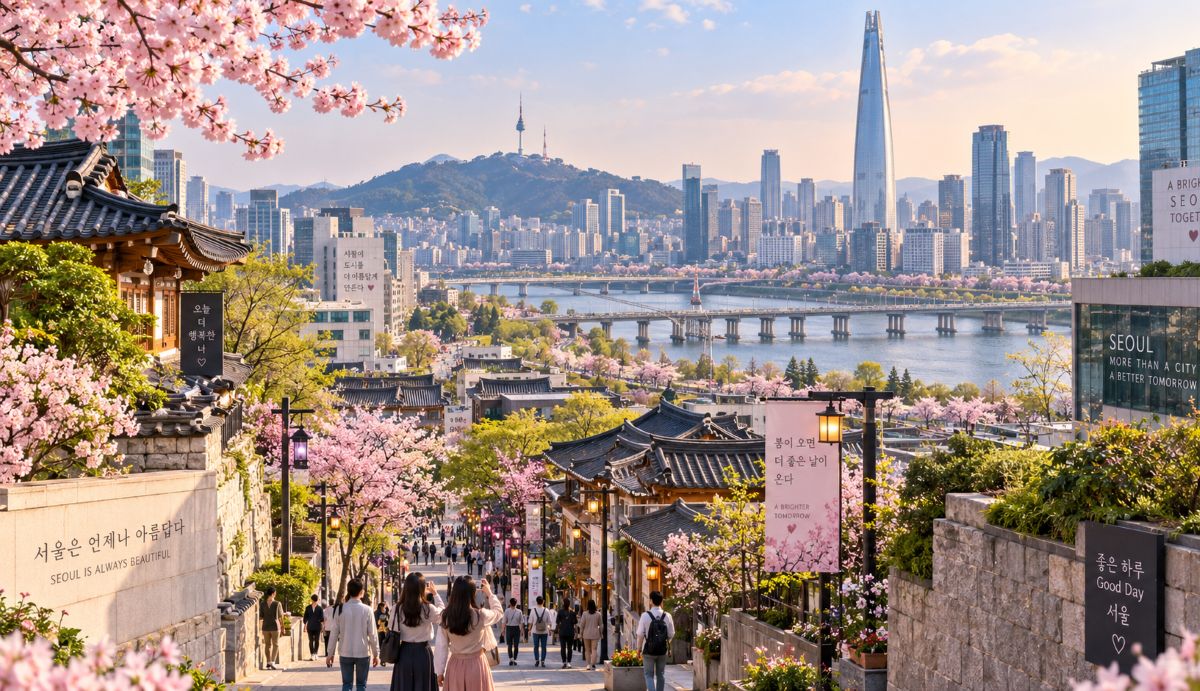
Image generated with Ai
South Korea’s spring has always been about patiently waiting, yet 2025 was something else. Under springtime’s canopy, the breeze causes falling petals to swirl. It can quiet the dreamer in all of us, and South Korea has that ability as well. This year, the dreamer feeling calmed the world before it wanted to travel. The end of the world travelers flew to Jeju Island to witness the sun setting among the tourist center of Seokchon Lake. South Korea made some history as a nation with tourism as smashed records. It was no longer about timing the springtime bloom. It was about witnessing nature’s and life’s celebration.
Why Did Spring 2025 Arrive So Surprisingly Early Across South Korea?
Advertisement
Advertisement
Unusually mild spring atmospheric shifts triggered an early floral bloom across the entire Korean peninsula, forcing floral buds to open up to eight days faster than historical climate baselines. Southern coastal ecosystems felt the atmospheric shift first, launching an explosive local tourist season much earlier than regional commercial vendors had originally anticipated.
Seogwipo on Jeju Island registered its official bloom on March 22, while the naval port city of Changwon and nearby coastal Busan saw full petal exposure on March 23. Travel itineraries across inland hubs like Daejeon and Jeonju required rapid adjustment as peak canopy arrived by late March, forcing millions of eager visitors to recalibrate their transit routes. Parks around Seoul registered dense floral coverage shortly after April 1, converting urban capital corridors into massive pink canopy walkways.
Advertisement
Advertisement
How Did South Korea Shatter Inbound International Visitor Records?
Official data confirmed an extraordinary rise in international arrivals during 2025, reaching 3.42 million visitors in Q1 alone to establish an unprecedented spring travel rush. The momentum expanded by 7.8% over 2019 baseline levels throughout Q2, bringing first-half total foreign tourist figures to a staggering 8.826 million arrivals.
Advertisement
Advertisement
Annual arrivals ultimately hit 18.937 million foreign tourists, permanently surpassing all pre-pandemic benchmarks and establishing South Korea as a premier global spring destination. Surging long-haul demand from Western markets combined with intense short-haul traffic across East Asia to keep regional transportation networks and hospitality sectors operating at absolute capacity.
Which Global Tourist Markets Drove The Unprecedented Spring Surge?
Advertisement
Advertisement
Surging arrivals from Greater China formed the core backbone of international tourism statistics during the 2025 spring bloom window, with mainland China delivering 5.48 million total annual visitors. Taiwan logged a remarkable 50.1% increase compared to pre-pandemic benchmarks, while Japan maintained its strong standing as the second-largest origin market through high weekend flight volumes into Incheon and Gimhae.
Long-haul travel markets registered explosive growth, led by a 42.1% surge in visitors from the United States taking advantage of seasonal holiday breaks. This broad diversification across origin markets prevented localized economic slumps and created continuous tourist traffic across every major provincial hub.
What Impact Did The Jinhae Gunhangje Festival Have On The Economy?
The legendary Jinhae Gunhangje festival in Changwon welcomed an astounding 3.34 million visitors during its two-week festival schedule, delivering high municipal attendance figures. Direct regional consumer sales reached 39 billion KRW as international and domestic tourists filled local markets, public transportation networks, and hospitality venues.
Advertisement
Advertisement
The total economic ripple effect generated across the South Gyeongsang regional economy reached an estimated 130 billion KRW ($97 million USD). Foreign tourists demonstrated the highest average daily per-capita spending at 57,872 KRW, transforming a brief seasonal natural phenomenon into a long-term financial windfall for small independent businesses.
How Did Seoul Hotspots Handle The Massive Visitor Crowds?
Over 3.5 million visitors gathered at the Yeouido Spring Flower Festival along the iconic Yeouiseo-ro tree canopy in Seoul, filling public transit channels along the Han River to maximum capacity. Across the capital, the Seokchon Lake Cherry Blossom Festival in Songpa-gu attracted roughly 2.2 million visitors, driving substantial commercial revenue for adjacent retail precincts.
Historical heritage sites like Gyeongbokgung and Changdeokgung palaces experienced unprecedented international foot traffic throughout early April. Thousands of foreign visitors wearing traditional Hanbok explored the manicured royal grounds, creating an ideal synthesis of cultural heritage and outdoor natural leisure.
Why Are Free Independent Travellers Overtaking Traditional Tour Groups?
Consumer surveys indicated a permanent structural shift toward independent exploration, with traditional group tours dropping to a minor 8.6% share of foreign arrivals. Free Independent Travellers (FITs) represented an overwhelming 82.9% of total incoming tourists, relying on transit cards and localized digital mapping applications to navigate regional transit systems autonomously.
Advertisement
Advertisement
Primary travel motivations shifted away from static retail shopping toward immersive experiential activities and outdoor cultural exploration. Younger demographics aged 20 to 30 comprised 31.2% of total foreign visitors, actively seeking out unique photographic locations, regional cafes, and media filming sites.
Unprecedented Mobility and Seamless Connectivity: How High-Speed Rail Transformed South Korea Regional Exploration
The spring 2025 seasonal rush demonstrated the pivotal role of South Korea’s advanced transport infrastructure in managing massive tourist inflows. Korea Railroad Corporation operated at near-maximum capacity as the high-speed rail network effectively decentralized visitor density away from the congested capital. During the peak floral travel window from late March to early April, high-speed rail passenger load factors on major southern corridors connecting Seoul to Busan and Shin-Gyeongju climbed to 94.2%. This efficient rail connection allowed international travellers to move swiftly across provincial territories, transforming traditional travel itineraries into multi-destination journeys.
Foreign tourist adoption of multi-day rail passes surged dramatically, reflecting a broader shift toward independent regional exploration. Usage of multi-day train passes by international visitors expanded by 38.5% year-on-year across the first two quarters of 2025. This accessibility enabled over 2.1 million foreign arrivals to venture beyond the Greater Seoul area within 48 hours of landing at Incheon International Airport. By dispersing travellers directly into regional cultural hubs such as Gyeongju, Jeonju, and Busan, the national rail framework relieved urban pressure on capital transit networks while distributing tourism revenues directly into regional economies.
The Remarkable Expansion of Medical and Aesthetic Tourism Across South Korea Urban Hubs
Spring 2025 marked a historic high point for South Korea’s medical and dermatological tourism sectors, as international visitors increasingly paired seasonal sightseeing with advanced health and cosmetic procedures. The country welcomed a record-breaking 2.01 million foreign medical patients throughout the year, representing a massive 71.9% increase compared to the previous annual period. Overseas patients and their accompanying companions generated 12.5 trillion KRW in direct health and leisure expenditure, which translated into an estimated 22.8 trillion KRW in total domestic economic production.
Advertisement
Advertisement
The vast majority of incoming international patients prioritized specialized, non-invasive outpatient procedures, with 87.7% seeking care at specialized cosmetic and dermatological clinics. Geographic distribution remained heavily concentrated within major metropolitan areas equipped with established medical infrastructure. Seoul secured 87.2% of all foreign medical visitors, hosting 1.76 million patients primarily within the specialized healthcare districts of Gangnam and Myeongdong. Regional coastal hubs also captured key market shares, with Busan receiving 3.8% of international patients and Gyeonggi Province accounting for 2.7%, illustrating the nationwide reach of the health tourism expansion.
Empowering Independent Travel Through Digital Payment Systems and Smart Navigation Tools
The unprecedented rise of independent travel across South Korea was directly enabled by widespread digital integration and smart municipal transit platforms. During the spring 2025 season, foreign credit card transactions and contactless mobile payments across retail, dining, and transit sectors registered a 64.2% year-on-year growth. This tech-forward ecosystem allowed overseas visitors to navigate local commerce effortlessly without relying on foreign exchange counters or cash-heavy transactions, dismantling long-standing transactional barriers for international guests.
Navigation and transit access underwent a similar technological revolution tailored specifically for independent foreign travellers. Issuance of specialized prepaid tourist transit passes exceeded 1.45 million units during the first half of 2025, giving visitors direct access to public buses, subways, and convenience store payment systems. Furthermore, over 78% of surveyed independent international travellers reported using localized navigation applications, specifically utilizing localized digital mapping software instead of global mapping platforms. This digital fluency empowered foreign visitors to explore complex municipal transit routes independently without guided tour groups.
Hallyu Culture and Media Filming Locations Reshaping Seasonal Travel Itineraries
Pop culture media and viral social trends served as major drivers of international travel patterns across South Korea during the 2025 cherry blossom season. Filming locations featured in popular Korean television dramas, music videos, and digital media platforms saw elevated foot traffic as travellers sought to experience iconic media settings in person. Approximately 32% of surveyed younger international visitors explicitly cited Korean media content locations as the primary deciding factor when planning their regional travel routes across the country.
Advertisement
Advertisement
This media-driven travel trend significantly elevated visitor volumes at historic and coastal destinations outside the capital area. Filming sites across Gyeongju, particularly around Bulguksa Temple and the vibrant Hwangridan-gil district, alongside scenic coastal spots in Gangneung, recorded a 41.3% increase in international visitor footfall compared to spring 2024. This spatial redistribution was heavily supported by younger demographics, with travellers aged between 20 and 30 accounting for 31.2% of total foreign arrivals in the first half of 2025, establishing them as the fastest-growing age segment in national tourism demographics.
Hospitality Industry Performance and Lodging Revenue Trends Across Major Cities
The massive influx of domestic and foreign travel pushed hotel occupancy rates and lodging revenues to exceptional levels across major South Korean destinations. Central Seoul districts, including Jung-gu and Jongno-gu, reached an average hotel room occupancy of 91.8% during the first week of April 2025 as peak urban floral blooms coincided with international holiday travel. High demand pressured regional room inventory, driving up average daily rates and total revenue per available room across both luxury and mid-scale lodging establishments.
Regional hospitality markets similarly experienced strong pricing power during peak blossom dates. Premium hotel room rates across Busan and Changwon rose by 27.4% during late March compared to baseline spring pricing, driven by intense demand around coastal blossom locations and local seasonal festivals. Concurrently, alternative accommodation choices experienced widespread popularity, with bookings for traditional wooden heritage lodgings and short-term residential rentals surging by 44.6% year-on-year across Jeonju and Seoul, demonstrating a strong consumer preference for authentic cultural stays.
Shifting Consumer Economics: Gourmet Dining and Local Convenience Store Retail Surges
Foreign visitor expenditure patterns during spring 2025 reflected a clear evolution in consumer behavior, shifting away from duty-free luxury shopping toward experiential spending and local retail. Total international tourist expenditure in South Korea reached 14.37 billion USD throughout 2025, driven largely by dining, entertainment, and personal leisure choices. Gourmet experiences emerged as a dominant travel priority, with 60% of surveyed foreign tourists ranking street food markets, traditional culinary tours, and local cafe culture as their primary spending focus.
Advertisement
Advertisement
Everyday retail environments experienced an unprecedented surge from international cardholders seeking immediate convenience and local products. Purchases made at neighborhood convenience store chains expanded by 52.1% year-on-year during the spring season. This sharp rise was heavily accelerated by the integration of instant tax-refund technology directly at checkout counters, enabling foreign travellers to claim immediate value-added tax deductions on everyday items, regional snacks, and daily travel necessities.
Sustainable Crowd Management and Ecological Protection Strategies at Floral Venues
Municipal authorities across South Korea implemented proactive safety and environmental management strategies to mitigate crowd congestion and protect delicate natural landscapes during peak travel dates. The Seoul Metropolitan Government and Changwon Municipality deployed over 2,500 municipal safety stewards and law enforcement personnel daily across high-density floral corridors, including Yeouido and Jinhae. These coordinated crowd-control operations ensured smooth pedestrian traffic flow while preventing safety hazards around popular photo spots and riverfront parks.
Environmental preservation measures successfully safeguarded natural parklands from foot traffic damage despite record attendance figures. Municipalities installed temporary protection barriers and designated elevated viewing platforms, which collectively reduced parkland vegetation damage by 18% compared to municipal damage estimates from 2024. Furthermore, local transportation departments increased municipal bus and subway service frequencies by 15% along primary festival corridors. This public transit expansion effectively offset more than 120,000 potential private vehicle trips into high-density zones, minimizing urban traffic gridlock and reducing overall carbon emissions throughout the peak travel period.
The Final Verdict
While spring dust settled, South Korea had a record number of smiles. South Korea had slipped the grip of language barriers for millions of people. As the spring breeze blew, memories began to form of the millions who would fall to the ground as the stems faded. 2025 changed more than just the statistical increases of people and the stressful booking of trains and accommodation. For those people, it meant being able to be close to nature, and being able to be tiny and being close enough to the stars and close enough to see the pink blossoms. Be it the quiet early morning jogs along the Jeju coast or leisurely evening strolls around Seokchon Lake, South Korea brought the traveling community a long awaited memory they will treasure forever.
Advertisement
Advertisement
Frequently Asked Questions
When did the 2025 cherry blossom season start in South Korea?
The 2025 cherry blossom season officially began on March 22 on Jeju Island. Warmer spring temperatures accelerated blooming across southern coastal cities like Busan and Changwon by March 23, before reaching the Seoul metropolitan area around April 1.
How many international tourists visited South Korea in 2025?
South Korea recorded an all-time record of 18.937 million foreign tourists in 2025. The first half of the year generated 8.826 million arrivals, marking the highest H1 total in the nation’s travel history.
Which cherry blossom festival generated the highest economic impact?
Advertisement
Advertisement
The Jinhae Gunhangje festival in Changwon generated an estimated economic impact of 130 billion KRW ($97 million USD). The event attracted over 3.34 million total visitors during its operational window.
What was the most popular way for foreign tourists to travel around South Korea in 2025?
Over 82.9% of foreign visitors traveled as Free Independent Travellers (FITs) rather than joining tour groups. Most visitors utilized public transit cards alongside navigation apps like Naver Map to travel independently across the country.
Advertisement
