
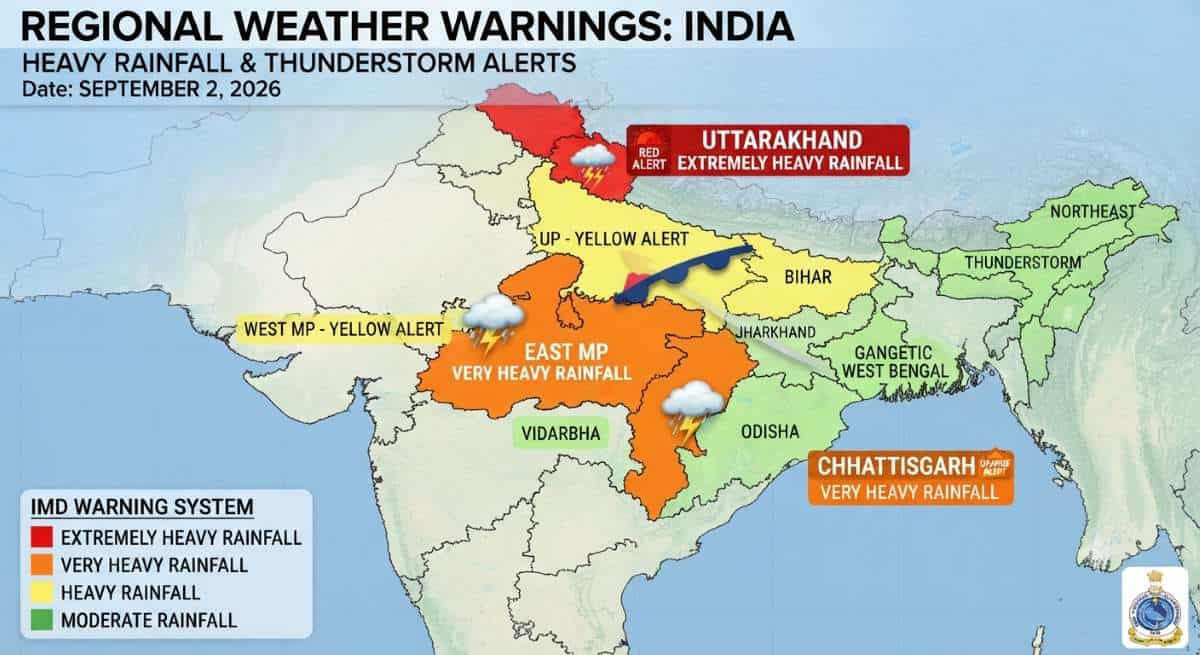
Image generated with Ai
An official weather warning was recently broadcast by the India Meteorological Department to address unfolding meteorological disturbances. Severe atmospheric conditions have been tracked across multiple administrative territories, prompting the issuance of heightened alert levels.
Continuous downpours have been anticipated in regions such as Chhattisgarh, East Madhya Pradesh, and Uttarakhand, alongside other surrounding geographical sectors. Continuous monitoring of low-pressure systems and moisture-laden winds is maintained by meteorological forecasters to understand the evolving monsoon patterns. Historical weather data indicates that seasonal troughs often trigger intensified precipitation spells during this period of the year. Comprehensive advisories are routinely disseminated to local disaster management authorities so that precautionary measures can be implemented swiftly across vulnerable districts.
Advertisement
Mobility networks and transit corridors are heavily influenced by adverse atmospheric occurrences. Surface transport operations are frequently disrupted when excessive water accumulates on national highways and local roadways. Rail networks and aviation schedules experience operational delays due to low visibility and waterlogging near crucial transit hubs.
Commuters and long-distance voyagers are advised to exercise extreme caution while navigating hilly terrains and flood-prone zones. Landslides and rockfalls are commonly reported in mountainous territories like Uttarakhand, posing severe risks to vehicular movement. Consequently, travel advisories are issued by regional authorities to restrict non-essential journeys until weather conditions stabilize significantly.
Advertisement
Advertisement
Economic sectors dependent on predictable weather patterns, such as agriculture and logistics, are closely observing these meteorological updates. Agricultural planning heavily relies on timely rainfall, but excess precipitation often leads to crop inundation and agricultural damage in low-lying fields.
Supply chain networks and freight transport companies encounter logistical bottlenecks when primary connectivity routes are temporarily blocked by mudslides or overflowing rivers. Insurance and risk assessment industries analyze these recurring weather anomalies to formulate better contingency frameworks. Furthermore, municipal and infrastructural planning boards are prompted to upgrade urban drainage systems to mitigate the long-term economic impacts of recurring severe downpours.
Emergency response mechanisms are activated across the affected states to assist residents during critical weather events. Helpline numbers and control rooms are operational around the clock to provide immediate assistance in case of flood emergencies or structural damage. Citizens are advised to stay tuned to official broadcast channels for real-time updates regarding precipitation forecasts and district-specific alerts.
Essential supplies, medical kits, and backup power sources are recommended to be kept ready in households situated near riverbanks or vulnerable slopes. Adherence to safety guidelines issued by local police and disaster response teams is strongly emphasized to prevent preventable casualties.
Advertisement
Advertisement
Modern weather forecasting methodologies exhibit significant advancements compared to historical protocols implemented a decade ago. Earlier dissemination models relied heavily on delayed bulletin distribution, whereas contemporary systems utilize automated alerts and digital communication networks for rapid dissemination.
Early warning frameworks have been substantially refined, allowing meteorological agencies to pinpoint affected districts with greater spatial accuracy. Coordination protocols between central forecasting organizations and state-level disaster response forces have also been streamlined. These progressive enhancements ensure that proactive measures are executed efficiently, minimizing potential risks to public safety and socio-economic infrastructure during extreme weather events.
Advertisement
Tags: alert, Chhattisgarh, east madhya pradesh, Heavy Rainfall, IMD
Advertisement
Advertisement













Saturday, September 5, 2026

Saturday, September 5, 2026

Saturday, September 5, 2026

Saturday, September 5, 2026

Saturday, September 5, 2026

Saturday, September 5, 2026

Saturday, September 5, 2026