

Malta Takes Centre Stage as Tourism Leaders Face Europes Growth Challenge

Published
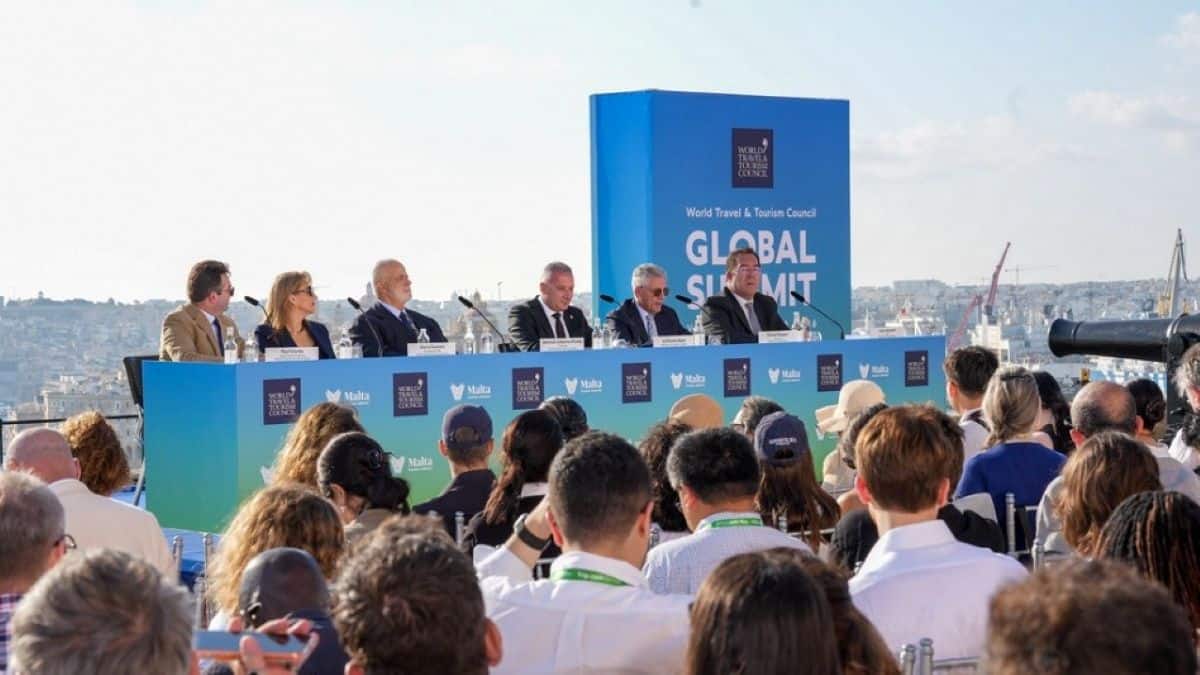
Malta becomes the main focus of attention when tourism officials meet to tackle the growth issue in Europe. The meeting, which is organized by WTTC, involves more than 1,000 participants from over 100 countries in the world. But the problem is bigger than that. How do countries attract tourists without forgetting to give their gains to locals and companies involved in the industry? It is even more urgent given the latest data from Malta. The number of arrivals increased during the first eight months of 2026; however, spending by each visitor decreased.
Valletta Hosts a Global Debate with a European Test at Its Heart
The 26th WTTC Global Summit takes place at the Mediterranean Conference Centre in Valletta from 7 to 9 October 2026. Its theme, FUTU[RE]SET, reflects a programme built around the forces changing travel. More than 100 speakers are taking part. The agenda includes artificial intelligence, investment, skills, connectivity, sustainable growth and the future of destinations.
Advertisement
Advertisement
The attendance figures show how widely tourism matters. WTTC said more than 1,000 delegates were gathering in Malta, including over 200 business and government leaders. Advance announcements said the summit would bring people from more than 100 countries. The programme named US tourism envoy Nick Adams, Mexican state tourism representatives, the European Commissioner for Sustainable Transport and Tourism, and ministers from several European countries.
That mix gives the summit an international scale. But the central article angle can remain firmly European. Europe is already a major tourism region, and the latest forecasts point to further growth. The practical test is how destinations manage that growth. More arrivals can create business and jobs. They can also add pressure to transport, public spaces, housing, water and heritage sites. The debate is therefore about more than drawing visitors. It is about how destinations share the benefits and manage the costs.
Advertisement
Advertisement
Malta’s Visitor Boom Raises a Question About Value
Malta’s National Statistics Office reported 3,160,974 inbound tourists between January and August 2026. That was 17.9% more than in the same period in 2025. Visitors spent about €2.96 billion, up 15.6%. Their total nights in Malta increased by 10.9% to 18.7 million. Yet expenditure per visitor fell from €956 to €937.
These figures create a useful puzzle. Visitor numbers grew faster than total spending. Nights spent also grew more slowly than arrivals. The figures suggest that the average visit may have become shorter. A fall in spending per visitor does not, on its own, prove that daily spending fell.
Advertisement
Advertisement
In fact, a simple calculation from the published growth rates suggests that spending per night rose by about 4.2%. This is an estimate based on rounded rates, not a separate figure published by Malta’s statistics office. The difference matters. A visitor who stays fewer nights may spend less during the whole trip while spending more each day.
This makes a stronger story than simply saying that visitor numbers are rising. It invites readers to ask whether destinations should measure success through total arrivals alone, or also look at length of stay, spending patterns, jobs and local benefits. The Malta figures do not answer every question. They show why those questions deserve attention.
Europe’s Tourism Growth Is Strong, but Its Effects Differ
WTTC forecasts that travel and tourism across Europe will grow by 3.1% in 2026. That is above the 2.5% forecast for global growth. The organisation also projects a 5.8% rise in international visitor spending across Europe. These are forecasts, not final accounts of the year.
Eurostat offers a separate view based on nights spent in tourist accommodation. It recorded about 1.3 billion nights across the EU in the first half of 2026, an increase of 1.7% on the same period in 2025. In the second quarter, 18 of the 27 EU countries saw more accommodation nights than a year earlier.
These figures should not be treated as if they measure the same thing. WTTC’s forecast covers the economic performance of travel and tourism across Europe. Eurostat’s figures count nights in accommodation across the EU. Europe and the EU are also different geographic areas. Used carefully, the two sources show that tourism activity remains strong, while making clear that the scale and effects of growth differ between places.
For Malta, those wider figures give the summit a direct regional context. The island is hosting a global meeting at a time when Europe expects the sector to expand. The question is how destinations will prepare for that growth and make it work over the long term.
Advertisement
Advertisement
Malta Challenges the Usual Story About Summer Crowds
Tourism pressure is often discussed as a summer problem. Malta’s figures offer a reason to look beyond that simple explanation. In 2025, 21.9% of the island’s annual accommodation nights fell in July and August. The EU average was 31.1%. Croatia recorded 54.5%, Bulgaria 43.4% and Greece 41.6%. Malta had the lowest share of those two peak months among EU countries.
That comparison does not mean Malta has no crowded places. It measures the share of accommodation nights in two months across a country. It cannot show whether a particular street, beach, bus route or attraction felt busy. Still, it changes the article’s central question. Malta’s experience suggests that spreading visits beyond the summer peak may not be the only challenge. Destinations also need to understand where visitors go, how long they stay and which services they use.
The summit’s agenda includes destination stewardship, which focuses on guiding tourism growth responsibly. The European comparison gives that discussion substance. A country may spread overnight stays across more months and still face intense pressure at specific places or times. Better data can help officials and tourism businesses spot those patterns before they harm the visitor experience or local life.
The Blue Lagoon Shows How Visitor Management Can Work
Malta has already introduced a practical measure at one of its best-known attractions. The Malta Tourism Authority launched an advance-booking system for people arriving by private or commercial boat who want to go ashore at Comino’s Blue Lagoon. The system began in May 2025 as part of a broader project to manage access.
The Authority’s strategic plan also sets out work on access, sanitation and facilities. It describes the aim of protecting the natural setting while helping people visit it.
This gives the article a concrete example of destination management. Instead of speaking only about broad ideas, it can ask how an access system affects the experience. Does advance booking make visits easier to plan? Does it help protect the site? Do local operators and nearby communities benefit? Those questions require evidence over time. The existence of a booking system alone does not prove that it has achieved every goal.
Advertisement
Advertisement
The Blue Lagoon measures pre-date the WTTC summit. They should be presented as a relevant Maltese example, not as a new decision made by delegates in Valletta.
Small Businesses Need a Share of Tourism’s Growth
On 8 October, WTTC announced an ambition to help one million tourism small and medium-sized enterprises through its Together in Travel community. The initiative aims to offer businesses information, practical resources, skills and opportunities to connect. WTTC said SMEs make up around 85% of the global travel and tourism community.
Small businesses are central to the visitor experience. They include independent hotels, restaurants, guides, transport providers and local attractions. They can help visitors connect with the character of a place. But they may need support to adopt digital tools, train staff, find finance or reach new customers.
WTTC also presented a scenario suggesting that a 10% productivity increase among tourism SMEs could add about US$63 billion in direct tourism GDP across eight economies. The analysis covers the United States, the United Kingdom, Germany, France, Spain, Mexico, Thailand and the United Arab Emirates. It is an illustrative model, not a forecast, funding pledge or Europe-wide total. It does not estimate how many jobs the scenario would create.
The European angle is therefore practical: what support helps small businesses take part in tourism growth? A separate European Commission conference in Seville on 9 October focused on EU funding guidance and resources for tourism businesses. It was not part of the Valletta summit, but it points to a related challenge: turning policy goals into projects that smaller operators can deliver.
Better Connections Could Send Visitors Beyond the Main Sites
Transport affects where visitors go. A destination may promote a quieter town or attraction, but travellers need a practical way to reach it. That means considering the whole journey: the airport or port, the local bus or train, the walk to the attraction and the route back.
Advertisement
Advertisement
A European Commission programme at Connecting Europe Days in September linked transport planning with tourism. It highlighted local public transport, smart mobility and first- and last-mile connections. The programme also discussed how better connections can help direct visitors towards lesser-known places.
That connection matters for both visitors and residents. Reliable services can make trips easier. They can also support businesses outside the most popular areas. But campaigns alone cannot guarantee that visitors will spread out. Destinations need to pair promotion with transport that works for different travellers and times of day.
Malta provides one setting for this discussion, while the wider European context includes rail, road, air and sea links. The summit’s focus on connectivity can therefore be tested against a clear question: can visitors reach more of a destination without adding unnecessary pressure to its busiest places?
Residents and Resilience Must Help Define Success
Tourism supports jobs and businesses, but destinations also depend on healthy communities and natural resources. In May 2026, the Council of the European Union adopted conclusions calling for tourism policy to consider economic, social and environmental factors. It highlighted local communities, cultural heritage, resource efficiency and cooperation among public authorities and industry.
Eurostat’s new sustainability indicators give officials a way to examine some of these issues. They include tourism intensity, seasonal concentration and pay in accommodation and food services. However, Eurostat also notes gaps in the available data, including measures of residents’ views, emissions and energy use.
Climate resilience is another part of the picture. European Environment Agency guidance says heat stress and water scarcity can affect tourism in southern Europe. It also notes that changes to travel seasons require flexibility from both visitors and tourism businesses. This identifies risks; it does not prove that visitors left Malta or the Mediterranean in 2026.
Advertisement
Advertisement
These limits point to a useful conclusion for the article. No single number can show whether tourism is working well for a destination. Arrivals and spending matter. So do working conditions, local business opportunities, transport, natural resources and residents’ experience.
Malta’s Summit Opens a Bigger Question for Europe
WTTC Summit in Malta, the tourism boom of Europe has been tested by the conference attendees. The influx of visitors is increasing in the region, but it is not enough to gauge who benefits from this growth in tourism. As such, delegates should look into how the expenditure, length of stay, connections, and impact on local areas would perform. In Malta’s latest statistics, there was an increase in the number of visitors, as well as the nights and expenses, which took a different course. It does not mean that growth in tourism is an issue. In fact, it requires planning and distribution of the benefits of tourism.
Advertisement
