

Kīlauea Volcano Activity Puts Hawaii Volcano Tourism on Alert as Fresh Seismic Tremors Threaten Trail Access

Published
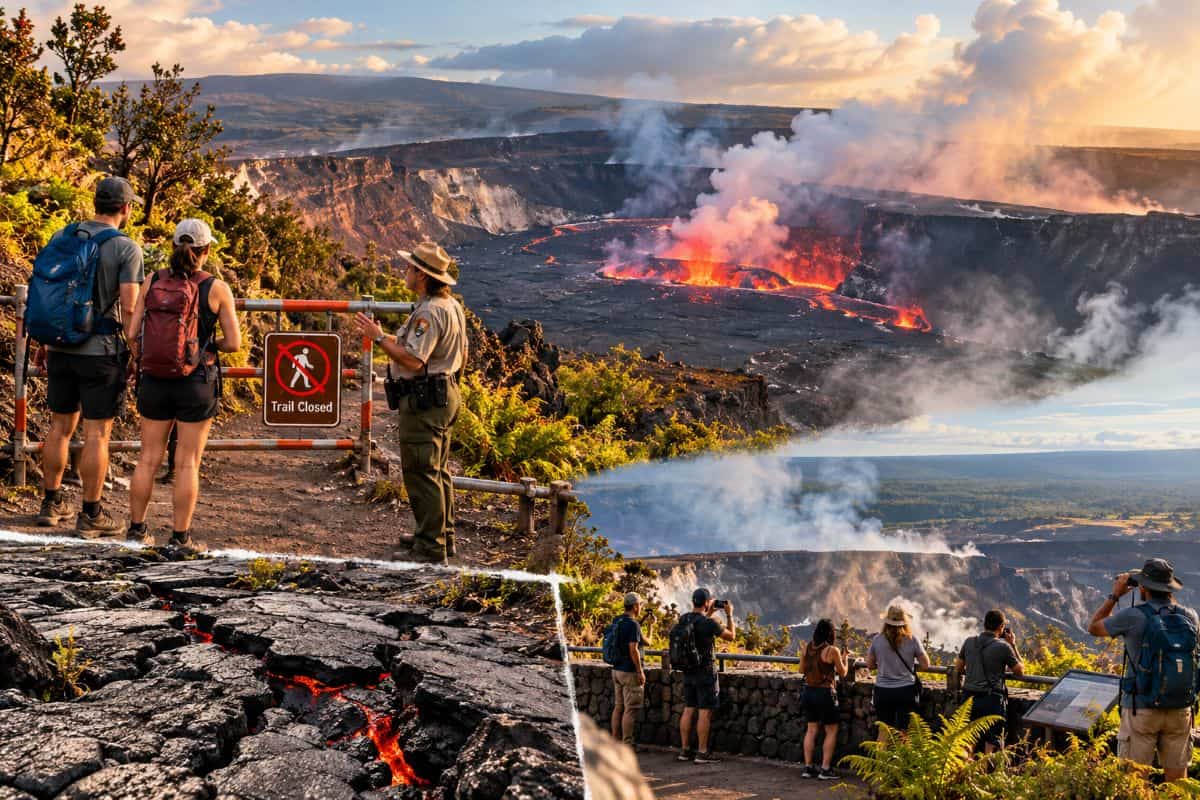
Hawaii’s volcanic tourism industry faces renewed safety concerns after Kīlauea volcano activity prompted temporary trail closures at Hawaiʻi Volcanoes National Park. Park officials closed Halemaʻumaʻu Trail and part of Byron Ledge Trail on 7 October, restricting access to a combined 1.3 miles of hiking routes. The decision followed more than 200 shallow earthquakes beneath the summit in a week and a magnitude-3.4 earthquake on 30 September. Scientists are monitoring renewed spattering at two vents, ground deformation and potential rockfalls. Although the volcano’s aviation colour code remains Orange, the timing of another major lava-fountaining episode remains uncertain. Travellers must check current park conditions before planning crater hikes or volcanic sightseeing.
Why Officials Closed the Crater Hiking Routes
The National Park Service introduced the closures because earthquake activity and ground instability have increased the danger of entering the caldera. Both affected trails descend from the rim towards the crater floor, where unstable rock formations create additional risks. Officials warned that further seismic activity could trigger more rockfalls without sufficient warning.
The immediate concern extends beyond the possibility of another eruption. Earthquakes can destabilise crater walls, widen existing ground fractures and dislodge rocks along popular walking routes. Consequently, even visitors who do not intend to approach active lava must respect restrictions around the summit.
The 30 September earthquake registered magnitude 3.4 and caused small rockfalls along the caldera’s northern wall. Scientists subsequently identified additional cracks on the crater floor between Uēkahuna and Wahinekapu, also known as Steaming Bluff. They believe a brief underground magma intrusion between 30 September and 1 October probably caused these changes.
Advertisement
Advertisement
The National Park Service also closed viewing areas on the Keanakākoʻi side of the caldera the previous week. Officials highlighted evacuation difficulties because the nearest parking lies approximately one mile from the overlooks. These restrictions demonstrate how quickly volcanic conditions can affect visitor access, even when major lava fountains are absent.
Kīlauea’s Current Volcanic Status Explained
The US Geological Survey continues to classify Kīlauea at Volcano Alert Level WATCH and Aviation Colour Code ORANGE. These are two separate indicators, addressing volcanic activity and aviation hazards respectively. Neither designation automatically means that every part of the national park is closed.
Advertisement
Advertisement
Orange indicates heightened volcanic activity and the possibility of hazardous eruptive developments. However, it does not automatically mean that an eruption is imminent or that commercial flights must stop. Aviation authorities and airlines assess relevant aviation information when making operational decisions.
The Hawaiian Volcano Observatory reported minor spattering at the volcano’s northern and southern vents in early October. This followed a shallow magma intrusion beneath Halemaʻumaʻu crater at the summit. Scientists cannot reliably predict whether the activity will develop into another major lava-fountaining episode.
Advertisement
Advertisement
The uncertainty matters particularly for visitors hoping to witness spectacular volcanic displays. A planned viewing trip may coincide with quiet conditions, renewed lava activity or additional access restrictions. Travellers should therefore treat eruption forecasts as provisional rather than guaranteed attractions.
| Monitoring Indicator | Latest Reported Position | Significance for Travellers |
|---|---|---|
| Volcano alert level | WATCH | Volcanic activity requires close monitoring |
| Aviation colour code | ORANGE | Heightened volcanic activity; aviation hazards are assessed separately |
| Recent seismic activity | More than 200 shallow earthquakes in one week | Increased risk of rockfalls and ground instability |
| Strongest specified recent earthquake | Magnitude 3.4 on 30 September | Triggered small rockfalls along the northern caldera wall |
| Trail closures | 1.3 miles combined | Access to two hiking routes is restricted |
| Summit vent activity | Minor spattering reported at two vents | Further eruptive activity remains possible |
| Forecast for the next major fountain episode | Uncertain | Visitors cannot reliably schedule a viewing around a predicted eruption |
Figures reflect official park and volcano-monitoring updates published on 6–7 October 2026. Conditions can change.
How Closures Affect Hawaii’s Tourism Experience
Hawaiʻi Volcanoes National Park remains a major attraction for visitors to the Big Island. Its appeal combines volcanic landscapes, crater viewpoints, hiking opportunities, geological features and opportunities to observe an active volcano. However, the same geological processes that attract visitors also create unpredictable operational challenges.
The park recorded more than 1.8 million recreational visits in 2025, according to the figures reported in the supplied news account. This scale underlines the importance of clear safety information and effective visitor management. Even a limited trail closure can require tour operators to adjust itineraries, redistribute visitors and revise expectations.
Advertisement
Advertisement
The present restrictions do not, by themselves, establish that the entire national park is closed. Instead, they target specific areas where officials have identified immediate safety concerns. Visitors should distinguish between a closed trail, a restricted viewing area and the broader park’s operating status.
For tourism businesses, the immediate challenge is managing uncertainty. Tour operators may need to alter walking routes, change departure timings or offer alternative stops. Accommodation providers can also help guests by directing them towards official updates before they travel.
Moreover, volcanic tourism depends on responsible interpretation. Visitors need to understand that an active volcano is a dynamic natural environment, not a scheduled entertainment attraction. Clear communication about closures, hazards and changing conditions helps protect visitors while supporting the destination’s long-term reputation.
Volcanic Hazards Extend Beyond Lava Flows
Lava fountains dominate photographs of Kīlauea, but they are not the only hazards facing visitors. The USGS has identified volcanic gases, unstable crater walls, ground cracks, rockfalls and airborne volcanic fragments as significant risks around the summit.
Sulphur dioxide can react in the atmosphere to produce volcanic smog, commonly called vog. Depending on concentrations and exposure, vog can irritate the respiratory system and aggravate existing breathing difficulties. Conditions can remain hazardous downwind of volcanic vents, even when visible lava activity subsides.
Another concern is Pele’s hair, a term for fine, glassy volcanic fibres formed during eruptions. Winds can redistribute small volcanic fragments after eruptive episodes. These particles may irritate the eyes and skin, making it important to follow official exposure guidance.
Advertisement
Advertisement
| Hazard | Potential Impact | Recommended Precaution |
|---|---|---|
| Rockfalls | Sudden impacts from unstable crater walls | Avoid closed trails and unstable cliff edges |
| Volcanic gases | Respiratory irritation and other health effects | Follow official advisories and leave affected areas when instructed |
| Vog | Poor air quality and respiratory discomfort | Check conditions, particularly if sensitive to air pollution |
| Glassy volcanic fragments | Skin and eye irritation | Minimise exposure and follow official safety guidance |
| Ground cracks | Unstable walking surfaces and possible localised collapse | Remain on permitted routes |
| Renewed lava activity | Rapidly changing hazards near the summit | Follow park instructions and avoid unauthorised viewing areas |
These precautions are especially important for families, older travellers and visitors with respiratory sensitivities. Tourists should not cross barriers for photographs or attempt to reach lava viewpoints independently. The USGS stresses that the caldera rim surrounding Halemaʻumaʻu has remained closed to the public since late 2007 because of its extreme hazards.
What Visitors Should Check Before Travelling
Visitors planning a trip to Hawaiʻi Volcanoes National Park should confirm access arrangements on the day of their visit. A trail that appeared accessible when an itinerary was booked may later close because of earthquakes, ground deformation or changing volcanic conditions.
The most reliable starting point is the National Park Service’s official visitor information. Travellers should also consult the Hawaiian Volcano Observatory for the latest volcanic updates, particularly if their plans depend on summit viewpoints or hiking routes.
Visitors should allow flexibility in their itineraries rather than building an entire day around one specific crater trail. Alternative permitted viewpoints and other park attractions may remain accessible, but availability must be confirmed locally. Tourists should never assume that a route remains open simply because it appears on an older map or travel website.
| Travel Planning Detail | Recommended Action |
|---|---|
| Trail access | Check the park’s current closure notices before setting out |
| Eruption forecasts | Consult the latest Hawaiian Volcano Observatory updates |
| Viewing locations | Confirm which overlooks are open and accessible |
| Guided excursions | Ask operators about route changes and cancellation terms |
| Air quality | Review volcanic gas and vog advisories |
| Emergency instructions | Follow park rangers’ directions and evacuation notices |
| Photography | Use permitted viewing areas and remain behind safety barriers |
Travellers should also consider footwear, water supplies, weather conditions and the physical demands of their chosen routes. Volcanic terrain can be uneven, while visibility and air quality may change during the day. Visitors should avoid entering restricted areas, regardless of whether other people appear to be doing so.
How the Latest Closures Compare With Previous Activity
Kīlauea’s current situation forms part of an intermittent eruptive cycle that began on 23 December 2024. The volcano has produced repeated episodes of lava fountaining within Halemaʻumaʻu crater, attracting visitors eager to observe the spectacle.
Advertisement
Advertisement
The previous major fountaining episode, identified as episode 54, ended on 25 August 2026. By 7 October, the volcano had gone 43 days without another fountaining episode, marking the longest such interval since the current eruptive cycle began. Nevertheless, scientists continued to observe renewed spattering and signs of summit pressurisation.
This history illustrates why volcanic tourism requires a different approach from conventional sightseeing. The principal attraction can change dramatically within hours, while safety restrictions may remain necessary during apparently quiet periods. A lack of spectacular lava fountains does not establish that the surrounding terrain is safe.
| Period | Development | Tourism Significance |
|---|---|---|
| 23 December 2024 | Current intermittent summit eruptive cycle began | Established a continuing attraction for volcanic sightseeing |
| 25 August 2026 | Episode 54 fountaining ended | Visible lava activity paused, but monitoring continued |
| 30 September–1 October 2026 | Shallow magma intrusion occurred beneath the summit | Ground changes and seismic activity increased safety concerns |
| 30 September 2026 | Magnitude-3.4 earthquake triggered small rockfalls | Reinforced the danger around the caldera |
| 7 October 2026 | Halemaʻumaʻu Trail and part of Byron Ledge Trail closed | Restricted access to 1.3 miles of hiking routes |
The latest measures are therefore targeted safety restrictions rather than evidence of a complete shutdown of Hawaii’s volcanic tourism destination. However, further changes remain possible as scientists monitor the summit.
What This Means for Tour Operators
For travel companies selling Hawaii itineraries, operational flexibility and accurate visitor communication are essential. Businesses should avoid promising a particular eruption, lava-fountaining episode or unrestricted crater access when conditions remain unpredictable.
Operators can instead present volcanic sightseeing as a conditional experience, subject to official access rules and geological developments. They should communicate route changes promptly and explain cancellation or substitution arrangements before departure. This approach manages expectations without diminishing the destination’s appeal.
Travel advisers should also distinguish between aviation alerts and ground-access restrictions. Kīlauea’s Orange aviation colour code does not automatically imply widespread flight disruption. The immediate closures concern particular hiking routes and viewing areas, while aviation decisions depend on relevant flight-safety assessments.
Advertisement
Advertisement
For destination managers, the situation highlights the importance of coordinating park authorities, scientists, guides and accommodation providers. Consistent information helps prevent visitors from arriving at inaccessible locations or attempting unsafe alternative routes. It also supports the credibility of Hawaii as a destination offering extraordinary natural experiences alongside responsible visitor management.
What Travellers Need to Know Next
Kīlauea remains an extraordinary geological attraction, but the latest trail closures demonstrate why safety must take precedence over witnessing an eruption. More than 200 shallow earthquakes, fresh ground cracks and renewed vent activity have prompted officials to restrict access around vulnerable sections of the summit. Scientists cannot yet reliably forecast the next major lava-fountaining episode. Consequently, travellers should keep their itineraries flexible and verify trail access before departure. The wider tourism experience may remain possible, depending on current park conditions. By following official instructions and avoiding restricted areas, visitors can make better-informed decisions while respecting the risks of an active volcanic landscape.
Advertisement
