
Travel Turmoil at Stockholm Arlanda as SAS, Lufthansa, Ryanair and Finnair Hit 72 Delays and 4 Cancellations Across Stockholm, Frankfurt, Paris and Other Routes

Published
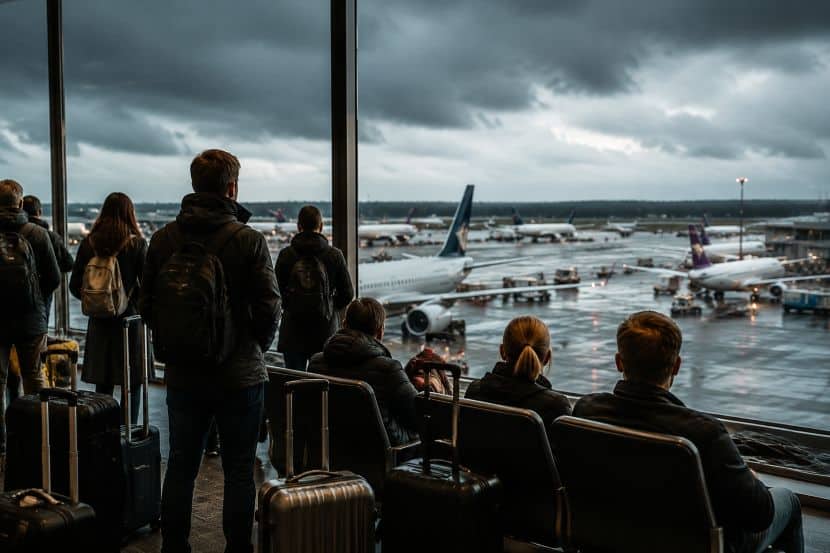
Image generated with Ai
Travel traffic at Stockholm Arlanda Airport has increased. This traffic has caused 72 significant delays for incoming and outgoing flights and 4 cancellations. This has made the already present issue of European flight delays, congested and more difficult for travelers.
Like many flights in the Nordic region, trips in and out of Stockholm are susceptible to severe weather. This can easily cause delay issues because many European flights are scheduled back-to-back with little time in between. Adding all of this together shows many problems, but the lack of one significant cause shows that the current conditions were more caused by limitations within the system rather than by one or more unmanageable outages or problems.
Many travelers have to wait a long time in an airport congested with many people. These delays become worse with time. Many travelers’ connecting flights to Central Europe, the UK, and the Mediterranean have all become severely congested.
Which airlines are most affected by the disruption?
Multiple European and intercontinental carriers are impacted at Stockholm-Arlanda, showing that the disruption is not limited to a single operator.
Advertisement
Advertisement
Key affected airlines include SAS, Norwegian Air Sweden, Lufthansa, Ryanair, Finnair, LOT Polish Airlines, Air France, and Pegasus Airlines among others. Low-cost carriers such as Ryanair and Buzz are also experiencing schedule adjustments due to aircraft rotation delays.
Advertisement
Advertisement
Legacy network carriers like Lufthansa and Air France are seeing disruptions mainly on inbound European connections, while regional operators such as CityJet and Scandinavian Airlines Ireland are facing turnaround delays.
The spread across both full-service and low-cost airlines suggests that the disruption is system-wide, likely linked to airport capacity management and European air traffic flow constraints rather than airline-specific operational failures.
How many passengers are affected by delays and cancellations?
While exact passenger figures are not officially published in real time, aviation industry load factors indicate that even short-haul European flights typically carry between 120 and 180 passengers per aircraft, while regional jets carry 70 to 100 passengers.
Advertisement
Advertisement
Given 72 delayed flights, the number of affected passengers could realistically extend into several thousands within a single operational day at Stockholm Arlanda Airport.
Cancellations, although limited to four flights, also create disproportionate disruption due to missed connections, rebooking pressure, and aircraft repositioning requirements.
Advertisement
Advertisement
The impact is particularly significant for transit passengers using Stockholm as a Nordic connecting hub, especially those travelling onward to Helsinki, Oslo, Copenhagen, and major Central European gateways.
What is the impact on tourism and business travel in Sweden?
The disruption is expected to create short-term friction for inbound tourism into Sweden, particularly for city breaks in Stockholm and regional Nordic tourism circuits. Delays at Stockholm Arlanda Airport can reduce schedule reliability, which is a key factor for weekend travellers and cruise-linked tourism flows in the Baltic region.
Business travel is also affected, especially for sectors dependent on just-in-time mobility such as finance, technology, and cross-border logistics between Sweden, Germany, and the UK. Missed connections can lead to reduced meeting efficiency and increased operational costs for corporate travellers.
Tour operators and airlines may need to adjust buffer times in itineraries, particularly for multi-city European travel packages involving Scandinavian capitals.
What does this mean for travellers and future flights?
For passengers using Stockholm Arlanda Airport, the current disruption highlights the importance of flexible scheduling and longer transit windows during peak European travel cycles.
Advertisement
Advertisement
Travellers are advised to monitor airline notifications closely, as rebooking availability may tighten during peak evening departures. Connecting passengers should also consider alternative hubs such as Copenhagen or Helsinki when planning onward travel across Europe.
Airlines operating at Stockholm-Arlanda are expected to stabilise schedules once aircraft rotations normalize, but residual delays may continue into subsequent operational cycles due to cascading effects.
Conclusion
Stockholm-Arlanda is a clear example of how easily the European aviation network can jam without extreme weather or other reasons. By having 72 delays and 4 cancellations, the disruption is noticeable, and it impacts a lot of people and a lot of different airlines. Normally disruptions like this would delay operations. Passengers relying on this major Nordic hub will be hit by changes to their flights.
Authors Observation: All information is manually obtained from FlightAware’s official website, and all operations are subject to change based on real-time updates. In order to maintain safety, airlines actively modify schedules and itineraries. In order to get to their destinations safely, passengers are asked not to panic in such situations and to look for alternate travel choices. Relying on real-time updates, reviewing airline rebooking restrictions, and maintaining flexibility with travel plans are all highly recommended.
Source: Flightaware
Advertisement
