
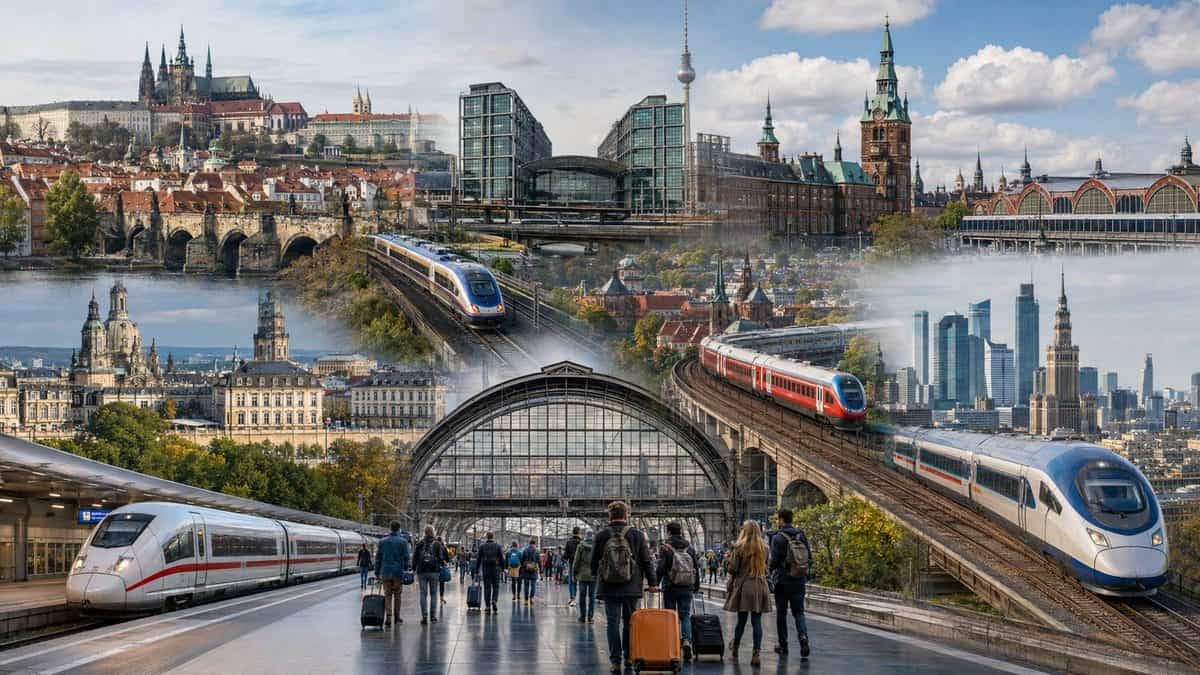
Image generated with Ai
European rail connections are making more places in Europe accessible with fewer transfers or no transfers at all. An example of this is the new Prague–Berlin–Copenhagen service which will connect Central Europe to Scandinavia with two trains a day between Berlin and Copenhagen with additional service in the summer months. The Berlin to Copenhagen leg of this route will take approximately 7 hours and the Copenhagen to Prague leg of this route will take approximately 11 hours. Direct Prague to Kraków or Warsaw serves Central Europe’s east to west connections. The increasing travel options within the EU matters since the 2025 EU statistics show that there were approximately 3.1 billion hotel stays in the EU and a 3.4% increase in international hotel stays.
The most important change is not simply the arrival of individual trains. European rail connections are increasingly changing how travellers combine cities, especially when one journey can cover several countries without changing trains.
The European Commission’s high-speed rail plan aims to shorten major journeys dramatically. By 2030, Berlin–Copenhagen is targeted at four hours instead of seven. By 2035, Sofia–Athens could fall to six hours from 13 hours 40 minutes. Paris–Lisbon and a Baltic corridor linking Tallinn, Riga, Vilnius and Warsaw are also part of the longer-term vision.
The tourism implications are significant. A destination no longer needs to compete only for direct international arrivals. It can also capture visitors already travelling through a neighbouring city.
Advertisement
Advertisement
That creates a new rail-fed visitor economy, where stations become gateways for multi-city breaks, short stays, cultural itineraries and slower journeys. For travellers, the appeal is equally practical: city-centre arrivals, fewer airport transfers and the ability to see several destinations within one holiday.Rail Development Tourism Significance Direct cross-border trains Removes transfer friction Faster intercity services Makes weekend breaks more realistic Night trains Converts travel time into usable holiday time Multi-country routes Encourages combined itineraries City-centre stations Reduces airport-to-hotel transfer time Better ticketing Makes complex European journeys easier to book
Prague is one of the strongest beneficiaries of this new connectivity cycle. The city gained a direct rail link to Copenhagen through Berlin and Hamburg in 2026, restoring a nonstop connection between the Czech and Danish capitals after more than a decade. The service operates with modern ComfortJet trains and includes Dresden among its German stops.
For Prague, the significance goes beyond Danish visitors. The service opens a practical northbound corridor for travellers from Scandinavia who want to combine Prague with Germany or continue towards Central Europe.
Prague already has substantial tourism momentum. The city welcomed 8.27 million tourists in 2025, up 3% from 2024, according to Czech statistical data cited by Prague City Tourism. Germany supplied almost 982,000 visitors, while the UK contributed more than 500,000.
Advertisement
Advertisement
The new rail connection therefore arrives in a market with established demand rather than creating interest from scratch. It gives Prague another access channel into important European source markets, while also making the city easier to add to a broader Scandinavian–German itinerary.
The city is also increasingly focusing on visitor value rather than raw volume. In the first half of 2026, Prague recorded 3.83 million visitors, approximately 1% more than a year earlier. Hotel occupancy in June was reported as stronger than in Vienna, Budapest and Rome, highlighting the city’s growing premium positioning.
Berlin occupies a different position because it is both a destination and a major interchange point. The German capital already has direct international rail services to Paris, Amsterdam, Warsaw and Prague, while 2026 has brought additional links and expanded night-train options.
The new Prague–Berlin–Copenhagen service strengthens that position by giving Berlin a direct north-south role. Travellers can now construct an itinerary around three capitals without changing trains between them.
Berlin’s tourism scale makes this particularly important. The city recorded 29.4 million overnight stays from 12.4 million guests in 2025, with international visitors accounting for 41% of overnight stays. The US, UK and Netherlands were its three largest foreign markets.
However, the latest figures also show why connectivity should not be treated as an automatic tourism guarantee. Berlin recorded 5.9 million guests and 13.6 million overnight stays in the first half of 2026. Arrivals were broadly stable, while overnight stays fell 2.7%, with visitors staying an average of 2.3 days.
The lesson is important for the wider European market. Rail can widen access, but destinations still need compelling products, pricing and reasons to stay longer.
Copenhagen has historically relied heavily on air access for international tourism. The new direct service changes that equation by strengthening its overland reach towards Germany and the Czech Republic.
The Copenhagen–Berlin journey takes about seven hours on the current service, while Copenhagen–Prague takes approximately 11 hours. Two daily return services operate throughout the year, with an additional seasonal service during the summer.
That creates new opportunities for rail-based city combinations. A visitor could begin in Copenhagen, continue to Berlin and then travel onwards to Prague without building separate flight segments into the itinerary.
Copenhagen already has a strong international tourism base. Foreign visitors represented around two-thirds of hotel stays in the city during the first ten months of 2024, while leisure hotel nights grew 8.35% over the same period.
Denmark as a whole also recorded a record 67.7 million tourist overnight stays in 2025, up 2% from 2024. Hotel accommodation was the strongest contributor to the increase, with approximately one million additional hotel nights.
The rail opportunity is therefore less about rescuing demand and more about diversifying Copenhagen’s access architecture. It strengthens the capital’s position within a continental holiday circuit rather than leaving it as a predominantly air-served Scandinavian endpoint.
Dresden is perhaps the most interesting secondary-city beneficiary on the route. The city sits between Berlin and Prague and gains direct access to the new international service without needing to become a destination travellers deliberately seek through air connectivity.
That distinction matters. Smaller cities often struggle to compete for direct international routes because their airports cannot match the scale of major hubs. Rail can offer another model, allowing them to borrow accessibility from a larger neighbouring city.
The Prague–Berlin–Copenhagen service stops at Dresden, creating a direct link with Copenhagen and Prague while retaining access to Berlin. The route therefore turns Dresden from a potential detour into a natural stop on a multi-city journey.
For travellers, that makes the city particularly suitable for cultural and heritage itineraries. Dresden can function as a one- or two-night stop between larger capitals, potentially spreading tourism spending beyond Europe’s dominant metropolitan centres.
The wider economic logic is exactly what European policymakers are pursuing. The Commission says faster and better rail connections can support regional economies and tourism by improving accessibility and reducing journey times.
Kraków illustrates another side of the rail transformation. Its tourism growth is already substantial, while new international rail services are making it easier to position the city within wider Central European itineraries.
Leo Express launched a daily Prague–Kraków service from December 2025 and planned a new direct Prague–Olomouc–Ostrava–Warsaw line from March 2026. These services strengthen connections between Czechia and Poland while creating additional options for international city-break combinations.
Kraków recorded 16.25 million visitors in 2025, approximately 10.4% more than the previous year. Of those, more than 8.79 million were overnight tourists, while estimated visitor spending reached PLN15.4 billion, up more than 70%.
The spending figure needs careful interpretation because inflation and higher tourism prices contributed to the increase. Nevertheless, city research also identified stronger interest in four- and five-star accommodation, restaurants, cultural events and paid attractions.
That makes better rail connectivity particularly valuable. Kraków does not simply need more visitors; it needs visitors who stay, spend and explore beyond the historic core.
Warsaw is emerging as another important node in the expanding Central European rail network. The new Prague–Warsaw service gives travellers a direct north-eastern extension from Czechia into Poland, while Berlin already has multiple direct services towards Warsaw.
This matters because Warsaw increasingly competes as both a leisure destination and a business city. The municipal visitor survey for 2025 found that 97% of surveyed visitors rated its cultural offer positively, while 75% said they intended to return. Foreign tourists spent an average of PLN1,838 per person, with 60% choosing four- or five-star hotels.
Rail therefore reinforces Warsaw’s existing proposition rather than defining it. The city can be inserted into longer European itineraries linking Germany, Czechia and Poland, while also benefiting from growing interest in affordable, culture-led city breaks.
Its attraction is increasingly diversified. New museums, revitalised industrial districts, modern architecture, green spaces and the Vistula waterfront give visitors reasons to extend stays beyond the traditional historic centre.
The wider market provides a powerful backdrop. EU tourism accommodation recorded almost 3.1 billion nights in 2025, up 2.2% year on year. International visitors generated 49.7 million additional nights, compared with 16.7 million additional domestic nights.
Rail is also expanding within this broader travel recovery. Eurostat reported increases in rail passenger transport performance across most EU countries in 2024, with particularly strong growth in Hungary, Slovenia, Latvia, Lithuania, Portugal, Ireland, Poland and Luxembourg.
The most important statistic, however, may be the projected reduction in journey times.Future Rail Corridor Current / Existing Journey EU Target Berlin–Copenhagen About 7 hours 4 hours by 2030 Sofia–Athens About 13h 40m 6 hours by 2035 Vienna–Ljubljana About 6h 05m 4h 30m Paris–Rome About 10h 50m 8h 45m Paris–Lisbon Longer multi-stage journey Improved connection by 2035
These are not merely transport targets. They represent potential changes in the commercial radius of a destination. A city that becomes reachable within four or five hours can enter a different market for weekend breaks and short cultural holidays.
The strongest tourism effect may ultimately appear outside the headline cities. Better cross-border services allow travellers to add secondary destinations without sacrificing too much holiday time.
This could help address one of European tourism’s most persistent problems: concentration. In 2025, July and August accounted for 31.1% of all EU accommodation nights, while some Mediterranean markets showed dramatically stronger seasonal concentration.
Rail can help destinations build shoulder-season itineraries around culture, gastronomy, festivals, Christmas markets and business events. A train journey can also connect several destinations into one product, allowing operators and destination organisations to market a regional experience rather than a single city.
The EU is also attempting to solve one of rail’s biggest weaknesses: booking complexity. Its May 2026 Passenger Package proposes easier single-ticket booking across multiple rail operators and stronger passenger rights across an entire journey.
That policy could prove as important to tourism as faster tracks. A train that exists but requires three websites, separate tickets and unclear passenger protection remains a barrier for international visitors.
For travellers, the emerging rail network changes how a European holiday can be designed. Instead of flying into one capital and returning from the same airport, visitors can increasingly create open-jaw itineraries, arriving in one city and departing from another.
The Prague–Berlin–Copenhagen service is especially useful for this approach. Two daily year-round services provide greater scheduling flexibility, while the summer evening service adds another option during the peak travel period.
Travellers should still check timetables before booking because infrastructure works can temporarily alter services. They should also compare through-ticket availability, luggage arrangements and connections when combining separate operators.
For longer journeys, the most valuable improvement will be integrated ticketing. If the EU Passenger Package becomes operational in its proposed form, travellers could eventually compare and purchase multi-operator rail journeys through a single transaction.
New European rail networks show how vital accessibility is for tourism competitiveness. Travellers can now include Prague and Copenhagen with Berlin on their trip, while Dresden, Kraków, and Warsaw get included in their Central European network.
We cannot cite railways as a strong enough incentive for travel to place tourists in amenities. There are other factors such as attractiveness, prices, and of course, a favorable economy. Evidently though, Europe is building a rail network that allows travelers to reach more destinations with fewer connections.
For travelers, a rail network that reaches more locations means less tedious logistics. For tourism, this means the ability to attract travelers from new territories. For smaller cities however, this is the most important. Rail networks can bring cities more accessibility without having to sacrifice to become a bigger airport.
Advertisement
Advertisement
Advertisement













Saturday, September 5, 2026

Saturday, September 5, 2026

Saturday, September 5, 2026

Saturday, September 5, 2026

Saturday, September 5, 2026

Saturday, September 5, 2026

Saturday, September 5, 2026

Saturday, September 5, 2026



