

Nevada Travel 2026: Las Vegas Pedestrian Bridge Law Sparks Fresh Tourist Fine Concerns

Published
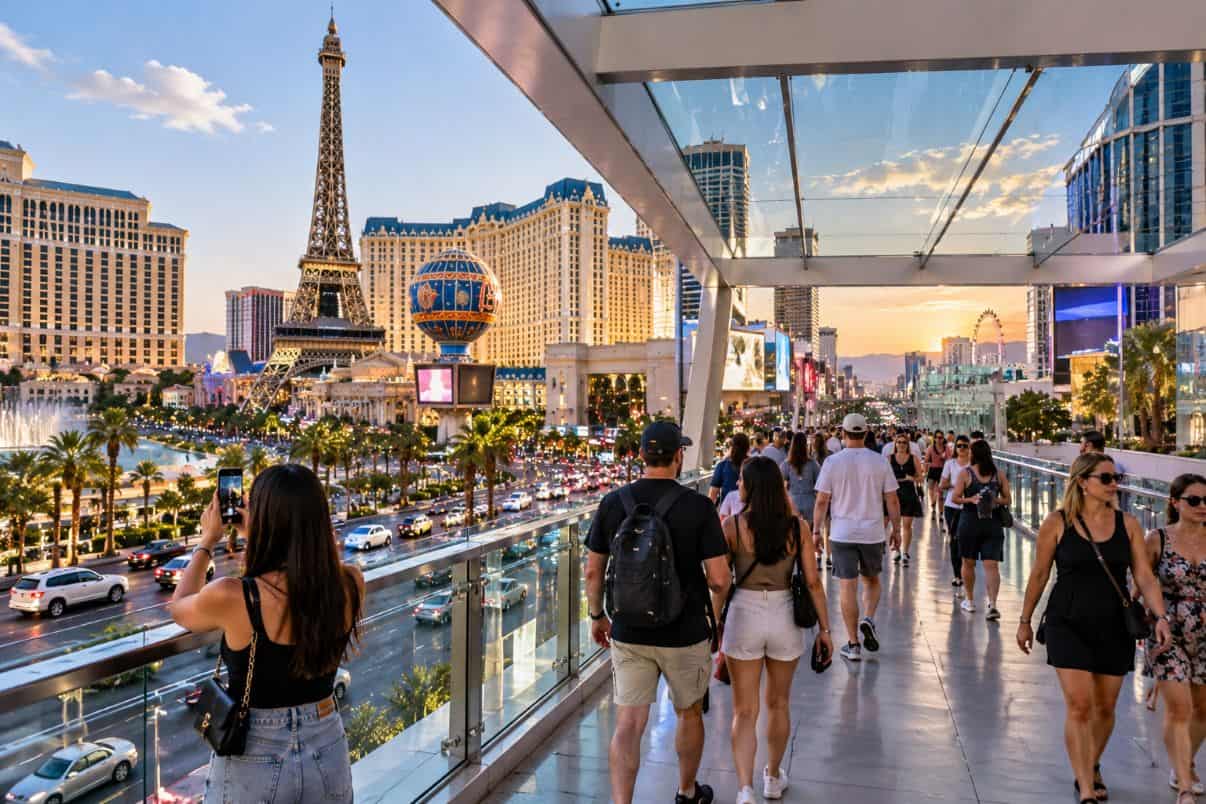
Las Vegas, Nevada, is drawing fresh attention to a controversial pedestrian safety law that could surprise tourists exploring the famous Strip. The Las Vegas Strip Fine 2026 refers to an existing Clark County ordinance allowing penalties of up to $1,000, six months in jail, or both, for prohibited stopping or standing in designated pedestrian-flow zones. Introduced in January 2024, the regulation returned to public attention after a federal judge upheld it in September 2026. Although visitors can still enjoy the Strip’s attractions and take photographs, stopping on covered pedestrian bridges could expose them to enforcement action.
Las Vegas Strip Fine 2026 Returns to Spotlight Following Federal Court Decision
Las Vegas visitors are being reminded of a pedestrian regulation that restricts stopping and standing on designated bridges along the city’s famous resort corridor.
Advertisement
Advertisement
The ordinance, adopted by Clark County in January 2024, was introduced to improve pedestrian movement and reduce congestion in heavily used crossing areas.
It attracted renewed attention following a federal court decision on 25 September 2026.
Advertisement
Advertisement
US District Judge Jennifer Dorsey upheld the regulation after considering a constitutional challenge brought by local residents.
The decision supported Clark County’s position that maintaining safe pedestrian movement was a legitimate public safety objective.
Advertisement
Advertisement
However, the American Civil Liberties Union of Nevada has appealed the ruling.
The ordinance therefore remains legally contested, although it continues to apply unless a court orders otherwise.
Advertisement
Advertisement
For tourists, the practical message is that pedestrian bridge restrictions remain relevant when exploring the Las Vegas Strip.
Why Could Tourists Face a $1,000 Fine on Las Vegas Pedestrian Bridges?
Clark County Code Chapter 16.13 establishes restrictions within designated pedestrian-flow zones.
These areas include specified elevated pedestrian bridges and zones extending up to 20 feet around associated stairs, escalators and elevators.
The regulation prohibits stopping, standing or deliberately engaging in activities that cause other pedestrians to stop within the covered areas.
Advertisement
Advertisement
Violations may constitute misdemeanours carrying maximum penalties of $1,000, six months in jail, or both.
However, these are statutory maximum penalties rather than automatic punishments for every incident.
The ordinance also includes exceptions, including circumstances involving people waiting to use elevators or escalators.
Importantly, the rule does not prohibit standing throughout the entire Las Vegas Strip.
Its application is limited to designated pedestrian-flow zones established under county law.
Travellers should therefore distinguish between ordinary sidewalks and locations covered by the restriction.
Advertisement
Advertisement
Can Visitors Still Take Selfies and Photographs Along the Las Vegas Strip?
Photography remains an important part of the Las Vegas visitor experience.
Tourists frequently photograph the Strip’s illuminated resorts, architectural landmarks and entertainment attractions.
The Clark County ordinance does not expressly prohibit photography itself.
However, stopping on a designated pedestrian bridge to take pictures may fall within the restriction.
This means visitors should avoid pausing in covered areas, particularly when their actions obstruct pedestrian movement.
Clark County and Las Vegas Metropolitan Police have previously explained that enforcement efforts are primarily intended to address congestion and safety concerns.
Advertisement
Advertisement
Police have also indicated that warnings and public education are generally preferred before enforcement.
Nevertheless, practical enforcement guidance does not eliminate the ordinance’s legal requirements.
Visitors can reduce potential problems by choosing suitable photography locations outside designated pedestrian-flow zones.
Federal Judge Upholds Controversial Las Vegas Pedestrian Bridge Restrictions
The September 2026 court decision followed a legal challenge involving two street musicians and a wheelchair user.
The plaintiffs argued that the ordinance could interfere with constitutionally protected expression and ordinary activities in public spaces.
They also raised concerns about accessibility and the effect of restrictions on people who may need to pause while travelling.
Advertisement
Advertisement
Clark County defended the regulation as a measure intended to prevent congestion and improve safety.
Judge Dorsey concluded that the ordinance served a significant public safety interest and satisfied the constitutional requirements considered by the court.
The ruling did not end the legal dispute.
The ACLU of Nevada subsequently appealed to the Ninth US Circuit Court of Appeals.
The appellate proceedings mean that the ordinance’s constitutional status remains contested.
However, the existing regulation continues to govern designated pedestrian-flow zones unless further judicial action changes its operation.
Advertisement
Advertisement
Why Did Clark County Introduce Strict Pedestrian Safety Rules?
The Las Vegas Strip attracts substantial pedestrian traffic throughout the year.
Visitors frequently move between hotels, casinos, restaurants, shopping centres and entertainment venues.
Elevated pedestrian bridges provide important connections across Las Vegas Boulevard, separating people on foot from busy vehicle traffic.
Clark County introduced the ordinance to reduce congestion and prevent bottlenecks around these crossings.
Officials identified pedestrian safety and continuous movement as central objectives.
The county’s Public Works Department maintains information about pedestrian bridge locations, elevators and escalators.
Advertisement
Advertisement
These facilities are particularly important for visitors with mobility requirements and people travelling with luggage.
However, the safety objectives behind the regulation have not eliminated concerns about its potential effect on accessibility and public expression.
The continuing legal challenge reflects those competing considerations.
How Many People Have Faced Enforcement Under the Las Vegas Rule?
TheStreet reported that county figures identified 122 citations and arrests associated with the pedestrian-flow ordinance since its introduction in 2024.
The figure demonstrates that enforcement activity has occurred.
However, the combined total does not establish how many people were ultimately fined, convicted or imprisoned.
Advertisement
Advertisement
It also does not identify how many cases involved tourists rather than local residents.
Consequently, the reported number should not be presented as evidence that 122 visitors received $1,000 penalties.
The maximum fine is a potential legal consequence, not the standard amount imposed in every case.
For travellers, the existence of enforcement activity reinforces the importance of understanding local restrictions.
Visitors should follow posted signs and lawful instructions from authorities when using pedestrian bridges.
What Should International Tourists Know Before Visiting Las Vegas?
International visitors planning holidays in Las Vegas should familiarise themselves with local pedestrian regulations.
Advertisement
Advertisement
The Strip remains accessible for sightseeing, shopping, dining and entertainment.
However, visitors should avoid stopping unnecessarily on designated pedestrian bridges.
Those hoping to photograph resorts and landmarks should select locations where pedestrian movement is not restricted.
Travellers should also consider accessibility arrangements when planning journeys between hotels and attractions.
Clark County provides official information about bridge locations and elevator and escalator facilities.
Visitors with mobility needs may benefit from checking these resources before travelling.
Advertisement
Advertisement
The regulation does not establish a general ban on sightseeing or photography across Las Vegas.
Instead, it concerns specific locations where the county seeks to maintain continuous pedestrian movement.
Understanding that distinction can help tourists explore the resort corridor more confidently.
Could the Las Vegas Pedestrian Law Affect Tourism and Visitor Experiences?
Las Vegas depends heavily on visitors attracted by entertainment, hospitality, conventions and major events.
Pedestrian bridges are essential to movement between many of the Strip’s prominent attractions.
Restrictions on stopping may influence how tourists photograph landmarks or gather with companions while crossing busy roads.
Advertisement
Advertisement
Supporters of the ordinance argue that uninterrupted pedestrian movement improves safety and reduces congestion.
Opponents remain concerned about potential restrictions on public expression and the needs of people with disabilities.
These perspectives form part of the continuing legal debate.
However, no verified tourism revenue loss or decline in visitor numbers has been attributed to the ordinance.
The regulation should therefore be understood as a local pedestrian management measure rather than evidence of a wider tourism downturn.
For visitors, the principal implication is the need to observe restrictions in designated crossing areas.
Advertisement
Advertisement
Las Vegas Visitors Can Still Enjoy the Strip While Following Local Rules
Las Vegas remains one of America’s most recognisable entertainment destinations, offering illuminated resorts, restaurants, shopping and live performances. The pedestrian bridge ordinance does not prevent visitors from enjoying these experiences, but it introduces restrictions that travellers should understand. Stopping or standing within designated pedestrian-flow zones can carry serious maximum penalties, although enforcement circumstances vary. The September 2026 federal ruling has renewed attention on the regulation, while an appeal continues. For tourists planning a holiday on the Strip, checking signs, keeping bridges clear and choosing suitable photography locations can help ensure a smoother sightseeing experience.
Advertisement
