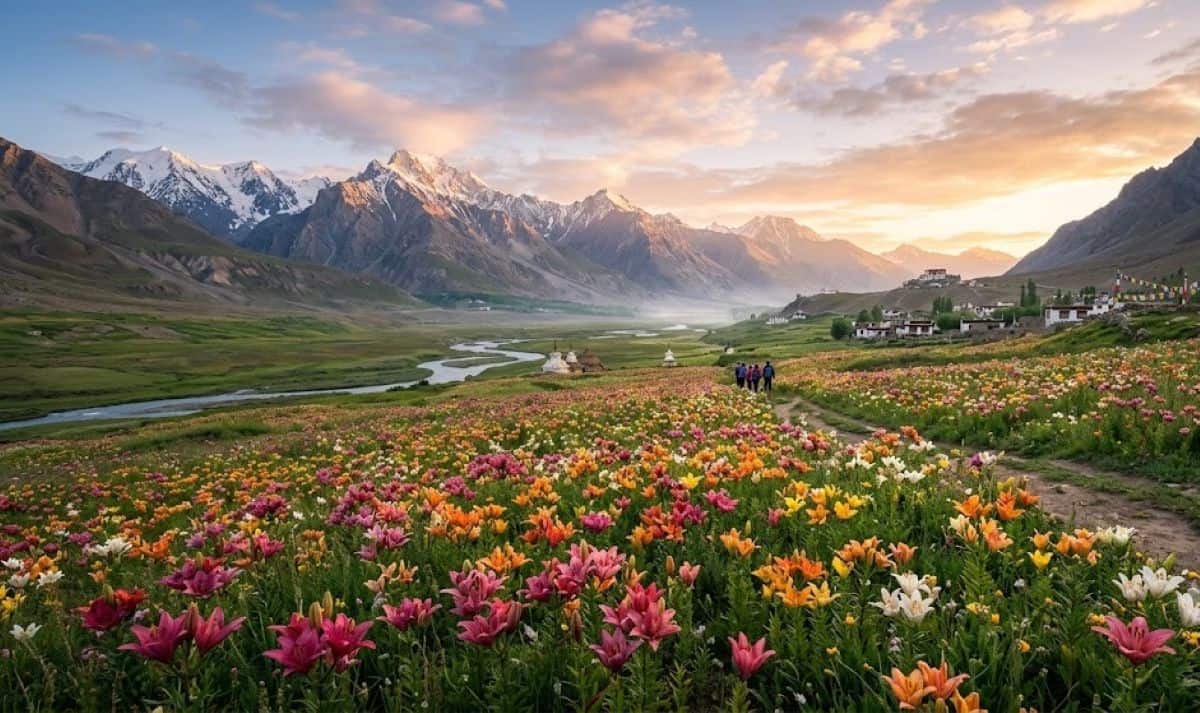
Image generated with Ai
Regional administrative bodies reported that local authorities are establishing India’s highest commercial Lilium flower field at an extraordinary elevation of 3,265 meters. Consequently, this pioneering project actively transforms rugged, cold-desert terrains into highly productive, sustainable floral landscapes across northern India. Furthermore, decision-makers emphasized that cultivating vibrant blooms in such demanding environmental conditions establishes a remarkable precedent for cold-climate floriculture. Indeed, official representatives highlighted that the primary objective centers on unlocking sustainable economic opportunities for native mountain populations. By integrating specialized horticultural techniques with regional tourism development, the venture aims to empower local farming communities while diversifying the broader Himalayan economy. Therefore, international sightseers and conscious travelers can anticipate an upgraded eco-tourism experience that harmonizes agricultural innovation with pristine natural preservation.
Transforming the High-Altitude Cold Desert into a Thriving Ecological Wonder
This ambitious project in Ladakh actively redefines how extreme geography can foster groundbreaking agricultural and tourism innovations. By introducing commercial Lilium cultivation at an elevation of 3,265 meters, local authorities demonstrate that extreme environmental conditions do not restrict sustainable human ingenuity. High-altitude regions often struggle with short growing seasons, low atmospheric oxygen, and freezing mountain winds. However, through careful land selection, organic soil management, and precision water conservation techniques, native agriculturalists can now produce high-value flowers. This incredible transformation of barren cold deserts into colorful floral fields creates a breathtaking contrast against the rugged Himalayan landscape, instantly capturing the imagination of researchers, travelers, and environmentalists around the globe.
In addition to its striking visual appeal, the venture establishes a vital blueprint for cold-climate agriculture across northern India. Regional planning bodies reported that integrating sustainable farming techniques with nature-focused travel offers a realistic path forward for fragile mountain ecosystems. Instead of relying solely on traditional subsistence crops or seasonal adventure tourism, the region is actively expanding its economic horizon. The introduction of specialized Lilium species ensures that agricultural workers cultivate high-value produce that commands premium prices in domestic and international markets. Consequently, this sustainable model demonstrates that ecological protection and commercial growth can comfortably coexist, offering a powerful blueprint for high-altitude communities everywhere.
Advertisement
Global Travel Impact and the Eco-Tourism Boom
From an international travel perspective, establishing a major floral destination at 3,265 meters significantly enhances the global reputation of Ladakh. World travelers increasingly prioritize authentic, ecologically responsible journeys that honor local heritage and protect sensitive natural environments. The creation of vibrant Lilium fields set against soaring, snow-covered Himalayan peaks gives visitors an unprecedented reason to visit northern India. Furthermore, this unique combination of high-altitude botany and scenic grandeur adds rich cultural depth to classic trekking routes, turning routine sightseeing journeys into profound educational and sensory experiences.
Additionally, this emerging attraction fundamentally shifts traditional travel patterns across the region. Regional administrative bodies noted that year-round agricultural attractions encourage tourists to visit outside peak summer months, helping distribute economic benefits evenly across all seasons. This steady flow of conscious wanderers directly supports local homestays, native guides, and regional transport providers. By attracting travelers who value conservation and community engagement, Ladakh protects its fragile habitats from overcrowding while offering global visitors unforgettable, meaningful connections with nature.
Economic Transformation and Rural Empowerment
Beyond its immediate agricultural success, this commercial enterprise serves as a powerful engine for socio-economic progress across remote settlements in Ladakh. Official reports confirmed that regional leadership expects the flower fields to provide reliable, long-term employment for resident farming households. By delivering comprehensive training in specialized floricultural methods, local bodies equip native workers with modern technical skills. This direct educational support enables mountain communities to build sustainable livelihoods, significantly reducing their historical reliance on uncertain seasonal labor or urban migration.
Moreover, forming a dedicated floral market allows local cultivators to connect directly with broader commercial networks across India and beyond. Supplying high-value Lilium stems to premium markets creates a steady revenue stream that insulates rural families against severe financial hardship. As young adults find meaningful, profitable career paths within their ancestral villages, local settlements gain renewed financial stability. Ultimately, this integration of modern horticulture and traditional wisdom transforms rural empowerment from a simple policy goal into a living reality across the Himalayas.
Sustainable Agriculture and Cold-Climate Floral Innovation
The establishment of this commercial field at 3,265 meters serves as a world-class model for high-elevation farming, proving that delicate Lilium varieties can thrive in demanding alpine conditions. Agricultural evaluations revealed that experts formulated specialized cultivation techniques specifically designed to withstand low atmospheric pressure, extreme temperature dips, and harsh winds in Ladakh. By carefully selecting cold-tolerant flower varieties and optimizing soil nourishment, the initiative proves that geographic barriers can be overcome through science, foresight, and sustainable land management.
Furthermore, environmental stewardship remains the core priority of this agricultural framework. Observers emphasized that organic soil enrichment, natural water conservation, and zero-chemical protocols are essential to maintaining long-term success. By upholding these rigorous standards, the project demonstrates that commercial flower farming can flourish high in the mountains without harming delicate native ecosystems or exhausting scarce water supplies. Serving as a living laboratory for high-altitude agriculture, this field provides invaluable research data that will benefit cold-region farming projects worldwide for years to come.
Advertisement
Tags: India, Ladakh, tourism updates, Travel News
Advertisement
Advertisement













Friday, September 4, 2026

Friday, September 4, 2026

Friday, September 4, 2026

Thursday, September 3, 2026

Wednesday, September 2, 2026

Friday, September 4, 2026

Friday, September 4, 2026