
Step Into a City Where Getting Lost Is Inevitable and History Closes In Around You The Astonishing Medina of Fes, Morocco!

Published
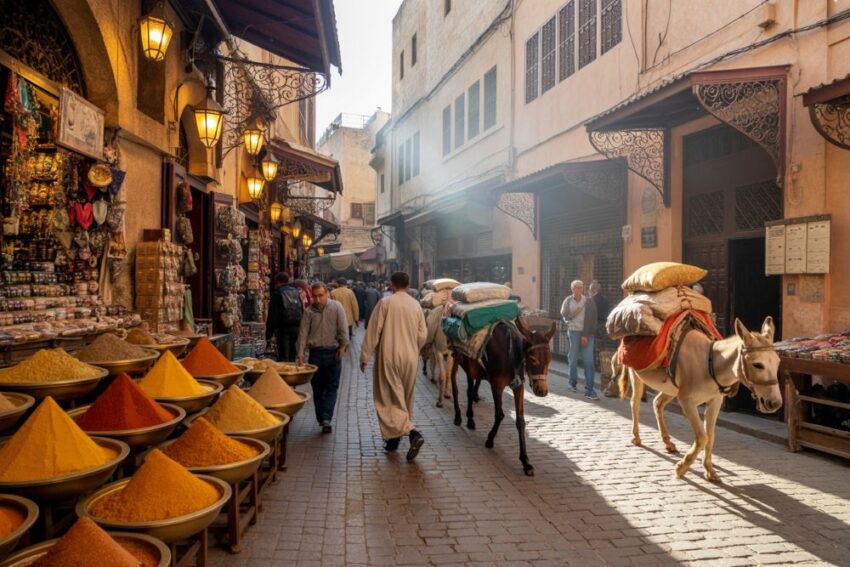 Image generated with Ai
The medieval medina of Fes stands as one of the most intricate and immersive historic urban centers in the world. Recognized by UNESCO as a World Heritage Site, this eighth-century district is widely described in official Moroccan tourism materials as one of the largest and best-preserved medieval cities globally. Spanning approximately 280 hectares, the old city often referred to as Fes el-Bali is considered the largest contiguous car-free urban zone in the world. Its dense network of more than 9,000 narrow alleyways forms a vast labyrinth that has evolved over more than a millennium. For visitors, navigating the medina can be both exhilarating and daunting.
A City Experienced Before It Is Seen
According to Morocco’s Ministry of Tourism, Fes developed into a major spiritual, intellectual and commercial center of the Islamic world shortly after its founding in the 8th and 9th centuries. Today, the medina remains a living city where commerce, craftsmanship and daily life unfold much as they have for centuries. The approach to the old city is marked by a sensory intensity that defines the experience. Long before entering the main market streets, visitors encounter a growing hum of activity metalworkers shaping brass, traders calling out to customers, and artisans crafting goods in open-front workshops. Aromas from spice stalls, leather workshops and food vendors fill the air, signaling arrival at one of the world’s most dynamic open-air marketplaces.
Advertisement
Advertisement
The World’s Largest Car-Free Urban Area
Official heritage documentation notes that the medina’s layout reflects a pre-modern urban design built entirely for pedestrians and pack animals. Cars cannot enter its inner quarters. Goods are transported by donkeys, handcarts and wheelbarrows through lanes that are often only shoulder-width. The narrow passages twist and intersect unpredictably. Many corridors appear nearly identical, and signage is minimal. Digital navigation systems frequently fail to provide reliable guidance within the dense stone walls and covered alleys. For travelers unfamiliar with the city’s structure, this can quickly become disorienting. Once inside the core market areas, retracing steps is rarely straightforward.
Advertisement
Advertisement
Moving Through the Markets
The medina’s commercial life centers on its souks, where trades are traditionally organized by craft. Streets devoted to metalwork shimmer under hanging lamps, while other alleys display textiles, ceramics, wood carvings and leather goods. The density of activity intensifies in the central zones. Traders compete for space alongside local residents completing daily shopping, while international visitors observe the spectacle. Pack animals weave through the crowds carrying goods, their handlers announcing their approach to clear a path. Given the complexity of the layout and the high volume of foot traffic, official tourism authorities recommend engaging licensed local guides. Organized groups typically proceed in single file to prevent separation in the narrowest sections. Guides are trained to manage routes efficiently while ensuring visitors remain together. If a traveler becomes separated from a group, standard guidance suggests remaining in place rather than attempting to navigate independently. Guides are accustomed to returning along their route to retrieve missing participants.
Advertisement
Advertisement
Structured Tours Versus Independent Exploration
While group tours offer security and efficiency, they often move at a steady pace designed to accommodate all participants. This can limit opportunities to pause for detailed observation, interact extensively with artisans or browse individual stalls. For visitors seeking a more personalized experience, hiring a private licensed guide is frequently recommended in official tourism materials. A dedicated guide allows greater flexibility to linger at specific shops, observe craftspeople at work and negotiate purchases according to local customs. In many cases, the savings achieved through informed bargaining can offset the cost of the guide’s services. Independent exploration remains possible but requires preparation and awareness. Moroccan tourism authorities advise identifying a clear landmark early in the visit to serve as a navigational reference point.
Key Landmarks for Orientation
Among the medina’s most significant landmarks is the University of al-Qarawiyyin. Established in 857 AD, it is recognized internationally as the oldest continuously operating university in the world. Originally founded as a mosque and educational institution, it played a central role in Islamic scholarship and intellectual exchange across North Africa and beyond. Its historic structures remain integral to the medina’s architectural landscape. Another major point of reference is the Chouara Tannery, one of the oldest functioning leather tanneries in the world. Dating back to at least the 11th century, it continues to use traditional dyeing methods in large stone vats arranged in geometric patterns. The site is known for its distinctive and powerful scent, which often alerts visitors before it comes into view. Locating such landmarks can provide reassurance before venturing deeper into the maze of alleys.
Advertisement
Advertisement
Commerce, Craft and Cultural Continuity
The medina of Fes is not a static historical exhibit but a thriving residential and commercial district. Thousands of people live within its walls, and many traditional crafts remain active. According to Morocco’s Ministry of Culture, Fes is particularly renowned for zellige tilework, carved cedarwood, embroidered textiles and intricate metal engraving. Workshops are often family-run enterprises passed down through generations. Bargaining is a customary aspect of commercial exchange in the souks. Official travel advisories recommend respectful negotiation practices and awareness of local pricing norms. Visitors unfamiliar with these customs may benefit from guidance to ensure fair transactions.
Preservation and Global Recognition
UNESCO inscribed the Medina of Fes as a World Heritage Site in 1981, recognizing its outstanding universal value as a remarkably preserved example of medieval Islamic urban planning. Preservation programs implemented by Moroccan authorities aim to protect historic buildings while improving infrastructure for residents and visitors. Restoration efforts have focused on madrasas, fountains, gates and residential structures vulnerable to structural decay. Maintaining the medina’s authenticity while accommodating modern needs remains a central challenge. The absence of motorized traffic has contributed to preserving the architectural integrity of the site, reducing pollution and structural stress on centuries-old foundations.
Practical Guidance for Visitors
Moroccan tourism authorities provide several practical recommendations for those planning to explore the medina:
- Engage licensed guides accredited by official tourism bodies.
- Wear durable footwear suitable for uneven stone pathways.
- Keep valuables secure in crowded areas.
- Respect local customs, particularly near religious institutions.
- Carry small denominations of local currency for purchases and tips.
Visitors who choose to explore independently and later require assistance often arrange informal guidance back to a main gate or landmark for a modest fee. Ensuring clarity on compensation beforehand helps avoid misunderstandings.
Advertisement
Advertisement
A World Wonder Experienced Fully
Emerging from the medina after hours of exploration brings a strong sense of achievement. The complexity that initially appears intimidating ultimately reveals itself as a living system shaped by centuries of adaptation. Fes offers a rare opportunity to experience a medieval urban environment functioning in its original form. Within its walls, historic institutions such as the University of al-Qarawiyyin continue to symbolize the city’s intellectual heritage, while daily commerce sustains its contemporary vitality. For travelers willing to embrace its intensity and unpredictability, the medina provides an immersive encounter with history, craftsmanship and community life. As Morocco continues to promote sustainable cultural tourism through official channels, the ancient heart of Fes remains one of the world’s most compelling and authentic urban experiences.
Advertisement
