
Birmingham Rail Disruption Hits New Street–Selly Oak Corridor as Emergency Incident Triggers Cancellations and 30-Minute Delays

Published
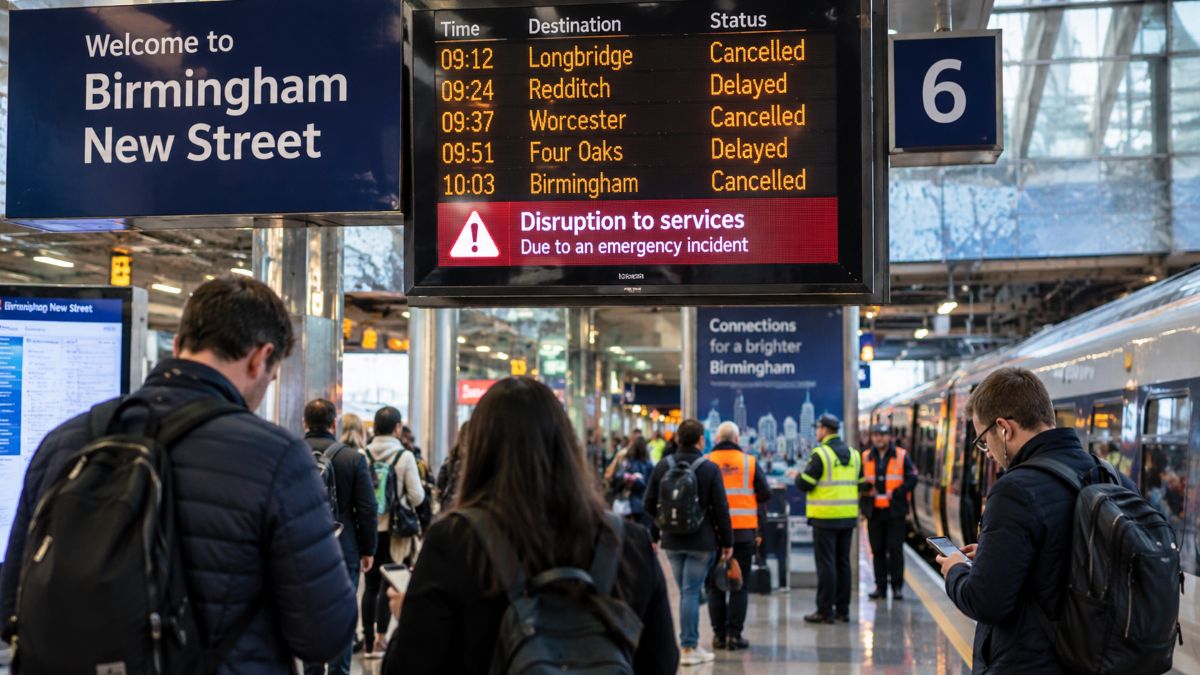 Image generated with Ai
Birmingham Rail Disruption Hits New Street–Selly Oak Corridor as Emergency Incident Triggers Cancellations and 30-Minute Delays because emergency services attended an incident near Selly Oak, forcing a temporary closure on a heavily used section of the West Midlands rail network. The disruption affected CrossCountry and West Midlands Railway services, with trains cancelled, revised or delayed by up to 30 minutes. Because Birmingham New Street is the busiest station in Great Britain outside London, problems on the New Street–Selly Oak Corridor can quickly spread across commuter, regional and long-distance routes. The Emergency Incident therefore Triggers Cancellations and wider travel disruption by blocking a key rail artery used by millions of passengers every year.
What Happened on the Birmingham Rail Line?
National Rail said the line between Birmingham New Street and Longbridge/Worcestershire Parkway via Selly Oak was closed while emergency services dealt with an incident.
The disruption was first recorded at 09:25 on 16 October 2026, with passengers warned that problems could continue until around 12:00. CrossCountry and West Midlands Railway services were both affected. CrossCountry routes linked Birmingham with destinations including Plymouth, Penzance, Cardiff Central, Nottingham, Manchester Piccadilly and Bristol Temple Meads, while West Midlands Railway services towards Bromsgrove, Redditch, Great Malvern, Hereford and Lichfield were also disrupted.
National Rail did not initially publish detailed circumstances beyond saying emergency services were attending. That is important for responsible reporting: the confirmed travel story is the closure, the resulting disruption and the passenger response measures, rather than speculation about the incident itself.
Advertisement
Advertisement
How Bad Were the Delays for Passengers?
National Rail warned that trains could be cancelled, delayed by up to 30 minutes or revised to operate only part of their normal route.
West Midlands Railway arranged road transport from Longbridge to Bromsgrove, Redditch and Worcester, as well as between Worcester and Hereford. Rail tickets were also accepted on numerous National Express West Midlands bus routes, including 11A, 11C, 18, 23, 24, 45, 47, 48, 49, 61, 63, 80, X20, X21 and X22.
Advertisement
Advertisement
Additional alternatives included Transport for Wales services between Hereford and Shrewsbury, West Midlands Railway services from Birmingham Moor Street to Shirley, and local buses towards Kings Norton, Longbridge and Northfield.
For travellers, the disruption therefore extended beyond a simple 30-minute delay. Some passengers had to change routes entirely, use road replacement transport or allow significantly longer journey times.
Why Did a Selly Oak Closure Affect Such a Large Travel Market?
Birmingham’s railway network carries exceptionally high passenger volumes.
Department for Transport data shows Birmingham New Street handled 36.6 million entries and exits in 2024–25, making it the busiest station in Great Britain outside London. Birmingham also recorded around 116,700 rail passenger arrivals on a typical autumn weekday in 2025, second only to London among major cities in England and Wales.
The affected line serves Selly Oak, Bournville, Kings Norton, Longbridge and Bromsgrove before connecting with routes further south.
That means a closure in one relatively short section can disrupt commuters travelling into Birmingham, university passengers, regional visitors and long-distance passengers making onward connections at New Street.
Advertisement
Advertisement
For tourists using Birmingham as a rail hub, the knock-on effect can extend to hotel check-ins, attraction bookings, airport connections and intercity rail journeys.
How Important Is Birmingham New Street to Britain’s Rail Network?
Official Office of Rail and Road figures show that Birmingham New Street is central to some of Britain’s busiest rail journeys outside London.
Four of the five busiest non-London rail flows in 2024–25 involved the station. Birmingham New Street–Coventry recorded 2.4 million journeys, New Street–Wolverhampton 1.9 million, New Street–Selly Oak 1.7 million, and New Street–University 1.5 million.
The 1.7 million annual journeys between New Street and Selly Oak are directly relevant because Selly Oak was at the centre of the October disruption.
Network Rail’s physical footfall data recorded approximately 52.14 million movements at Birmingham New Street in 2024–25, while ORR’s separate ticket-based usage estimate stood at 36.62 million. Footfall increased 5.3% year on year, while the ORR estimate grew 9.9%.
Why Can Birmingham Rail Delays Spread So Quickly?
Birmingham New Street operates under considerable timetable pressure, which means disruption can spread rapidly.
Advertisement
Advertisement
Official Network Rail representations show that during the December 2023 timetable, national on-time performance stood at 65.2%, compared with 46.9% at Birmingham New Street. Under the June 2024 timetable, national performance was 61.9%, while New Street recorded 42.9%.
West Midlands Trains recorded 51.8% on-time performance under the December timetable and 47.7% under the June timetable.
Network Rail also reported that Birmingham performance could fall from 76.7% to 38% during the morning peak, while evening peak punctuality could slip below 35%.
When a route closes unexpectedly, trains and crews quickly become displaced. Even after the infrastructure reopens, operators may need time to restore normal patterns, causing residual delays well beyond the original incident.
How Many Operators and Passengers Depend on Birmingham New Street?
Birmingham New Street has 12 through platforms, each divided into A and B ends, plus bay platform 4C.
Five major passenger operators use the station: Avanti West Coast, CrossCountry, London Northwestern Railway, Transport for Wales Rail and West Midlands Railway.
Advertisement
Advertisement
The station also manages substantial numbers of passengers requiring assisted travel. Between April 2023 and March 2024, New Street handled 68,040 passenger assistance requests. On 27 December 2024 alone, it delivered 833 passenger assists.
This is particularly significant during disruption. Platform changes, cancelled trains and replacement buses create additional challenges for travellers with reduced mobility, older passengers and those unfamiliar with Birmingham.
For leisure travellers, the complexity of the station makes real-time information especially important whenever services are altered at short notice.
Were Birmingham Travellers Already Facing Other Disruptions?
The Selly Oak incident followed several separate railway problems around Birmingham during October 2026.
On 13 October, a train fault at Northfield caused delays of up to 30 minutes between Birmingham New Street and Bromsgrove/Redditch. On 14 October, a track safety inspection near Rowley Regis caused delays of up to 15 minutes. On 15 October, an emergency-services incident between Birmingham and Leicester/Derby produced delays of up to 60 minutes. Damaged overhead wires near Stafford on 10 October had already caused delays of up to 50 minutes.
These were unrelated events and should not be presented as one continuing problem.
Advertisement
Advertisement
However, their proximity illustrates how quickly travellers can encounter repeated disruption on a heavily used rail network and why passengers making time-sensitive journeys should check live information before departure.
What Rights Did Affected Passengers Have?
National Rail confirmed that passengers whose trains were cancelled could use participating alternative operators up to two hours before or two hours after their original departure time.
Travellers who decided not to travel, or who could not complete their journey because of cancellation, were entitled to seek a full refund from the original point of sale. Passengers delayed while completing their journey could also be eligible for compensation, depending on the circumstances and operator.
National Rail advised affected customers to retain tickets, keep journey details, consult the real-time Journey Planner and allow additional time for replacement transport.
For tourists and visitors, keeping digital booking confirmations and screenshots of disruption notices can also make compensation or refund applications easier after the journey.
What Do the Key Birmingham Rail Statistics Show?
The scale of the disruption becomes clearer when placed alongside official passenger data.
Advertisement
Advertisement
| Measure | Official figure |
|---|---|
| Incident reported | 09:25, 16 October 2026 |
| Maximum stated delay | Up to 30 minutes |
| Expected disruption | Until around 12:00 |
| Birmingham New Street usage, 2024–25 | 36.6 million |
| Network Rail New Street footfall | 52.14 million |
| Typical Birmingham weekday arrivals | 116,700 |
| New Street–Selly Oak journeys | 1.7 million |
| Through platforms | 12 + platform 4C |
| Passenger assistance requests | 68,040 |
| Passenger operators | 5 |
These figures explain why even a temporary closure can have consequences far beyond one suburban station.
Comment From Anup Keshan, Founder and Editor-in-Chief of Travel And Tour World
“Birmingham is one of Britain’s most important rail gateways, so even a relatively short closure can have a significant effect on commuters, leisure travellers and visitors connecting to other parts of the country. What matters most during an incident is clear passenger information, practical alternative transport and quick communication between operators. The availability of replacement buses and ticket acceptance across other services can help reduce disruption, particularly for tourists unfamiliar with local routes. With Birmingham New Street handling tens of millions of passenger movements each year, resilient contingency planning remains essential for maintaining confidence in regional and long-distance rail travel.”
Why Does This Birmingham Rail Incident Matter for Travellers?
The Birmingham Rail Disruption Hits New Street–Selly Oak Corridor as Emergency Incident Triggers Cancellations and 30-Minute Delays because one of Britain’s busiest rail hubs depends on tightly connected regional and long-distance routes.
National Rail confirmed that emergency services attended an incident near Selly Oak, temporarily closing the route towards Longbridge and Worcestershire Parkway. Passengers faced cancellations, revised journeys, replacement buses and delays of up to 30 minutes.
The wider reason for the impact is scale: Birmingham New Street handles 36.6 million annual entries and exits, while the New Street–Selly Oak flow alone accounts for around 1.7 million journeys.
For travellers, the episode underlines the importance of checking live services, allowing extra connection time and retaining tickets whenever major Birmingham rail routes are disrupted.
Advertisement
