
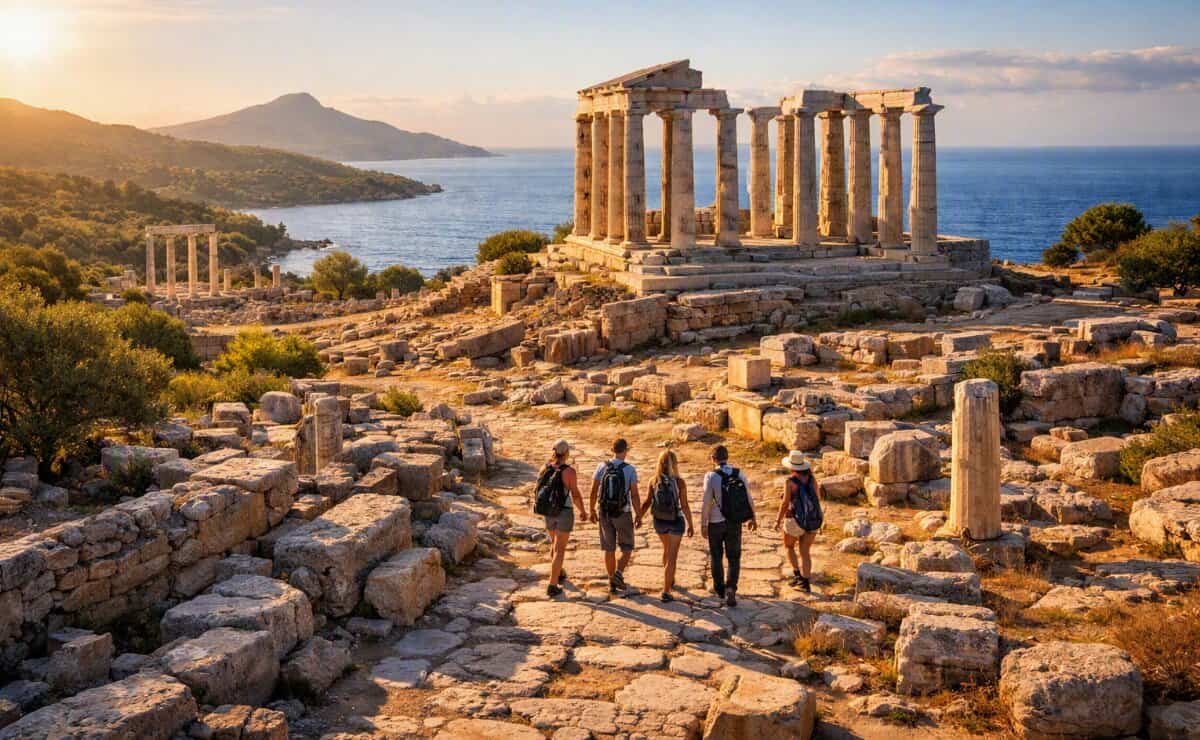
Image generated with Ai
Still, Greece remains one of the best places for the history traveler with its impressive landmarks of the ancient age that can tell the stories of thousands of years of the existence of humanity. Starting with the famous Acropolis of Athens and moving to ancient cities of the Peloponnese as well as Byzantine monasteries, located in mountains, Greece landmarks give people the opportunity to explore the stories of philosophers, warriors, artists, and other people that affected the development of world history.
Those travelers that are looking for more than beaches and vacations on islands should come to Greece as there is a unique possibility to learn about classical civilization, mythology, religion, and architecture of the country. The landmarks of Greece reflect different periods of the history, starting from kingdoms of the Bronze Age and ancient Greek states to Rome and Byzantine heritage. The most of these landmarks are considered to be culturally significant and are listed by UNESCO as the World Heritage sites.
At the same time, history tourism still attracts those visitors that are seeking more interaction with destination. Greece gives them all the opportunities.
Greece’s historical attractions are important because they show how ancient societies influenced modern politics, philosophy, science, art and architecture. A journey through Greece is not simply a sightseeing experience; it is an opportunity to understand the origins of ideas that continue shaping the world.
Advertisement
For history lovers, the country offers a rare combination of archaeological discoveries, dramatic landscapes and cultural traditions.
These landmarks also encourage travellers to explore beyond popular cities and islands, bringing attention to smaller regions with rich cultural identities.
The Acropolis of Athens is Greece’s most famous historical landmark and one of the most recognised symbols of ancient civilisation. Located above the modern city, this hilltop complex represents the achievements of classical Athens during its golden age.
The Parthenon, dedicated to Athena, remains the centrepiece of the Acropolis. Built during the fifth century BC, the temple reflects the architectural skill and artistic ambition of ancient Greece. UNESCO recognises the Acropolis as one of the world’s most significant cultural sites.
Advertisement
Advertisement
A visit to the Acropolis allows travellers to understand the birthplace of democracy, philosophy and classical artistic traditions.
Located on the slopes of Mount Parnassus, Delphi was one of the most important religious centres of ancient Greece. Ancient Greeks believed the site was connected with Apollo and visited the famous Oracle of Delphi to seek guidance.
The archaeological site combines historical importance with spectacular mountain scenery, creating one of Greece’s most memorable cultural experiences. Delphi is included on UNESCO’s World Heritage List because of its outstanding historical value.
For travellers interested in ancient beliefs, Delphi provides insight into how religion influenced decision-making in the Greek world.
Ancient Olympia is one of Greece’s most important archaeological destinations because it was the birthplace of the Olympic Games. Located in the Peloponnese region, the site hosted athletic competitions dedicated to Zeus.
The ancient games began more than two thousand years ago and created a tradition that continues globally today. UNESCO recognises Olympia as a site of exceptional cultural importance.
For sports enthusiasts and history travellers, Olympia provides a unique opportunity to stand where ancient athletes competed.
The Sanctuary of Asklepios at Epidaurus represents one of the most fascinating connections between ancient Greek culture, theatre and medicine. The site was dedicated to Asklepios, the Greek god associated with healing.
Its ancient theatre remains famous for its exceptional design and acoustics, demonstrating the advanced engineering knowledge of ancient builders. UNESCO lists Epidaurus among Greece’s important cultural heritage locations.
Epidaurus shows how ancient Greeks connected health, performance and spirituality.
Meteora offers one of Greece’s most dramatic historical landscapes, combining natural wonders with religious heritage. Massive rock formations rise above the Thessaly region, where monasteries were built on top of towering cliffs.
The monasteries represent centuries of Orthodox Christian tradition and Byzantine influence. Meteora is recognised by UNESCO for both cultural and natural importance.
Meteora proves that Greece’s history extends far beyond the ancient Greek era.
Before the classical period, Greece was home to the powerful Mycenaean civilisation. The archaeological site of Mycenae provides visitors with a window into this early Greek society.
The ancient city was once a major political and military centre, known for its impressive walls, royal tombs and legendary connections with Greek mythology.
Mycenae allows travellers to explore a period of Greek history that existed centuries before Athens reached its peak.
Travellers planning a history-focused trip to Greece should prepare carefully because many archaeological locations are outdoor attractions requiring walking, sun protection and comfortable footwear.
Good preparation helps travellers enjoy Greece’s heritage sites while avoiding unnecessary challenges.
Greece’s historic landmarks demonstrate why cultural tourism remains one of the strongest travel trends worldwide. More visitors are searching for destinations that provide knowledge, authenticity and meaningful experiences.
Exploring Greece’s ancient sites supports heritage preservation and helps local communities benefit from tourism beyond traditional beach destinations.
For travellers, Greece offers something rare: the chance to physically connect with places that influenced human civilisation for thousands of years.
The Acropolis, Delphi, Olympia, Epidaurus, Meteora and Mycenae are among the most important historic landmarks in Greece.
A week or more allows travellers to combine Athens with major mainland archaeological destinations.
No. Greece also offers Byzantine monasteries, medieval towns and religious heritage sites.
Spring and autumn are ideal because temperatures are comfortable for outdoor exploration.
Yes. Many archaeological sites provide educational experiences suitable for visitors of all ages.
Even today, Greece is known to be one of the most unique destinations on the face of Earth for historic tourism. The temples, historical and cultural sites make up for a walk through the very foundation of the civilized world.
Starting from the monuments made of marble in Athens and up to the monasteries on the rocks in Meteora, Greece is offering the chance to delve into the tales that have been around for thousands of years.
Advertisement
Advertisement
Advertisement













Friday, September 4, 2026

Friday, September 4, 2026

Friday, September 4, 2026

Thursday, September 3, 2026

Wednesday, September 2, 2026

Friday, September 4, 2026

Friday, September 4, 2026