
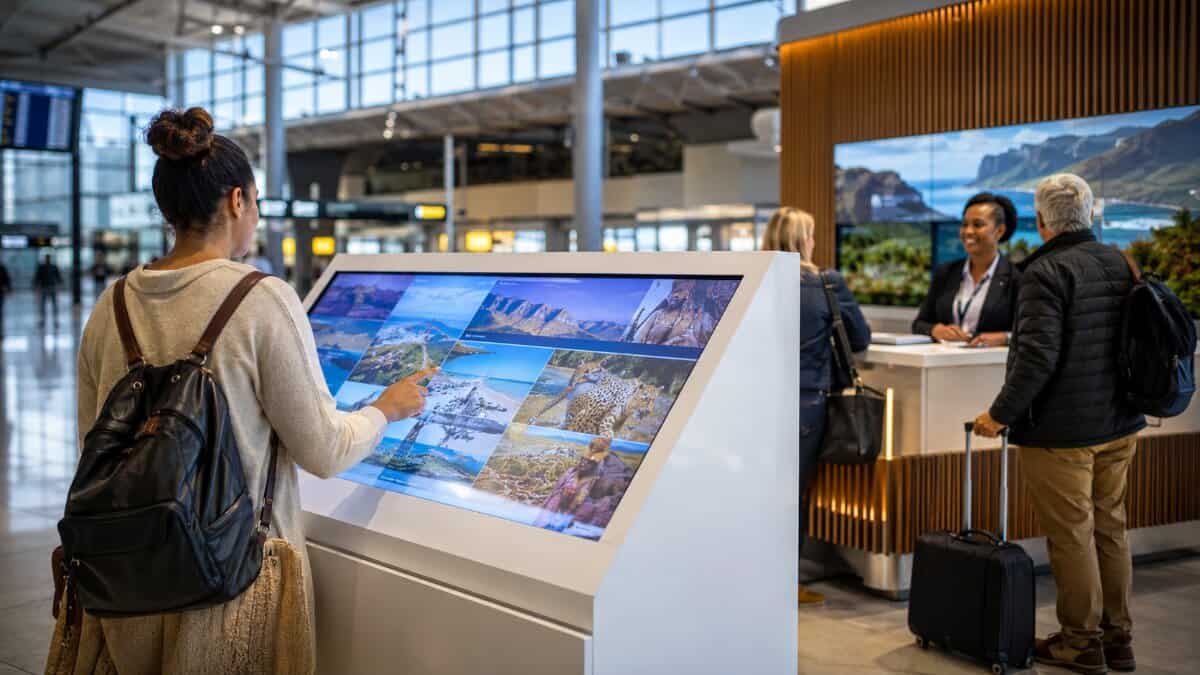
Image generated with Ai
South Africa’s paperless Smart Visitor Information Centre at OR Tambo International Airport is becoming strategically important for a reason that extends beyond digital destination discovery. International tourism is expanding, Johannesburg is receiving additional European capacity and OR Tambo has entered another phase of its R14.5 billion infrastructure programme. Yet only 9.2 per cent of international tourists travelled across more than one province during the fourth quarter of 2025. The centre must therefore convert airport arrivals into longer, bookable multi-province itineraries if tourism growth is to reach businesses beyond established gateways.
The Smart Tourism Visitor Information Centre was opened in the international arrivals precinct at OR Tambo on 19 November 2025. It was designed as an interactive, paperless destination-marketing facility offering real-time information about tourism, culture and heritage across South Africa’s nine provinces.
Its immediate functions include accessible digital displays, assistance from six information officers and an automated tourism-complaints system. Official plans also envisage a connected visitor application offering digital navigation, curated itineraries, transport options, multilingual audio material and province-specific destination content.
Those features appeared innovative at launch. Eight months later, however, their economic significance has increased.
Advertisement
Advertisement
South Africa welcomed 4,761,108 international visitors between January and May 2026, representing growth of 12.8 per cent over the corresponding period of 2025. May alone produced 861,750 tourists, including 222,641 who entered by air.
The central question is no longer whether arriving passengers can discover South African destinations on a screen. It is whether the centre can help convert that expanding audience into measurable provincial travel, accommodation nights, attraction admissions, ground-transport purchases and tourism SME revenue.
The latest detailed official international-tourism performance report shows a sharp contrast between arrival growth and tourism distribution.
During the fourth quarter of 2025, South Africa received 2.9 million international tourists and generated R28.8 billion in foreign direct tourism spend. However, overall geographic spread declined to 9.2 per cent, meaning fewer than one in ten international tourists visited more than one province.Official tourism indicator Latest available result Strategic meaning for the OR Tambo centre International visitors, January to May 2026 4,761,108, up 12.8 per cent A larger inbound audience is entering the destination-marketing funnel. Tourists recorded in May 2026 861,750, up 7.2 per cent year on year Sustained monthly growth increases the number of potential users requiring immediate destination guidance. Tourists entering by air in May 222,641 Air travellers represent the most immediately addressable market within airport arrivals. Overall multi-province travel in Q4 2025 9.2 per cent Most international trips remained concentrated within one province. Africa Land geographic spread 2.3 per cent Regional land visitors rarely added a second province. Africa Air geographic spread 8.4 per cent Even air travellers from African markets showed limited provincial dispersal. Overseas geographic spread 30.7 per cent Long-haul tourists remain the strongest market for multi-province packages. Overseas share of arrivals and spending in Q4 25.2 per cent of arrivals and 57.1 per cent of spending High-value long-haul visitors offer the strongest immediate conversion opportunity.
The gap matters because South Africa’s tourism value is not distributed evenly. Gauteng received 1.2 million international arrivals during the fourth quarter and generated R13 billion, equal to 45.1 per cent of national foreign direct tourism spend. The Western Cape attracted 466,800 visitors and generated R7.9 billion. Together, the two gateway provinces accounted for a substantial share of visitor expenditure.
By comparison, the Eastern Cape received 106,600 international visitors and generated R1.3 billion. The Northern Cape recorded 29,800 visitors and R500 million, while Limpopo welcomed 116,400 visitors and produced R1.6 billion in foreign direct spend.
The figures do not suggest that established gateways should receive fewer travellers. They show why additional arrivals must be converted into supplementary journeys reaching a broader provincial economy.
A Department of Tourism release dated 1 July printed 4,220,586 as the January to May 2026 total while simultaneously reporting 12.8 per cent growth. That figure was the 2025 baseline and was therefore inconsistent with the stated increase. A later official update published on 8 July reported 4,761,108 visitors, a total consistent with the announced growth rate. The later figure has consequently been used in this report.
OR Tambo is positioned to influence traveller decisions because of its exceptional scale. The airport handles more than 21 million passengers annually, has capacity for 28 million and supports services by 41 airlines linking South Africa with five continents. Its central terminal covers 110,000 square metres, while its domestic terminal covers 90,000 square metres.
A direct Air Europa service between Madrid and Johannesburg began in June 2026 with three weekly frequencies. The service gives Spain direct access to Johannesburg while supporting onward European connections through Madrid.
Further capacity is scheduled from October. Turkish Airlines plans to increase Johannesburg frequencies from seven to ten weekly flights as part of a wider expansion to 20 weekly South African services. The airline’s Cape Town operation is also scheduled to rise from seven to ten weekly frequencies.
These developments are particularly relevant to the smart centre because overseas visitors are already the segment most likely to travel across provincial boundaries. New European capacity can therefore support circuits combining Gauteng with wildlife, heritage, coastal, food, adventure and community-based products elsewhere in the country.Connectivity or infrastructure development Implementation status Traveller opportunity B2B implication Madrid to Johannesburg direct service Operating three times weekly from June 2026 Easier access from Spain and connecting European markets Operators can build Johannesburg-led circuits rather than treating the city only as a transit point. Istanbul to Johannesburg expansion Ten weekly services scheduled from October 2026 Greater frequency, itinerary flexibility and connecting access Agents can package secondary destinations around shorter Johannesburg connection windows. OR Tambo infrastructure programme R14.5 billion programme under way Progressive improvement of terminal and passenger facilities Product promotion must account for changing passenger flows, temporary works and wayfinding requirements. Infrastructure Phase Two Scheduled to commence in July 2026 Further passenger-facility modernisation The visitor centre must remain visible and accessible as terminal circulation changes. Tourism Growth Partnership Plan Targets 15 million annual international land and air tourists by 2029 Wider air access, destination development and improved travel facilitation Digital discovery must evolve into trackable referrals, itinerary construction and commercial conversion.
The timing of OR Tambo’s latest infrastructure phase adds an operational dimension to the visitor centre.
Infrastructure investment can improve the long-term passenger experience, but construction programmes also alter walking routes, dwell times, visibility and the positioning of passenger services. The centre’s effectiveness will therefore depend partly on whether international arrivals can find it quickly and continue using its information after leaving the terminal.
A fixed airport display has limited influence once a traveller enters a vehicle, hotel or connecting terminal. The proposed visitor app is therefore the more commercially important component of the project. Digital navigation, provincial itineraries and transport information could extend engagement throughout the trip rather than confining it to a brief encounter after passport control.
The app could also reduce a persistent planning barrier. Travellers may recognise major South African attractions but remain uncertain about domestic flight schedules, driving distances, guided transfers, attraction opening arrangements and the time required to combine provinces safely. A useful platform must present those practical connections, not simply destination imagery.
The exclusive industry issue emerging in July 2026 is an accountability gap.
Official material reviewed through 19 July confirms the physical visitor centre, provincial information, complaints function, staffing model and longer-term app concept. It does not provide publicly reported visitor-centre footfall, interaction totals, destination searches, referral clicks, itinerary saves, bookings generated, complaints resolved or second-province conversions. The reviewed official updates also do not provide confirmation that the proposed visitor app has entered public operation.
That absence does not indicate failure. It identifies the next policy and commercial requirement.
Screen views and visitor enquiries are activity measures. They do not demonstrate tourism dispersal. Meaningful performance indicators would include the percentage of users selecting a second province, qualified referrals delivered to tourism enterprises, subsequent accommodation bookings, provincial attraction purchases, transport conversions and incremental bed nights outside the traveller’s primary gateway.
This is where the centre could generate disproportionate value. It is a comparatively focused digital intervention located inside an airport processing more than 21 million passengers a year. Even a modest conversion rate could direct meaningful demand towards businesses with limited international marketing reach. That outcome, however, requires current inventory, bookable links, reliable transport data and post-interaction measurement.
The centre was designed to provide information and communications technology support to enterprises in villages, small towns and dorpies. Provincial tourism authorities are also expected to feed tourism products and experiences into the platform.
For small operators, airport visibility can address part of the market-access problem. It cannot resolve weak booking systems, limited availability information, unsuitable payment processes or uncertain last-mile transport.
A property, guide, attraction or community tourism enterprise displayed at OR Tambo must be capable of receiving and converting an enquiry immediately. Long-haul travellers making decisions after arrival are unlikely to wait for manual confirmations or incomplete pricing.
The platform will consequently produce stronger commercial outcomes where provincial content is connected to live operating information, mobile-ready booking paths, verified contact channels and realistic journey planning.
The OR Tambo Smart Visitor Information Centre is no longer merely a digital amenity attached to an airport-arrivals hall. It now occupies a strategic point between expanding air access and a national tourism economy seeking 15 million annual international land and air visitors by 2029. The same national plan targets international tourism spend of R115.2 billion a year.
Arrival growth alone will not guarantee inclusive results. The commercial test is whether travellers who enter through Johannesburg can be encouraged to remain longer, add another province, purchase formal tourism services and reach enterprises that do not possess the marketing power of established destinations.
The smart centre can support that shift. Its long-term influence will depend on the delivery of its connected app, the quality of provincial inventory and the publication of transparent conversion data. When destination discovery becomes measurable itinerary creation and confirmed regional spending, OR Tambo can function not only as South Africa’s largest aviation gateway, but as a distribution engine for the entire national visitor economy.
Advertisement
Tags: Digital Destination Discovery, international arrivals, Johannesburg Tourism, Multi Province Travel, OR Tambo International Airport
Advertisement
Advertisement













Friday, September 4, 2026

Friday, September 4, 2026

Friday, September 4, 2026

Thursday, September 3, 2026

Wednesday, September 2, 2026

Friday, September 4, 2026

Friday, September 4, 2026