
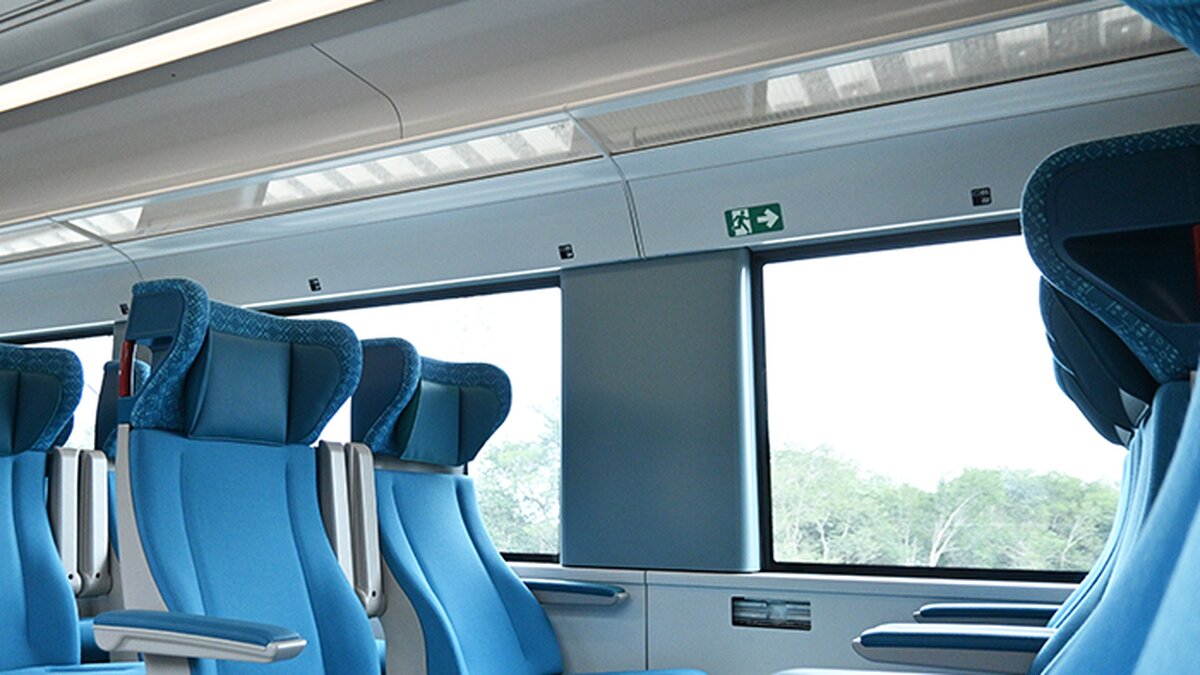
Mexico’s Tren Maya is moving beyond point-to-point railway transport by embedding remote Calakmul into organised overnight journeys between major gateways including Chetumal and Palenque. The next Santuario Maya programme runs from 11 to 17 September 2026, combining rail travel with Tulum, Chetumal, Bacalar, Calakmul and Palenque over seven days and six nights. Its September booking window has already closed, but November and December departures remain scheduled, making the larger development increasingly relevant to travel sellers building multi-day rail itineraries across Mexico’s Maya region.
The important railway development is no longer whether travellers can reach southeastern Mexico by train. The more significant shift is how Tren Maya is beginning to control the sequence of a trip once passengers leave the platform.
According to the official Tren Maya Santuario Maya programme, the railway operator has created a seven-day, six-night journey incorporating Tulum, Chetumal, Bacalar, Calakmul and Palenque. Calakmul is scheduled as the principal archaeological experience on the fourth day, while the wider journey uses rail, organised accommodation and destination activities to connect several geographically dispersed Maya attractions.
That structure changes Calakmul’s commercial positioning.
Advertisement
Advertisement
Instead of asking international travellers to independently coordinate a train, remote ground transport, archaeological admission, overnight accommodation and onward travel, the railway is increasingly being used as the backbone around which those components can be assembled.
The 11–17 September departure is particularly relevant because it represents the next scheduled use of that model. Sales closed on 28 August, meaning travellers cannot treat the September programme as a last-minute booking opportunity. However, the same official programme lists departures from 9–15 November and 11–17 December 2026, providing additional inventory later in the year.Official Tren Maya product Rail-tourism geography Duration 2026 timing Why it matters for Calakmul Santuario Maya Tulum, Chetumal, Bacalar, Calakmul, Palenque 7 days / 6 nights 11–17 Sept; 9–15 Nov; 11–17 Dec Inserts Calakmul into a multi-destination rail itinerary rather than a standalone excursion Un Tesoro Maya Palenque, Calakmul, Palenque 6 days / 5 nights 1–6 Dec Explicitly includes travel towards Campeche followed by accommodation in Calakmul Gran Santuario Verde Chetumal, Calakmul, Chetumal 2 days / 1 night Operated 2–3 Aug Demonstrates that even a short rail product can require an overnight Calakmul stay Gran Tour del Mundial Cancún, Mérida, Edzná, Palenque, Calakmul, Chetumal, Bacalar, Tulum 13 days / 12 nights Operated 7–19 June Places Calakmul inside a much larger circuit built around the railway network
Chetumal and Palenque are not decorative additions to this story. Both are structurally connected to the railway product.
The current official Tren Maya timetable published on 5 September shows a south-eastern rail axis operating from Chetumal to Escárcega and onward to Palenque, with the reverse journey also listed. Calakmul lies on the same southeastern network between the Quintana Roo and Campeche sections represented on Tren Maya’s official route material.
Advertisement
Advertisement
That makes Chetumal an eastern gateway into the Calakmul corridor while Palenque provides a western archaeological anchor and a gateway into Chiapas.Published railway movement Official departure Official arrival Planning significance Chetumal → Escárcega 06:30 11:18 Connects Quintana Roo with the Campeche rail corridor Escárcega → Palenque 11:38 14:42 Creates a scheduled onward connection towards Chiapas Palenque → Escárcega 14:00 16:49 Forms the west-to-east return flow Escárcega → Chetumal 17:09 21:57 Returns travellers towards southern Quintana Roo
There is also a practical B2B detail worth noticing.
The official timetable currently contains internal inconsistencies between some listed departure and arrival times and the displayed journey-duration fields. For example, several clock-time differences do not reconcile with the duration printed beside them. Travel agents building independent connections should therefore work from confirmed live booking inventory and reconfirm departure times instead of relying solely on the duration column displayed on the public schedule page.
That discrepancy becomes more important when a traveller is combining rail with a remote archaeological transfer.
The existence of Calakmul station does not turn the archaeological zone into a station-side attraction.
According to Mexico’s official Visit Mexico platform, travelling from Calakmul Tren Maya station to the archaeological site takes about 90 minutes by taxi. The same official destination guidance notes that trips involving the Tren Maya Hotel Calakmul commonly include transport from the railway, which materially simplifies access.
This is precisely why the overnight-package angle matters.
For destinations such as Valladolid or Mérida, railway arrival can feed comparatively straightforward urban stays. Calakmul is different. Rail solves the inter-regional journey, but the protected jungle location leaves a substantial final transfer.
Grupo Mundo Maya’s government profile for Hotel Tren Maya Calakmul lists 144 rooms, places the property 10 kilometres from the archaeological zone, and identifies a much greater separation from the railway station. The hotel therefore performs a transport function as well as an accommodation function: it allows the rail arrival, archaeological visit and onward journey to be spread across separate stages.
That makes Calakmul commercially closer to an overnight rail excursion than a conventional station stop.
This is where the development becomes more consequential for travel businesses.
Tren Maya has effectively created the ingredients for a rail-stay-archaeology corridor. Chetumal can feed travellers westward. Palenque can anchor a longer archaeological circuit. Calakmul can operate between them as the high-value remote experience requiring accommodation and controlled ground transport.
The December Un Tesoro Maya itinerary makes that model particularly clear. According to Tren Maya, the six-day, five-night programme begins around Palenque, places passengers aboard the railway towards Campeche on the third day, provides accommodation at Calakmul and allocates the following day to the archaeological zone before returning towards Palenque.
That is materially different from selling a train ticket.
The railway becomes the distribution spine for hotel nights, transfers, archaeology and destination expenditure.
For tour operators, that can increase average itinerary length and create reasons for travellers to remain in the southeastern circuit rather than concentrating their holiday around Cancún, Tulum or a single archaeological site.
Another development strengthens this interpretation.
According to Mexico’s Secretaría de Turismo, Visit Mexico introduced an online reservations module on 5 August 2026 through which travellers can access purchases for Tren Maya rail tickets, Mexicana flights and Grupo Mundo Maya hotel accommodation.
This matters because a railway tourism ecosystem only becomes genuinely scalable when the surrounding components become easier to buy.
Earlier in 2026, Sectur also expanded Tren Maya distribution through Flix. The government described that agreement as a way to strengthen international visibility, particularly in European markets. At that time, Tren Maya was operating across 1,554 kilometres and 34 stations in five southeastern states.
However, there remains an important distinction for travel sellers.
Individual rail and hotel products have become increasingly accessible through digital channels, while several Tren Maya tourism packages still direct customers towards quotation and contact channels rather than functioning as completely self-service dynamic packages.
That leaves room for travel agencies, receptive operators and destination management companies to add value through itinerary design, transfers and inventory coordination.
The transition towards packaged rail tourism is occurring against rising cumulative passenger volumes.
Tren Maya reported 2.15 million cumulative passengers by 27 January 2026. By 15 July 2026, the operator reported 2,665,699 passengers across its 34 stations. That represents an increase of approximately 515,699 cumulative journeys, or about 24 per cent, between those two reported totals.Official reporting point Cumulative passengers Additional passengers from January baseline 27 January 2026 2,150,000 Baseline 15 July 2026 2,665,699 515,699 Calculated increase — About 24%
Those numbers do not reveal Calakmul-specific demand. They do, however, show why the operator has an incentive to move beyond pure transportation.
Once a railway has attracted a substantial passenger base, increasing the number of nights, destinations and services attached to each rail journey becomes a logical tourism-development strategy.
The importance of Palenque is being reinforced institutionally.
On 15 August 2026, Tren Maya and the Chiapas tourism authorities examined possible cooperation involving Palenque as an access point, station connectivity, tourism packages and links with local service providers. No binding commitments were announced, but the subjects considered show that the Palenque station is being examined not simply as a railway terminal but as a tourism-distribution node.
For Calakmul, that matters because it strengthens the western end of the itinerary.
If Chetumal functions as the southern Quintana Roo gateway and Palenque gains greater integration with Chiapas tourism services, the railway section between them becomes increasingly suited to multi-stage cultural itineraries.
More railway access does not mean unlimited tourism growth.
Calakmul is part of the Ancient Maya City and Protected Tropical Forests of Calakmul World Heritage property, making visitor management inseparable from railway expansion.
The UNESCO World Heritage Committee’s 2026 decision requested continued monitoring of visitor numbers and cumulative tourism impacts associated with Tren Maya and related infrastructure. It also called for close monitoring of the operating Calakmul hotel, including water consumption, ecological integrity and visitor management.
INAH subsequently reported in August that the reactive monitoring process did not establish conditions requiring Calakmul to be placed on the List of World Heritage in Danger.
The implication for the travel industry is important. Successful rail tourism around Calakmul will have to depend on managed access, timed transfers and controlled stays, rather than simply maximising visitor throughput.
INAH currently lists the archaeological zone as open from 08:00 to 17:00, with final access at 16:00, another operational constraint that tour planners must incorporate into railway arrival and ground-transfer schedules.
There is also a near-term operational consideration.
On 31 August 2026, Tren Maya reported a track-related incident involving the final carriage of a Cancún–Palenque service shortly after departure from San Francisco de Campeche. The operator reported no injuries among the 123 passengers and transferred travellers by road to Edzná so their journey could continue aboard another train.
The present Tren Maya timetable remains published with the Chetumal, Escárcega and Palenque services visible as of 5 September.
For trade partners, that means current itineraries should not automatically be treated as suspended, but rail timings should still be reconfirmed close to departure.
The strategic importance lies in destination conversion.
Railway infrastructure alone can make a remote place technically reachable without making it commercially easy to sell. Calakmul demonstrates the distinction.
The station provides regional access. The hotel creates overnight capacity. Ground transfers bridge the remaining distance. Archaeological opening hours define the visit window. Chetumal and Palenque provide recognisable gateway markets. Packaged departures put those components into a usable sequence. Digital ticket and hotel distribution reduces friction further.
Together, these elements turn Tren Maya from a transport asset into a tourism operating platform.
That is the deeper development travel businesses should watch.
If the model succeeds, Calakmul could become a template for other comparatively remote cultural attractions where railway infrastructure alone cannot deliver a seamless visitor journey. The commercial opportunity is therefore not simply additional train passengers. It is additional bed nights, destination spending, transfer demand and longer regional itineraries generated around railway movements.
The most meaningful measure of Tren Maya’s tourism influence may eventually be less about how many passengers board trains and more about how railway connectivity changes length of stay and geographic distribution of tourism expenditure.
Calakmul is becoming an important test.
A place that was far away and not often visited by archaeologists is now being added to organized train trips that go from Chetumal to Palenque. These trips last anywhere from two nights to two weeks across a bigger network. Mexico is trying out an idea where the train tracks don’t just link places to see; they decide how places are put together ordered and experienced.
For tour companies, from countries this means there is a more advanced Mexico experience available moving beyond the usual way of going to the Caribbean by plane and staying there.
For the railway, it creates a pathway from transportation revenue towards an interconnected ecosystem of accommodation, archaeological tourism and regional ground services.
And for Calakmul, the September circuit shows why the next phase of Tren Maya may be defined not by opening another station, but by turning difficult-to-reach places into planned overnight rail destinations that can sustain longer, higher-value journeys through southeastern Mexico.
Image Source: Tren Maya
Advertisement
Advertisement
Advertisement













Saturday, September 5, 2026

Saturday, September 5, 2026

Saturday, September 5, 2026

Saturday, September 5, 2026

Saturday, September 5, 2026

Thursday, September 3, 2026

Saturday, September 5, 2026

Saturday, September 5, 2026


