
Sweden Makes Coach-Ready Destinations a Strategic Key to Spreading Tourism Beyond Cities

Published
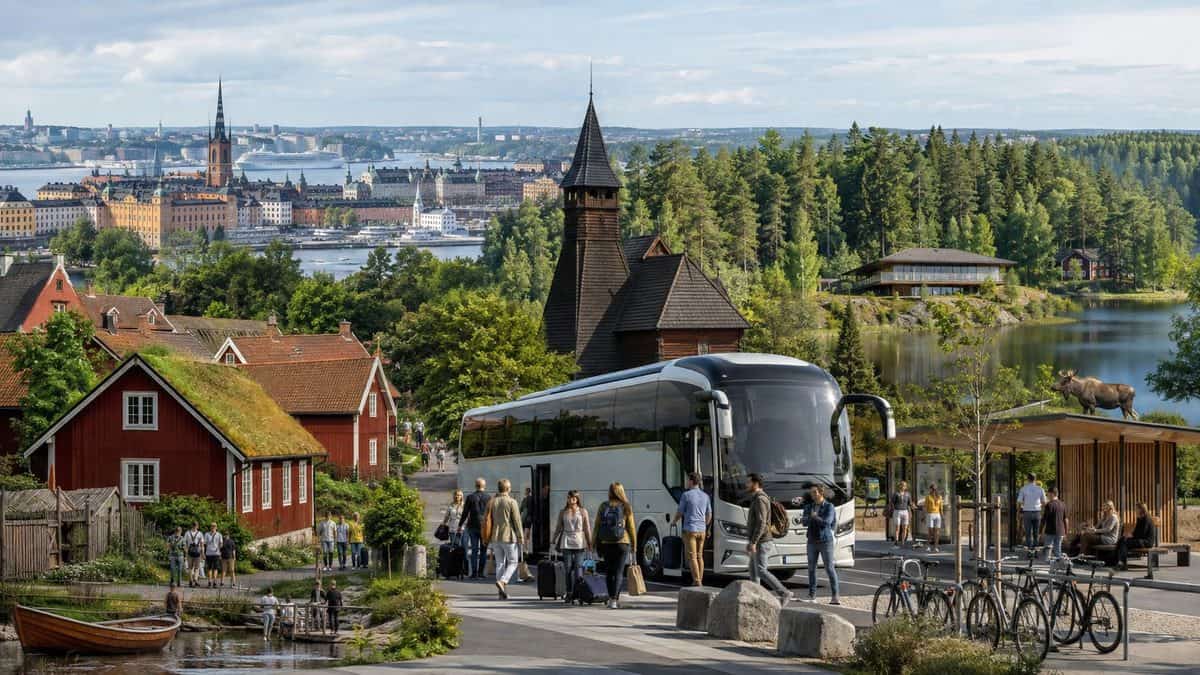
Image generated with Ai
Sweden recognises that its tourism assets are much less valuable if there’s no accessible way to transport travelers to those destinations. That’s why Sweden’s Bus and Coach Federation is encouraging tourism organizations to design tourist attractions so they meet the transportation needs of organized group travel.
The transportation accessibilities focus on coach parking and safe drop-off areas, along with group facilities and more partnerships with tour operators. This accessibility focus has been developed by Sveriges Bussföretag and the regional destination organization in Södermanland. This organisation has developed a very innovative guide to help tourism attractions understand the factors that ultimately decide if a destination is included on a coach itinerary.
Advertisement
Advertisement
This is Sweden’s prime opportunity to capture massive tourism growth potential. Sweden’s tourist guest nights in 2025 were 70.8 million, and Sweden’s tourism consumption reached SEK 504 billion, giving tourism 2.8% of Sweden’s total GDP.
The simple message for rural destinations is that SV recommends making attractions coach-accessible to capture tourism spending, so that rural communities do not have to rely solely on private car use.
Advertisement
Advertisement
What Makes a Destination Coach-Ready?
The Swedish model starts with an uncomplicated question: can a coach operator actually use the destination efficiently?
For an individual traveller, a difficult final kilometre may be manageable. A 50-seat coach faces a very different challenge. Drivers need adequate turning space, passengers need safe access and operators need predictable stopping arrangements.
Advertisement
Advertisement
That makes apparently minor infrastructure surprisingly important. A coach may bypass an attraction if parking is distant, drop-off arrangements are unclear or a group cannot access facilities conveniently.
Sveriges Bussföretag has therefore developed a practical framework for destinations seeking organised coach business. The material includes a checklist, case studies and films showing how attractions can work with coach operators.
Advertisement
Advertisement
The principle is commercially important. Destinations should involve coach operators before designing the visitor journey, rather than asking transport providers to solve access problems afterwards.
| Coach-ready requirement | Why it matters to operators | Traveller benefit |
|---|---|---|
| Dedicated coach parking | Reduces delays and manoeuvring problems | Smoother arrival |
| Safe drop-off points | Protects passengers during boarding | Easier access |
| Clear coach routing | Helps drivers navigate unfamiliar areas | More reliable itineraries |
| Group-friendly facilities | Handles large visitor volumes efficiently | Less waiting |
| Toilets and rest areas | Supports longer excursions | Greater comfort |
| Tour-operator cooperation | Improves itinerary planning | More destinations become viable |
| Accessible boarding areas | Supports diverse passenger needs | More inclusive travel |
| Clear advance information | Reduces operational uncertainty | Fewer disruptions |
This approach also fits wider Swedish transport policy. Trafikverket says improving public transport access outside major cities can encourage people to choose shared transport rather than cars. It also highlights accessibility and safer boarding environments as important infrastructure considerations.
Rural Sweden Has the Strongest Case
Sweden’s tourism geography makes the issue particularly relevant.
Many attractions sit beyond the major urban centres. Nature experiences, heritage locations, cultural attractions and regional food destinations frequently operate in areas with limited rail connections.
Advertisement
Advertisement
For independent travellers, driving can fill that gap. However, private-car dependence can leave rural tourism vulnerable to congestion, parking pressure and fragmented visitor spending.
Coach travel offers a different model. One vehicle can bring a sizeable group directly to a destination. That group can then spend across accommodation, restaurants, attractions and local shops.
The economic opportunity is becoming more visible. Sweden’s 2025 tourism consumption reached SEK 504 billion, the highest level since 2019. Tourism generated 2.8% of Swedish GDP.
Accommodation demand also remains substantial. Sweden recorded 70.8 million guest nights in 2025. Hotels accounted for 61% of those nights, while camping represented another 24%. Stockholm County led with 15.9 million guest nights. Västra Götaland followed with 11.7 million.
Yet the concentration of demand in major regions underlines the opportunity elsewhere.
A coach-ready strategy can help spread tourism beyond established gateways.
Advertisement
Advertisement
The Numbers Behind Sweden’s Tourism Momentum
Sweden’s wider tourism performance strengthens the argument for improving destination accessibility.
The country recorded 30.8 million commercial guest nights during June, July and August 2025. That represented a 3.4% increase from the previous summer and a new summer record.
Foreign visitors generated 9.4 million summer guest nights. That was an 8.8% annual increase. International visitors therefore accounted for roughly three in every ten summer guest nights.
Germany remained Sweden’s largest foreign market during that summer. German visitors generated 2.6 million guest nights. Norway followed with 2.2 million. Together, those two markets produced more than half of Sweden’s foreign summer guest nights.
| Indicator | Latest figure | Tourism significance |
|---|---|---|
| Commercial guest nights, 2025 | 70.8 million | Strong national accommodation demand |
| Tourism consumption, 2025 | SEK 504 billion | Record economic value |
| Tourism share of GDP | 2.8% | Major national economic contribution |
| Summer guest nights, 2025 | 30.8 million | Record summer performance |
| Foreign summer guest nights | 9.4 million | Strong international demand |
| Growth in foreign summer nights | 8.8% | International market momentum |
| Stockholm County guest nights | 15.9 million | Leading tourism region |
| Västra Götaland guest nights | 11.7 million | Major regional market |
| Skåne guest nights | 7.0 million | Important southern gateway |
The figures also suggest why rural accessibility matters. Sweden does not need only more visitors. It needs better distribution of visitor spending.
Coaches Can Unlock Harder-To-Reach Experiences
The traveller impact could be considerable.
Advertisement
Advertisement
A coach itinerary can connect an urban gateway with a rural attraction without requiring visitors to hire cars. That matters for international groups, school parties, older travellers and holidaymakers travelling without private vehicles.
It can also improve itinerary design. Operators can combine several attractions within a single route, creating multi-stop journeys that individual travellers may find difficult to organise.
For destinations, the commercial calculation is equally compelling.
A coach can deliver dozens of potential customers at once. Those visitors may require meals, admission tickets, guides, accommodation and retail services. The coach therefore becomes part of the destination’s distribution network.
This is particularly relevant for shoulder seasons. A well-designed group itinerary can help attractions generate demand outside the busiest summer weeks.
Sweden’s winter tourism provides evidence of continued seasonal potential. During winter 2024/25, the country recorded 21.3 million commercial overnight stays. Foreign guest nights increased 7% and reached 4.5 million.
Advertisement
Advertisement
That creates opportunities for coach itineraries around winter landscapes, cultural attractions and regional experiences.
The Real Test Comes Before Arrival
The Swedish approach challenges a common weakness in destination marketing.
Tourism organisations often promote what travellers can see. However, operators must first determine whether they can physically deliver visitors there.
The visitor experience begins before the coach arrives.
That means destinations should assess roads, turning areas, parking, arrival procedures and walking distances. They should also understand how long a group typically needs at each stage.
A coach itinerary cannot absorb the same uncertainties as independent travel. Delays at one attraction can affect every subsequent booking.
Advertisement
Advertisement
This makes communication essential. Destinations should provide operators with precise arrival information, parking instructions, unloading arrangements and contact details.
The benefits extend beyond tourism. Better access can also support residents and local businesses when infrastructure is designed intelligently.
Sweden’s Model Has Wider Industry Lessons
Sweden is not treating coach travel as a niche transport service. Instead, it is positioning coaches within broader destination development.
That distinction matters.
Across Europe, cities and attractions increasingly face competing demands for road space. Tourist coaches need places to stop, yet local authorities must balance those requirements with pedestrian safety, public transport and environmental objectives.
Recent industry discussions in Gothenburg illustrate the tension. Sveriges Bussföretag has identified safe boarding areas, temporary stopping locations, environmental-zone planning and access to entertainment venues as practical challenges for tourist coaches.
Advertisement
Advertisement
The lesson is not that coaches should receive unrestricted access. Rather, destination planners need to account for coaches before visitor flows are designed.
That can mean timed arrivals, designated parking, controlled drop-offs and clear operating rules.
Such measures can make coach tourism more manageable without compromising urban mobility.
How Sweden’s Approach Differs
The Swedish proposition is less about creating a new tourism policy than changing how destinations think about transport.
Traditional destination development often begins with the attraction. The coach-ready model starts with the complete visitor journey.
| Traditional destination planning | Coach-ready planning |
|---|---|
| Starts with the attraction | Starts with the complete journey |
| Promotes visitor experiences | Plans access alongside experiences |
| Treats transport as supporting infrastructure | Treats transport as part of the product |
| Focuses heavily on individual travellers | Designs for organised groups too |
| Addresses parking reactively | Plans coach parking in advance |
| Markets destinations independently | Works with tour operators |
| Measures arrivals | Considers operational usability |
The difference could become increasingly important as tourism authorities seek lower-impact forms of visitor mobility.
Advertisement
Advertisement
Shared passenger transport can move groups using fewer vehicles than individual car travel. However, its effectiveness depends on infrastructure and efficient routing.
Sweden’s approach therefore places destination design and sustainable mobility in the same conversation.
What Travellers Should Expect Next
For travellers, the most visible change may not be dramatic new infrastructure. Instead, it could be a more seamless journey.
A coach-ready destination should make arrival predictable. Visitors should know where they will be dropped off, how far they must walk and where facilities are located.
Accessible infrastructure can also make organised travel more attractive to passengers with different mobility needs.
Trafikverket’s current work provides a useful wider example. On Gotland, several bus stops are being upgraded with improved layouts, seating, cycle facilities and weather protection. The stated aim is to make public transport safer, more comfortable and more accessible.
Advertisement
Advertisement
Although local bus infrastructure differs from tourist-coach operations, the underlying principle is similar.
Better boarding, better access and clearer infrastructure improve the entire journey.
A Practical Checklist for Destination Planners
The Swedish experience offers a useful framework for tourism organisations elsewhere.
A destination should first identify whether a full-size coach can reach the attraction safely. It should then establish where passengers can disembark without creating conflicts with pedestrians or other vehicles.
Next comes the visitor experience. Toilets, refreshments, waiting areas and accessible routes can determine whether a short stop becomes a longer commercial visit.
Finally, destinations need direct communication with operators. A tourism website may describe an attraction beautifully, yet still leave out the information a coach planner needs.
Advertisement
Advertisement
| Planning question | What destinations should establish |
|---|---|
| Can coaches reach the site? | Road restrictions and suitable routes |
| Where can passengers disembark? | Safe and practical stopping points |
| Where can the coach wait? | Legal, accessible parking |
| How long should groups stay? | Realistic visit duration |
| Can facilities handle groups? | Toilets, catering and visitor capacity |
| Is access inclusive? | Step-free and accessible routes |
| Can operators plan confidently? | Accurate advance information |
| Who manages coach arrivals? | A clear local contact |
Sveriges Bussföretag’s guidance exists precisely because these operational details can influence commercial decisions. The federation says destinations that deliver strong products are more likely to attract returning coach operators.
Sweden’s Rural Tourism Opportunity Is Larger
The wider opportunity extends beyond Sweden.
Destinations across Europe face the same challenge. Scenic attractions often sit away from rail stations and major public transport corridors. At the same time, tourism authorities want to distribute visitors more widely.
Coach tourism can bridge that gap.
The strongest destinations will not simply advertise themselves as accessible. They will prove it through practical infrastructure and operator cooperation.
Sweden’s experience also shows why destination managers should measure access as carefully as visitor numbers. A popular attraction that repeatedly turns away coaches because of poor logistics is leaving potential revenue on the table.
Advertisement
Advertisement
Conversely, a smaller attraction with excellent coach facilities can become commercially attractive.
That changes the competitive landscape for rural tourism.
Better Access Could Spread Tourism Further
Sweden’s example shows the emerging pattern of using an established transportation network to drive the development of tourism. Transportation can never be an afterthought again.
Sweden has a strong position in this case study. Sweden has great potential tourism demand. In 2025, Swedish tourism providers recorded nearly 71 million guest nights. The total value of tourism was over 504 billion Swedish Krona. International tourism demand strengthened in the key tourist months.
The next step is distribution.
To assist in this weak area, the goal is to obtain the status of “coach ready destination”. This means the tourist attraction will be accessible for a organized group coach tour. This would take travelers outside the major cities and into the rural / remote region.
Advertisement
Advertisement
There are many benefits for travelers and service providers. Travelers may have easier and less complicated journeys. There would be reliable tourist services and better access to rural businesses.
The lesson to be learned is not political or ideological. Attractions need transportation infrastructure to be developed to allow travelers to move easily between tourist sites. Sustainable tourism may need to focus more on the networks that connect tourist sites rather than the tourist activities/sites themselves.
Advertisement
