Angana Dutta Angana Dutta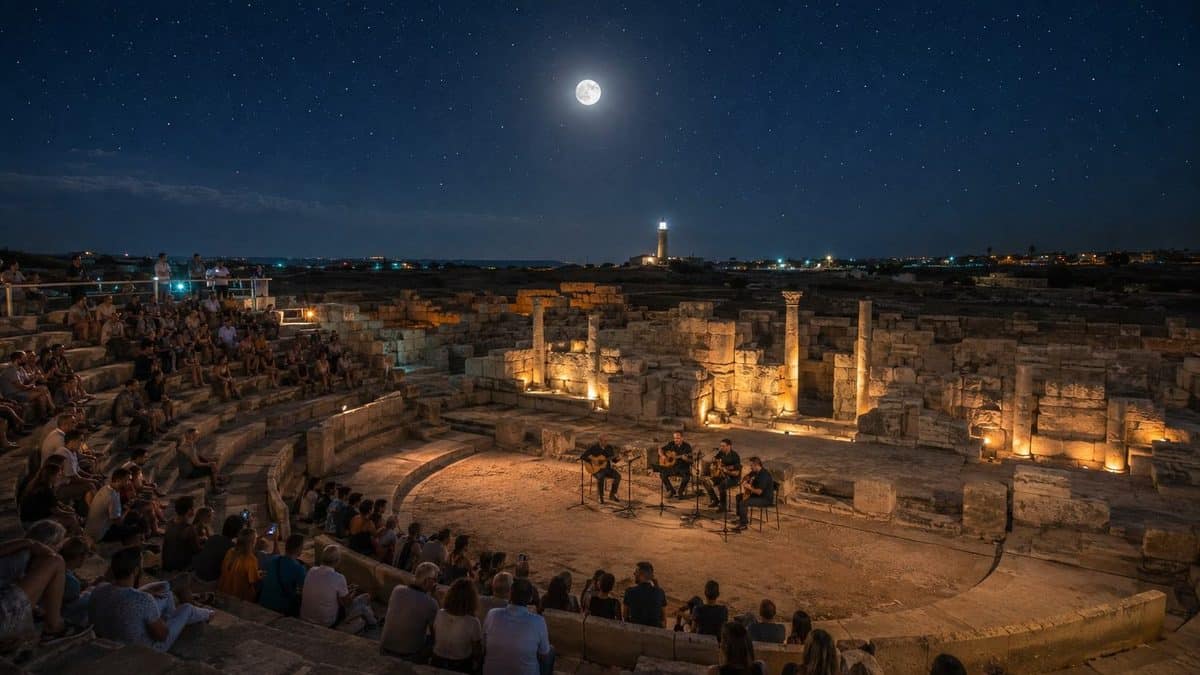
Image generated with Ai
The Department of Antiquities and Deputy Minister of Culture will offer a free cultural event, with music, mythology, and guided stargazing at the Ancient Odeon of Pafos, to be held on Friday, 28 August 2026, at 20:30, under the Full Moon. They hope the event will help Cyprus Tourism creatively associate heritage with contemporary night-time events. The guests will enjoy performances of an acoustic bouzouki quartet, a myriad of mythologies, and will have the opportunity to view star constellations guided by the Cyprus Space Exploration Organisation. This is important because since Pafos has lots to offer beyond its beaches during the summer, it can help maintain the ancient legacy of the area active and accessible.
The Ancient Odeon of Pafos will become the setting for an evening combining archaeology, music, storytelling and astronomy. The free programme will begin at 20:30 on Friday, 28 August 2026.
The event forms part of the series called “Archaeological Sites in the Light of the August Full Moon”. It is being organised by the Department of Antiquities under the Deputy Ministry of Culture of the Republic of Cyprus.
This year’s programme is titled “Beyond Time, Under the Oxyrhynchus Moon”. It has been designed as an evening of culture and remembrance rather than a conventional performance at a historic venue.
Advertisement
Visitors will hear a musical narrative supported by a bouzouki quartet. They will also be invited to look beyond the stage and discover the night sky above Pafos.
The Cyprus Space Exploration Organisation will lead a guided observation of the stars. It will introduce the constellations that once helped sailors, travellers and other observers understand direction, time and season.
The official Cyprus government announcement presents the Ancient Odeon as both a monument and a living cultural meeting place. That distinction gives the event its wider tourism relevance.
The programme brings several separate experiences into one heritage setting. Visitors will not simply attend a concert or walk through an archaeological attraction.
Advertisement
Advertisement
They will encounter music, ancient mythology and guided stargazing within the same evening.Event detail Official information Event Archaeological Sites in the Light of the August Full Moon Programme title Beyond Time, Under the Oxyrhynchus Moon Date Friday, 28 August 2026 Starting time 20:30 Venue Ancient Odeon of Pafos, Cyprus Admission Free Main experiences Musical narrative, bouzouki quartet and guided stargazing Astronomy guide Cyprus Space Exploration Organisation Organisers Department of Antiquities and Deputy Ministry of Culture Tourism themes Archaeology, culture, music, mythology and astrotourism
The free admission makes the event particularly relevant to travellers already staying in Pafos. It can be added to an evening itinerary without requiring a separate ticket purchase.
Travellers should still arrive early. The official announcement confirms the time and venue, but it does not publish a guaranteed seating arrangement or reserved visitor capacity.
The programme draws inspiration from Oxyrhynchus, the sharp-snouted fish associated with ancient Egyptian traditions surrounding Osiris. The story travelled beyond Egypt and entered a broader Mediterranean cultural world.
Within the event, the figure represents ideas connected with life, death, memory and rebirth. Those themes suit an archaeological setting where physical remains allow visitors to meet traces of communities that lived centuries ago.
The theme also creates a link between ancient Egypt and the Hellenistic Mediterranean. Cyprus occupied an important geographical position within that connected world.
The event does not treat mythology as a decorative addition. It uses the story to show how ideas moved between places and continued to influence art, belief and cultural memory.
This provides a more layered experience for travellers. They can encounter the Ancient Odeon not only as an old structure but as a setting for stories that crossed the Mediterranean.
The Ancient Odeon sits within the wider archaeological landscape of Kato Pafos. The area contains monuments and remains spanning a long period, from the fourth century BC to the Middle Ages.
Most of the surviving remains within the archaeological park belong to the Roman period. The wider site also includes celebrated mosaic floors depicting scenes from Greek mythology.
This heritage gives Pafos a strong identity beyond its hotels and coastline. Archaeological tourism helps distinguish it from Mediterranean destinations that depend mainly on sun-and-sea holidays.
The Odeon also has an advantage as an event setting. Its historic form allows live performance to connect directly with the site’s earlier public and cultural use.
Bringing music back into the monument creates continuity without pretending to reproduce the ancient past. Visitors experience a modern programme within an authentic archaeological environment.
For Cyprus Tourism, this is an important form of destination development. It strengthens an existing cultural asset through carefully planned public use rather than relying on a newly built attraction.
The archaeological importance of Pafos extends well beyond the Odeon. The city’s heritage landscape includes ancient villas, palaces, theatres, fortifications, tombs and richly decorated mosaics.
Pafos was added to the UNESCO World Heritage List in 1980. Its monuments reflect the long history of the cult of Aphrodite and provide important evidence of ancient architecture, art and society.
The archaeological park’s mosaics are among its best-known features. They survive in Roman villas known as the Houses of Dionysos, Theseus, Aion and Orpheus.
Their scenes present gods, heroes, hunting, nature and other parts of the ancient imagination. They help visitors understand how mythology appeared inside elite Roman homes.
The full-moon event expands this established heritage offer. It provides a reason to engage with Pafos after normal daytime sightseeing hours while respecting the cultural character of the location.
Many archaeological visits take place during the hottest and brightest part of a Mediterranean day. A carefully managed evening programme changes how travellers experience the site.
Lower evening temperatures may create a more comfortable setting during August. Moonlight, live sound and guided observation also produce a different relationship with the monument.
This does not mean archaeological sites should become entertainment venues without limits. Their preservation must remain the first priority.
The Pafos programme has been organised by the Department of Antiquities. That official involvement matters because cultural use is being placed within the institution responsible for protecting Cyprus’s archaeological heritage.
Night-time programming can also help spread visitor activity across more hours. Travellers can visit beaches, museums or other attractions during the day before attending a cultural event in the evening.
Hotels and tour operators can incorporate such programmes into destination information. However, the event is a public cultural initiative and should not be presented as a private tourism product.
The guided exploration of the Pafos sky gives the event an astrotourism component. Visitors will learn about constellations that guided travellers and sailors long before modern navigation systems appeared.
This is especially relevant in Cyprus. The island’s position in the eastern Mediterranean placed it within old maritime routes connecting Europe, North Africa and western Asia.
Astronomy also creates a bridge between ancient knowledge and modern science. People once used the sky to understand movement, agriculture, time and seasonal change.
Modern astronomy can explain those same visible objects with far greater scientific precision. Presenting both perspectives can make the experience accessible to families, culture enthusiasts and travellers interested in science.
The programme does not amount to a national astrotourism strategy. No official announcement links it to a wider investment or infrastructure plan.
It does show how astronomy can support cultural tourism when it is connected to a relevant place and a clear historical story.
The full-moon programme arrives during a challenging year for the country’s visitor economy. Cyprus remains a major Mediterranean destination, but official figures show that 2026 arrivals have remained below the exceptionally strong levels recorded in 2025.
According to the Statistical Service of Cyprus, tourist arrivals reached 582,754 in July 2026. This was 1.1% below the 589,116 arrivals recorded in July 2025.
Between January and July 2026, arrivals totalled 2,238,769. The comparable figure for the first seven months of 2025 was 2,432,129, meaning arrivals declined by 8%.
The July result was therefore stronger than the cumulative performance for the year. The official data suggest that the monthly gap narrowed during the main summer season.
The United Kingdom remained Cyprus’s largest source market in July 2026. British residents generated 185,981 arrivals, equal to 31.9% of the monthly total.
Israel ranked second with 119,293 arrivals and a 20.5% share. Poland contributed 36,912 visitors, followed by Germany with 21,338 and Sweden with 19,899.Cyprus tourism indicator Latest official result Comparison Tourist arrivals in July 2026 582,754 Down 1.1% year on year Tourist arrivals, January–July 2026 2,238,769 Down 8% year on year UK arrivals in July 185,981 31.9% of total Israel arrivals in July 119,293 20.5% of total Poland arrivals in July 36,912 6.3% of total Holiday share in July 85.2% Largest travel purpose Visiting friends and relatives 11.7% Second-largest purpose Business travel 3% Smaller share
The official July 2026 tourism release confirms that holidays accounted for 85.2% of visits. This large leisure share explains why additional cultural experiences matter during the summer season.
Tourism revenue reached €355.2 million in May 2026, according to the Statistical Service. This was below the €373.3 million generated in May 2025.
For January to May 2026, tourism revenue was estimated at €798.2 million. That represented a 16.5% decline from €955.8 million during the corresponding five months of 2025.
The revenue decrease was therefore greater than the decline in arrivals over part of the same period. That difference makes visitor spending, length of stay and the range of available experiences important issues for destination planners.
A free cultural event does not directly produce admission revenue. It can, however, encourage activity around the venue and add value to an existing stay.
Visitors may use local transport or visit nearby food and hospitality businesses before or after the event. Such effects are logical possibilities, but no official economic assessment has been published for this specific programme.
The official May 2026 tourism revenue report provides national figures only. It does not measure the Odeon event or its local commercial impact.
A destination’s performance cannot be judged only by the number of border arrivals. The quality and variety of the visitor experience also influence satisfaction, spending and the strength of a place’s identity.
The Pafos programme provides a clear example. It gives visitors a reason to engage with archaeology, music and science during one evening.
The experience can appeal to several groups:
This range matters because Cyprus receives visitors with different interests. A mature destination must offer more than a single type of holiday.
Cultural programming can also make heritage easier to approach. Some travellers may feel uncertain about visiting an archaeological site without a guide or prior historical knowledge.
Music and storytelling offer an accessible entry point. Expert stargazing then adds another form of interpretation that does not require visitors to be archaeology specialists.
The event can help accommodation providers strengthen their local destination information. Reception teams can tell guests when and where the programme takes place and explain that admission is free.
Tour operators working in Pafos can also alert customers to the event. They should clearly distinguish the official public programme from any paid transport or guiding service they sell.
Hotels near Kato Pafos may benefit from having a major cultural experience available during the evening. Guests can attend without committing to a full-day excursion.
Local guides can use the event as a reason to explain the wider archaeological importance of Pafos. They should not imply that the full-moon programme includes a complete tour of every monument in the archaeological park.
The event announcement confirms a musical narrative and guided sky observation. It does not promise a comprehensive archaeological tour.
No new airline route or airport project has been announced as part of the full-moon event. Any direct claim connecting the programme with additional air capacity would therefore be unsupported.
The effect on aviation is indirect. Airlines and airports benefit when a destination offers a deeper and more varied range of experiences.
Pafos International Airport gives overseas visitors direct access to the region. Cultural events can strengthen the reasons for selecting Pafos, particularly for travellers comparing Mediterranean destinations.
An individual one-night programme will not determine airline schedules. A consistent calendar of heritage, food, sport and cultural events can support the overall attractiveness of a route over time.
That distinction is important. The full-moon event enriches the destination, but official sources do not assign it an aviation target.
Cyprus has placed sustainability within its tourism policy. In heritage destinations, sustainability includes the physical protection of monuments as well as environmental and economic concerns.
Events at archaeological locations require careful management. Lighting, temporary equipment, sound, visitor movement and waste must be controlled around vulnerable remains.
The Department of Antiquities’ leadership provides an essential institutional safeguard. The event is not being staged independently of the body responsible for the site.
Free access also supports social sustainability. Residents can share the experience with tourists rather than seeing an important cultural monument used only for higher-priced commercial activities.
The programme therefore brings together public access and heritage stewardship. Its value lies in creating life around the monument without treating the monument as expendable scenery.
International visitors must follow the normal entry requirements applying to their nationality and journey. The Pafos full-moon programme does not include a new visa policy, special visitor permit or separate border arrangement.
Travellers already lawfully visiting the Republic of Cyprus can attend the event under the usual conditions. The official announcement does not require a tourism pass.
Visitors should not confuse free admission with unrestricted access to every archaeological location in Pafos. Normal opening hours and ticket rules can still apply at other sites and at other times.
Anyone planning a longer heritage itinerary should check current operating information before travelling. Temporary closures can occur for conservation, infrastructure or operational reasons.
The official programme shows an intention to keep archaeological places active through culture, art and science. It presents the Ancient Odeon as a meeting place rather than a silent object from the past.
No published target has been attached to the event for attendance, tourism revenue or international arrivals. Those figures should not be estimated without evidence.
Its immediate purpose is cultural. Its wider tourism value comes from giving visitors a meaningful, place-specific evening experience.
Future editions would depend on official programming by the Department of Antiquities and cultural authorities. Travellers should not assume that the same activities, venue or date will return in an identical form.
The confirmed 2026 programme nevertheless demonstrates a usable model. Heritage interpretation can be combined with performance and astronomy while remaining under public cultural oversight.
Yes. The official announcement states that the programme is free to attend. It begins at 20:30 on Friday, 28 August 2026, at the Ancient Odeon of Pafos. Visitors should consider arriving early because the announcement does not guarantee reserved seating.
Visitors can expect a musical narrative performance, a live bouzouki quartet and guided observation of the night sky. The Cyprus Space Exploration Organisation will introduce constellations connected with the history of travellers and sailors.
The official programme confirms music, storytelling and guided stargazing. It does not advertise a complete guided tour of the archaeological park. Travellers wishing to explore the mosaics and other monuments should check normal site access and opening information separately.
The Ancient Odeon’s full-moon program shows how heritage sites can be experienced as “living” by visitors without diminishing their value as historical sites. The program offers free stargazing complemented by music and readings of mythological tales, and will be offered in Pafos on the night of August 28th, 2026. This program on its own will not alleviate the tourism issues that impact the region, however it does offer cultural programming at an existing destination and tourism site. The most important thing for Cyprus Tourism is that the program indicates that the islands offers more than simply a beach holiday. The program also demonstrates that Pafos can create a performing arts festival that interweaves science, archaeology, and the performing arts, but still maintains environmental sustainability.
Advertisement
Tags: cyprus tourism, Pafos, Tourism news, Travel News
Advertisement
Advertisement













Friday, September 4, 2026

Friday, September 4, 2026

Friday, September 4, 2026

Thursday, September 3, 2026

Wednesday, September 2, 2026

Friday, September 4, 2026

Friday, September 4, 2026