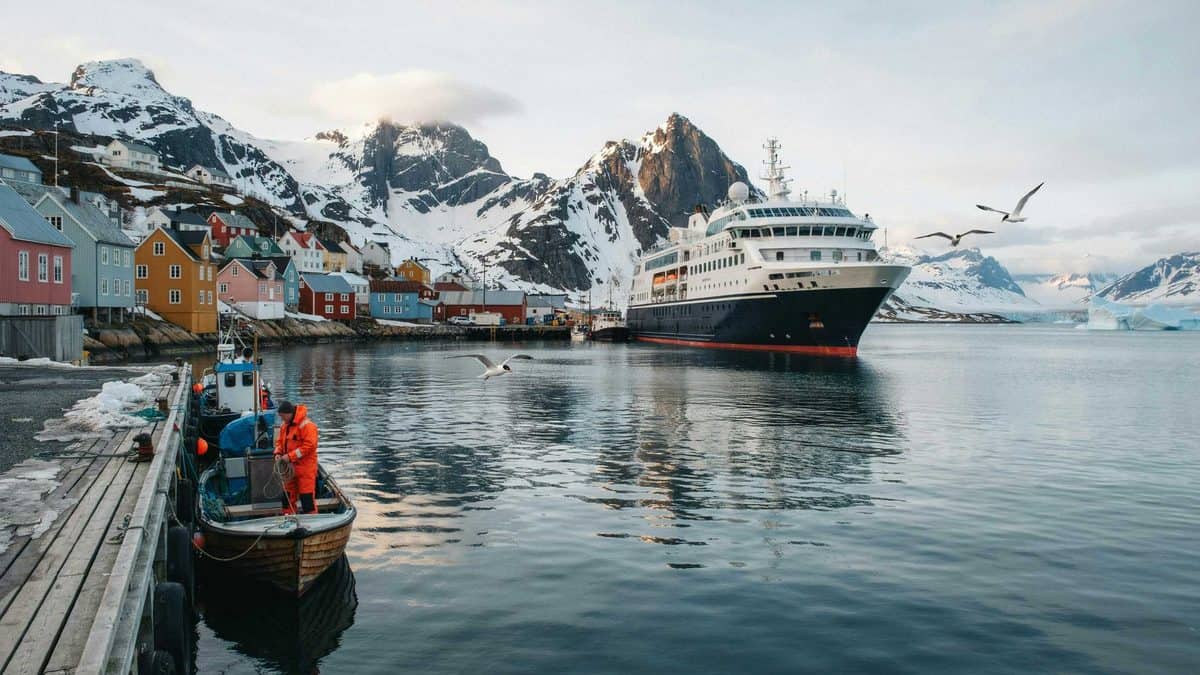
Image generated with Ai
Nuuk, Greenland – A decision to join Cruise Europe by Sikuki Nuuk Harbour in 2026 has become yet another milestone for the Arctic capital since it is becoming clear what will be the future role of this place as a cruise gateway. It should be stated that nowadays cruise business contributes to the tourism industry of Greenland in terms of 765 million US dollars (102 million euros), and the development of infrastructure attracts expedition cruise operators and premium guests.
Greenland used to be considered one of the most remote tourism destinations in the world. Due to its huge glaciers, beautiful fjords, and remote settlements, this area had become attractive for numerous tourists, but accessibility became one of the main problems.
Advertisement
Nowadays, a revolution is taking place there.
Nuuk used to be perceived as the destination to visit during an Arctic tour; however, nowadays it has become an important point for organizing expedition tours, turnaround point for international cruise operators, and the gateway connecting Greenland with other tourist routes in the North Atlantic.
Advertisement
Advertisement
The Cruise Europe membership arrives at a crucial moment for Greenland’s tourism industry.
The Arctic has become one of the world’s fastest-growing expedition travel regions as travellers increasingly seek remote destinations, wildlife encounters and authentic cultural experiences. However, the challenge for destinations like Greenland has always been balancing tourism opportunities with environmental protection and local capacity.
Nuuk’s strategy is different from many established cruise destinations.
Rather than attracting the largest possible ships and passenger volumes, the city is developing infrastructure designed around higher-value visitors who spend more time exploring local landscapes, culture and communities.
According to an independent study commissioned by Visit Greenland and conducted by Ramboll, cruise tourism generated approximately DKK765 million (€102 million), representing around 40% of Greenland’s total foreign tourism turnover of DKK1.9 billion. Expedition cruising accounted for DKK501 million, while conventional cruise operations contributed DKK264 million.
This economic contribution shows why cruise tourism has become increasingly important for Greenland.
The sector is creating new opportunities beyond traditional industries and expanding the role of tourism in Arctic communities.
| Key Area | Current Development | Importance for Greenland Tourism |
|---|---|---|
| Cruise Europe membership | First Greenland port to join the network | Improves international visibility and industry cooperation |
| Cruise passengers | 43,670 passengers handled in 2025 | Shows rising demand for Arctic experiences |
| Cruise calls | 78 calls in 2025 | Demonstrates growing port activity |
| Turnaround operations | 27 turnaround calls in 2025 | Allows passengers to begin and end cruises in Greenland |
| Airport connection | Nuuk International Airport opened in 2024 | Improves global accessibility |
| Port expansion | 350 metres of new quay planned by 2028 | Creates dedicated cruise capacity |
| Tourism model | Expedition and premium travel focus | Supports lower-impact, higher-value tourism |
What others are missing is that Greenland is not attempting to become another Caribbean-style cruise destination.
Its competitive advantage comes from rarity.
Travellers today are increasingly searching for destinations that feel undiscovered. They want landscapes that cannot easily be replicated, experiences that feel personal and journeys that offer something beyond conventional sightseeing.
Greenland delivers exactly that.
Nuuk sits on Greenland’s west coast in an ice-free area of the Arctic, allowing maritime operations throughout the year. Its location provides access to dramatic fjords, mountain landscapes and wildlife-rich waters.
For expedition cruise companies, this creates a powerful opportunity.
Instead of simply stopping at a destination for a few hours, ships can build deeper Arctic itineraries around Nuuk’s surrounding environment.
Popular shore experiences already include:
These experiences represent a shift in cruise tourism. The focus is moving from passenger volume towards meaningful engagement.
One of the biggest changes behind Nuuk’s cruise ambitions is aviation connectivity.
The opening of Nuuk International Airport in November 2024 created new possibilities for turnaround cruises — where passengers begin or finish their cruise journey in Greenland rather than simply visiting as a port call.
The airport provides year-round connections with Copenhagen through Air Greenland and Reykjavik through Icelandair, alongside seasonal United Airlines services from Newark in the United States.
This connection between air and sea travel is critical.
Before the airport expansion, Greenland’s remote location limited cruise operations. Passengers often needed complex travel arrangements before reaching their ships.
Now, Nuuk can function more like an international cruise gateway.
The combination of:
is creating a new travel model for the Arctic.
This is particularly valuable for expedition operators, where flexible embarkation points can make itineraries more efficient.
The numbers behind Nuuk’s cruise development show rapid progress.
Sikuki Nuuk Harbour handled:
The majority of vessels are expedition ships carrying up to approximately 600 passengers, although Nuuk has also welcomed larger cruise brands including AIDA Cruises, Norwegian Cruise Line, MSC Cruises and Royal Caribbean.
Although cruise calls are expected to fluctuate year by year, the long-term direction remains positive. Forecasts indicate a return towards stronger activity, with expectations of around 70 calls and 45 turnaround operations in the future.
The growth reflects a wider Arctic travel trend.
Travellers are increasingly moving towards:
Greenland sits directly within this growing market.
| Destination | Main Cruise Strength | Tourism Position |
|---|---|---|
| Nuuk, Greenland | Untouched landscapes and expedition access | Emerging premium Arctic gateway |
| Iceland | Strong infrastructure and global awareness | Established Arctic destination |
| Norway | Large cruise network and mature ports | Leading northern cruise market |
| Faroe Islands | Scenic landscapes and boutique experiences | Smaller North Atlantic cruise stop |
Nuuk’s opportunity comes from entering the market at a time when traveller preferences are changing.
The future Arctic cruise passenger is not necessarily searching for the busiest port.
They are searching for authenticity.
Greenland’s challenge will be managing growth while protecting the environment and ensuring local communities benefit from tourism expansion.
Nuuk’s cruise ambitions are not based only on increasing passenger arrivals. The destination is preparing the physical infrastructure required to support a new generation of Arctic travel.
Sikuki Nuuk Harbour is currently undergoing a major expansion programme designed to separate commercial maritime activity from cruise operations. The project includes approximately 350 metres of new quay development, scheduled for completion in 2028.
The expansion could become one of the most important tourism infrastructure upgrades in Greenland’s modern history.
Currently, cruise vessels use the Atlantkaj and Feederkaj facilities. Atlantkaj is the main cruise berth, measuring 100 metres in length with a depth of 10 metres, while Feederkaj provides access for smaller expedition ships with a depth of 6.5 metres.
Although Atlantkaj itself is 100 metres long, it can accommodate vessels reaching up to 300 metres in overall length.
The planned expansion will allow commercial vessels to move away from existing cruise areas, creating dedicated facilities for cruise passengers.
This matters because cruise growth depends heavily on operational reliability.
International cruise operators require:
Nuuk is gradually building these capabilities.
The harbour’s new turnaround terminal already provides passport control, immigration facilities and baggage services, creating a smoother connection between arriving passengers, aircraft and cruise ships.
For an Arctic destination, where logistics are often the biggest barrier, this infrastructure investment represents a significant competitive advantage.
Many global cruise destinations are now facing a difficult question: should tourism growth be measured by the number of visitors or by the value those visitors create?
Greenland appears to be choosing the second option.
The country’s geography naturally limits large-scale tourism expansion. Communities are separated by mountains, glaciers and oceans. Unlike many European destinations, Greenland does not have extensive road networks connecting towns.
This limitation could become a strength.
Instead of competing with high-volume cruise destinations, Nuuk is positioning itself as a premium Arctic experience.
The emerging model focuses on:
This approach matches changing traveller behaviour.
Luxury and adventure travellers are increasingly willing to pay more for rare experiences. They are seeking destinations where landscapes remain authentic and where encounters feel exclusive.
Greenland’s Arctic environment provides exactly that.
A passenger arriving in Nuuk is not simply visiting another port.
They are entering a destination defined by:
This creates a tourism product that cannot easily be copied.
Cruise tourism’s importance in Greenland extends far beyond port revenue.
While Sikuki Nuuk Harbour reported cruise activity as a major vessel-related revenue category, the wider economic impact reaches transport providers, restaurants, museums, guides, accommodation providers and local businesses.
In 2025, cruise activity represented approximately 38% of vessel-related revenue at Sikuki Nuuk Harbour and around 6% of the harbour’s overall turnover.
However, the wider tourism ecosystem benefits from passenger spending.
Cruise visitors require:
For Nuuk, this creates opportunities for small businesses and local entrepreneurs.
The growth of cruise tourism also supports employment.
Tourism-related jobs are especially valuable in Arctic communities where economic opportunities can be limited due to geographic isolation.
The increasing importance of cruise tourism demonstrates how Greenland is diversifying its economy while maintaining its connection with traditional industries.
What others get wrong is assuming Greenland’s cruise future depends on attracting the largest ships possible.
The Arctic is not a destination designed for unlimited expansion.
Environmental sensitivity, infrastructure limitations and community capacity all require careful planning.
The success of Nuuk will depend on maintaining balance.
The destination’s greatest asset is its untouched character. If tourism growth damages the very qualities visitors come to experience, Greenland risks losing its competitive advantage.
The future Arctic cruise market will likely reward destinations that can provide:
Nuuk’s strategy aligns closely with these trends.
The destination is not selling quantity.
It is selling access to one of the planet’s most extraordinary environments.
Sustainability will be one of the defining issues for Greenland’s cruise future.
The Arctic environment is highly sensitive, and increasing vessel activity creates challenges related to waste management, emissions and ecosystem protection.
Sikuki Nuuk Harbour already provides bunkering and potable water services, but waste management remains more complex.
The harbour has indicated that existing incineration capacity is insufficient for large volumes of cruise waste, meaning visiting vessels are encouraged to remove waste from the Arctic region.
Shore power is also being considered as a future development.
Nuuk’s electricity supply is generated through hydropower, creating potential advantages for cleaner maritime operations in the future.
However, the port does not currently view cruise shore power as an immediate priority.
This reflects a wider reality facing Arctic destinations.
Sustainability investments must match operational demand and financial feasibility.
The challenge is creating a tourism model that supports economic growth without overwhelming local systems.
The Arctic cruise market is entering a new phase.
Historically, destinations such as Norway and Iceland dominated northern cruise itineraries because of their established infrastructure and accessibility.
Greenland now has an opportunity to capture a different segment of travellers.
The future Arctic visitor is likely to be:
Nuuk’s combination of airport access, cruise infrastructure and natural attractions gives it a strong foundation.
| Destination | Market Advantage | Future Opportunity |
|---|---|---|
| Nuuk, Greenland | Authentic Arctic experiences and expedition appeal | Premium low-volume cruise growth |
| Reykjavik, Iceland | Strong international connections | Mature Arctic cruise hub |
| Bergen, Norway | Established cruise infrastructure | High-volume northern gateway |
| Tórshavn, Faroe Islands | Remote North Atlantic identity | Boutique expedition tourism |
The competition will not simply be about who handles the most passengers.
It will be about who creates the most valuable experiences.
The decision by Sikuki Nuuk Harbour to join Cruise Europe represents a symbolic milestone.
However, the bigger story is the transformation happening behind the announcement.
Greenland is building a new tourism identity.
For generations, the country was viewed as a remote destination that few travellers could reach. Today, improved aviation links, modern port facilities and growing expedition demand are changing that perception.
Nuuk is becoming the bridge between Greenland’s extraordinary natural environment and the global tourism market.
The city’s development demonstrates how remote destinations can compete internationally by focusing on uniqueness rather than scale.
The next decade could determine whether Greenland becomes one of the world’s leading premium Arctic destinations.
From a travel analytics perspective, Nuuk represents a wider industry movement.
Cruise tourism is increasingly shifting away from traditional volume-driven models towards personalised, destination-rich experiences.
Several trends support Nuuk’s growth potential:
1. Rising demand for expedition travel
Travellers are increasingly interested in polar regions, wildlife experiences and remote landscapes.
2. Premiumisation of tourism
High-value travellers are seeking destinations where exclusivity and authenticity matter more than traditional attractions.
3. New aviation connectivity
Direct air links reduce barriers and make remote cruise gateways more commercially viable.
4. Infrastructure-led destination growth
Ports that combine cruise facilities with airport connections have a stronger opportunity to attract turnaround operations.
5. Sustainability-driven choices
Future travellers are expected to favour destinations that demonstrate responsible tourism management.
Nuuk fits many of these emerging trends.
Sikuki Nuuk Harbour is one of the successful cases of cruise destination development.
This is an example of a different strategy which was born because of changed attitude towards remote locations.
It seems like no attempt to make the country a tourist destination for visiting by tourists.
What makes Greenland special is its authenticity and wonderful natural sights.
Future winners in the sphere of Arctic tourism will not necessarily be those with the largest ports and greatest number of visitors.
It will be about preserving uniqueness and earning money at the same time.
In other words, Sikuki Nuuk Harbour is an example of how it is possible to develop an Arctic port into a cruise destination.
It is clear from this case study that future success will be reserved for the remote destinations which have become accessible now.
As far as the tourists concerned, who prefer remote destinations for visiting, Greenland becomes more central now.
Advertisement
Advertisement
Advertisement











Wednesday, September 2, 2026
Tuesday, September 1, 2026

Wednesday, September 2, 2026

Wednesday, September 2, 2026
Tuesday, September 1, 2026
Tuesday, September 1, 2026

Tuesday, September 1, 2026

Tuesday, September 1, 2026



