
Venezuela Leads Brazil and Others in Fueling South America to Outpace Global Tourism GDP and International Visitor Spending Growth in 2026

Published
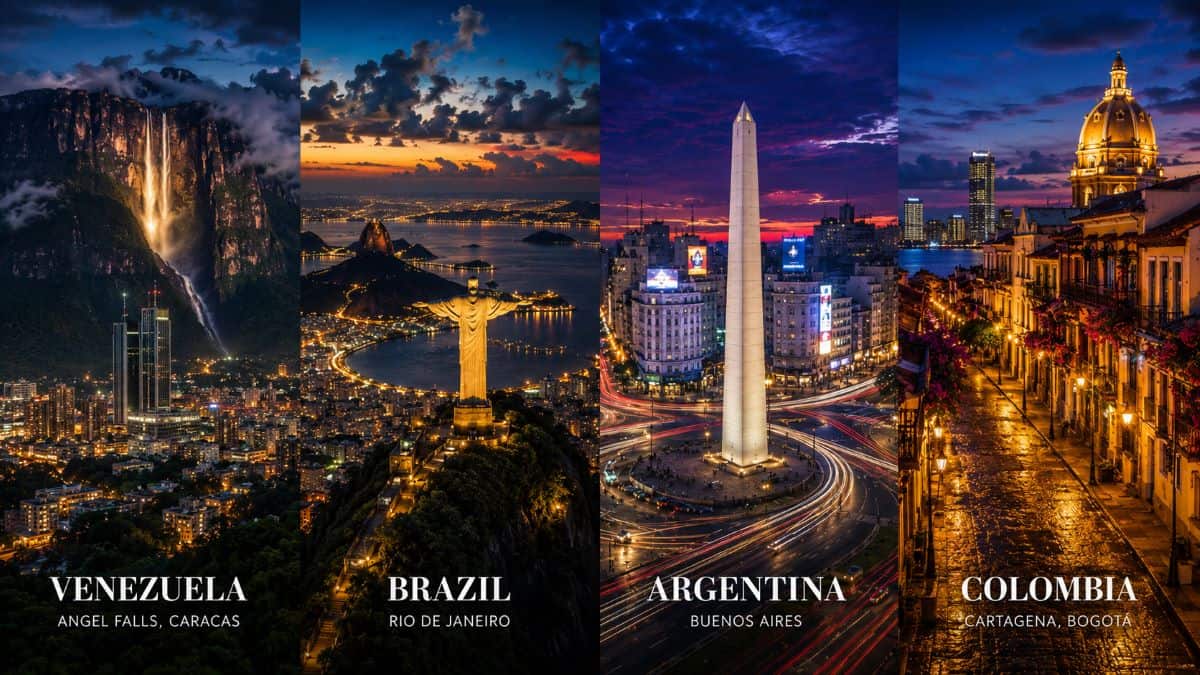
Image generated with Ai
Venezuela leads Brazil and others in fueling South America to outpace global tourism GDP and international visitor spending growth in 2026 as the region’s Travel and Tourism sector is projected to expand faster than worldwide averages. Strong domestic demand, rising international visitor spending and improving travel conditions are supporting the surge, with South America forecast to achieve 4.1% tourism GDP growth compared with 3.2% globally, while international visitor spending is expected to rise 7.8%. Venezuela stands out with a projected 33.2% tourism GDP increase and 34.8% growth in international visitor spending, while Brazil and other markets add further momentum to the region’s tourism expansion.
Venezuela Leads the Region With a Striking 33.2% Tourism GDP Surge
Venezuela stands out with the fastest projected growth among the countries highlighted. Travel and Tourism GDP is forecast to jump 33.2% in 2026, while international visitor spending is expected to climb an even stronger 34.8%. These rates place Venezuela far above the regional forecasts of 4.1% for tourism GDP and 7.8% for international visitor spending. The percentage increase is significant, although rapid growth can partly reflect expansion from a smaller or previously depressed base. For tourism businesses, the outlook nevertheless points towards stronger demand across accommodation, transportation, attractions and other visitor services. Sustaining that momentum will depend on traveller confidence, international connectivity, tourism infrastructure and the wider operating environment.
Advertisement
Advertisement
Brazil Grows More Slowly but Its Tourism Scale Changes the Equation
Brazil is forecast to post more moderate growth, with Travel and Tourism GDP increasing 2.1% in 2026 and international visitor spending rising 3%. Both are below the regional averages, but that does not mean Brazil is losing importance. Brazil operates from a much larger economic and tourism base than many neighbouring markets, meaning even modest percentage growth can translate into substantial additional activity. Its enormous domestic travel market provides another layer of resilience. Rio de Janeiro, São Paulo, the Amazon, beaches, cultural destinations, major events and nature tourism give Brazil a highly diversified tourism economy. Continued aviation expansion and infrastructure investment could help the country translate its scale into stronger international competitiveness over the longer term.
Colombia Keeps Tourism Growth Above Regional and Global Levels
Colombia is projected to record 5.7% Travel and Tourism GDP growth in 2026. That puts the country ahead of both the 4.1% regional forecast and the 3.2% global average. Colombia’s tourism proposition has broadened significantly around Bogotá, Medellín, Cartagena, the Caribbean coast, coffee-growing regions, nature, culture and gastronomy. This diversification gives travellers reasons to combine several destinations rather than concentrating solely on one gateway. Stronger international aviation connectivity can further support the sector by opening Colombia to additional North American, European and Latin American source markets. The challenge will be ensuring tourism growth spreads economically across different regions while maintaining traveller confidence and avoiding excessive concentration in already popular urban and coastal destinations.
Advertisement
Advertisement
Argentina Moves Ahead of the Regional Average With 4.9% Growth
Argentina is forecast to achieve 4.9% Travel and Tourism GDP growth in 2026, placing it above Central and South America’s 4.1% regional projection and the 3.2% global rate. Argentina benefits from an unusually broad tourism portfolio. Buenos Aires provides culture, gastronomy and urban tourism, while Patagonia, Mendoza, Iguazú Falls and other regions attract nature, adventure and wine travellers. International visitor demand can also provide valuable foreign expenditure for the wider economy. However, affordability can move in both directions. Currency movements can make Argentina attractive to overseas travellers but also create uncertainty for tourism businesses. WTTC’s broader warnings about inflation and consumer sentiment are therefore particularly relevant to the country’s ability to maintain sustained tourism expansion.
The 2026 Tourism Growth Map Shows a Region Moving at Different Speeds
The WTTC projections reveal considerable variation across Central and South America. Venezuela’s extraordinary forecast leads the group, while Ecuador and Bolivia are also expected to record double-digit tourism GDP growth.
Advertisement
Advertisement
| Country | 2026 Tourism GDP Growth | International Visitor Spending Growth | Key 2026 Trend |
|---|---|---|---|
| Venezuela | +33.2% | +34.8% | Fastest growth among highlighted markets |
| Ecuador | +11.6% | Not stated | Major double-digit tourism expansion |
| Bolivia | +10.3% | +25.8% | Exceptional international spending growth |
| Panama | +8.4% | +8.9% | Connectivity supports expansion |
| Guatemala | +6.1% | +9.3% | International spending outpaces GDP growth |
| Colombia | +5.7% | Not stated | Above regional and global forecasts |
| Argentina | +4.9% | Not stated | Growth above regional average |
| Brazil | +2.1% | +3.0% | Slower growth from a much larger base |
| Central & South America | +4.1% | +7.8% | Outperforming global tourism |
| Global benchmark | +3.2% | +3.7% | Regional growth is stronger |
The comparison also shows why tourism GDP growth and international spending should be considered separately. Bolivia, for example, is forecast to grow tourism GDP 10.3%, but international spending is projected to surge 25.8%.
International Visitor Spending Becomes the Bigger 2026 Story
The regional 7.8% projected increase in international visitor spending is one of the strongest indicators in the WTTC outlook. It is more than twice the 3.7% global forecast. This matters because tourism success is not determined by arrival numbers alone. A destination benefits economically when visitors stay longer, use accommodation, eat locally, book experiences and travel within the country. Venezuela’s 34.8% spending forecast and Bolivia’s 25.8% increase stand out particularly strongly. Guatemala at 9.3% and Panama at 8.9% are also forecast to outperform the regional rate. If these projections materialise, international travellers could inject significantly more money into airlines, hotels, restaurants, tour companies, attractions and local businesses.
Advertisement
Advertisement
Domestic Travellers Give the Region an Important Safety Net
WTTC identifies resilient domestic travel demand as an important factor supporting Central and South America’s outlook. Domestic tourism provides destinations with demand that is less dependent on long-haul aviation or economic conditions in distant source markets. This is especially important in large countries such as Brazil, Argentina and Colombia, where residents can sustain airlines, hotels and destinations through substantial internal travel. Strong domestic demand can also help tourism businesses operate outside international peak seasons. The combination of domestic travellers and faster-growing international expenditure creates a more diversified tourism economy, making the region potentially more resilient when geopolitical or economic disruption weakens one part of the global travel market.
Regional Tourism Faces Less Direct Exposure to Middle East Disruption
Another factor highlighted in the WTTC research is the region’s comparatively lower exposure to disruption associated with ongoing conflict in the Middle East. Central and South American destinations generally rely less heavily on affected transit corridors and source markets than some other parts of the world. This gives the region a degree of protection, although it remains exposed to wider effects such as fuel prices, aviation costs and global consumer confidence. Geography could therefore become an advantage in 2026. Strong intra-American travel, domestic tourism and direct links with major North American and European markets can help destinations maintain demand even when geopolitical disruption changes travel patterns elsewhere.
18.5 Million Jobs Put Tourism at the Heart of Regional Employment
Travel and Tourism is forecast to support 18.5 million jobs across Central and South America in 2026, equivalent to 8.3% of all employment in the region. That means approximately one in every 12 jobs is expected to be supported by the sector under WTTC’s methodology. The economic footprint extends well beyond hotels and tour operators. Tourism supports airlines, airports, restaurants, entertainment, retail, transport, attractions and numerous small businesses. Rapid growth in countries such as Venezuela, Ecuador and Bolivia could therefore create opportunities across broad tourism supply chains. Workforce development will become increasingly important because destinations need enough trained workers to maintain service quality as visitor demand and tourism investment expand.
Connectivity Could Decide Which Countries Capture the Most Growth
WTTC identifies connectivity and destination infrastructure as critical to sustaining the regional expansion. The relationship is straightforward: travellers cannot visit destinations easily without sufficient airline capacity, airports, roads and local transport. Panama already demonstrates how strong aviation connectivity can create an advantage. Colombia and Brazil also benefit from extensive air networks, while destinations with fewer international connections may struggle to convert tourism interest into actual arrivals. New routes can have an outsized impact by reducing travel time and opening destinations to new source markets. But connectivity must be accompanied by sufficient accommodation, digital infrastructure, attractions and transport if destinations are to capture the full economic benefit of additional visitors.
Advertisement
Advertisement
Affordability Could Give Latin America Another Competitive Advantage
WTTC also identifies affordability and stable travel environments as important drivers of resilience. This could work in Central and South America’s favour as travellers worldwide become increasingly conscious of holiday costs. Destinations offering strong value across accommodation, food, attractions and experiences can compete effectively for travellers who may find traditional long-haul destinations increasingly expensive. But affordability is fragile. Strong visitor demand can push hotel and restaurant prices higher, while inflation can increase operating costs for tourism businesses. Destinations therefore need to maintain value without suppressing the revenue required to invest in infrastructure and service quality.
Inflation and Consumer Confidence Remain the Biggest Warning Signs
The strong forecasts do not remove economic risks. WTTC identifies inflationary pressure and weaker consumer sentiment as possible threats in some markets. Tourism is discretionary spending for many households, which means higher airfares, hotel rates and everyday living costs can quickly influence travel decisions. Travellers may shorten trips, choose cheaper accommodation or postpone long-haul holidays altogether. Central and South American destinations therefore need to compete on both experience and value. Stable economic conditions, predictable travel costs and strong traveller confidence will be essential if the region is to turn projected growth into sustained tourism performance rather than a temporary rebound.
Global Tourism Is Heading Towards a US$12 Trillion Year
Central and South America’s expansion forms part of a much larger global tourism economy. WTTC forecasts Travel and Tourism will contribute US$12 trillion to the world economy in 2026, representing 9.9% of global GDP. The industry is also expected to support 376 million jobs worldwide.
The longer-term outlook remains strong. Over the next decade, global Travel and Tourism GDP is forecast to expand at an average annual rate of 3.6%. That is 1.5 times faster than the wider global economy, which is projected to grow at 2.4% annually.
For Central and South America, outperforming that already-strong global industry would strengthen tourism’s role as a major economic growth engine.
Central and South America Could Become a Major 2026 Tourism Growth Story
The numbers point towards a region gaining momentum on several fronts at once. Travel and Tourism GDP is forecast to grow 4.1%, compared with 3.2% globally. International visitor spending is expected to surge 7.8%, against 3.7% worldwide. Tourism is forecast to support 18.5 million regional jobs, representing 8.3% of employment.
Advertisement
Advertisement
Within that wider story, Venezuela’s 33.2% tourism GDP growth, Ecuador’s 11.6%, Bolivia’s 10.3% and Panama’s 8.4% stand out. Guatemala, Colombia and Argentina are also projected to outperform global growth, while Brazil remains one of the region’s most important tourism economies despite its slower 2.1% expansion.
The opportunity now depends on execution. More flights, stronger infrastructure, skilled workers, competitive pricing and stable travel environments will determine how much of the forecast growth countries actually capture.
Venezuela leads Brazil and others in fueling South America to outpace global tourism GDP and international visitor spending growth in 2026 as strong domestic demand, rising international spending and improved travel momentum push the region ahead of global forecasts. South America’s tourism GDP is projected to grow 4.1%, above the 3.2% global rate, while international visitor spending is expected to rise 7.8%.
In conclusion, Venezuela leads Brazil and others in fueling South America to outpace global tourism GDP and international visitor spending growth in 2026 as the region benefits from stronger domestic travel demand, rising international visitor expenditure and improving tourism resilience. With South America’s Travel and Tourism GDP forecast to grow 4.1%, above the 3.2% global average, and international visitor spending projected to increase 7.8%, the region is emerging as a major global tourism growth force. Venezuela’s rapid expansion, Brazil’s large tourism base and the momentum across other markets show how South America is strengthening its position through connectivity, infrastructure development and growing traveller confidence.
Advertisement
