
Inside the Transformation of Madaba into Jordan’s Premier Heritage Hub

Published
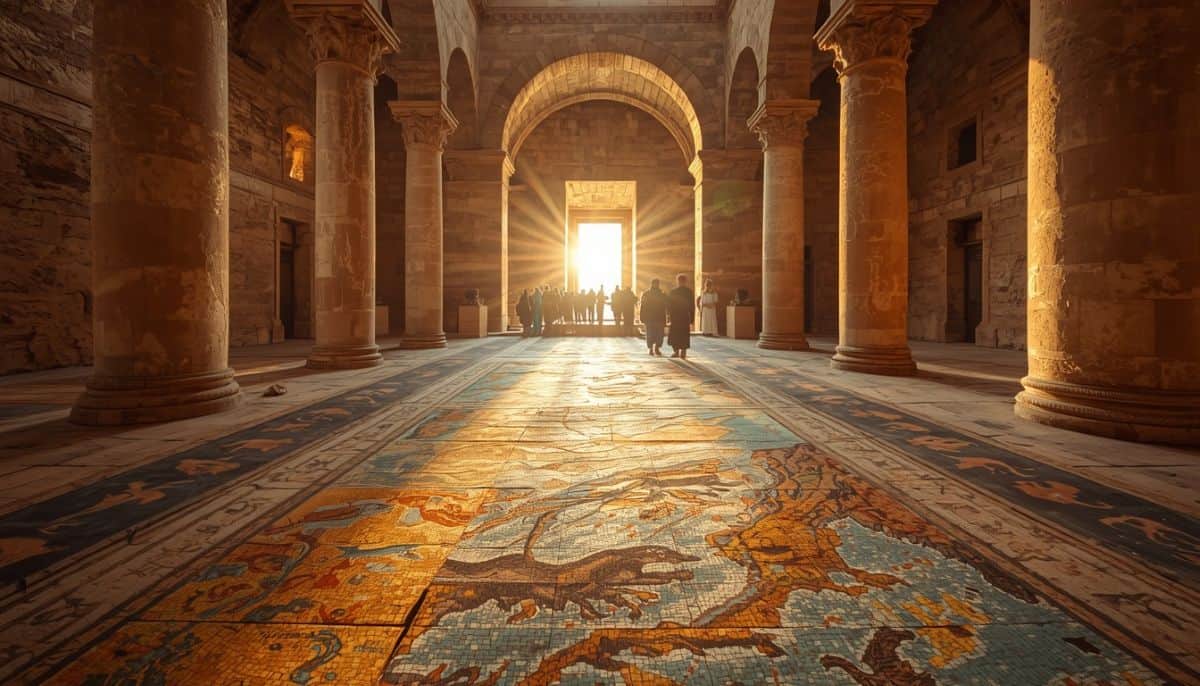
Image generated with Ai
Madaba, Jordan’s most important mosaic centre, has the highest concentration of 4th–8th century Byzantine and Umayyad floor pavements in the Levant, featuring the famous 6th-century Madaba Mosaic Map. The city, 30 kilometres southwest of Amman, is the strategic base camp for Jordan’s central biblical corridor (Mount Nebo, Machaerus and Bethany Beyond the Jordan). Jordan’s MoTA, the Madaba Institute for Mosaic Art and Restoration (MIMAR), Ottoman adaptive reuse, and municipal heritage trails are reshaping visitor flows from quick 2-hour bus stops into high-value overnight stays.
For decades, Madaba was treated as an ephemeral, two-hour waypoint on standard Middle Eastern tour itineraries. Tour motorcoaches would idle along the perimeter of the 19th-century Greek Orthodox Church of Saint George, discharging groups just long enough to view the mosaic floor before shepherding them onwards to Mount Nebo, the Dead Sea, or south toward Petra.
Advertisement
Advertisement
That transit-dependent model is undergoing structural reform. Under Jordan’s National Tourism Strategy (led by the Ministry of Tourism and Antiquities [MoTA] alongside the Jordan Tourism Board), regional decentralization has moved to the centre of national tourism policy. By focusing on secondary heritage hubs, the kingdom seeks to convert hurried day trips into multi-night stays, capturing direct local spend and relieving visitor pressure on primary heritage assets.
Madaba anchors this strategy through targeted pedestrian corridors, the adaptive reuse of late-Ottoman architectural fabric, and sustained public-private investment in its working artisan community.
Advertisement
Advertisement
What Makes Madaba the Centre of Jordan’s Mosaic Heritage?
Madaba earned its moniker as the “City of Mosaics” because it houses the densest concentration of in-situ Byzantine (4th–7th century CE) and Umayyad (7th–8th century CE) floor pavements discovered in the Levant. When late-19th-century Christian families resettled the ancient tell, building foundations repeatedly exposed ancient pavement complexes that had remained sealed beneath alluvial soil and earthquake rubble since the 8th century.
The city’s cartographic centrepiece is the Madaba Mosaic Map, uncovered in 1884 inside the basilica ruins where the modern Greek Orthodox Church of Saint George now stands. Commissioned circa 560–565 CE during the height of the Justinianic building boom, this cartographic marvel originally comprised more than two million stone tesserae measuring roughly 21 by 7 metres. Facing east toward the altar, it represents the oldest surviving topographic depiction of the biblical Holy Land, providing scholars with decisive topographical coordinates for Jerusalem’s Cardo Maximus, Neapolis, and Roman-era baptismal sites along the Jordan River.
Advertisement
Advertisement
Beyond Saint George, Madaba’s archaeological reserves preserve private domestic courtyards and grand liturgical spaces:
| Archaeological Site | Key Historic Features | Chronological Era |
| Church of Saint George | The Madaba Mosaic Map: depictions of Jerusalem, the Dead Sea, and the Nile Delta | c. 560–565 CE (Byzantine) |
| Madaba Archaeological Park I | Hippolytus Hall (classical mythology), Church of the Virgin Mary, restored Roman street | 6th century CE |
| Madaba Archaeological Park II | Burnt Palace (late Byzantine aristocratic residence), Martyr’s Church | Late 6th – Early 7th century CE |
| Church of the Apostles | Masterwork mosaic signed by master artisan Salamanios, depicting the personified Sea (Thalassa) framed by marine life | Dedicated 568 CE |
These works illustrate a distinct regional school of mosaicists who synthesized classical Greco-Roman mythology, Christian iconographic motifs, and naturalistic scenes of Jordan Valley agricultural life.
Advertisement
Advertisement
Bridging Jordan’s Biblical Pilgrimage Route
Rather than functioning as an isolated excursion, Madaba serves as the urban, logistical, and culinary anchor for central Jordan’s biblical geography. Three internationally venerated sites sit within a 30-minute radius:
- Mount Nebo (Siyagha) (9 km northwest): Identified as the promontory from which Moses viewed the Promised Land. The contemporary Memorial Church houses restored 6th-century monastic baptistery mosaics overlooking the Jordan Rift Valley and Dead Sea.
- Bethany Beyond the Jordan (Al-Maghtas) (35 km northwest): A UNESCO World Heritage site recognized as the authentic location of the baptism of Jesus by John the Baptist, positioned along the eastern bank of the Jordan River.
- Machaerus (Mukawir) (30 km southwest): The fortified hilltop redoubt of Herod Antipas, historically associated with the imprisonment and martyrdom of John the Baptist, offering panoramic views over the southern Dead Sea basin.
By basing their itineraries in Madaba, independent travelers and pilgrimage groups can systematically traverse these sacred topographies without packing luggage daily or retreating to congested transit nodes in Amman.
How Infrastructure Investments Are Extending Visitor Stays
Historical baseline figures from MoTA visitor monitoring surveys showed that secondary historic towns in Jordan struggled with average dwell times under four hours, while overnight hotel conversion rates frequently lingered below 12%.
To turn day visitors into overnight guests, municipal initiatives and international development partners (including USAID tourism initiatives and Italian cultural cooperation projects) have revitalized Madaba’s historic core:
Advertisement
Advertisement
- The Madaba Heritage Trail: A lit, flagstone-paved pedestrian corridor connects Archaeological Park I, local spice and craft markets, and the Church of the Apostles. By improving street lighting, wayfinding signage, and pedestrian safety, the trail keeps foot traffic flowing through downtown shops and restaurants well after tour buses depart.
- The Madaba Institute for Mosaic Art and Restoration (MIMAR): As the only regionally accredited tertiary institution dedicated solely to mosaic conservation, MIMAR trains young Jordanian conservators. Visitors can watch working restoration labs in real time, observing the delicate salvage of regional tesserae using reversible conservation mortars.
- Boutique Hospitality Networks: Private operators and heritage trusts have converted late-Ottoman limestone residences—such as heritage homes with traditional cross-vaulted ceilings—into boutique hotels, cooking schools, and family-run restaurants. This captures hospitality spending within the local community.
Sustainable Tourism and Regional Decentralization
Petra, Jordan’s leading tourist spot and a UNESCO World Heritage site, is often overrun with visitors. Such heavy foot traffic poses long-term threats to the delicate sandstone structures. Adding living, inhabited urban centres such as Madaba to the national circuit helps to protect the country’s tourism economy from regional shocks and also spreads economic benefits to the governorates.
Tourism spending on overnight stays in Madaba benefits directly independent conservators, stone workshops, restaurateurs and family-run accommodations. Major monuments are still structurally conserved through strategic alliances with MoTA, foreign archaeological institutes and international donors. Yet a sustainable local hospitality ecosystem gives the community a direct stake in conserving its historic streetscape.
Madaba shows that when historic preservation is part of a proactive urban planning process, transforming a former stopover into a complex cultural destination, it is more resilient.
Advertisement
