
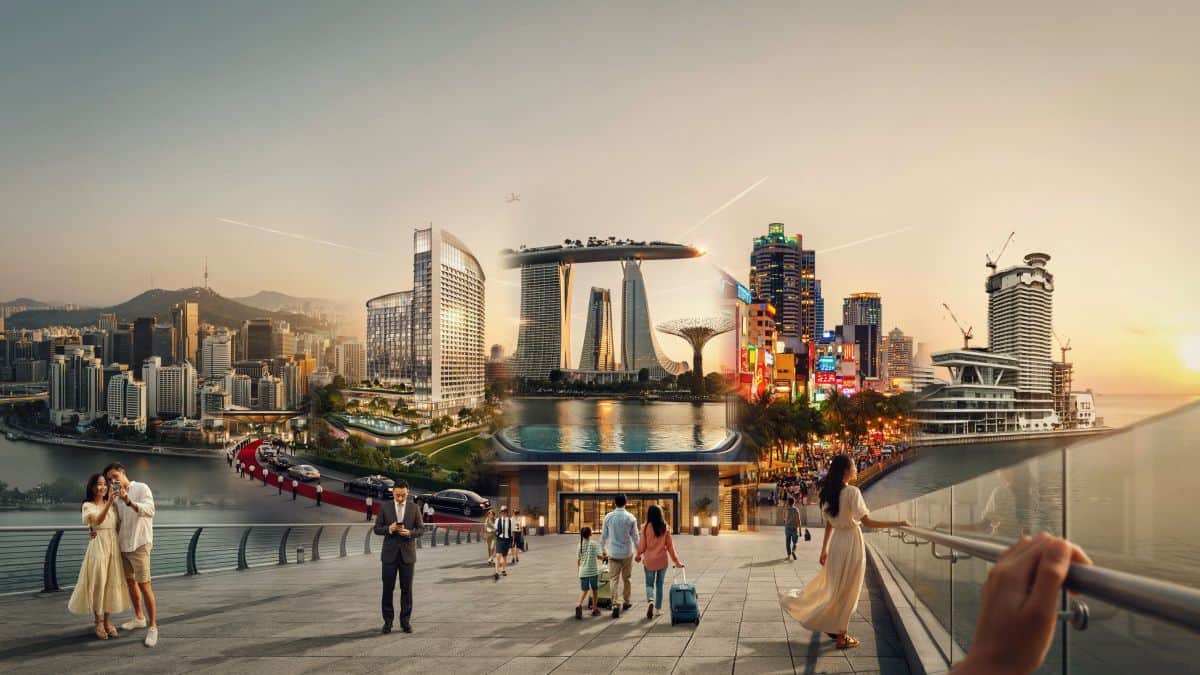
Image generated with Ai
Singapore, Philippines and Japan Challenge South Korea’s Tourism Future Amid New Casino Rules Threatening Foreign Investment and Regional Travel Growth. Challenges to South Korea’s tourism future from Singapore, Philippines and Japan challenge South Korea’s tourism future as the country’s casino tourism sector faces growing pressure from new regulations and rising regional competition. Visitors to South Korean casinos are strictly foreign visitors, new casino gambling rules restrict foreign gambling investment and traveling, so new casino gambling establishes local competitiveness over South Korea’s tourism competitiveness, while also enhances its oversight.
| Issue Area | Proposed Government Change | Industry Concern | Tourism Industry Impact |
|---|---|---|---|
| Tourism Fund Contribution Levy | Increase the maximum contribution paid by foreigner-only casino operators to the Tourism Promotion and Development Fund from 10% to 15% of gross gaming revenue (GGR) | Operators argue the levy is based on revenue rather than profit, meaning businesses may face higher payments even during weak financial periods | Could reduce funds available for resort upgrades, marketing campaigns and international visitor attraction |
| Profitability Pressure | Higher financial contribution requirements for casino operators | Industry groups argue foreigner-only casinos already face high operating costs and dependence on overseas visitors | Lower profitability could affect tourism investment, employment and service improvements |
| Five-Year Licence Renewal System | Replace long-term operating approvals with mandatory licence reviews every five years | Operators argue shorter review cycles create uncertainty for investors planning large tourism projects | Could make South Korea less attractive compared with Singapore, Japan and the Philippines where integrated resorts seek long-term investment confidence |
| Foreign Investment Risk | Stronger government review powers over casino operations | Tourism organisations warn international investors may choose competing Asian markets with more predictable conditions | Potential impact on future integrated resort development and tourism infrastructure expansion |
| Shareholder Change Approval | Government approval required before major ownership transfers or controlling shareholder changes | Businesses argue additional approval procedures could slow investment decisions and corporate restructuring | May affect international partnerships and future resort expansion plans |
| Integrated Resort Development | Increased regulatory oversight of casino operators | Industry groups say large-scale resorts require billions of won in capital and long recovery periods | Could influence projects involving hotels, entertainment facilities, restaurants and tourism attractions |
| Regional Tourism Competition | Reform introduced while Asian rivals expand casino and resort markets | Industry warns South Korea may lose competitiveness against Macau, Singapore, Philippines and Japan | Could affect international visitor flows and tourism spending |
| Foreign Visitor Dependence | Existing foreigner-only casino structure remains focused on overseas customers | Operators highlight vulnerability to changes in travel demand, visas and regional competition | Tourism performance depends heavily on international arrivals from China, Japan and Southeast Asia |
| Post-Pandemic Recovery | Operators continue rebuilding international visitor markets after travel disruption | Industry argues additional costs could slow recovery | May affect tourism-related businesses including hotels, restaurants and transport services |
| Government Oversight Objective | Government argues reforms modernise an ageing regulatory framework | Industry accepts oversight but seeks a balance between regulation and competitiveness | Final rules could shape South Korea’s future tourism investment environment |
South Korea’s tourism industry is raising concerns over proposed changes to the country’s foreigner-only casino regulations, warning that the reforms could create uncertainty for investors and operators. A coalition of 12 major tourism organisations has urged the government to reconsider the planned amendments to the Tourism Promotion Act.
The group includes major industry bodies representing casinos, hotels and travel companies. They argue that additional financial obligations and shorter licence review periods could weaken South Korea’s ability to attract international investment.
The organisations believe integrated resorts require long-term planning because projects involve significant capital commitments, often reaching hundreds of billions or trillions of Korean won.
Advertisement
Advertisement
They warn that increased regulatory pressure could make South Korea less competitive compared with neighbouring tourism and gaming destinations such as Macau, Singapore, the Philippines and Japan.
The dispute highlights a wider challenge facing tourism policymakers: balancing stronger regulation with maintaining investment attractiveness.
| Reform Proposal | Government Objective | Industry Response |
|---|---|---|
| Higher Tourism Fund Levy | Increase tourism funding contributions from casino revenue | Could weaken operators’ ability to invest and compete internationally |
| Five-Year Licence Review | Strengthen compliance monitoring | Creates uncertainty for long-term investors |
| Ownership Approval Requirements | Improve transparency and regulatory control | Could slow foreign investment and partnership opportunities |
| Competitor Market | Competitive Advantage | Why South Korea’s Industry Is Concerned |
|---|---|---|
| Singapore | Marina Bay Sands and Resorts World Sentosa integrated resort model combining hotels, entertainment and business tourism | South Korea must compete with highly developed premium tourism experiences |
| Philippines | Expanding Entertainment City developments and flexible investment environment | Attracts international visitors and gaming investment |
| Japan | Upcoming MGM Osaka integrated resort expected around 2030 | Could capture Japanese travellers who currently visit South Korea |
| Macau | Global gaming reputation and large-scale tourism infrastructure | Maintains strong international recognition and visitor appeal |
South Korea’s tourism future is facing increasing pressure as neighbouring Asian destinations strengthen their own integrated resort and entertainment tourism industries. Singapore, the Philippines and Japan are investing heavily in large-scale tourism developments designed to attract international visitors, luxury travellers and high-spending customers.
South Korea’s foreigner-only casino model makes the country particularly exposed because operators rely almost entirely on overseas visitors. Unlike some competing markets, domestic customers cannot provide a stable customer base, increasing the importance of international travel flows.
Advertisement
Advertisement
The competition has moved beyond casinos alone. Modern travellers are choosing destinations based on complete experiences that include luxury hotels, entertainment, shopping, dining, conventions and cultural attractions.
Singapore’s Marina Bay Sands and Resorts World Sentosa have created globally recognised integrated resort models. The Philippines has expanded Entertainment City in Manila, while Japan is preparing for the opening of MGM Osaka around 2030.
South Korean tourism leaders argue that regulatory decisions must consider this rapidly changing regional environment.
| City | Major Tourism Asset | Potential Impact From Casino Regulation Debate |
|---|---|---|
| Seoul | Urban tourism, business travel, Seven Luck Casino properties, luxury hospitality | Investment decisions could affect entertainment tourism competitiveness |
| Incheon | International airport gateway and Paradise City integrated resort | Future integrated resort expansion depends on investment confidence |
| Busan | Coastal tourism, conventions and entertainment sector | Competition for international visitors may increase |
| Jeju Island | Resort tourism, international visitors and multiple foreigner-only casinos | Highly exposed to changes in regional travel patterns |
Seoul remains South Korea’s largest tourism hub, attracting international visitors through shopping, culture, business events and entertainment experiences. The city’s foreigner-only casino sector forms part of a broader tourism ecosystem that includes hotels, restaurants and attractions.
Major operators such as Grand Korea Leisure’s Seven Luck Casino facilities and Paradise Co.’s Walkerhill Casino depend on overseas travellers visiting the capital.
However, Seoul faces increasing competition from other Asian cities offering larger integrated tourism experiences. Singapore has positioned itself as a premium destination for luxury travellers, while Japan’s upcoming casino development could attract visitors who previously travelled elsewhere in Asia.
Industry groups believe South Korea must maintain an attractive investment environment to ensure Seoul remains competitive.
They argue that additional regulatory costs could reduce the ability of operators to upgrade facilities, expand services and compete with international rivals.
The challenge for Seoul is ensuring tourism growth continues while balancing stronger regulatory oversight.
Incheon has become a crucial part of South Korea’s tourism strategy because of its international airport connectivity and role as a gateway for overseas visitors. The city is home to Paradise City, one of South Korea’s largest integrated resort developments.
Located near Incheon International Airport, Paradise City combines luxury accommodation, entertainment, restaurants, retail and foreigner-only casino facilities. The project represents South Korea’s ambition to compete with international integrated resort destinations.
Integrated resorts are designed to increase visitor spending by encouraging travellers to stay longer and experience multiple tourism products in one location.
However, industry groups argue that future investment depends on regulatory stability. Large-scale tourism projects require significant capital and long-term planning before investors can recover costs.
They warn that uncertainty around casino regulations could influence future decisions by international companies considering South Korea.
Incheon’s experience demonstrates how casino tourism is closely connected with broader travel growth, airport connectivity and international investment.
Busan is emerging as another important city in South Korea’s tourism landscape, combining coastal attractions, cultural events, business tourism and hospitality infrastructure.
The city attracts international visitors through beaches, festivals, conventions and entertainment experiences. Its casino sector contributes to a wider tourism economy that supports hotels, restaurants and local attractions.
However, Busan faces competition from regional destinations offering large-scale entertainment complexes and integrated resorts.
The Philippines has developed Manila into a major tourism and gaming hub, while Singapore continues attracting premium travellers through globally recognised resort developments.
South Korean tourism officials and industry leaders recognise that Busan must strengthen its international appeal to compete effectively.
Investment in tourism infrastructure, visitor experiences and international marketing will become increasingly important.
The city’s future tourism success will depend on creating a complete destination experience rather than relying on individual attractions.
Jeju Island occupies a unique position in South Korea’s tourism industry because it combines natural attractions, resort development and a large concentration of foreigner-only casinos.
The island hosts several major tourism properties, including Jeju Dream Tower and Jeju Shinhwa World, which combine accommodation, entertainment and casino facilities.
Jeju attracts visitors through beaches, volcanic landscapes, cultural experiences and international resort offerings. However, its tourism economy is highly sensitive to changes in international travel demand.
The island relies heavily on visitors from regional markets, particularly China and Japan. Changes in diplomatic relations, visa policies or competing destinations can quickly influence visitor numbers.
Industry groups argue that regulatory uncertainty could make future resort investment more difficult.
They believe investors need confidence before committing significant capital to large tourism projects.
For Jeju, maintaining competitiveness means balancing responsible regulation with the need to attract international travellers and investment.
South Korea’s Ministry of Culture, Sports and Tourism has proposed several regulatory changes affecting foreigner-only casinos, creating debate across the tourism sector.
One major proposal involves increasing the maximum contribution rate to the Tourism Promotion and Development Fund from 10% to 15% of gross gaming revenue.
Industry groups argue that a revenue-based levy creates additional pressure because payments are calculated before operational expenses are considered.
Another proposal introduces a five-year licence renewal system. Government officials state that this would strengthen compliance checks, while operators fear it could create uncertainty for long-term investment.
A third proposal would require government approval for major shareholder changes and ownership transfers.
Tourism organisations argue that these measures could make South Korea less attractive compared with competing markets.
The government maintains that reforms are necessary to modernise oversight and create a more sustainable industry framework.
The final outcome will determine how South Korea balances regulation with tourism competitiveness.
Foreign investment is central to South Korea’s integrated resort ambitions because large tourism developments require substantial capital and long-term commitment.
Industry leaders argue that investors compare markets across Asia before choosing where to develop new projects. If South Korea appears less predictable, capital could move towards Singapore, Japan or the Philippines.
Integrated resorts often require billions of dollars in investment and many years to achieve profitability.
Operators argue that shorter licence periods and higher costs could reduce confidence among international investors.
They believe South Korea must consider the wider regional competition when designing tourism policies.
Government officials argue that improved regulation can strengthen industry credibility and protect sustainable growth.
The debate highlights a major challenge facing tourism policymakers worldwide: creating rules that protect public interests while encouraging investment.
For South Korea, maintaining international competitiveness will depend on finding the right balance.
Singapore has become one of Asia’s strongest examples of how integrated resorts can transform a destination’s international tourism appeal. Marina Bay Sands and Resorts World Sentosa have developed a model that combines luxury hotels, entertainment, dining, shopping, conventions and gaming into complete visitor experiences.
Unlike South Korea’s foreigner-only casino structure, Singapore’s tourism model focuses on attracting a broad range of international travellers through diversified attractions. The integrated resort approach encourages longer stays and higher visitor spending across multiple sectors.
South Korean industry groups argue that Singapore’s success demonstrates the importance of investment certainty and long-term planning. They believe South Korea must create conditions that allow operators to modernise facilities and compete with global tourism hubs.
Singapore’s advantage is not only its casino industry but its ability to position entertainment facilities as part of a wider destination strategy.
For South Korea, the challenge is developing a similarly competitive tourism ecosystem while maintaining effective regulation.
The Philippines has rapidly expanded its integrated resort sector, creating a stronger competitor for international travellers in Asia. Manila’s Entertainment City has become a major tourism zone featuring large resorts, luxury accommodation, restaurants and entertainment facilities.
Operators in the Philippines have benefited from a growing visitor market and investment conditions designed to encourage resort development.
South Korean tourism organisations argue that these advantages allow Philippine destinations to compete aggressively for both mass-market travellers and VIP visitors.
The concern is that stricter regulations in South Korea could reduce the ability of Korean operators to reinvest in their properties and improve visitor experiences.
As Asian travellers gain more choices, destinations must compete on the overall quality of tourism experiences rather than individual attractions.
The Philippines demonstrates how flexible investment policies and large-scale tourism developments can quickly reshape regional travel patterns.
South Korea’s challenge is ensuring its tourism sector remains attractive as neighbouring markets expand.
Japan’s entry into the integrated resort market represents one of the biggest future challenges for South Korea’s casino tourism sector. The planned MGM Osaka integrated resort, expected to open around 2030, could significantly change the regional tourism landscape.
Japan already attracts millions of international visitors through its culture, food, shopping and natural attractions. Adding a major integrated resort could create a powerful new tourism product for East Asian travellers.
South Korean operators are particularly concerned because Japan is one of their important visitor markets.
If Japanese travellers choose domestic integrated resort experiences in Osaka, South Korean casinos could lose a valuable customer segment.
The impact could extend beyond casinos because international visitors often combine entertainment activities with hotels, shopping and cultural tourism.
The development highlights the importance of regional competition in Asia’s tourism industry.
South Korea must prepare for a future where neighbouring destinations offer increasingly sophisticated visitor experiences.
Macau remains one of the most established gaming tourism destinations in Asia, offering unmatched scale, international recognition and extensive resort infrastructure.
Its connection with mainland China’s visitor market gives Macau a significant advantage in attracting large volumes of travellers.
The destination has developed a complete tourism ecosystem featuring luxury hotels, shopping districts, entertainment venues and major events.
South Korea’s smaller foreigner-only casino market faces a different operating environment because it depends heavily on specific international visitor groups.
Industry leaders argue that competing with Macau requires continued investment in facilities, marketing and visitor experiences.
The challenge is not only attracting casino customers but competing for the wider tourism spending generated by international visitors.
Macau’s success demonstrates the importance of scale and destination branding in modern tourism.
South Korea must determine how its own tourism model can remain competitive while offering unique experiences.
South Korean tourism organisations argue that proposed casino reforms could create additional challenges at a time when regional competition is intensifying.
The proposed increase in tourism fund contributions, five-year licence reviews and ownership approval requirements are viewed by industry groups as possible barriers to investment.
Operators argue that higher costs could reduce funds available for facility upgrades, marketing and international expansion.
They also believe regulatory uncertainty could influence foreign investors when comparing South Korea with competing markets.
The tourism industry’s concern is that investment could shift towards countries offering longer-term certainty and expanding resort opportunities.
Government officials maintain that the reforms are designed to improve oversight rather than discourage investment.
The ongoing discussions reflect a wider tourism policy challenge: ensuring regulation supports sustainable growth without reducing international competitiveness.
South Korea’s future position in Asian tourism will depend heavily on how this balance is achieved.
Integrated resorts require significant financial commitments and long-term confidence from investors. Large developments can take decades to recover costs, making regulatory stability a critical factor.
Industry groups argue that uncertainty around licence renewals and increased financial obligations could make South Korea less attractive for future international investment.
They fear investors may choose alternative markets such as Japan, Singapore or the Philippines where integrated resort industries are expanding.
Reduced investment could affect future tourism infrastructure, including hotels, entertainment facilities and visitor services.
The impact would extend beyond casinos because integrated resorts often support wider tourism ecosystems.
Local economies in cities such as Incheon, Seoul, Busan and Jeju Island benefit from visitor spending generated by these developments.
South Korea’s tourism competitiveness will therefore depend not only on current casino operations but also on the ability to attract future investment.
A stable investment environment could help the country compete more effectively in Asia’s expanding tourism market.
South Korea’s tourism future will depend on how effectively it responds to a rapidly changing Asian travel environment. The country has strong advantages, including global cultural influence, advanced infrastructure and internationally recognised destinations.
However, competition from Singapore, the Philippines, Japan and Macau is increasing as these markets expand their tourism offerings.
The future challenge is creating a balanced strategy that combines responsible regulation with investment attractiveness.
Integrated resorts can contribute significantly to tourism growth when they are connected with wider visitor experiences, including culture, entertainment and hospitality.
South Korea must also reduce reliance on limited visitor segments by attracting more diverse international travellers.
The debate around casino reforms represents a larger discussion about the country’s tourism competitiveness.
As Asia’s travel market continues evolving, destinations that provide attractive experiences and stable investment conditions will have a stronger advantage.
South Korea’s next steps will shape its role in the region’s future tourism economy.
| Industry Position | Explanation |
|---|---|
| Need For Regulatory Balance | Tourism organisations argue that oversight should continue but must avoid reducing South Korea’s competitiveness. |
| Protect Investment Confidence | Large resorts require long-term financial planning and international capital. |
| Support Visitor Growth | Operators argue competitive tourism policies are needed to attract global travellers. |
| Maintain Regional Position | South Korea must compete with expanding Asian tourism markets. |
| Government View | Explanation |
|---|---|
| Modernising Regulation | Authorities argue existing rules require updates to reflect current tourism and investment conditions. |
| Compliance Monitoring | Licence reviews are presented as checks on operational standards rather than automatic re-bidding processes. |
| Ongoing Consultation | Government officials continue discussions with industry representatives and experts before final implementation. |
While the other three countries have an uncertain outlook for South Korea’s casino-related tourism caseload, they will continue their competition in South Korea. While South Korea relies too heavily on foreign visitors, South Korea’s casino tourism model remains quite profitable. The problem relates to South Korea’s casino tourism industry, which is balanced and adequately adjusted within the regulations that oversee it. However, it still encourages long-term and extensive investments. The South Korean government needs to maintain competitiveness in Asia’s evolving travel market.
Advertisement
Tags: Asia Tourism, Busan, East Asia travel, Incheon, japan
Advertisement
Advertisement













Thursday, September 3, 2026

Thursday, September 3, 2026

Thursday, September 3, 2026

Thursday, September 3, 2026

Thursday, September 3, 2026

Wednesday, September 2, 2026
Thursday, September 3, 2026

Thursday, September 3, 2026


