
Edinburgh Aligns with Munich, Tomorrowland in Belgium, Glastonbury in the UK, and More as Europe’s Unstoppable 2026 Summer Festival Explosion Creates Historic Attendance Milestones, Massive Visitor Surges, Accommodation Battles, and Transport Chaos Across Iconic Destinations

Published
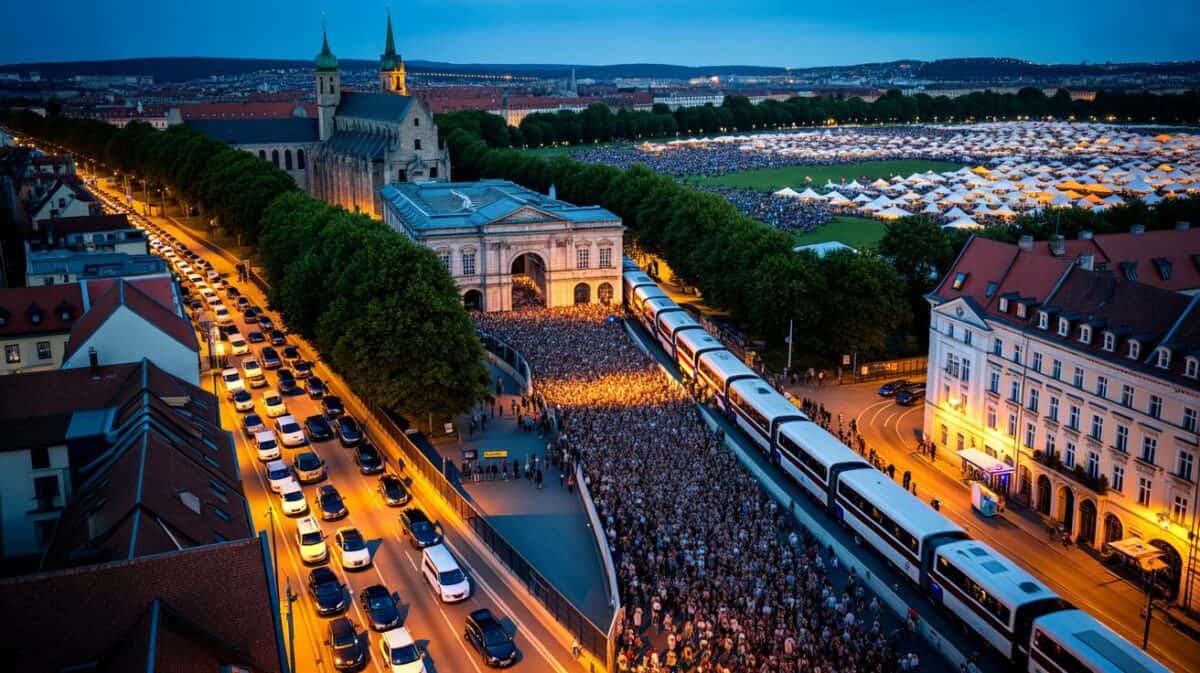
Image generated with Ai
Across Europe, a fierce summer Festival Explosion is being revealed in 2026 through official data and government planning, and a common pattern is being exposed across iconic visitor corridors from Edinburgh to Munich, from Tomorrowland in Boom to the regulatory shadow of Glastonbury, with density, mobility, and beds being pressed at once. In Edinburgh, more than 3.2 million attendances were reported for the August festivals in 2025, while city research has shown that current accommodation supply is not meeting demand and that transport improvement is required. In Munich, a city with 97,390 visitor beds and nearly 19.7 million overnight stays in 2024, the Tollwood summer run is being staged inside an event ecosystem that already handled almost 4 million visitors at Olympiapark events. In Boom, extra truck traffic, ANPR tracking, traffic regulations, and mobility controls are being deployed around Tomorrowland. In the United Kingdom, Glastonbury is not being staged in 2026, yet its 210,000 capacity model and 2025 debrief remain the benchmark. In Pamplona, overflow screens and crowd monitoring are being used to manage another packed urban celebration.
Edinburgh and the August pinch
The most persuasive official warning for Europe in 2026 is being supplied by Edinburgh. In a Scottish Government briefing that was released in 2026, audience to the August festivals in 2025 was stated as over 3.2 million from nearly 100 countries, with significant increases in new and first time attendees. In the same paper, major festivals in Edinburgh were said to generate 367 million pounds for the economy of Scotland, support almost 6,000 full time jobs, and return 33 pounds for every public pound invested. A continental pattern is therefore being made visible in one city. When the cultural upside is measured at that scale, pressure is not being created at the fringes of urban policy. It is being placed at the core of transport planning, public space management, and visitor accommodation strategy, well before a 2026 festival poster is even fully circulated.
Further stress has been recorded in the city administrative record. The 2025 Summer Festivals Scorecard listed 2,445,609 attendances for the Edinburgh Festival Fringe alone, alongside 25,268 for the Edinburgh Jazz and Blues Festival and substantial totals across the other summer events. That distribution matters because the city is not being tested by one show or one venue. It is being tested by the stacking of many events into the same high season, in close geographic proximity, under the same urban constraints. By the time audiences, artists, workers, suppliers, and day visitors are layered together, routine city movement is being turned into a festival operations problem. Edinburgh is therefore not being squeezed by popularity in the abstract. It is being stretched by simultaneity, by density, and by the fixed limits of a heritage city that cannot simply be widened when seasonal demand rises.
The accommodation evidence is even more direct. A 2026 City of Edinburgh economic needs study concluded that current supply does not meet the needs of all visitors, that many are being priced out, and that there is simply not enough supply to satisfy demand during peak periods. Overspill into neighbouring authority areas and Glasgow was explicitly identified. The same study stated that the decline in short term let supply since regulation and licensing has likely contributed to very high demand and pricing in serviced accommodation, while hotels and serviced apartments were described as performing close to peak capacity for much of the year. In other words, the constitutional debate around housing categories has already been converted into a practical festival consequence. When formal supply tightens and temporary supply becomes scarcer, the market is not being softened. It is being sharpened against visitors, workers, students, and lower budget travellers at the precise moment when seasonal demand surges.
Advertisement
Advertisement
The movement response now being used by the council shows how severe the compression can become when festival crowds are added to a historic urban fabric. Summertime Streets 2026 has been introduced with city centre street closures and restrictions running from July 19 to September 7 in order to support summer events and festivals and to help everyone get around safely and comfortably. Earlier council messaging for the same seasonal street changes stated that the city population effectively doubles during the busy festival period. That language is especially revealing. A doubling is not being described as a possible inconvenience. It is being treated as a recurring operating condition. The result is that ordinary street hierarchy is being suspended, walking space is being protected, access is being managed, and movement is being redesigned around temporary crowd realities. In Edinburgh, the annual cultural boom is no longer being handled as a background celebration. It is being administered like a seasonal urban stress test.
Advertisement
Advertisement

Image generated with Ai
Munich and the infrastructure test
Munich is often discussed through image and atmosphere, yet the stronger official story is being told by municipal statistics and event geography. The city portal has confirmed that Tollwood summer festival in 2026 is being held from June 19 to July 19 at Olympiapark South. That schedule is being inserted into an urban environment that was already carrying substantial visitor weight before this summer season was opened. Official city statistics for 2024 recorded 467 hotels, guest houses, and pensions, 97,390 available beds, 9,279,239 total guests, and 19,712,703 overnight stays. Those are not niche leisure numbers. They reveal a city that is already being filled on a metropolitan scale. When a month long cultural event is then added inside the event belt of Olympiapark, the festival does not enter an empty stage. It is being laid into a city where tourism, sport, business travel, and entertainment are already competing for the same sleeping space and the same transport bandwidth.
That base is made even clearer by the figures for Olympiapark. Official city statistics for 2024 recorded 3,995,249 visitors to individual events in the park complex, in addition to more than 1.3 million visitors to permanent facilities. The significance of Munich in the wider Europe discussion is therefore not being created by a single headline event. It is being created by concentration. Major visitor demand is being channelled into a city that hosts repeated event peaks, sustained leisure flows, and an already mature accommodation market. In that context, Tollwood should not be read as an isolated summer fair. It should be read as another major claimant on a heavily used urban events machine. The city can absorb that scale because infrastructure has long been provided, yet the same figures also show how quickly pressure can compound. Once crowds are multiplied across concerts, park activity, trade fairs, and city breaks, available slack in the system is being reduced with startling speed.
Recent official city reporting on another mega event has shown what that absorption can look like. During the first three of six Munich match days at UEFA EURO 2024, around half a million out of town visitors were said by the city to have arrived, while hotel occupancy on match days was reported at 79 to 93 percent and tourism value on the six match days was placed at more than 150 million euros. That was a football tournament, not a music festival, yet the urban lesson is transferable. When an event spike is layered onto an already successful visitor economy, accommodation is not merely being sold. It is being rationed by price and timing. Streets are not merely being animated. They are being saturated by converging schedules. Munich therefore aligns with Edinburgh not because the cultural forms are the same, but because both cities are being required to handle temporary waves that far exceed ordinary daily rhythms.
Advertisement
Advertisement
Even the quieter official mobility messages carry the same implication. The city directs drivers toward Park and Ride facilities with dedicated occupancy forecasts, while municipal statistics map an urban network of nine S Bahn lines, eight U Bahn lines, twelve tram lines, and seventy nine bus lines. Such systems are not being publicised because demand is light. They are being maintained because the city must repeatedly process concentrated flows without allowing the central area to stall. Munich therefore matters in this 2026 story as a measure of scale. If a city with deep transport provision, high accommodation capacity, and a park complex built for mass events still has to actively distribute and forecast movement, smaller festival destinations should be assumed to be under even sharper strain. The urban challenge in Europe is not being created only where systems are weak. It is being created even where systems are comparatively strong.

Image generated with Ai
Boom and the Tomorrowland traffic state
The 2026 picture around Tomorrowland is being shown with exceptional clarity by the local administration in Boom. On June 2, the municipality announced that the build of the Tomorrowland festival had started and that each year this brings a great deal of extra freight traffic into Boom and Rumst. The mayors of both municipalities were said to have already agreed arrangements on the spreading of traffic, and additional traffic measurements were confirmed for this year as well. The focus was placed especially on incoming logistical traffic linked directly to the festival and to DreamVille. That phrasing is important because the pressure is not being limited to audience arrival and departure. It is being generated by the whole event life cycle, including construction, deliveries, staffing, servicing, and breakdown. In a smaller host community, that distinction matters enormously. Before the first headline act is reached, the municipal road system is already being placed under festival pressure.
Advertisement
Advertisement
The measurement programme itself reads like the language of a controlled transport zone. According to the municipality, the evolution of traffic flows to and from Tomorrowland and DreamVille is being mapped, the impact of already taken traffic and mobility measures is being evaluated, and logistical insight during build, festival, and breakdown phases is being refined. Fourteen locations with ANPR cameras are being used on important access routes and at gates to the site, while timing, route choice, vehicle type, and traffic volume are all being examined. Measurements are being extended from the end of May through August 20. This is not a casual layer of observation. It is a structured attempt to understand how a global festival temporarily reshapes the movement patterns of an entire locality. When such detailed monitoring is being needed over such a long period, the scale problem is being admitted by the host authority itself, even without a dramatic phrase being used.

Image generated with Ai
Tomorrowland Turns Boom into Belgium’s Festival Traffic Command Centre as Safety, Roads and Crowd Pressure Intensify in 2026
The municipal mobility portal deepens that impression. Area wide traffic rules during Tomorrowland, temporary traffic measures during Tomorrowland, parking maps for the event, and information for taxi drivers for Tomorrowland 2026 are all being listed as distinct administrative items by Boom. That menu reveals a compact town being temporarily converted into a layered event jurisdiction. Roads are being managed differently, police regulations are being activated, professional drivers are being given bespoke instructions, and local parking is being recoded around event logic. What is seen in Boom is therefore not only a famous festival arriving in Belgium. A micro state of mobility management is being built around it. The normal road order is being bent around visitor demand, logistics demand, and safety demand at the same time. That is why Tomorrowland has become such an important case study for Europe. It shows how transport friction is being produced long before a visible crowd crush is reported.
The 2026 edition is also being staged after a shock that was recorded by the Province of Antwerp. Official provincial material noted that the Tomorrowland main stage burned in 2025 and that provincial authorities later discussed both the fire and a safety simulation in De Schorre. That background matters. It means that the 2026 season in Boom is being approached not only through traffic management but through a heightened risk memory. In this sense, Tomorrowland represents one of the clearest continental examples of how mega events in 2026 are being shaped by both volume and vulnerability. The destination is being asked to receive global demand, host complex logistics, protect public roads, and carry the residue of a recent safety incident all at once. In larger capitals, that burden is often diffused across systems. In Boom, it is being made visible at municipal scale, and the strain can therefore be read with unusual clarity.
The Glastonbury benchmark and the wider European signal
If a false assumption is stripped away first, the official Glastonbury lesson becomes even more useful. A full Glastonbury festival is not being staged in 2026. That position was reflected in official public sector material, including a regional policing finance paper in which income related to the event was excluded temporarily because 2026 was a fallow year, and a local government event notice that also identified 2026 as a break year. Yet absence has not reduced relevance. In fact, the opposite is being shown. Because Glastonbury is not taking place, the site can be treated as a regulatory benchmark rather than a current operational distraction. The United Kingdom reference point in this wider Europe story is therefore being supplied by precedent, by licensing structure, and by debrief practice. What matters is not a live crowd at Worthy Farm in 2026. What matters is the model that has already been built there and is now being used to understand the limits of large scale event management.
The capacity question remains central to that benchmark. Somerset committee material has repeatedly referred to a 210,000 limit, with council documents explaining that the licence was increased from 203,000 to 210,000 and that tickets are strictly controlled and scanned. The 2025 debrief trail also showed the breadth of oversight being applied. Council material stated that licensing, public safety, food safety, water supplies, and noise were monitored, and official minutes reported that costs were reduced by 25 percent compared with 2024. This is a valuable counterweight to the more glamorous language that often surrounds major events. Underneath image and myth, a festival of this scale is being treated as a governed settlement. Entry is being capped. Compliance is being audited. Community impact is being reviewed. When Europe is said to be entering another dominant summer of destination events, the British lesson is that prestige does not dissolve regulation. It intensifies the need for it.
Advertisement
Advertisement
The wider continental warning can then be seen by looking beyond the famous names already discussed. In Pamplona, the official programme for San Fermin 2026 showed that the ceremonial opening was being relayed on giant screens across six public locations, while a city backed crowd lab project had already been launched to obtain high precision measurements of movement in high density conditions and to improve safety for public events with very high participation. That is the same story in another form. A historic city is being prepared for overflow, not simply celebration. Crowd behaviour is being studied, not guessed. The shared 2026 message from Edinburgh, Munich, Boom, the Glastonbury benchmark, and Pamplona is accordingly unmistakable. Across Europe, the strongest festival destinations are not being defined only by artistic pull. They are being defined by how much pressure can be absorbed by beds, streets, transit, and local administration before popularity starts to resemble managed disruption.
What 2026 is signalling
What is being exposed by these official records is not a loose collection of isolated summer headaches. A structural pattern is being shown. Attendance is being lifted by destination prestige, by calendar clustering, and by the global visibility of a small number of cultural capitals. Accommodation is not being expanded at the same speed in the places where the spike is sharpest. Historic centres are being squeezed first because beds, venues, and landmark streets are being placed close together. Transport is then being asked to absorb demand that arrives in short violent waves rather than in a steady urban rhythm. That is why Edinburgh is being pushed into seasonal street management, why Boom is being turned into a measured traffic operation, why Munich is being kept reliant on large scale public movement systems, and why the Glastonbury template continues to be studied even in a fallow year. A continental festival economy is being enlarged, but it is also being forced into a more regulated, more data driven, and more openly contested phase.
For travellers, operators, and public authorities, the message for the rest of 2026 is therefore unlikely to be subtle. Beds will be fought over earlier. Travel windows will be narrowed faster. Local tolerance will be tested more quickly where freight, pedestrian flow, nightlife, and heritage streets must occupy the same footprint. More temporary rules will be imposed, more crowd monitoring will be normalised, and more event planning will be treated as urban systems management rather than cultural add on. The current Europe season is therefore not merely being defined by music, spectacle, and screens. It is being defined by how much friction a destination can absorb before celebration starts to resemble controlled congestion. In that respect, Edinburgh, Munich, Tomorrowland, Glastonbury, and Pamplona are not separate stories. A shared warning is being issued through them. The strongest destinations are no longer being identified only by how many visitors can be attracted. They are being identified by how much pressure can be measured, housed, routed, and politically sustained when peak festival demand arrives all at once.
Taken together, Edinburgh, Munich, Boom, Glastonbury, and Pamplona are not describing a temporary burst of summer inconvenience. A continental operating model is being revealed. In that model, festival success is being bought at the edge of urban capacity, and every ticket, train arrival, road closure, and room booking is being felt beyond the gates, beyond the stages, and into each host destination.
Advertisement
