
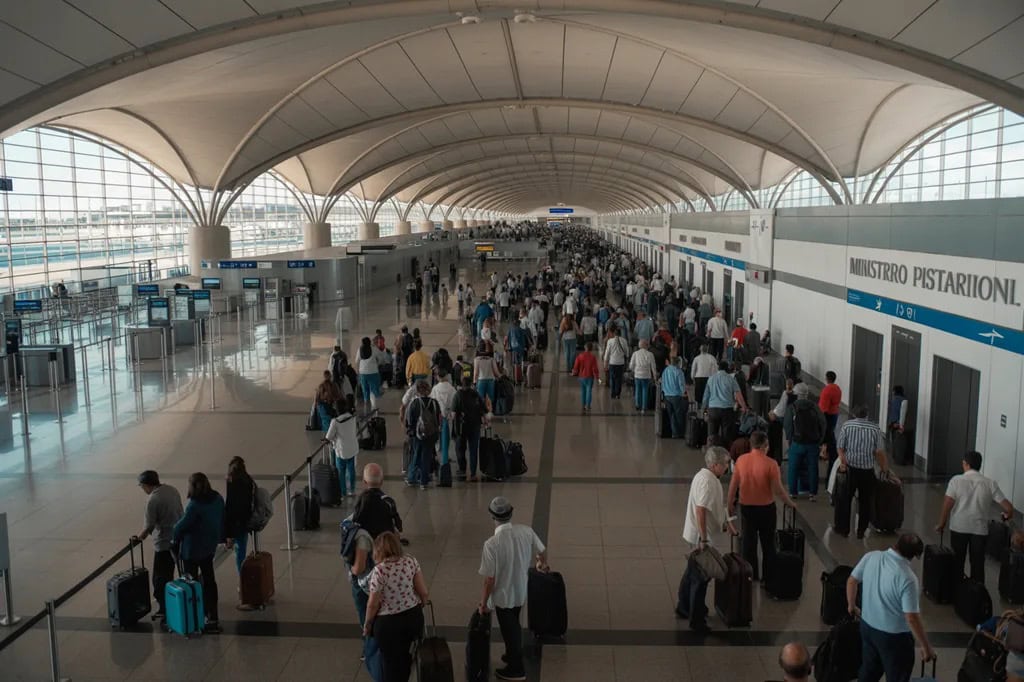
Image generated with Ai
Argentina is grappling with an massive outflow of foreign reserves as international tourism habits drain the central bank. According to the National Institute of Statistics and Census (INDEC), the country recorded a staggering USD 3.184 billion travel deficit during the first quarter of 2026. This imbalance means citizens spending cash overseas vastly outpaced the revenues generated by foreign holidaymakers arriving on domestic soil. The economic impact ripples far beyond simple airline ticket sales. It fundamentally weakens the national fiat currency by exhausting precious dollar reserves needed for vital international trade.
The root cause tracks directly to local consumer behavior patterns. Millions of Argentines routinely seek international vacations to hedge against domestic hyperinflationary environments. They prefer using foreign assets over holding volatile local cash. Consequently, outbound travel spending hit an astonishing USD 4.825 million in just three months. This structural problem remains incredibly difficult for the government to stabilize through monetary policy alone.
Regional holiday destinations are heavily draining Argentina of its financial resources. Brazil remains the absolute largest beneficiary of this outbound economic flight. Argentines spent USD 1.635 million inside Brazil during the quarter. However, Brazilian tourists only brought USD 228 million back across the border. This created a massive bilateral shortfall of USD 1.407 million. Neighbouring Uruguay followed closely, responsible for a deficit of USD 583 million.
Chile and Paraguay also drew significant capital away, logging individual losses of USD 299 million and USD 378 million respectively. Interestingly, the United States stood out as a remarkably balanced market. The deficit with America was restricted to a minor USD 80 million gap. This occurred because incoming American business travel helped offset outbound leisure costs. Together, just five nations accounted for roughly 74.2% of the entire outbound travel expenditure. This represents a heavy concentration of economic leakage centered strictly within a few key partners.
Advertisement
Advertisement
International journeys are currently the single largest driver of Argentina’s broader economic services deficit. Total services imbalances reached USD 4,028 million in the early months of this year. Remarkably, the travel category alone accounted for nearly 79% of that total negative balance. No other segment comes close to inflicting this level of damage on the balance of payments. For instance, international freight transportation only generated a deficit of USD 762 million.
Meanwhile, intellectual property fees and telecommunication services remained relatively modest, costing USD 367 million and USD 8 million respectively. Only a single industry managed to record a positive balance for the state. The specialized business services sector brought in a healthy net surplus of USD 686 million. Yet, these commercial victories are completely overshadowed by the massive scale of holiday spending. It proves that tourism habits dictate the health of the entire service ledger.
Despite these alarming totals, historical data reveals an encouraging macro trend. The first-quarter deficit actually narrowed by USD 280 million compared to the same period in 2025. That previous year endured a much harsher shortfall of USD 3,464 million. This quiet recovery stems from a dual shift in passenger movement. Fewer locals booked foreign flights, while global arrivals in Buenos Aires experienced a steady uptick.
Volume data shows outbound tourism dropped by 12.2% year-on-year to 4,455,000 departures. Simultaneously, inbound foreign visitor counts climbed up by 4.8% to reach 1,725,800 people. This positive friction significantly eased immediate pressure on external accounts. Experts believe localized inflation adjustments are making domestic resorts highly attractive once again. Nevertheless, the total number of departures still massively outweighs arrivals, meaning the core deficit remains a long-term fiscal hurdle.
Advertisement
Advertisement
The travel spending gap fits directly into a highly fragile macroeconomic current account matrix. Argentina ended the quarterly cycle with an overall current account shortfall of USD 1,651 million. Thankfully, substantial foreign funding offset this deficit. Wall Street investment and direct financial channels poured USD 2,398 million into the domestic environment. Without this critical capital influx, the nation’s financial system would face severe liquidity gridlocks.
Because of this specific funding cushion, the central bank’s reserve holdings managed to edge upward by a tiny USD 11 million. This minuscule growth underlines how closely the national bank is skating on thin ice. Every single dollar saved from international holiday habits allows the treasury to fortify its defensive economic positions. If travel outflows accelerate again during the winter season, the current financial equilibrium could easily shatter.
Advertisement
Advertisement
Advertisement












Friday, September 4, 2026

Thursday, September 3, 2026

Friday, September 4, 2026

Friday, September 4, 2026

Thursday, September 3, 2026

Wednesday, September 2, 2026

Friday, September 4, 2026

Friday, September 4, 2026


