
Uzbekistan Raises Minimum Salary to UZS 1.36 Million From September 2026: What Foreign Workers and Accreditation Card Applicants Must Know

Published
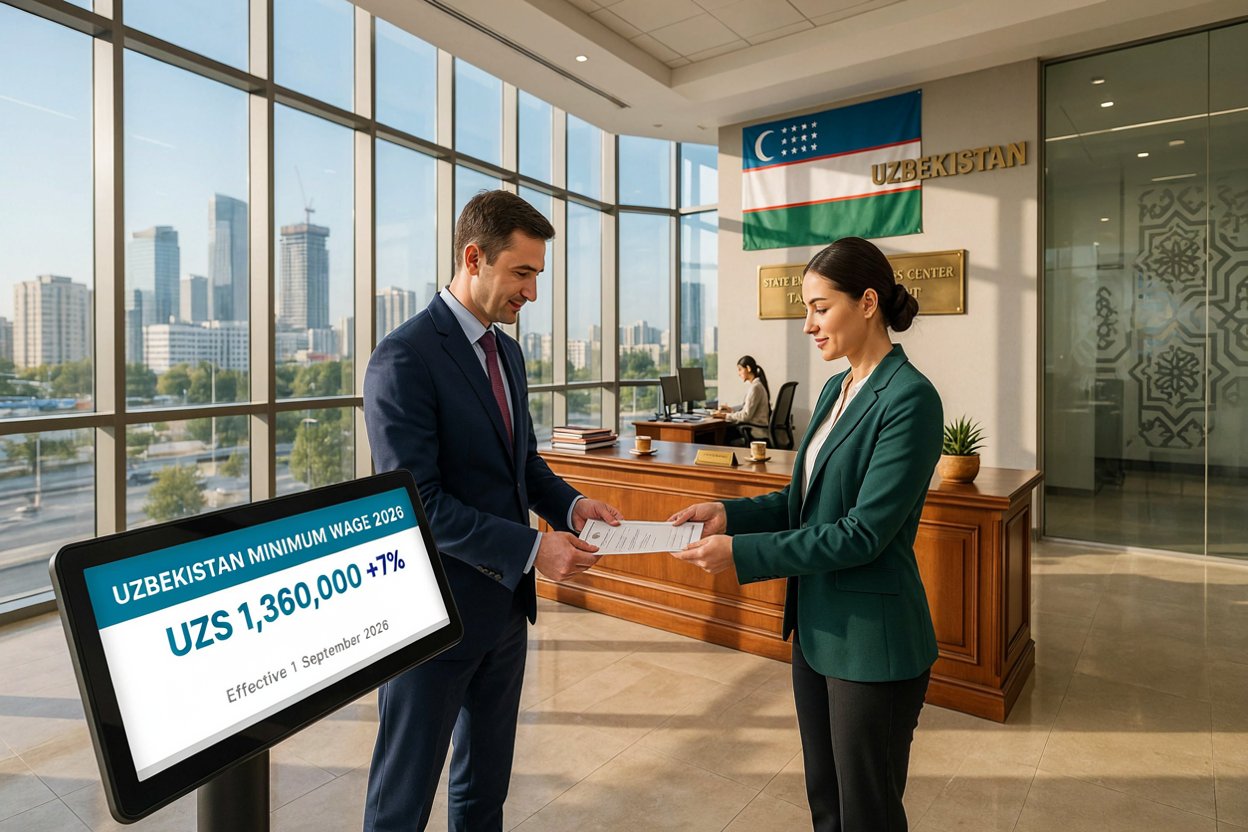
Uzbekistan has increased its statutory minimum monthly salary to UZS 1,360,000 from 1 September 2026, replacing the previous threshold of UZS 1,271,000. The UZS 89,000 increase, equivalent to approximately 7%, follows a presidential decree issued on 23 June 2026. The adjustment is particularly relevant to employers, international professionals and foreign nationals preparing employment-related documentation in Uzbekistan. However, an important distinction applies: while the new national minimum wage is officially confirmed, applicants must separately establish whether their particular accreditation card or employment authorisation category uses that figure as an eligibility threshold.
Uzbekistan Minimum Monthly Wage Increase – September 2026
| Particulars | Amount / Details |
|---|---|
| New Minimum Monthly Wage | UZS 1,360,000 |
| Previous Minimum Monthly Wage | UZS 1,271,000 |
| Monthly Salary Increase | UZS 89,000 |
| Percentage Increase | Approximately 7% |
| Annual Salary Increase | UZS 1,068,000 |
| Previous Wage Effective From | August 2025 |
| New Wage Effective From | 1 September 2026 |
Uzbekistan’s New Minimum Salary Rules Take Effect Under Presidential Decree
Uzbekistan’s revised minimum salary was established through Presidential Decree PF-115, dated 23 June 2026, concerning increases in wages, pensions, scholarships and social benefits.
Advertisement
Advertisement
The decree introduced several changes on different dates. Pension and benefit adjustments began on 1 July, while the new minimum wage and higher salaries for employees of budget-funded organisations took effect on 1 September.
The Ministry of Energy’s official government announcement confirms that the minimum monthly wage was set at UZS 1,360,000. The decree also established a separate basic calculation amount of UZS 440,000, which is relevant to certain statutory payments and administrative charges.
Advertisement
Advertisement
This distinction matters because Uzbekistan uses different financial reference values for different regulatory purposes. A salary threshold, administrative fee and basic calculation amount are not interchangeable.
The decree confirms a nationwide wage adjustment. It does not, by itself, establish that every foreign national seeking an accreditation card must earn precisely UZS 1,360,000. That question depends on the rules governing the applicant’s particular category.
Advertisement
Advertisement
How Much Has Uzbekistan’s Minimum Monthly Salary Increased?
The September adjustment represents the latest change in Uzbekistan’s statutory minimum wage, following an earlier increase that took effect in August 2025.
Official government information and the country’s published wage history establish the previous and revised figures.
| Salary requirement | Before September 2026 | From September 2026 |
|---|---|---|
| Minimum monthly wage | UZS 1,271,000 | UZS 1,360,000 |
| Monthly increase | — | UZS 89,000 |
| Percentage increase | — | 7.00% approximately |
| Annual equivalent | UZS 15,252,000 | UZS 16,320,000 |
| Annual difference | — | UZS 1,068,000 |
The annual figures are mathematical equivalents of 12 months at the stated minimum wage. They do not represent guaranteed annual earnings, additional benefits or a separate government salary requirement.
For employers, the increase creates a straightforward payroll consideration. Workers whose applicable pay arrangements were based on the previous statutory minimum may require a salary review.
For foreign professionals, the implications are more specific. Their contracts, employment classifications and applicable authorisation procedures must be considered before determining whether the change affects an application.
Why Uzbekistan’s Minimum Salary 2026 Matters for Foreign Workers
Foreign nationals working in Uzbekistan may encounter several regulatory processes involving employment contracts, immigration permission, registration and professional accreditation.
Advertisement
Advertisement
These procedures serve different purposes. A foreign employee may need authorisation to work, permission to enter or remain in the country, and additional accreditation where a specific professional or organisational category requires it.
The new minimum wage matters because employers must consider applicable labour legislation when determining remuneration. It may also affect an administrative process where the relevant rules explicitly reference the statutory minimum wage.
However, it would be inaccurate to assume that all foreign workers face the same accreditation requirements.
An overseas specialist employed by a private company, a foreign national working for an international non-governmental organisation and a visitor attending a business meeting may fall under different regulatory arrangements.
The correct approach is to identify the applicant’s immigration and employment category before applying any salary-based requirement.
This is particularly important for people relocating to Uzbekistan for the first time, as well as employers arranging documentation for international recruits.
Advertisement
Advertisement
Which Foreign Nationals Need Accreditation Cards in Uzbekistan?
Uzbekistan’s accreditation system covers particular categories of foreign nationals. It should not be treated as a universal requirement for everyone entering the country for employment.
Official government guidance identifies several groups whose accreditation is administered through the Ministry of Foreign Affairs or Ministry of Justice.
Categories Covered by Official Accreditation Procedures
These include:
- Diplomatic and consular personnel, including certain accompanying family members.
- Foreign media representatives and eligible family members.
- Officials and personnel of certain international intergovernmental organisations.
- Foreign employees of non-governmental non-profit organisations, including relevant international and foreign NGO representative offices.
- Eligible dependants of foreign NGO employees, where the applicable rules provide for accreditation.
The Ministry of Foreign Affairs handles designated diplomatic, media and international-organisation categories. The Ministry of Justice administers accreditation for the specified NGO-related categories.
The precise requirements vary according to the applicant’s status and sponsoring organisation.
A professional relocating to work for a commercial employer should therefore not automatically follow the procedure intended for foreign NGO personnel.
Advertisement
Advertisement
Likewise, holding an accreditation card does not necessarily confer unrestricted employment rights throughout Uzbekistan.
For example, the government’s NGO accreditation guidance specifies that the card authorises the foreign employee to work only for the receiving NGO.
This employer-specific limitation demonstrates why accreditation, immigration status and the scope of permitted work must be considered together.
Does the New UZS 1.36 Million Salary Apply to Every Accreditation Card?
The September 2026 minimum wage is officially established, but a universal salary-based accreditation requirement has not been demonstrated by the government sources reviewed for this report.
The distinction is significant.
Presidential Decree PF-115 sets the statutory minimum wage at UZS 1,360,000. Separately, government accreditation guidance identifies eligible foreign-national categories, relevant ministries, administrative fees and conditions attached to accreditation.
Advertisement
Advertisement
The reviewed accreditation guidance does not establish UZS 1,360,000 as a universal income threshold for every accreditation card.
Applicants should therefore distinguish three questions.
First, does the employer have to comply with Uzbekistan’s revised statutory minimum wage?
Second, does the applicant’s particular immigration or professional authorisation category impose an additional remuneration requirement?
Third, does that requirement use the national minimum wage or another calculation method?
A positive answer to the first question does not automatically resolve the other two.
Advertisement
Advertisement
For foreign professionals, the safest course is to request written clarification from the employer or relevant Uzbek authority before submitting salary-dependent documents.
Uzbekistan’s Accreditation Fees Are Calculated Differently From Salaries
Another important aspect of Uzbekistan’s administrative system is the distinction between the minimum wage and the basic calculation amount.
From 1 September 2026, the basic calculation amount increased to UZS 440,000. This is separate from the UZS 1,360,000 minimum wage.
The government’s accreditation guidance specifies a fee equivalent to five basic calculation amounts for the relevant NGO accreditation procedure.
Using the new September 2026 reference value, that produces an indicative fee of UZS 2,200,000.
| Reference or fee | Amount |
|---|---|
| Minimum monthly wage | UZS 1,360,000 |
| Basic calculation amount | UZS 440,000 |
| Five basic calculation amounts | UZS 2,200,000 |
| 50% of the standard five-unit fee | UZS 1,100,000 |
The final two figures are calculations based on the published fee formula, not separately quoted government fee notices. Applicants should verify the current payable amount and whether the particular procedure attracts additional charges or exemptions.
Advertisement
Advertisement
For the specified NGO accreditation process, government guidance also states that the accreditation fee is not refunded if an application is refused.
The same guidance sets the replacement charge for a lost or unusable accreditation card at 50% of the standard fee.
These amounts should not be confused with tourist visa charges, work-authorisation fees or other immigration-related payments.
How Foreign Workers Can Apply for Employment Authorisation
Uzbekistan maintains a separate administrative process for confirming the right of foreign nationals to undertake employment.
The country’s official public-services portal provides a service for obtaining confirmation of the right to work in Uzbekistan.
The published process involves an application, supporting documents and assessment by the responsible authority.
Advertisement
Advertisement
Documents Identified in the Official Work-Authorisation Service
The government service information identifies the following documentation:
- An electronic copy of the foreign national’s passport.
- A draft employment contract specifying the proposed employment terms, including remuneration.
- An electronic photograph measuring 3 × 4 cm.
- Documents establishing the applicant’s professional qualifications.
- Relevant entry-visa documentation where applicable.
The service description also indicates that the authorities assess the proposed employment of foreign nationals in relation to available domestic labour.
These are documents identified for the published work-confirmation service. They should not be presented as a universal checklist for every accreditation, immigration or visa application.
The inclusion of remuneration in the draft employment contract makes the September wage increase particularly relevant to employers preparing new applications.
If a proposed contract falls below the applicable statutory minimum, the employer should resolve the discrepancy before proceeding.
Applicants should also verify whether their employment category has additional rules, exemptions or requirements.
Advertisement
Advertisement
What Employers Must Review After the September Salary Increase
For businesses employing foreign nationals, the immediate priority is ensuring that employment contracts and payroll arrangements comply with the applicable labour legislation.
The presidential decree recommends that employers adjust remuneration in accordance with the statutory minimum and ensure that wages do not fall below legally established requirements.
This creates practical considerations for organisations that use the minimum wage as a reference when preparing contracts.
An employer whose proposed monthly salary remains at UZS 1,271,000 should review whether that amount satisfies the new legal minimum for the relevant employment arrangement.
A salary difference of UZS 89,000 may appear limited, but an outdated figure can create an avoidable inconsistency between a contract and the applicable wage rules.
Employers should also check how salary components are treated. Basic pay, allowances, bonuses and other remuneration elements may have different treatment under labour legislation.
Advertisement
Advertisement
The government decree should not be interpreted as automatically increasing every private-sector salary by 7%. The announced 7% increase for budget-funded employees is a distinct provision, while employers generally must ensure compliance with the statutory wage floor.
Practical Compliance Priorities
Businesses recruiting international employees should review contracts, payroll records, the applicant’s authorisation category and any salary evidence required by the relevant government service.
They should also confirm that the sponsoring organisation is correctly identified and that the proposed duties match the scope of the permission being requested.
These checks matter particularly when employment documentation has been prepared before September but is being submitted afterwards.
What Happens to Accreditation Cards Already Issued?
The wage adjustment does not, on the evidence reviewed, establish an automatic cancellation or replacement requirement for every accreditation card issued before 1 September 2026.
Existing cardholders should check the conditions and expiry date of their particular accreditation.
Advertisement
Advertisement
For foreign NGO personnel, the government’s published guidance states that accreditation can be granted for a period not exceeding 12 months.
It also specifies circumstances in which accreditation cards must be returned, including expiry, termination of employment and permanent departure from Uzbekistan.
These conditions are important for foreign professionals whose employment arrangements may change during their stay.
A worker changing organisations should not assume that an existing accreditation or work authorisation automatically transfers to a new employer.
The government’s published work-authorisation guidance also describes employer-linked permissions, reinforcing the need to verify the applicable procedure when employment changes.
Anyone approaching an accreditation expiry date should confirm the renewal requirements with the issuing authority rather than relying solely on the date when the card was first approved.
Advertisement
Advertisement
How the Change Affects Indian Nationals Planning to Work in Uzbekistan
For Indian nationals considering employment in Uzbekistan, the September 2026 wage adjustment introduces an additional point to check during recruitment and contract negotiations.
The statutory minimum applies within Uzbekistan’s labour framework. However, nationality alone does not establish which work-authorisation or accreditation process an applicant must follow.
An Indian professional joining a commercial employer may need a different procedure from an Indian national taking up a position with an international NGO or accredited organisation.
Before accepting an overseas job offer, prospective employees should establish the employer’s legal identity, proposed salary, work location, contractual responsibilities and responsibility for immigration documentation.
They should also verify the visa category that permits their intended activities.
Uzbekistan’s Ministry of Foreign Affairs publishes separate visa categories for tourism, business and employment. These categories are not interchangeable merely because a traveller has a valid passport or an invitation from a local organisation.
Advertisement
Advertisement
An applicant should avoid treating a tourist visa as permission to take up paid employment.
Similarly, an employment offer does not itself establish that the person has received all necessary authorisations.
For Indian jobseekers, reviewing the written employment contract before travelling can reduce uncertainty over salary, permitted activities and sponsorship responsibilities.
Why Uzbekistan’s Wage History Provides Important Context
The September 2026 adjustment follows several earlier changes in Uzbekistan’s minimum wage.
The country’s official published wage history shows that the minimum rose from UZS 1,050,000 in December 2023 to UZS 1,155,000 in October 2024 and UZS 1,271,000 in August 2025.
The latest increase brings the monthly figure to UZS 1,360,000.
Advertisement
Advertisement
Uzbekistan’s statutory minimum monthly wage
Selected effective dates, in Uzbek soums
Uzbekistan’s official minimum wage history and June 2026 presidential decree. Figures are nominal monthly amounts, not inflation-adjusted earnings.
The figures demonstrate a series of upward adjustments to the statutory wage floor.
However, they do not establish how much the purchasing power of minimum-wage earners has improved.
Such an assessment would require inflation, household expenditure and other economic data covering the same periods.
Advertisement
Advertisement
For international employers, the historical pattern provides a reason to monitor official wage announcements rather than assuming that a salary threshold will remain unchanged throughout a recruitment cycle.
Why This Matters
Uzbekistan’s minimum wage increase has implications beyond the headline monthly figure.
For employees, the revised statutory floor establishes a higher nominal benchmark for applicable remuneration.
For employers, it requires attention to payroll compliance and employment documentation.
For international recruitment, the change reinforces the importance of distinguishing a statutory wage requirement from a separate immigration or accreditation condition.
The distinction is particularly relevant because Uzbekistan has multiple administrative procedures for foreign nationals, including work confirmation and accreditation for designated professional categories.
Advertisement
Advertisement
A foreign employee could satisfy an employer’s proposed salary requirement but still need additional immigration documentation.
Conversely, possession of an accreditation card does not necessarily establish unrestricted permission to work for any organisation.
The development also illustrates how a domestic wage-policy decision can affect international recruitment administration without necessarily changing tourist entry rules.
No evidence in the official wage decree establishes a new general salary requirement for ordinary holidaymakers.
The practical effect therefore depends on whether the traveller is visiting Uzbekistan, undertaking permitted business activities, entering employment or applying for a specialised accreditation.
What Travellers Should Know
Foreign nationals preparing to visit or work in Uzbekistan should first identify the purpose of their trip.
Advertisement
Advertisement
The September wage change is primarily a labour-policy development. It should not be interpreted as a new financial entry condition for every international visitor.
Before Booking or Applying
- Tourists: Check the visa or entry conditions applicable to your nationality. The new minimum wage is not a general tourist entry fee.
- Foreign employees: Confirm that the proposed salary complies with the applicable employment rules and that the correct work authorisation is being arranged.
- Accreditation applicants: Identify the issuing ministry and verify the requirements for the specific accreditation category.
- Employers: Review salary figures in contracts and supporting applications prepared before September 2026.
- Existing cardholders: Check the card’s validity, sponsoring organisation and conditions before changing employment or applying for renewal.
- Indian applicants: Confirm the appropriate entry and employment procedures with the Uzbek authorities and sponsoring employer before departure.
The most useful starting points are Uzbekistan’s official government portal, Ministry of Foreign Affairs guidance and the country’s interactive public-services portal.
Applicants should rely on current official instructions when paying fees or submitting documents, particularly where administrative charges are linked to reference values that may change.
What Does the New Salary Mean for Recruitment Costs?
The direct difference between the previous and new statutory monthly wage is UZS 89,000.
For an employee paid at the applicable minimum throughout a full year, that translates into UZS 1,068,000 in additional nominal gross wages compared with 12 months at the previous rate.
For an employer with several workers paid at the statutory floor, the aggregate wage impact depends on how many employees are affected and for how long.
Advertisement
Advertisement
For illustration, ten full-year positions each moving from the old minimum to the new one would generate a combined annual gross wage difference of UZS 10,680,000.
This is an arithmetic scenario, not a government estimate of recruitment costs.
Actual employer expenditure may differ because of employment dates, hours, contract terms, payroll contributions and other applicable obligations.
There is also an important distinction between a minimum wage and the market salary offered to an international specialist.
The new statutory floor does not establish the typical remuneration for foreign engineers, executives, teachers, consultants or other professional categories.
Employers should assess market compensation and any category-specific immigration requirements independently.
Advertisement
Advertisement
How Uzbekistan’s Work Visa and Accreditation Systems Differ
Uzbekistan’s official immigration guidance distinguishes between different reasons for entry.
Tourist visas are intended for tourism. Business categories serve specified business purposes, while employment-related entry and work-authorisation procedures address labour activity.
Accreditation operates within additional administrative frameworks for particular groups of foreign nationals.
The government’s accreditation guidance identifies separate responsibilities for the Ministry of Foreign Affairs and Ministry of Justice.
This division is important because the document a foreign national receives may have a different purpose from the one issued to another applicant.
For example, the accreditation rules governing NGO employees specify conditions relating to the receiving organisation and the validity of the card.
Advertisement
Advertisement
The separate work-confirmation procedure concerns authorisation for foreign nationals to undertake employment in Uzbekistan.
A traveller should therefore establish not only which document is required but also what activities that document permits.
This can prevent misunderstandings involving employer changes, business visits, temporary assignments and long-term employment.
Frequently Asked Questions
1. What is Uzbekistan’s minimum monthly salary from September 2026?
Uzbekistan’s statutory minimum monthly wage is UZS 1,360,000 from 1 September 2026. The amount was established under Presidential Decree PF-115, dated 23 June 2026.
2. How much did Uzbekistan increase its minimum wage?
The monthly minimum increased by UZS 89,000, from UZS 1,271,000 to UZS 1,360,000. This represents an increase of approximately 7%.
3. Must every foreign national earn UZS 1,360,000 to receive an accreditation card?
The official sources reviewed do not establish that amount as a universal accreditation-card eligibility threshold. Applicants must check the requirements of their particular category. The statutory minimum wage and accreditation eligibility are distinct regulatory questions.
Advertisement
Advertisement
4. How much does an accreditation card cost in Uzbekistan?
For the specified NGO accreditation procedure, government guidance sets the fee at five basic calculation amounts. Using the UZS 440,000 reference amount effective from September 2026, this equals UZS 2,200,000. Applicants should confirm the current fee with the responsible authority.
5. Does the salary increase affect tourist visas or ordinary holidaymakers?
The September 2026 wage increase does not establish a new general salary requirement for tourists. Visitors must follow the entry and visa conditions applicable to their nationality and travel purpose.
Closing Update: Foreign Professionals Should Verify Salary and Accreditation Rules Before Applying
Uzbekistan’s decision to increase its statutory minimum monthly wage to UZS 1,360,000 marks another adjustment to the country’s labour framework, with practical implications for employers and foreign nationals preparing employment documentation.
The increase is confirmed by Presidential Decree PF-115 and took effect on 1 September 2026.
For international professionals, the central issue is not simply the higher salary figure. It is whether the revised statutory minimum affects their employment contract and whether their particular accreditation or work-authorisation category imposes separate conditions.
Employers should review remuneration and supporting documentation, while applicants should confirm the appropriate procedure with the relevant Uzbek authority.
The distinction between wages, accreditation fees, work authorisation and visa eligibility remains essential. Understanding those differences before submitting an application can help foreign nationals prepare more accurately and avoid unnecessary administrative complications.
Advertisement
